
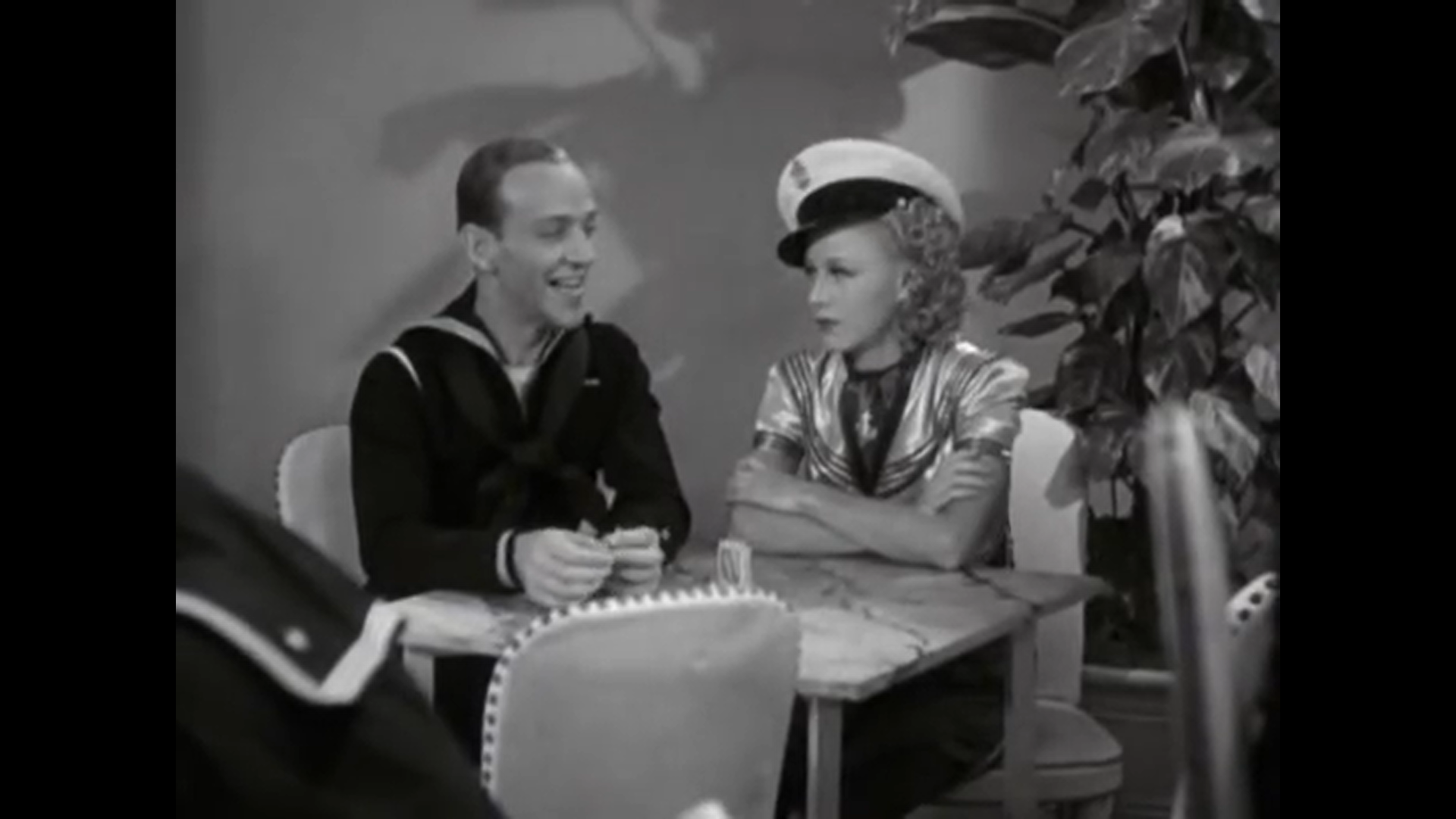
 Taken in the lineage of movie musicals, Follow The Fleet feels like a prototype for On The Town, or maybe there were just more movies focusing on sailors on leave back in the day. It’s like romances set on ocean liners. With the proliferation of commercial air travel, it’s possible a whole subgenre went kaput. For now, it’s safe, and the boys descend on Frisco.
Fred Astaire stars as a gum-smacking sailor, Blake Baker. He wears the abrasiveness lightly because he was always an appealing personality beyond his graceful taps. Randolph Scott takes on the role of the best bud, Bilge Smith, as they continue their pairing from Roberta. Astaire similarly has a girl he wants to check in on…They had a falling out, and you can just about imagine who might be playing her.
As the sailors roll into the city, it has the distinct stench of a pile of pesky high schoolers infecting the place. They sneak into a local joint on one ticket, and Bilge hooks them up with a couple of paper bags of beer from the outside. All they require is the establishment’s table, and they do the rest themselves.
Connie Martin (Harriet Hilliard) plays a homely, bespectacled brunette girl who makes Randolph’s acquaintance; she needs a man to get inside, and he obliges, though he’s quick to brush her off and forget about it. Connie also just happens to be the sister of Sherry (Ginger Rogers), who’s the floor show at Paradise.
It’s the old trope we’ve known since the dawn of time. Ginger Rogers hails from the Gentlemen Prefer Blondes school. As she points out, men like blondes because they look dumb. The operative word is “look” since you would never believe someone pulling one over on Ginger Rogers. “It takes a lot of brains to be dumb.”
Lucille Ball enlisted to make Connie look presentable. The ugly duckling arc feels dead on arrival. This movie just needed another plot to bide its time. Her new look makes a startling impression on Bilge, and we know she has feelings for him already. His problem is living a transient life; he’s also easily swayed by shinier, more affluent objects in the form of divorced socialites.
Rather like Roberta, the sluggish romance all but writes itself, making Astaire and Rogers the primary reason to stay with the picture and see it through. There’s the fun pretense of a dance-off with another couple, and then Astaire and Rogers go nuclear into another stratosphere. The scene becomes there’s, and there’s alone. The movie almost seems to forget there were ever any other dances spliced into the scene, and we do too.
The sailors are whisked away on a moment’s notice, and the women — as the title implies — must take up pursuit! The movie requires it. Connie vows to get a boat so the man that she loves can captain it.
It’s rather hypnotic seeing Astaire tapping on deck with a whole host of sailors keeping time behind him; there’s a military cadence to it with a certain added level of artfulness. It’s like the maritime context creates a playground for him to then work within and offer us some novel hoofing.
There’s also a cruel comic irony watching him return to town trying to nab his girl an audition and derailing a “sure thing’s” chances by spiking her drink with bicarbonate of soda. His wires get horribly crossed. You can fill in the rest because Ginger’s the poor woman who suffers at his hands. Being pretty plucky herself, she’s more than equipped for some brutal payback.
These moments of “plot” are the movie’s saving grace because at least A & R’s romantic entanglements are mostly comedic. Rogers has the feistiness to make them a joy, and Astaire doesn’t have a malicious bone in his body, so the comedy comes off mostly affable and light.
The final act is comprised of putting on a show to keep Connie from losing the refurbished ship she sunk her savings into — she did it for Scott, but you hardly need to know this. Nor the fact that Blake has to go AWOL to get to the benefit in time. It doesn’t matter.
All that matters is that Fred is there to dance with Ginger, and everything else falls away. The apex of the movie is “Let’s Face The Music and Dance,” which feels like a quintessential American Songbook number that I’ve been sleeping on. My sincerest apologies to Irving Berlin.
It’s classic Astaire and Rogers at their classy best, dancing on the deck of the ship and making us forget the sitcom fluff for something transcendent like they gave us so often. It’s a worthy place to end.
I said my apologies to Berlin, and now I owe one to Ms. Hiliard. I didn’t realize she was thee Harriet of Ozzie and Harriet fame until I was practically finished with this review. The longevity of her career in itself is quite remarkable.
3.5/5 Stars
 4 Star Films