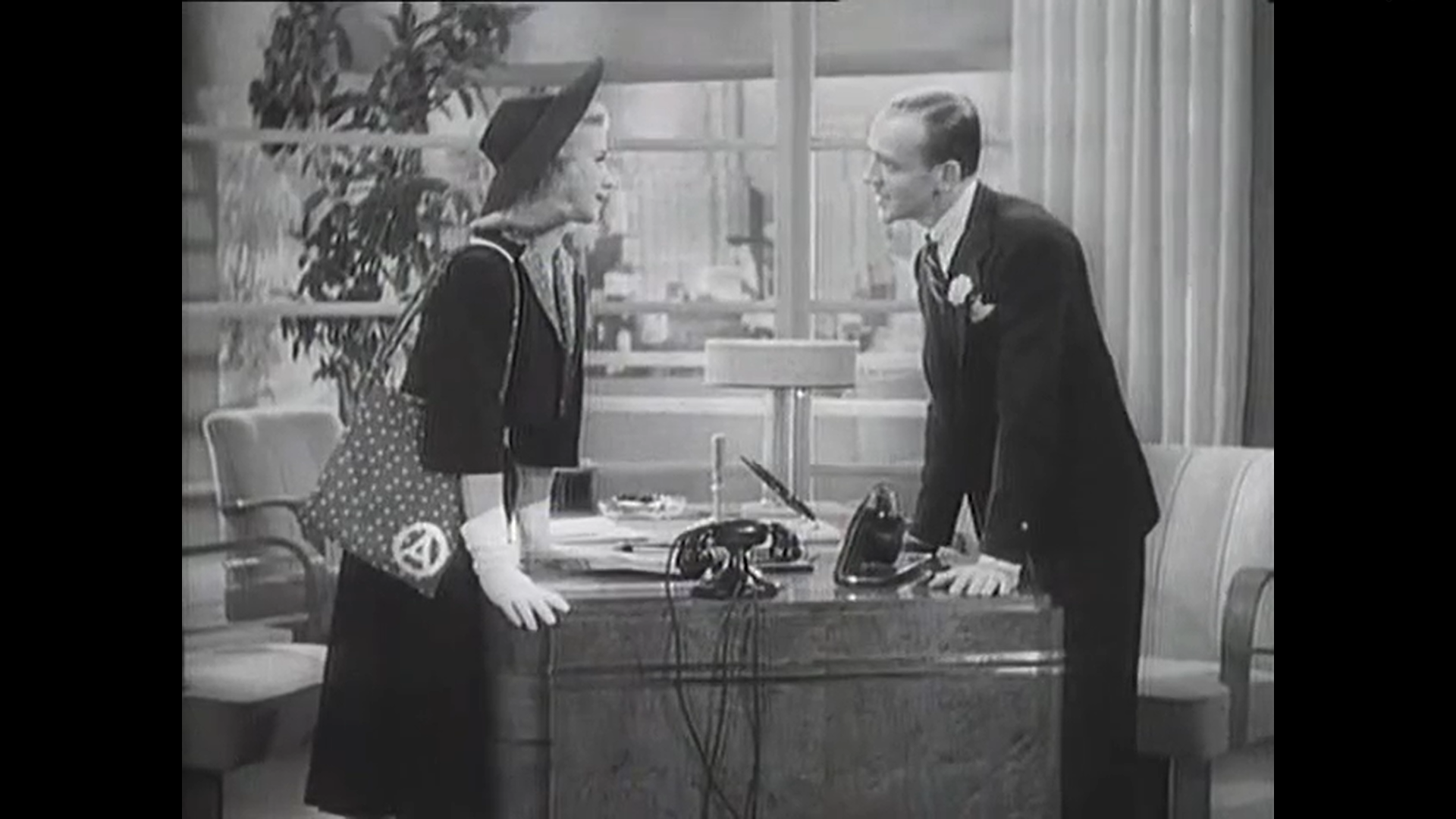
 Ralph Bellamy, Jack Carson, and Fred Astaire sounds like a stellar triumvirate for a movie, and Carefree does us a favor by getting the three men together. Bellamy takes up his usual post as the other man and jilted lover, Stephen Arden. Amanda Cooper (Ginger Rogers) can’t seem to make a decision to marry him, and so she agrees to visit his buddy, who just happens to be a psychiatrist.
Fred Astaire as Dr. Tony Flagg is quite the piece of casting, and the situation gets more outlandish when she happens to overhear some of his condescending dictation about the female psyche.
By the time he calls her in for psychoanalysis with perfect candor, she’s already wise to him becoming the most wearisome patient he can possibly imagine. No one takes kindly to disparaging remarks.
With old pros like Clarence Kolb and Franklin Pangborn rounding out the cast at the local country club, you know exactly what you’re going to get. Luella Gear isn’t quite Helen Broderick as far as the wisecracks go, but she has a kind of warm, bright-eyed gameliness in her own right. Behind a certain level of propriety, as Amanda’s Aunt Cora, there’s also a dry sense of humor.
Although it feels like Rogers’s picture for the most part, a high point for Astaire is watching him make dance out of golf, looking quite competent with both as he hits balls off the tee with a rapid fire cadence perfectly in step.
There’s also a dreamscape Astaire and Rogers number within Amanda’s mind, giving license to their longest and most luxuriant kiss to date on celluloid. “I Used to Be Color Blind” would have been more spectacular and made more thematic sense if it had been filmed in Technicolor, but the slow-motion action has a novelty to it. It’s also a secret she must keep to herself: She must subconsciously love Tony, not Stephen.
Not much stock should be put into Astaire’s therapy techniques because they only serve to aggravate the situation, though this is very much on purpose. Ginger under anesthesia allows the story to play up its best screwball antics, and she was always game for a laugh and a few shenanigans.
She proved time and time again in movies of the era like Vivacious Lady and Bachelor Mother, that she was an unmatched comedienne, even when there was little to no dancing for her to partake in. Carefree ventures into the arena of near-surreal silent comedy as she effectively plays a “drunk” character bumbling nearby traffic, giving the stink eye to truck drivers and the like.
“The Yam” is a quirky piece of puff, but it’s exhilarating to watch Astaire and Rogers in one of their most wide-ranging immersive dances. Usually, we get these specified incubated perimeters in which to enjoy their dancing and marvel at their prowess.
Here, it feels like giddy performance art where everyone is drawn into the far more fluid frame with them as they pick up onlookers like an ever-growing amoeba. They move their way through the country club, strutting through the dining rooms past tables as Rogers bounces in and out of the seats with a sweep of her partner’s arms. It’s an utterly delightful outpouring from the consummate professionals.
In a subsequent scene, Astaire talks to his subconscious in the mirror. He knows he’s falling in love with Amanda, and he tries one final desperate act to salvage her relationship with his friend. He hypnotizes her and implants the idea that “men like him should be shot down like dogs.” It’s definitely not a recommended method, but it sets Rogers up for the final act.
Watching the actress skeet shooting Tyrolian hats under the spell of hypnosis is one of the more hilarious things in the picture. It’s good ol’ fashioned fun playing off Kolb’s ornery judge character. One doesn’t work as well without the other.
But there’s also a real menace, even if it’s screwy watching her tromp around the club as the men flee every which way to stay out of the line of fire of her shotgun. Astaire’s ploy worked a little too well.
He realizes he still loves her and expresses his feelings with the crooning classic “Change Partners” imbued with a kind of melancholic yearning out on the dance floor. He waits until the eleventh hour, but with Jack Carson’s help, they try to get into Amanda to thwart Stephen and make sure the right people get married on the wedding day.
There’s a subtle shift in this film within the Astaire and Rogers canon in that it leads with the screwball elements, with the musical aspects playing almost a secondary role. In other words, it breaks with their typical formula and relies on a more compact screwball structure and the capacity of its stars. But the movie also feels like a supreme showcase for what Rogers was capable of on her own.
3.5/5 Stars
 4 Star Films