
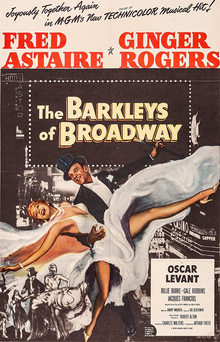
 The Barkleys of Broadway was initially conceived as a reunion. It was meant to star Fred Astaire and Judy Garland to capitalize on their successful partnership with Easter Parade.
Taking nothing away from Judy, it does feel like there’s something propitious about Astaire and Rogers getting back together one last time instead. Because Easter Parade is such a delight, it also makes what we missed out on a little less painful, and what we got in its place all the more enjoyable.
It’s been a decade, the studio changed, and the aesthetics are different in Technicolor, but it’s still an immeasurable pleasure seeing one of the movie’s most transcendent screen couples in yet another picture together. She was always a supernal star in black & white, but Ginger Rogers is a great beauty in Technicolor, too.
The movie opens with the credits as our stars stand on the stage doing their routine as it should be. It’s just like old times. Josh and Dinah Barkley sing each other’s praises awkwardly, and their friend Ezra Millar pries them offstage before they compliment each other to death.
When the performance is over, they walk the gauntlet of all their well-wishers and admirers, signing autographs. I imagine I’ve seen this sequence countless times from All About Eve, Opening Night, and The King of Comedy. It’s like a rite of passage for the entertainment superstar.
They cuddle up in the cab full of lovey-dovey affection and effusive praise until a note of criticism creeps in and all sides blow up; it’s nothing if not a mercurial relationship. Oscar Levant is the peacekeeper and his usual goofball piano man extraordinaire, with his endless array of wry wisecracks.
His persona on film is such that it almost obfuscates the heights of his talents. The rapid-fire runs of “Saber Dance” are a tour de force on keys compressed into a few minutes. A personal pet peeve is actors who sit with their hands hidden behind the piano, and everyone knows they aren’t actually playing. It breaks the illusion. However, Levant, like Astaire, is so prodigious that the camera sits close unbroken as it admires the mastery of their respective art.
Whether planned or partially happenstance, it’s difficult not to read into the meta qualities of the story both real and imagined. The movie has a laugh playing up the tiffs between Astaire and Rogers as portrayed by the contemporary media. Whereas in reality, they seemed like two very driven people with a singular focus to do their work to the best of their abilities. They were generally well-liked and had nothing but high praise for one another. It’s gratifying to hear though it hardly sells newspapers.
Billie Burke appears as a tittering patron of the arts who throws them a party though they try and avoid their congenial hostess like the plague sneaking out to the patio. Dinah meets a French playwright and admirer Jacques Pierre Barredout (Jacques François) on her way out.
The young man strokes her ego telling Dinah she’s wasted in musical comedy. ” You could be a great tragic actress,” he says. Her husband is distrustful of his fawning and besides he sees his wife as a “song and dance girl.”
He’s like the Svengali who molded her, and that image doesn’t go over well with her. She’s ready to get out from under her husband’s influence; she’s no Pygmalion creation or shrinking violet. The rest of the movie is built out of this seemingly trivial tension in the rom-com mode.
Of course none of this conforms to reality as Rogers had won adulation and an Oscar for her work in Kitty Foyle at the beginning of the decade and she was largely the bigger star before they were ever teamed up. She maintained a fairly impressive film career throughout the ’40s and early ’50s. Reading into these tenuous parallels too much is laughable, but it is part of the enjoyment.
The behind the scenes rehearsal environs do yeoman’s work in making this feel like the quintessential MGM the studio of Freed, Gene Kelly, writers Adolph Green & Betty Comden, and all those wonderful collaborations like Singin in the Rain and The Band Wagon.
It highlights the love of performance and the sensation of catching this brand of tap dancing-like lightning in the bottle as if we’re on the ground floor and privy to something only a select few get to see. That’s part of the magic of how they created these worlds for their characters to inhabit where the backstage and everything in between is blurred and the camera’s right in the thick of it to capture it all.
The couple agrees to go out for some fresh air in the country much to Ezra’s chagrin. While Josh plays golf, Dinah agrees to become Jacques’s muse. Thereafter the Barkleys have a photoshoot with Look magazine right at the precise moment he realizes she has the script for the Frenchman’s play.
It becomes a send up of the perfectly quaint and manicured All-American Person to Person fireside chat as the married couple go ballistic once again, this time tearing through their house in a rage in between camera setups. These are mostly vapid bits of fun.
The true high points come when the stars are given these incubated moments to flash their inspiration in front of the camera. “Shoes With Wings On” conjures up a storefront milieu reminiscent of the toy shop in Easter Parade. Astaire puts on a pair of possessed dancing shoes and lets them carry away as only he can. It leads into a magical interlude where he’s joined with an army of ghost taps all stepping in time almost ready to run him off the stage until he takes arms in a surrealist defense involving a broom and toy guns.
Ezra tries to trick his friends into a reunion and they stand backstage at a benefit while he conducts a performance of Tchaikovsky. The man really has range, but then again he was a compatriot of the Gershwins who famously cut so lithely between popular, classical, and jazz composition. From my understanding, they made them one and the same with no delineation between high and low art.
The Barkley or rather Fred and Ginger are paired one last time with the Gerswhin tune “They Can’t Take That Away From Me.” If it’s not immediately apparent, there’s actually a bit of poeticism to its inclusion. So many years ago — in 1937 in fact — Astaire sang the song to his costar in Shall We Dance.
This time around they turned it into a dance with their typical elegance and joie de vivre. The Barkley of Broadways is unreserved proof they’re back, and they never lost it.
It’s so good to see them together; it’s also exactly what our hearts yearn for especially those who have lived vicariously through them for many years. Somehow they embodied us and still reached for heights we could only dream of and they did it with pure class.
3.5/5 Stars
 4 Star Films