
Below, I highlighted some of the other movies and documentaries I watched in 2025 and managed to jot down a few thoughts. Thanks for reading!
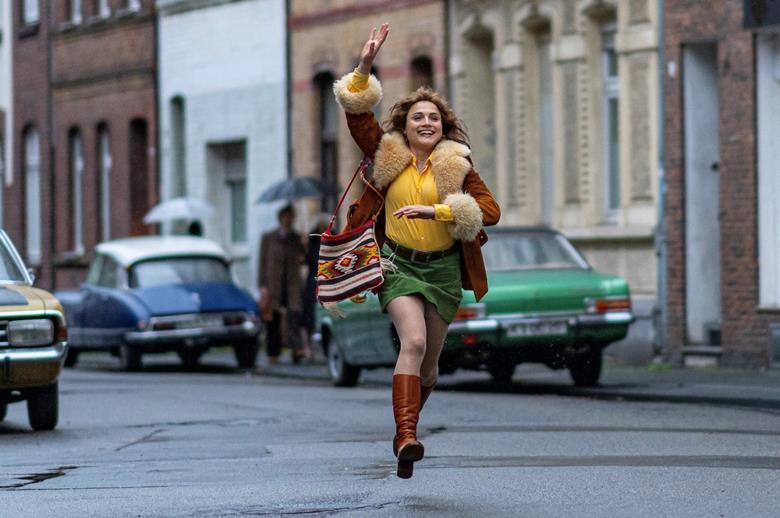
Koln 75
Like the modern biopic, it’s cheekily self-aware, but it’s also good fun. Koln 75 slaloms through time and space, German and English, while pledging an abiding love for jazz music. For the uninitiated, it documents the unlikely rise of teenage concert promoter Vera Brandes (Mala Emde) and her ultimate coup to get world-renowned pianist Keith Jarrett to bring his improvisational style to Germany.
One of the pleasures of a smaller musical biography comes with the element of surprise because the average viewer likely does not know this story backwards and forwards, thus leaving room to sit back and enjoy without overanalyzing.
The movie does get a bit sidetracked upon finally introducing Jarrett (John Magaro) to the degree that it almost feels like a different movie. However, the chaotic thrills up to the actual performance make for a handy thriller we can feel in our beings. It makes the final product all the more exhilarating, and for those who have dabbled in Jarrett only sparingly, it feels like an encouragement to take another plunge to meet the real artist and his improvisational virtuosity.
Riefenstahl
In one sense, Leni Riefenstahl is a complex figure to begin to decipher. She was a pioneering woman within film of the 20th century and a centenarian who lived to see the 21st. However, her work during the rise of Hitler during the 1930s raises questions of complicity. Triumph of the Will was labeled a “Pied Piper” film for creating a god-like ethos around a mere man. In controversial talk show appearances, she was questioned about how much she knew about the Holocaust and why she didn’t rebel, and each and every time, she comes back with indignation.
In one sequence from an unaired special, she throws a fit on camera from a similar line of questioning, denying she was ever a close friend or confidante of the Nazi inner circle, including Hitler and Goebbels. It feels a bit like Peter vehemently denying he knew Christ. It points to a deeper regret even as the documentary frames this conversation with many candid interactions between the filmmaker and the German high command.
Riefenstahl’s rapport with architect Albert Speer fascinates me because he is one of the archetypes of “The Good German,” who fashioned himself as an artist, not a war criminal. It does feel like Riefenstahl is even more ripe for film because it is the very medium she helped to push forward.
One notable contradiction for me was how Jesse Owens featured so prominently in Olympia, where his speed and agility almost feel like a joke for how easily he blows out the competition. Riefenstahl gave us documentation even as she was closely aligned with such a disturbing ideology propped up by eugenics, antisemitism, and all kinds of racism. And yet a point is made, Riefenstahl would never show a disabled body; it would not be worthy of the screen.
It’s difficult for me to pronounce judgment on a scared human being, but across what feels like a sprawling account, we see Riefenstahl caught in these “little white lies.” There’s the cumulative effect of someone trying to alter and control the narrative around them. Still, the cracks continue to form. One of the biggest was the realization she was chosen to document the Polish campaign at the start of the war. She asked to be released as a war correspondent after what she had seen….
Later, she made a movie called The Lowlands during the war and had gypsie children carted in as extras. Records later indicated all these children were eventually shipped to concentration camps and perished…Riefenstahl is not a character who needs to be redeemed. However, I do wish I could understand her better. This documentary begins a conversation worth having.
Marlee Matlin: Not Alone Anymore
I had no recognition of Marlee Matlin’s early career when she reached audiences again with the Oscar-winning CODA (2022). This new documentary about her life and career quickly rectified this blind spot. It’s such an obvious realization, but she was so young when she shot into the public eye with Children of a Lesser God across from William Hurt.
The landscape in Hollywood for deaf actresses felt mostly untrod, and she was learning as she went along, leading an initial title wave of change, even as the progress after her early win seemed incremental. Certainly, the format of this documentary is oriented around Matlin, but she was also a changemaker in getting closed captioning, which is now ubiquitous.
The moment when she recounts experiencing her favorite childhood movie, The Wizard of Oz, anew is a fitting moment. And even when the movies weren’t there, it was inspiring to see how she carved out a space for herself in television, pushing representation of her community in the limelight from Seinfeld to The West Wing. As an avowed Henry Winkler fan, I knew he had been a lifelong supporter of those with dyslexia, but what a wonderful discovery that he and Matlin have been close for decades. In a fickle industry, it’s a joy to celebrate such stalwart relationships and the irrepressible vigor of Matlin herself.
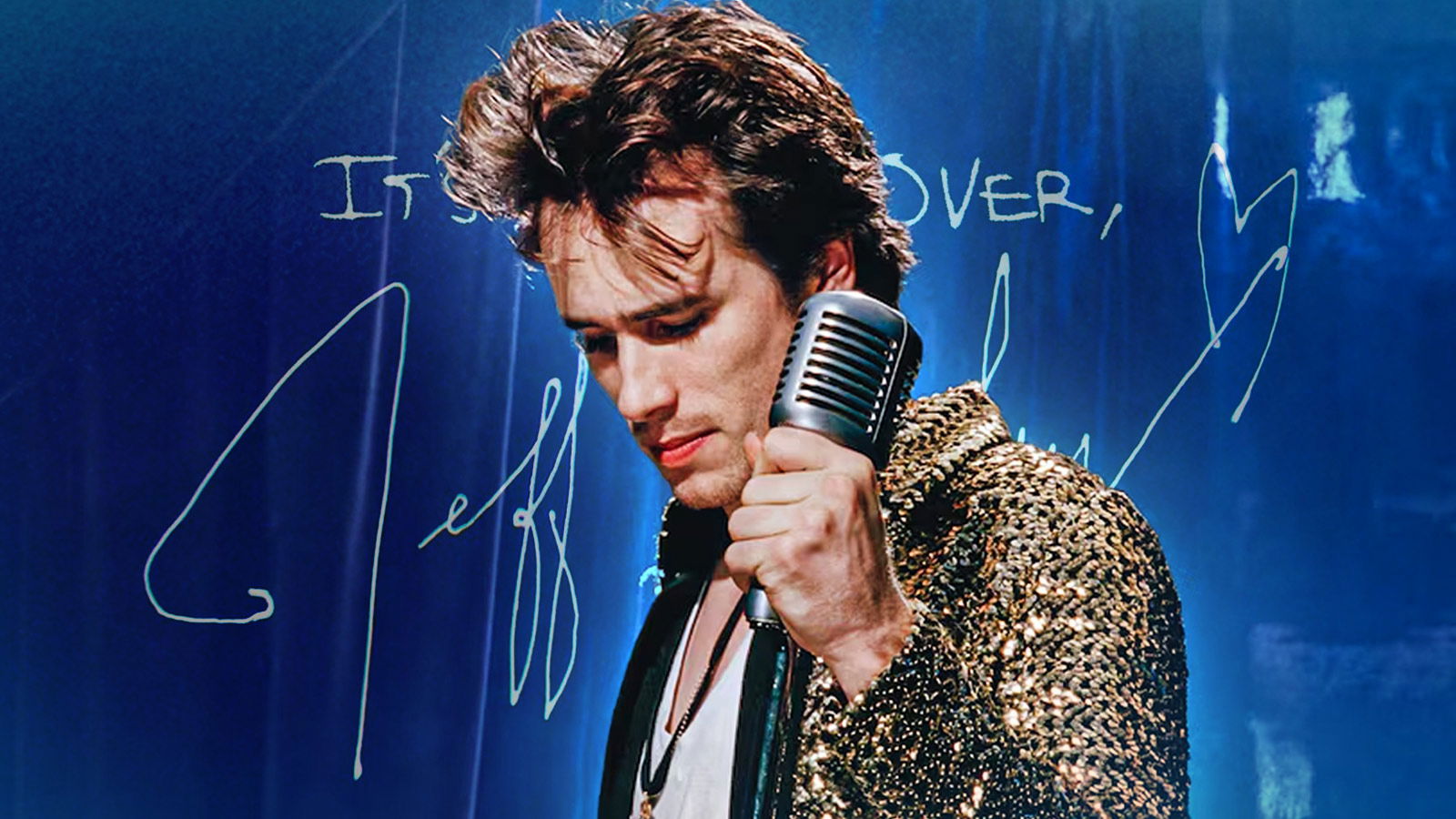
It’s Never Over, Jeff Buckley
I knew Jeff Buckley tangentially because of Leonard Cohen, but I came to know him better through my folk phase when I came to listen to Tim Buckley. If he wasn’t much of a father, maybe their devotion to music was aligned, even if their ambitions were different. They shared the voice passed down through a family tree.
St. Ann’s Brooklyn tribute to Tim was part of Jeff’s coming-out party in 1991, and from then on, Jeff jumped out of this documentary. He comes off as a soulful, thoughtful individual, full of thoughts and poetry, and a desire to be a great songwriter and a vocalist in a tradition as diverse as Nina Simone and Nusrat Fateh Ali Khan
He had the fire in his eyes and the remarkable chords, but we quickly recognize the incubator of community provided to him in places like Shanay’s coffee shop, where he got to hone his craft with a receptive audience.
He parlayed it into Grace — a death prayer of an album – articulating this idea of not fearing anything because there is finally someone who loves you for real. You can achieve a state of grace from someone else loving you…
What becomes evident is the many remarkable women who had a part in Buckley’s life, but he is also always reaching for the transcendent, even if he cannot quite grasp it.
I think of one perceptive line where he notes that without an ordinary life, there is no art: balanced meals, reading, sleeping, relationships, love. It’s a quiet moment after the onslaught of celebrity and touring, but it’s one of many moments slowly reclaiming his story. Lest we think otherwise, this is not another star who burned out brightly, but instead a young man who was finding himself and settling into a life to manage the stressors of fame so he could sustain his art.
What comes through is not the destructive nature of creativity, but the sensitivity radiating out from him and the genuine sense of loss because it doesn’t feel like the story was meant to end. He had so much to live for, and it seems like he recognized it within the core of his being. He was aware of mortality, even the death of his father, and that gave him a desire to love and conjure up beauty through his lyrics and songs. Whatever he says, when I hear his rendition of “Hallelujah,” it puts me in touch with something greater than myself. For that, I thank him.
Secret Mall Apartment
The rule follower inside of me gets intense anxiety watching Secret Mall Apartment, but there’s also something quite spectacular about it, taking something which could have been a stunt and turning it into something more. It’s part commentary on gentrification and a group art project. What’s more, this vibrant community of hungry artists galvanized by Michael Townsend stretched out their hands to offer their creativity in service of memorials to the Oklahoma City attack and 9/11 and countless patients in local children’s hospitals.
It’s a reminder that art need not have utility. Giving people hope and making them smile is enough. However, what are we to do when public art crosses barriers and breaks societal rules? This is part of the tension, and what we get is not only a time capsule of a certain time and place at Providence Mall in New Hampshire. All the sensible among us can live vicariously through their ambition to do something wild and still somehow domesticated.
Others will wonder what the point is. They didn’t make any money, and they put all their time and effort into ventures without any lasting impact. And yet not many people can say they’ve lived in a Secret Mall Apartment. This doc, executive-produced by Jesse Essenberg, is more fascinating than it has any right to be. Sometimes it’s nice to be reminded we live in a wild world full of wacky people. Part of what makes it mean something is banding together and looking to bring hope and beauty into existence.
Rental Family
Rental Family has a premise that might feel like a punchline. But living in Japan and even meeting people who seem to stick out like Philip-san (Brendan Fraser), it feels quite believable. It’s the kind of movie I would have appreciated growing up because it deals in cross-cultural and cross-generational storytelling. It feels as if we have found ourselves in a world where more people are curious and even familiar with these liminal spaces of navigating different cultures.
The best moments get Japanese culture and dynamics so well, and part of this is embodied by Fraser. He’s not fluent in Japanese, but you can sense him getting the hang of it, and enough so that it works for an expat.
The services they provide are meaningful when it revolves around companionship in an isolated landscape or providing an outlet for personal grieving. It does cross a line, however, when it facilitates a lie or mobilizes harmful behavior. Philip learns this firsthand with the clientele. The storytelling itself becomes quite twisty because so much of the movie is designed around this sense of performance and what is fiction vs. reality. Sometimes these fictions can be pernicious.
There’s a kind of poeticism to the movie being framed by funerals. In the end, regardless of what it says about ethics or religion seen through the lens of Shintoism and Buddhism, the most universal themes are about chosen family. My only other realization worth sharing is how director Hikari took her name from the Japanese word for “light,” and I can see how, in an age of loneliness, her movie is meant to guide people toward the beacon of community and human connection.
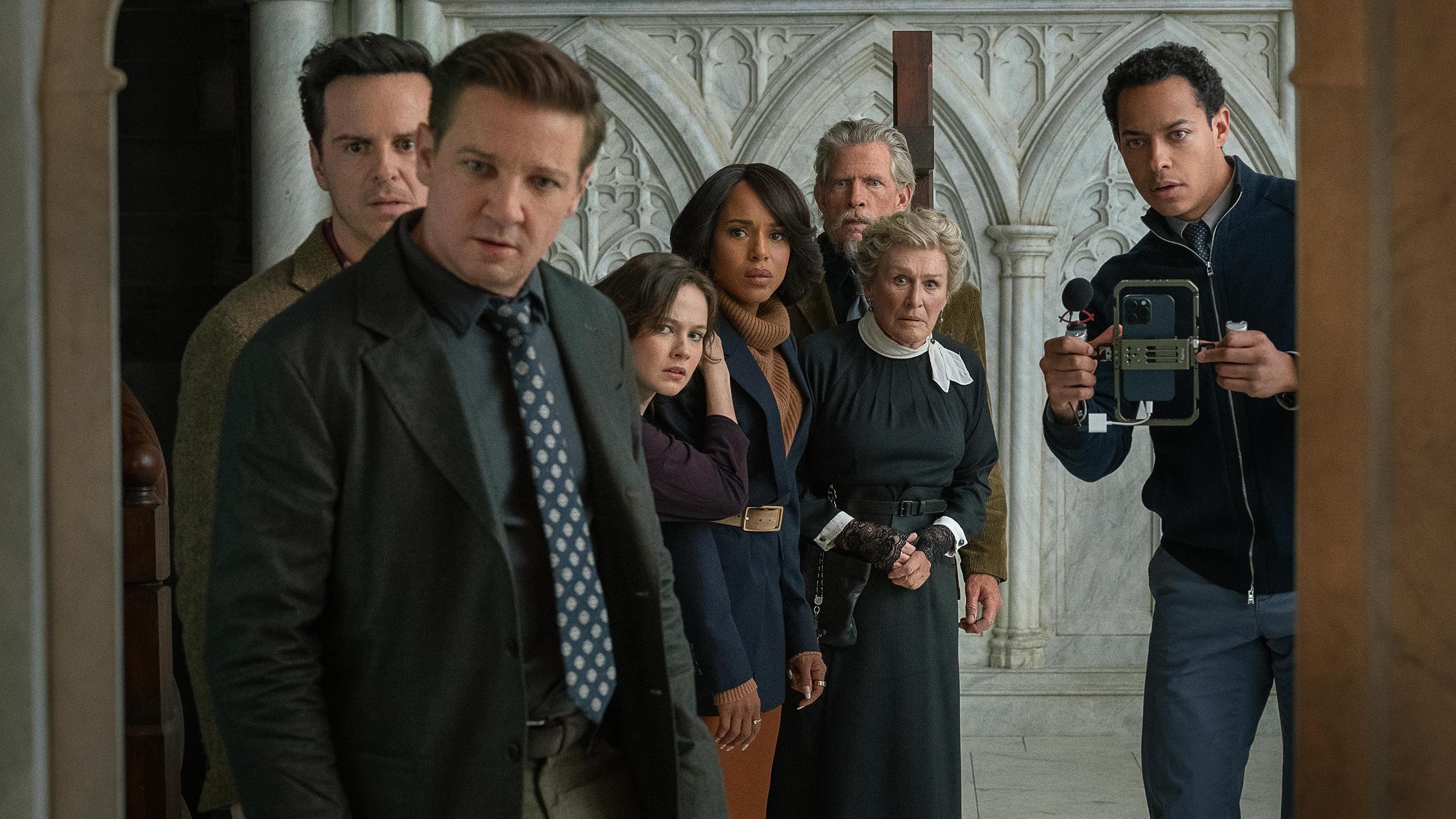
Wake Up Dead Man: Knives Out
Rian Johnson seems like a windsome human being, and I want to like his films more than I do. My greatest compliment for Wake Up Dead Man is the charitable posture he seems to have in a movie surprisingly preoccupied with faith, and it at least extends partially beyond “Christians” as an amorphous political bloc.
Because it is a film laying bare the cult of personality that builds around any divisive leader, but specifically those in religious communities who promote a narrative of a culture war and a traditional way of life under attack.
There is language and rhetoric bandied about – what people might normally call Christianese – without any of what Jesus seems to represent. This must be disconcerting for anyone who has actually ever sat and ruminated over His teachings from something like The Sermon on the Mount.
But in the earnestness of Father Jud (Josh O’Connor), who becomes our primary protagonist, it tries to offer an alternative point of view of what a genuine life of faith looks like. He takes on the mantle carried by Ana de Armas and Janelle Monáe, effectively living as a minority in the world around them – in this case, the world of Christendom.
Watching the film, it becomes apparent that much of the story is invested in the ritual and iconography of faith. It reminds me of the distinction of how having a cross as a necklace is tantamount to having an electric chair on a chain around your neck. It holds no significance, and it’s little better than a church without a cross if it doesn’t lead you anywhere else.
Two of the most compelling moments come initially when Jud first meets Detective Blanc, and they speak about the story of faith. Blanc is an avowed skeptic and distrustful of organized religion, understandably so. The young Father Jud welcomes it even as he asks whether these stories convince us of a lie, or perhaps they resonate with something deep inside of us that is profoundly true. It echoes much of the ongoing debate of J.R.R. Tolkien and C.S. Lewis about myth becoming fact.
And although Wake Up Dead Man functions first as a mystery film and a faith dialogue second, we do get a moving interaction of the Father ministering. He takes a call from a grieving woman and extends her the utmost compassion, slowing the pulse of the movie down so he can pray for her. It felt like the high point of a movie from a series that, while still intermittently clever, provides diminishing returns as genre fare.
Familiar Touch
There is a small canon of aging parent movies, including the likes of Away from Her, The Father, and Thelma. Familiar Touch is fit to join this small but mighty cadre of films made in conjunction with a retirement community, and a few professional actors leading the ensemble. What makes it slightly different is how it maintains the subjective point of view of our heroine, Ruth.
Despite getting disoriented and disrupted by her own bout of memory loss, we witness her acclimate to life in assisted living and her innate gifts for food preparation born from years of life experience. Even as her facilities continue to deteriorate, there’s a beautiful gift in seeing glimpses of her talents when they come in the service of others. We see not where she ended up but who she was in her former life, imbuing her with dignity.
Familiar Touch has my favorite needle drop of the year: Dionne Warwick’s “Don’t Make Me Over.” Sometimes music has a way of expressing feelings and emotions we cannot articulate in any other way – it brought tears to my eyes. It could easily be the emotional ending of the movie. However, first-time director Friendland opts for the realistic, not so much the feel-good or cinematic. Amid the minor victories of caregivers, life keeps moving on for our loved ones, whether we’ve made peace with it or not.
Lurker
Lurker’s narrative conceit is ripe for a modern-day psychological thriller. It observes the ecological and potentially parasitic framework around modern celebrities, where unbalanced parasocial relationships suggest the semblance of real friendship.
In a storyline imprinting itself on the dynamics of All About Eve, a no-name creative who works in a clothing store, crosses paths with an up-and-coming musician. His obliviousness in the face of this emerging pop star makes him unique and cool because of his perceived indifference.
However, after being swept up into this world and the posturing it entails, it becomes an intoxicating web pulling him in continually. He wants to ride the waves of this lifestyle without conventional work hours or experiences, all the while vying for acceptance. The most pointed needle drop pops up multiple times in the form of Jame and Bobby Purify’s 60s classic “I’m Your Puppet.”
At times, the movie feels like a modern incarnation of C.S. Lewis’s concept of The Inner Ring, where people want to be in proximity of celebrity and what is perceived as cool. People will do anything to maintain their place with the in-crowd, and the movie shows the creative relationship taken to its most harrowing extreme.
 4 Star Films