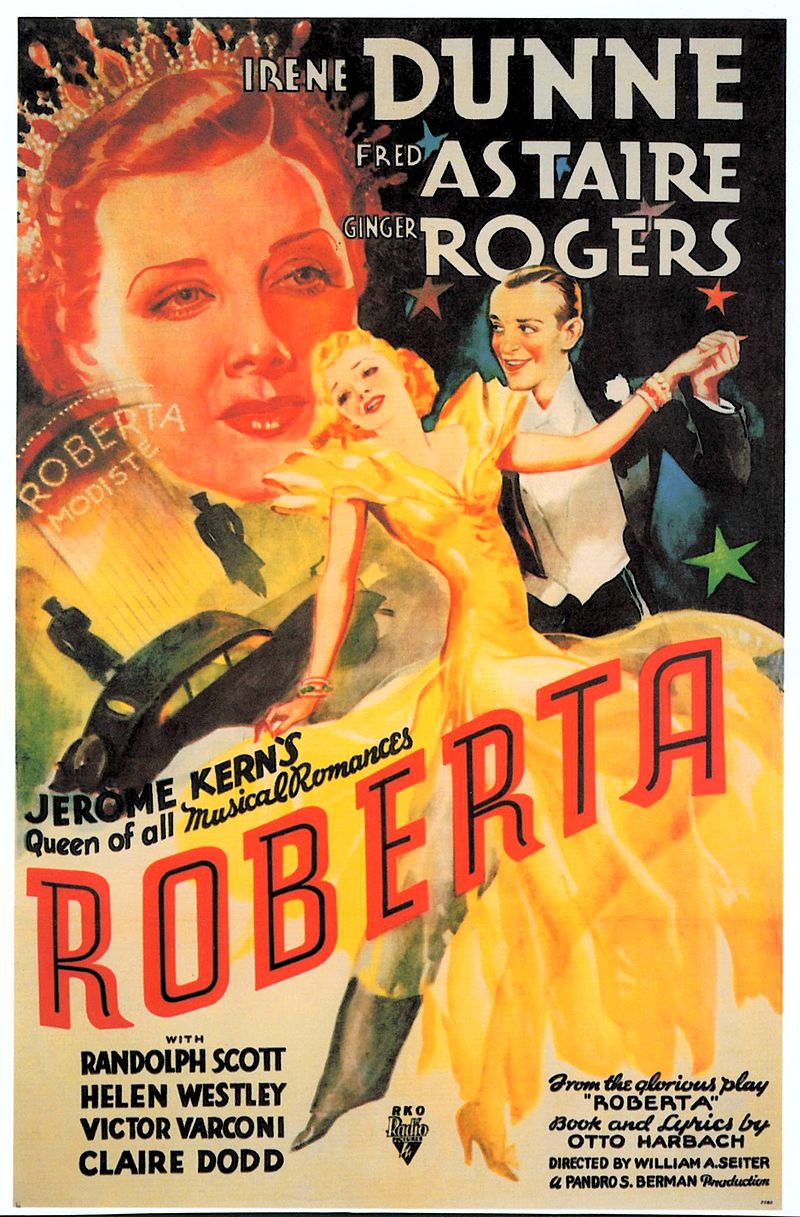
 Roberta opens with a troupe of musicians known as the Wabash Indianans who perform a wonderfully kooky organ routine in the middle of a train depot. It’s so inventive in fact, including the verbal gymnastics of Candy Candido, that they get sacked before they can even begin their gig in France. The proprietor was looking for some more exotic entertainment.
The boys need a fallback plan fast. Huck Haines (Fred Astaire) vaguely knows a girl named Lizzie, and John Kent (Randolph Scott), well, his aunt just happens to be the most famous dressmaker in the city. Only in the movies…
Time is of the essence, and so he pays the famed monoymous Roberta (Helen Westley) a visit. Scott gets stuck in the gilded elevator and has his meet-cute with Irene Dunne. It took a moment to recognize her because she addressed him in French. Stephanie (Dunne) is Roberta’s designer and most faithful staff member.
Scott is instantly smitten and goes leaping up and racing across the room just to have the chance to open the door for her. He rumbles around with the giddy energy of a colt; his aunt likens him to her favorite Newfoundland puppy.
If you’re keeping score, there’s one name that hasn’t cropped up yet. Ginger Rogers shows up as a feisty countess; her accent is worse than Dunne’s, but it doesn’t matter. She’s got the spunk to make it count. She stands at the balcony listening to the band do their performance, and when she actually gets face-to-face with Astaire, there’s really some fun to be had.
Flying Down to Rio found them coming into their own; they were sidekicks who caught the eyes of the audience with their craze-creating “Carioca” routine. With Roberta, they had already hit it big with The Gay Divorcee, and now they get to have a good time with the material without the onus of the story being on them.
They seem to relish this kind of sidekick role; it’s almost like they’re playing a level of meta comedy here because they know all the beats of the story and what it takes to have the commensurate repartee. After all, outside the film, they’ve already built up a cache of goodwill.
We really begin to understand it when they both drop the act. Because she’s not a countess but the same fast-talking dame named Lizzie he knew in a former life. Now their familiarity makes sense for the sake of the story.
In “I’ll Be Hard to Handle,” they get reacquainted with some flirtatious dancing as they reminisce about old times. This devolves into a dance-off with a slap for good measure, all captured in a rush of an unbroken take between two consummate performers loving what they do in front of us.
It feels like things are humming along. The demonstrative nightclub owner Alexander Petrovich Moskovitch Voyda, who communicates only in raised octaves, is coaxed by Lizzie into offering the boys a job this time around. Things are looking up.
There’s even a French lesson with Randolph Scott and Fred Astaire, which so obviously lays the groundwork for “Moses Supposes” in Singin in the Rain. It’s impossible to see it any other way.
Admittedly, Scott and Dunne have a rapport I like, though I’m equally tempted to say I want to see the movie with Astaire and Rogers at the reins. They almost need two separate movies because the story’s not big enough for all they have to offer. The script goes tugging and seesawing good-naturedly enough between the players, but the story almost doesn’t know how to handle it all.
It’s an embarrassment of riches, and it’s not even named for any of them. This distinction goes to Helen Westley. Then, Auntie Auntie dies peacefully — Scott and Dunne have a pact to run her fashion empire together, and John’s old flame Sophie comes from America for the obligatory complication.
She and Astaire don’t mask their mutual disdain for each other, and her entrance is great for the sake of comedy if little else. The fact that they have a bet over how her dress will be received by John pays dividends simply with the opportunity of watching Astaire’s smug face as he struts off and palms her dough.
Roberta could be a stolid affair straight through, and it is from time to time. No disservice to the lovely Irene, but her style of singing went out about 80 years ago, and I will always be enraptured by the Platters’ cut of “Smoke Gets In Your Eyes.”
I realized what made the Astaire and Rogers formula work was that they cut out the middle man: they were the floor show, the romance, and comedy all wrapped up into one. Roberta almost has too many parts.
Irene Dunne’s a star deserving top billing to be sure, but it’s easy to say the same about her costars even if it’s in retrospect. Still, there are enough delights in this one to look kindly on it.
3.5/5 Stars
 4 Star Films