
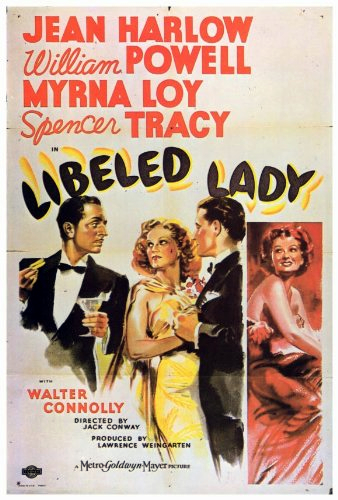
 The topical sweet spot of screwball comedy, journalism, and ocean-liner romances makes Libeled Lady feel like a quintessential 1930s movie. Trusted studio director Jack Conway and the stars peg it as prime MGM.
Spencer Tracy is Warren Haggerty, the managing editor of the New York Evening Star. He’s pulled away from the altar because the paper has made a major boo-boo. In his absence, they erroneously published a story about aristocrat Connie Allenbury. Before they can quash the story, her influential father James (Walter B. Connolly) gets a copy and prepares to slam them with a libel suit.
There’s only one man who can save the paper from utter ruin, and so they go tracking down a real firecracker named Bill Chandler (William Powell) all across the country and all over the world. Of course, he’s right under their noses all the time, barely able to pay his hotel bill.
The two men converge on one another, looking to feel each other out because they both have something they need. It makes for great comedy because this situational irony underpins every proceeding action. Likewise, Tracy and Powell taking stabs at each other is one of the great cinematic pleasures in life because they both have a knack for it. Ultimately, Chandler leverages his position and agrees to bail them out for a small fee.
It calls for him to “marry” Haggerty’s girl. The peeved bride-to-be is Jean Harlow, who makes the part something because she’s a girl who can give it as well as she takes it. Gladys is conscripted into their ploy, and it’s the absurdity that such a picture thrives on. Once Chandler has “married” Gladys, he will woo Ms. Allenbury, and then the Evening Star will either retroactively have proof for their baseless story or, better yet, new fodder will be whipped up. The loopier the better, and they make it stick.
Harlow’s character is indignant and also proves her to be one of the great comediennes, schmoozing with her faux husband and hamming it up with the boys. The intertextual relations between Powell and Harlow certainly help matters, because you can read their real relationship into the convoluted pseudo-couplings of the film, all played for comedy.
Bill gets to work meeting the jovial Mr. Allenbury and his far more guarded daughter. As part of the game, he coaches himself on all types of fishing, including anglers because his mark is an avid fisherman; Loy’s quick to pick up that Mr. Chandler is quite the “angler” himself. He even has a fishing instructor sent to their honeymoon suite to learn how to hook curtains and lampshades (if not fish).
Of course, Loy and Powell prove themselves to be another cinematic dream team. My wires probably got crossed somewhere, but to my mind, they’re one of the most prolific screen couples ever. Libeled Lady is another ticklish feather in their cap.
Their excursion out on the stream bed devolves into a wonderfully goofy corralling of a fabled trout as Powell goes splashing and stumbling through the frigid waters. What’s most curious about the moment is how it’s not drummed up with a lot of score, but we just have the sound of the water as Powell struggles hook, line, and sinker like any of us would. He’s an amiable hero, and though it’s funny, it’s a turning point: the moment Loy likes him for real. Perhaps he realizes too that if he tries to be something different, it’s really possible to change (Maybe it’s just a good joke).
But he and Loy have some wonderful moments of more sentimental chemistry. It makes the relationship feel less like the required beats of a plot we know must end badly when he’s caught in a lie. If you’re like me, you like them together, and you have goodwill from the movies they made previously. We want the best for them no matter the screwball antics at the film’s disposal.
These moments are suspended in time. And what’s more, for these isolated instances with Harlow and Tracy out of the frame, they nearly steal away the picture and make it their own like so many others. It’s a credit to the strength of the ensemble that you’re never going to forget their other scene partners completely. They’re too shrewd and incomparable as performers in their own right.
Tracy throws out the middle man, and Conway forgoes any kind of interstitial exposition, allowing the newspaperman to cut straight to the chase with Mrs. Allenbury, reasoning with her to drop the libel suit. The fact he’s cut out all the fancy stratagems shows his genuine desperation. Part of it is Chandler.
Haggerty has the feeling the man he’s hired might have been working on the wrong girl — his girl — though it’s exactly the opposite. He was working so well on the right girl that it affected him, and he found himself changed. He’s falling in love.
The two men have a pointed conversation of innuendo as Myrna Loy looks on without the foggiest notion, or maybe she just doesn’t care. Instantly, the ball is in Tracy’s court; he seems to hold the power because he knows the other man’s secret. He’s caught him in something.
However, soon after, Tracy stands astounded at his news desk as his nemesis waltzes in with his fiancée. They just went dancing, and she’s not going to oust him as they had planned. There’s nothing particularly elegant about the blocking because there doesn’t need to be. This time Harlow’s in the middle of the frame, though favoring her “husband,” and we have quite a different dynamic. This round goes to Powell.
For all his grousing, we begin to feel a little sorry for Tracy. If this keeps up, he’s going to be jobless and girless. A lovely bit of narrative verve and confluence brings them together in one space to have it out as we always imagined they would. We go ping-ponging with every imaginable plot twist one could imagine, and we would expect nothing less for such a screwy story. But the joy is watching everyone end up where they need to be, and the cockeyed journey to get there is just about as fun courtesy of our stars.
MGM was always hailed as the studio with more stars than there are in the heavens. I take this to be attributed mostly to prestige pictures and early Oscar bait. However, Libeled Lady is a reminder that screwball comedies are no less indebted to the studio system. Very rarely have we seen a picture hum with stars of this caliber.
4/5 Stars

