
 “God chose the foolish things of the world, that He might put to shame those that are wise. And He chose the weak things of the world that he might put to shame those that are strong” – Ira quoting 1 Corinthians 1:27
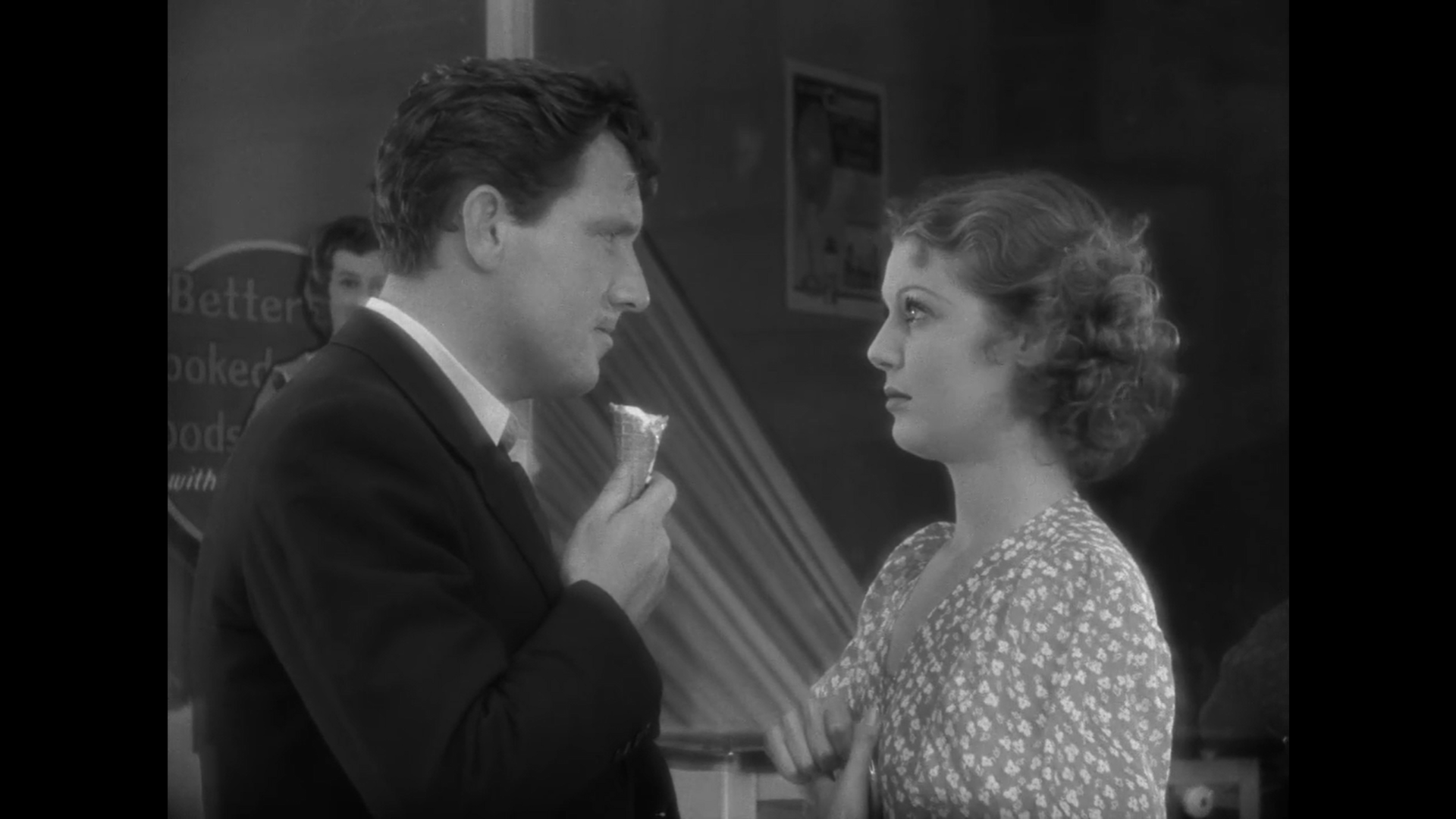
Man’s Castle has a wonderful set-up for a beautiful gag, although we have to come face to face with the throes of the Depression to truly appreciate it. A man (Spencer Tracy) in a top hat and tails is feeding the pigeons on a park bench. He spies a hesitant young ingenue (Loretta Young) watching nearby. He gives her a smart remark, and she almost cries. She’s soft-hearted and hungry. She just wants to eat the crumbs he’s tossing to the birds.
He’s not a complete curmudgeon and has a change of heart. Blink, and they’re in a fine restaurant. He’s chomping on a cigar, a look of satisfaction on his face, watching her put away a whole plate of food. She may be all skin and bones, but she eats ravenously. This is how we meet Bill and Trina.
But we have yet to mention the punchline. Bill calls on the manager of the establishment casually, then he proceeds to tell the preening man that he’s dead broke…He doesn’t have any money to pay for the food, and yet in a world littered with wealth, what’s one gift of charity? They end up walking out with full bellies without greater implications.
It’s an upside-down world they live in. This is what Frank Borzage gives us. We get down to the humble roots of the temporal world of shantytowns and impoverished working stiffs only for the director to bring his quintessential transcendence to the proceedings. It may come off as high-minded talk for such a meek picture, and yet with Borzage, romanticism can break into any environment within any strata of society.
In such a space, Bill and Trina become an unlikely couple. Bill’s always looking to make a casual buck to maintain his unattached lifestyle. It means light-up signs on his chest, stilt walking, and serving summons to one dancehall starlet, Fay La Rue (Glenda Farrell). The lady is visibly impressed, watching his self-confident shrewdness in getting to her. He’s a man with ingenuity.
Loretta Young has the most voluminous eyes in cinema, and with the fresh-faced garb of youth and what butterfly lighting can do, she fills up the screen with radiance. Trina contents herself with keeping a home for Bill. She takes his demeanor in stride, knowing full well it obscures an affable heart. All she knows is that she’s deliriously happy with their meager slice of paradise.
When you’re dead, you get a hunk of dirt, and while he’s alive, Bill wants to hang on to the hunk of blue up above him in the sky. He could do a lot worse. He is a character of paradox. At his best, he’s like a grown-up kid who hasn’t lost his impishness. He has a buddy in Hollywood lifer Dickie Moore and even finds time to get booted off the stickball team by the local kids.
He’s founded on a gruff, insult-laden shtick, and then he comes right around and pulls out the new stove his girl’s been eyeing. Actions speak in ways belying his words. It’s how he shows his affection. In another scene, he swipes a zinnia when his neighbor (Walter Connally) isn’t looking and drops it in the soup Trina has lovingly prepared.
He makes a whole stink about it, grousing, then half-heartedly belittling while he half-smiles through the other side of his face. He does a little playacting before both Trina and Ira, before slipping the man a dime in the moment. It’s such a wonderful encapsulation of who this man is in a single crystallized moment. Like Whitman said, “I contain multitudes.”
But this is part of what made Borzage such a preeminent filmmaker because his stories can be distilled down to these remarkable moments showing off the acumen of someone well-versed in the syntax of visual storytelling carried over from the silent days. Where the images seem to evoke more than the mere sum of their parts. There is a depth and pregnant meaning to some of the more somber, starry-eyed sequences.
Bill is a kind of begrudging Joseph with Trina, his pure Madonna keeping all these things in her heart. Eventually, they get a common-law marriage presided over by Ira. In the ’30s, it might seem scandalous, but watching it play out is nothing of the sort. There’s not a lot of fanfare, and it means something deeply profound. Bill makes a vow to be with his “Whosit” for life, and whatever he might say to the contrary, there’s a sense he’ll make it stick.
Even when he half-heartedly robs a safe for some quick cash to leave his bride, he’s more concerned with the view outside the window and the wind-up doodad he’s going to take home to his girl. This is what his life revolves around, even as the world can be harsh, disrupting his reverie with a cruel twist of fate.
If you let it, Man’s Castle is the kind of unassuming film with the capacity to break into your own existence and remind you in all humility what it means to live radically in the mundane rythyms of life. It’s not about religious zealots or powerful leaders, but the kind of folk who have much to teach us about what’s actually important. If we look down at them or disregard what they have to teach us, we miss the whole point. Just as seeing this as a little film with a short running time is a grave mistake. This might be one of the biggest, grandest films you have the chance of experiencing.
The final images almost feel like a sculpted piece of marble or an illumination by one of the greats. Bill and Trina are in repose in a cattle car, glowing like saints, lowborn royalty. It’s not so much a gospel movie, even as Borzage is not an overtly Christian filmmaker, and yet the imagery and language of the beatitudes are hard to miss.
It’s an upside-down world where the last will be first. The meek shall inherit the earth, and the passionate forces to save the world can be found in the most common places, be it a manger or a cattle car.
4/5 Stars

