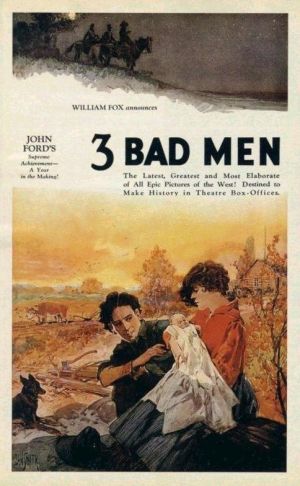
 At the outset, 3 Bad Men feels like a pile of tropes. We get a sense of the sprawling West: There are wagons crossing the prairie, a lust for gold, outlaws, and intrepid heroes.
George O’Brien embodies an early Irish portrait from John Ford; he’s strapping and jocund with a giant harmonica and a song in his heart. Olive Borden has a certain Clara Bow aura as a screen beauty, though far more aloof. She has taken to the trail with her father as they look to seek their fortunes.
However, they feel out of their depth in an austere terrain full of natural danger and deceitful characters. Dan’s a friendly face and more than willing to oblige with his services, especially with a pretty girl like Lee nearby.
A little over 15 minutes in, we get our first sense of something truly intriguing for upending the typical conventions you’d expect in a silent picture. It shouldn’t be a total surprise because Ford has titled his movie 3 Bad Men.
It feels like a precursor to Bicycle Thieves in that the title has a kind of ambiguous meaning. It takes something dubious and reclaims it as first Carlton and then the audience put their trust in these three grizzled vagabonds.
They begin as “Wanted” outlaws who spy some thoroughbreds on their way toward the gold rush in the Dakotas, and they’re prepared to raid them, only to become the indignant defenders against another attack.
It becomes a muddying of morality in a world where reputation comes to mean so much even as action tells a very different story about these people. These men have a price on their heads in multiple states and countries, and yet in this moment of need, they become heroic benefactors of a woman he doesn’t have anywhere else to turn.
The primary antagonist is a white-teethed sheriff, Layne Hunter, who’s more despot and renegade than he is an emblem of the law in the booming gold town of Custer. The irony is difficult to miss.
A sad-eyed, wispy-haired Minister arrives and doesn’t represent goodness to the local populace as much as he does a certain utility. With a minister, a woman can be married. Eventually he will have to beseech the sheriff to take action; whether or not it will do any good is another matter.
Bull, Mike, and Spade acknowledge they are three old terrapins not fit to take care of her, and they vow to become her matchmakers to find her a suitable husband. At times, the more comic scenarios feel like two-reeler-type gags from looking for husband material in the saloon. It gives the material an agreeable sense of levity.
There’s a quick, easy camaraderie between the most obvious male leads, O’Brien and Bull, when it would be so easy to turn them against one another for ready-made drama. When they join a saloon brawl together, it galvanizes them, and all future conflicts come from outside forces. They have nothing but goodness and chivalry to offer.
What’s easy to appreciate about the film is how it has many of the archetypes and elements of the early Western, but there’s an intricacy to the character dynamic that makes it more compelling than run-of-the-mill sagebrush fare. It’s not just about a rudimentary plot that we’ve seen umpteen times before.
And though Ford can never be called one of the most urbane comedic directors, one of the joys of 3 Bad Men is how it blends goofy antics and the toils of romantic comedy against the underlying drama of the West. It gives it a depth and a breadth so many of its contemporaries lack when viewed from the present. Ford offers us more to enjoy than just superficial pleasures.
The sides are drawn up with a burning wagon sent hurtling toward the church as a harbinger of the chaos to come in the fight for control of the community. What was striking to me in hindsight was how the imagery of Hunter’s mob felt so very much like what I’m accustomed to seeing of the KKK, from burning crosses to fear and intimidation tactics.
There are also Ford landscapes and stunning set pieces like the race to lay down their claims, but even at this early juncture in his career, he never lets the scale get in the way or neutralize the centrality of the character moments that give the film its meaning.
Like watching three men walking across the ridge of the prairie, it suggests something profound. Ford knew how to shoot an ending, and it presages something like The Searchers, where the image feels quintessential to the western milieu, as if walking into the sunset offers a kind of finality. Though it’s just the beginning for some who must keep on wandering.
There are a handful of directors who had the good fortune and skill to have longevity in Hollywood. I think of the likes of Martin Scorsese and Steven Spielberg, but before them there was John Ford. There’s little doubt we see a master craftsman being formed in the teens and 20s, and he would continue to exhibit his talents well into the 60s.
We usually look at directors like Ford or some of his contemporaries in their fully formed state with many films under their belts, but it’s equally instructive to look at how they honed their skills early on before they had legendary acclaim. 3 Bad Men is a surprising and unmitigated delight, developing the western genre from the ground up.
4.5/5 Stars

