
Wargames is a movie for the age of “Star Wars,” and by Star Wars, I’m referring to Ronald Reagan’s Strategic Defense Initiative. Because, despite detente, these are still the days of the Cold War, mutually assured destruction, and the threat of nuclear holocaust. Warm and fuzzy topics to be sure.
But isn’t this the beauty of movies from the ’80s? They can be packaged in such a way that’s entertaining, somewhat ridiculous, and generally cathartic. Somehow, it seems like there is a greater license for the suspension of disbelief. Wargames could be a certain type of movie that’s easy to place. We’re introduced to a NORAD control center with a brain trust of government employees who keep the country protected alongside gruff cigar-chomping military types.
One of their great assets is technology. Namely, the WOPR, a supercomputer using game theory to calculate all possible outcomes of a WWIII, should we ever come to such a crisis.
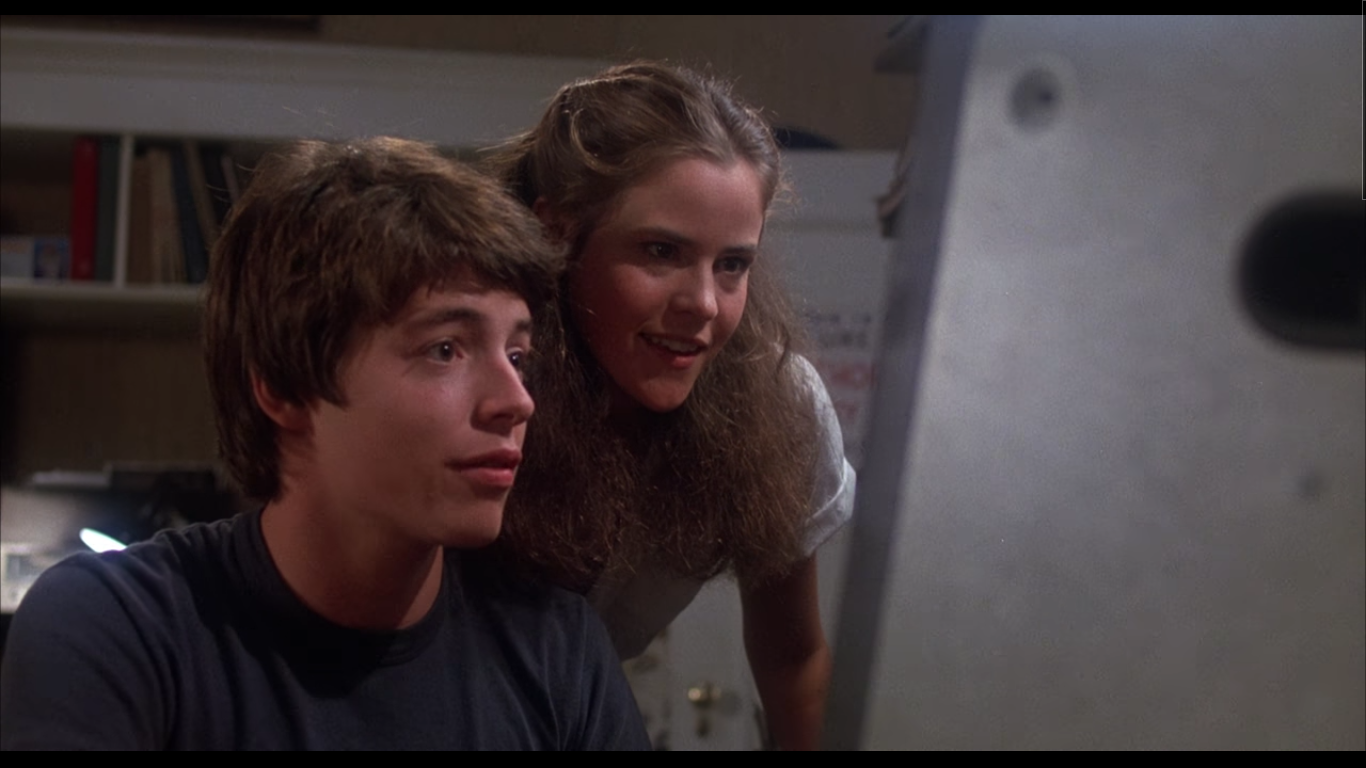
However, we also meet David Lightman (Matthew Broderick). He’s seemingly your average Seattle high school student. Unmotivated but intelligent. Broderick plays him as a bit of a likable smart-aleck who also happens to be a video game and technological whizz.
When he’s not in the arcade or goofing off in class, he’s holed up in his bedroom. His love interest is obvious. Peer pressure or crossing social cliques is never an issue in this picture, and they form a relaxed rapport from the outset. Ally Sheedy is your quintessential giggly All-American teenager (Pre-Breakfast Club). She’s lovey-dovey with the family dog and comes jogging past the home in her gym attire to pay a visit.
With a certain boyish bravado to impress a girl, David gets into the school computer and proceeds to change both their failing grades. Jennifer has some amount of personal conscience, but not enough to be a killjoy. Anyway, these escapades feel relatively mundane given the world we find ourselves in.
To this point, it also sounds like we’re talking about two entirely different movies: one concerned with world affairs and another a lot more juvenile in scale. Where can these worlds collide? It’s all too obvious.
You can see how it’s a jumping-off point for the troublemaking charisma of Ferris Bueller that seems to come so easily for Broderick. Instead of a day on the town, his prowess winds up helping him unwittingly break into the government’s defense program.
It turns into a rather illuminating exploration of contemporary technology like computers (green text on a black screen), library index systems, and newspaper microfilm readers, all tools of the trade for those trying to find any form of information, well before the proliferation of Google and the interwebs. For those with shorter lifespans or attention spans, it’s a reminder of where we’ve been before.
Sure enough, he gets into the program thinking he’s playing a game simulation called thermonuclear warfare, and it is a simulation, one that the computer “Joshua” believes to be real. David pretty much triggers a shot heard around the world.
We get establishing shots of the Emerald City, and later, David is being tracked down by FBI agents. Forget about Sleepless and Seattle. I’ll never think about the city the same way again after War Games. It’s crazy, cathartic, compelling — all of these things — blending the current events with all the facets of what we think of the 1980s coming of age genre.
Why do they leave him unattended in an office with a computer? You could name any number of other reservations with the plot, but then this is a movie with a whole premise based on a teenager who disrupts the United States government’s defense mechanisms. Any of these passing captious nitpicks misses the entire point.
In the era celebrating heroes like MacGyver, there’s something to be said for independent know-how when Google couldn’t answer all your questions, and it’s possible to use your superior intellect to solve seemingly life-or-death situations.
It’s hardly a narrative criticism when they meet an eccentric genius (John Wood) living in obscurity with a clouded past and an infatuation for dinosaurs. He’s living on a remote island under a presumed name. He’s become jaded by the world, and for whatever reason, he believes extinction is just a part of the natural order of things. Add it to all of the film’s other nerdy stereotypes.
Likewise, a game of tic-tac-toe was never so important. Every clock imaginable is counting down. They’re on the hotline with the president, jets are preparing to meet the enemy, and they have open lines of communication with bases all across the continent. And then the game is up, and all the screens burst into fireworks. What do they tell us? “Joshua” has concluded rather succinctly: No one wins in nuclear war. The message couldn’t be any clearer.
So David gets the girl and saves the world from imminent destruction. It sounds like the synopsis to a really bad movie. Believe it or not, I found Wargames rather refreshing. It isn’t imbued with a great deal of social significance, nor does it take itself too seriously, but it has a dose of ’80s-era charm, of Spielberg or Hughes, giving it a sense of good fun and developing an experience we can enjoy and be a part of. There’s also a message.
I’m usually quite hard on the ’80s from a film perspective, but the decade certainly has its share of perks. You only miss something like Wargames when you don’t see it being made anymore. It seems right to say it. They don’t make movies like they used to.
4/5 Stars

