
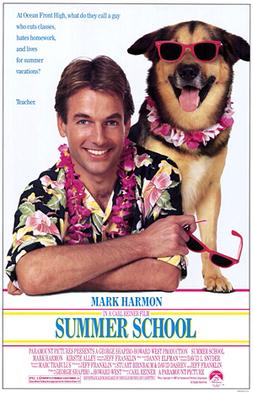
 I never went to summer school, and I genuinely enjoyed taking standardized tests. But I still feel an instant kinship for these kids and their world.
I was a high school student decades later, and I’ve only taught in a classroom on a very limited basis. And yet, these experiences made me recognize one of the continual ironies of public education.
Sometimes it feels like the place where learning goes to die, and if not learning, then at least curiosity and passion. Oftentimes, organized education takes all the fun out of learning, assigning letters and tests to each of us and thereby effectively replacing our genuine desire to know more with extrinsic, even mercenary motivation.
If you’re like me, someone genuinely impatient with wasted time, public school is one of the worst time sucks known to man. If you factor in the substitute teachers, passing periods, and busy work, there are very few equals. It’s no wonder kids get bored, and that’s not even factoring in other distractions or genuine learning disabilities. It’s a wonder anyone learns anything at all, and this is a testament to inspiring teachers (and a certain amount of self-dedication).
I initially had to do a double-take because I thought Rob Reiner was the director until I realized it was his father, Carl Reiner (who also has a delightful opening cameo). The movie’s screenplay was written by Jeff Franklin, who created Full House very soon after.
Although there are pretty exchange students, bikini gags, and a few throwaway moments that are regrettably 80s, for the most part, the fact that Summer School feels quintessentially of its time is the highest compliment, given the world and rank-and-file of Ocean Front High School.
The school itself feels instantly placeable from its sun-soaked vibes to the student body’s total devotion to summer and the sweet freedom it represents to every teenager since the dawn of time.
It might be a testament to what my cinematic diet has been of late, mostly dour and serious “cinema,” but sometimes you want something diverting like this; it delivers on its promise and doesn’t try to overshoot its ambitions as a teen comedy. And yet in delivering the goods, it does what many of its peers can’t always manage. It bends toward heart over crassness, making for a satisfying confection.
Mark Harmon is also such a charismatic lead. As a former UCLA football star, he falls easily into the role of a So-Cal P.E. teacher who has more use for waves to surf than a classroom. The premise works because there’s a sense that he used to be like some of his students. He’s more of a friend than a figure of authority. The latter role is taken on by the cartoonish ’80s villain par excellence, Vice Principal Gills.
Kirstie Alley is slotted in as the teacher overseeing the honors course next door. She watches Shoop with mild interest and then bemusement as she goes for the more intellectual romantic option in the vice principal, but we know who she’s meant to be with. Our hero does too. It’s only a matter of time.
In this way, perhaps it is a fantasy, fulfilling genre conventions, and yet as he’s stuck teaching an English course in Summer School to a room full of failures and misfits, there is a joyous, genuinely hilarious camaraderie that forms. It allows the movie to become something worthwhile above the level of typical drivel.
I’m completely sympathetic to their desire to break out of the monotony and drudgery of the classroom. At first, they take “field trips” to Knott’s Berry Farm bumper cars and petting zoos, although these plans are eventually curtailed, and they have to either get it together or throw in the towel for good.
Sure, there are complications. Mr. Shoop looks about ready to give up multiple times, even as his cordial advances toward Ms. Bishop are politely rebuffed. The movie develops a nice cadence not through the usual antagonism of a Breakfast Club, but a pact between teens and adults to get to the finish line together.
Their contract of sorts involves “wishes” from all of them, and Mr. Shoop agrees to help them along if it means they will at least try to study and not goof off. However, it becomes more than bargaining because they see a teacher who goes above and beyond, and they begin to form a community where they look out for one another and cheer for each other’s victories.
“Chainsaw” and Dave are two of the worst goof-offs and loafers, but in their deep, abiding love for Chainsaw Massacre and gore in general, we see a passion and expertise in costuming and makeup that’s extraordinary even as it does not fit into the neatly created parameters of vocab tests and SAT scores.
As I’ve gotten older, I’ve realized more and more of the flaws in education. And I loved school, but for some people, they have gifts and talents that will not be showcased in the classroom unless they are given the space to explore what truly interests them. These are the spaces where they can flourish.
This might seem too high-minded for a goofy comedy like this, but I think that’s part of why I was so taken with Summer School. These characters feel inherently decent, and we want to cheer for them as they bond.
There’s a teen pregnancy played for a laugh, and yet the girl has the baby — it’s never a question — even as she decides to give the child up for adoption since she doesn’t feel prepared. Another teen is smitten with her teacher, and it feels like a queasy scenario, yet she’s mature and realizes it is only a phase. Others have their own growth, whether it’s getting a driver’s license or improving their study habits.
What’s more, the message is not perfection or even the pipe dream that now everyone gets straight As and will go off to Harvard thanks to their teacher. The dream is of a different nature. All these kids and their parents gather in the principal’s office as the vice principal accuses Mr. Shoop, like Satan in a suit and tie.
Because the story it’s telling is not about doing all of this so you’ll get into a school of your dreams or get your heart’s content (though there is some wish fulfillment). Instead, it’s saying something more about what it means to truly invest in a community and pour into other people. Sometimes we think it will take everything out of us; we must simply look after our own interests. Except Mr. Shoop gives of himself, and everything else is added to him.
And sure, in his case, he gets a From Here to Eternity embrace with Kirstie Alley in the surf and doggy kisses to boot. But it just goes to show Summer School never forgets its identity while also never totally dumbing itself down to the least common denominator.
I feel like many people might be pleasantly surprised by what this movie has to offer, especially if they’re craving a trip back to the ’80s in all their glory. I never lived through the decade, but with a teacher like Mr. Shoop, I wish I had at least momentarily. Although that probably goes for any era, because teachers are such formative people in our adolescent lives.
3.5/5 Stars

