
 For the two years I lived in Japan, one of my immediate joys was discovering music that was new to me: It included the likes of Happy End and Mr. Children. And that’s before you broach the subject of City Pop. But about the same time, I was smitten by some of the tunes of Yumi Arai.
It wasn’t until recently that I learned two of her most famous classic tracks gained a second life in Kiki’s Delivery Service, and a third was used in The Wind Rises. For this, I must thank Studio Ghibli because the songs evoke instant nostalgia even if you’ve never heard them before. They pair so wonderfully with the opening and end credits, setting the mood with such a peppy rush of gleefulness as embodied by our titular heroine.
It’s always a consummate joy watching Hayao Miyazaki’s films for the very reason that they rarely follow the most well-traveled road. Closer still, his films pursue what we want in our heart of hearts. There’s a vigor of youth, an idealism, and space for big dreams and aspirations that reach high into the atmosphere.
What you come to admire about him as a maker of animated films is how magic is nothing to be skeptical about. In his stories, it feels integrated like a crucial part of everyday life. Something that he probably acknowledges when he’s walking around his neighborhood.
Who else would think about taking the story of a young witch coming of age and spin such a delightfully winsome yarn? In truth, he adapted Eiko Kadono’s 1985 novel, but there is a sense that Miyazaki has an outsized influence on where the story occupies itself.
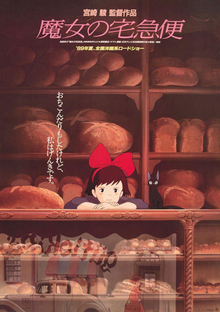
Kiki leaves her parents behind at the ripe young age of 13, armed with her broom and transistor radio, and her black cat companion Jiji, to find a new town to settle in. It could be such a lonely tale with the slant of Oliver Twist, and yet it’s rarely this kind of story.
She finds a place to stay in the attic of a bakery called Gutiokipanja, thanks to the maternal warmth of the proprietor, Osono, who becomes like a surrogate mother to Kiki. Her husband is hard-working and taciturn, proving himself to be covertly kind. They provide a framework of warmth to build the rest of the movie around.
We are still in Miyazaki’s early period. As best as I can describe it, the hand-drawn images look older, but the vintage quality is part of their charm, helping us venture back into a bygone era right alongside Arai’s pop songs. They fit well together.
And yet Miyazaki has made a career out of layering all these influences that have endured throughout his work. Joe Hisaishi’s scoring is the height of elegance, while the animation itself is replete with architecture, street corners, and automobiles, accentuating a European sensibility fractured through a romanticized Japanese lens. Regardless, it’s a beautiful, ever-magical world to be privy to.
With her lodging and provisions in place, Kiki sets out to make a life for herself using her talent for broomstick travel into a local delivery service. In the days before Lyft and Uber Eats, she feels cutting edge, delivering all sorts of things across the countryside.
Her first booking is a present for a young boy’s birthday, and the stuffed toy looks strikingly like Jiji. However, en route, she runs into a spot of bother, and so her faithful companion takes one of the team so Kiki can save face and try to recover the original.
This vignette introduces the family’s elderly dog, who languishes lazily by the hearth with nary a sound. In a Disney movie or Warner Bros. cartoon, he would be the obvious villain of the scenario, and yet Miyazaki, with his bewitching kinship toward animals, makes him into a wonderful ally. In fact, Kiki meets many such people across her journey.
Try as one might to manufacture conflict, most of these interactions feel refreshing and honest. Surely this is not how you make a movie traditionally, and still, by some alchemy, Miyazaki pulls it off. Kiki spends most of her time with a zest for life and in the service of others, with the trusty Jiji by her side.
Her biggest crisis comes near the end. It’s hardly a spoiler to say she loses her powers as well as her ability to talk with Jiji. Even here, she gains a ready-made mentor in Ursula, an independent artist who paints and lives in the nearby forest.
The final act evokes Miyazaki’s constant preoccupation with the skies, building off Kiki’s broom-riding, the young boy Tombo’s propeller bike, and finally, a giant zeppelin that evokes a bit of the Hindenburg. He gives the finale of his picture a slam-bang bit of spectacle as the aircraft loses control and Kiki must summon her talents to save her young crush. To say any more would rob the audience the pleasure of experiencing the culmination of the film for themselves.
Because eventually, the world does settle back into its rhythms and the prevailing good-nature that runs through the entire story. The only curious change is how, now that Jiji has a lady friend, even after Kiki’s triumph, she doesn’t seem able to speak with him. Perhaps it’s part of her coming-of-age journey. Giving up childish things in a sense, while never totally relinquishing her wonder.
One imagines this is how you grow up to be the ripe old age of someone like Miyazaki. Still being able to call on your imagination vividly, and believe in forces that seemingly break into the mundane moments of everyday life. In the waning moments, it’s apropos that Yumi Arai’s final song sends us off just as we began. Kiki’s Delivery Service goes from strength to strength, never allowing us to falter in having a good time.
4.5/5 Stars


I adore Kiki and Jiji, in fact my perennial paper diary features them. (Even though my favourite Ghibli films are Spirited Away and My Neighbor Totoro).
LikeLiked by 1 person