 Before the movie played, there was a short featurette following famed animator Hayao Miyazaki leading up to his Oscar win for Boy and The Heron in 2024. He sits with one of his fanciful drawings and mumbles something to the effect that it’s a pain going back to the real world.
You only say that if you have an extraordinary imagination. But like many of us, Miyazaki seems to yearn for a better if not a different world altogether. When he wins the award, the man’s nowhere to be found.
Because that’s not why he made his film. It was the process and the exhilaration of reaching back into his imagination and exploring a different world. In documentaries, the director always strikes me as a somewhat cagey if unassuming individual, but what a joy it is to be privy to his creations.
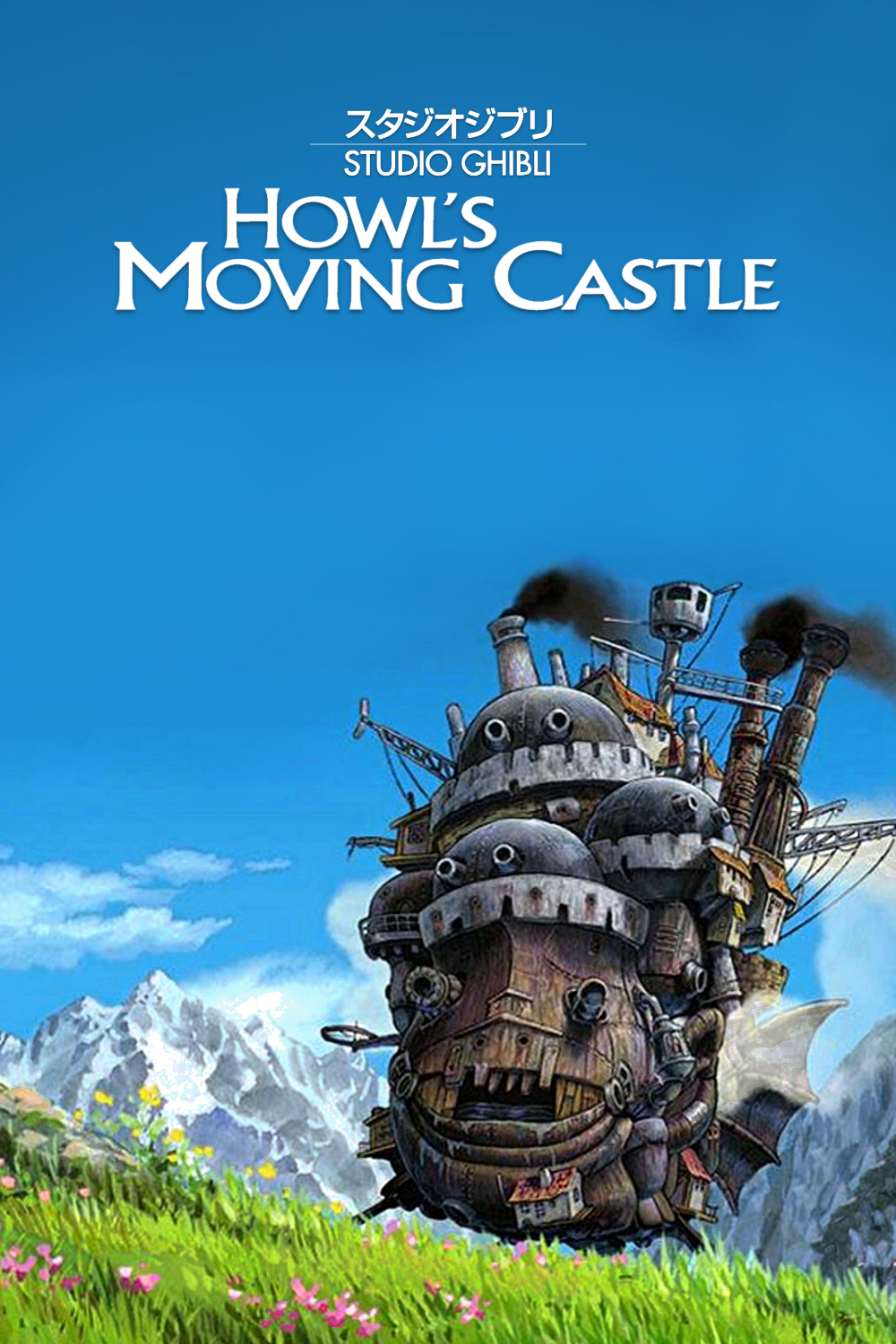
It’s little different with Howl’s Moving Castle, which now sees its 20th anniversary come to pass. It’s a striking opening image following this mechanical Baba Yaga-like castle (from Russian folklore), almost anthropomorphic in its movements. Howl’s abode is not only a visual marvel, but it is also the seat of this entire story.
The eponymous man is a charismatic wizard, benevolent if somewhat vain and periodically selfish. But he is not the film’s only hero. Its true core begins with Sophie, a young girl who works as a hat maker. She has the humble beginnings that fit right at home in a fairy tale, and true to convention, her fearlessness means she has a spell cast on her by the menacing Witch of the Waste.
Instantly, her youth is snatched away from her, and she’s stricken with the wrinkles and arthritic posture of old age. But Sophie is a driven, ever stalwart heroine, and she resolves to find a resolution for her fate. She must venture to Howl’s Castle in search of answers. Upon seeing how dank and grungy the wizard’s abode is, she hires herself on as a cleaning woman, determined to cultivate it.
Once again, I’m struck by how Miyazaki conjures up a world of the grotesque, from creepy crawlies to ghoulish, otherworldly adversaries, and dark forces. But the fairy tale almost demands these elements; they feel like a prerequisite because they give us a threshold for great beauty and even serenity in the lap of nature. One would not be as potent without the other.
Like some of the great adventure stories, Sophie and her newfound acquaintances form a disparate family unit reminiscent of The Wizard of Oz, Star Wars, or even Pixar’s UP.
There’s Markl, a precocious little boy with a bearded cloak who earnestly tries to hold down the fort while the master of the house is indisposed. Calcifer is the obstinate fire demon who begrudgingly powers Howl’s mobile fortress even as he dreams of being freed from his fate. Later additions include a scarecrow christened “Turnip Head” by Sophie, and then a sad-eyed, wheezing canine Heen and, eventually, a wilting Grandma.
In a subsequent scene, Markl looks up to his surrogate maternal figure and asks her if they are family, and she quietly affirms him with added conviction. What he asks is right and good. Not only that, it is true. They look after one another.
Joe Hisaishi’s score, including the jaunty waltz-inflected “Merry Go Round Life,” augments the entire panoply of Miyazaki’s world as the composer always seems to do. In this case, it’s an added European flavor to go with the opulent architecture. I could not help thinking of the French phrase, “La Ronde.” It no doubt has many meanings, but it suggests to me that stories, like life, often come full circle. We’re all interconnected.
In another sense, I was struck by the way Howl seems timeless, even as a film that turned 20 years old in 2024. It stands outside of that moment to mean something more to us that’s universal.
The story is gripped in the throes of war and the destructive chaos it engenders. It’s difficult not to see the film living in the literal shadow of The Bomb, as many Japanese films have post-WWII. Because while Howl is not about a literal time and place, that’s not to say history cannot bleed into the storyline. Especially because Miyazaki is a personal filmmaker laying himself bare and sharing his thoughts and emotions through his creative offerings.
The glory of a Miyazaki movie is how deep his imagination takes him as he pushes to the limits in the most glorious of ways. I come out of his most epic films overwhelmed. If you asked me to give a rundown of plot points, I could not without feeling discombobulated, because watching his films is not about plot points but an overarching experience. It’s so easy to remember crystallized interactions, character moments, and these grand, almost innate themes.
In the deepest sense, perhaps Howl’s Moving Castle is a love story. Transcendent, yes, but also a tale about opening up your heart. I’ve often heard the words in a spiritual context, but it fits here too: I will give you a new heart and put a new spirit in you; I will remove from you your heart of stone and give you a heart of flesh. The metaphor is clear.
It feels as if Howl is transformed and regains a heart and a desire for love he never had before. As the Narnia author C.S. Lewis wrote, “To love at all is to be vulnerable. Love anything and your heart will be wrung and possibly broken.”
Howl is injured, and our heroes are taken to the brink of death on multiple occasions, and yet the risk seems worth it. Because there is hope and then elation before the final curtain when those who are meant to be together are reunited.
Of course, this is all a world Miyazaki has conceived with the aid of Diana Wynne Jones’s novel, but just as his real life seems to bleed into the fantasy, I feel like we would like to believe that the fairy tale permeates the real world, too. Love, sacrifice, beauty, camaraderie, these are profound things to strive for in life. They can hardly put us to shame.
They give meaning in ways worldly accolades like an Oscar could never satiate. Miyazaki seems to know deep within his bones that this is true. Look no further than his films for proof.
4/5 Stars
Note: This review was originally written in 2024 around the 20th anniversary of Howl’s Moving Castle.

