
“Nobody knows if a person’s good or bad except the person themselves, and they won’t tell.”
Pre-Code has garnered a salacious reputation for the titillating nature of its content and themes, which all but fly in the face of what contemporary society perceives to be Classical Hollywood morality as imposed by Joseph Breen and his minions.
Frank Borzage is a director who was held in high regard throughout the ’20s and ’30s as a popular success and a maker of star-crossed, transcendent romances. For whatever reason, he is very rarely canonized as a great filmmaker. That’s a conversation for another day, but given his penchant for heartfelt romance, there’s an initial inclination to see his sensibilities fitting like oil and water with the uninhibited 1930s.
However, this proves far from the truth. Bad Girl is hardly neutered. It’s drenched in this newfound freedom of the 1930s. The opening shot is a bit of ironic trickery as we watch a wedding procession unfold. This is traditional matrimony playing out in front of us until we realize we’re actually in the middle of a high-end establishment, and these women march forward (without Spencer Tracy’s father of the bride to be seen) for the clientele looking on. Everything falls into place.
Girls dress in scanty clothes to pick up men right off the modeling floor. The men try their best lines only to be rebuffed with a foolproof excuse. The girls are streetwise enough to judge their intentions. Always ready and willing to shoot down a pickup line that’s getting too fresh. Still, relations between men and women are stripped down to their bare essentials with an almost primordial sense of mating and love.
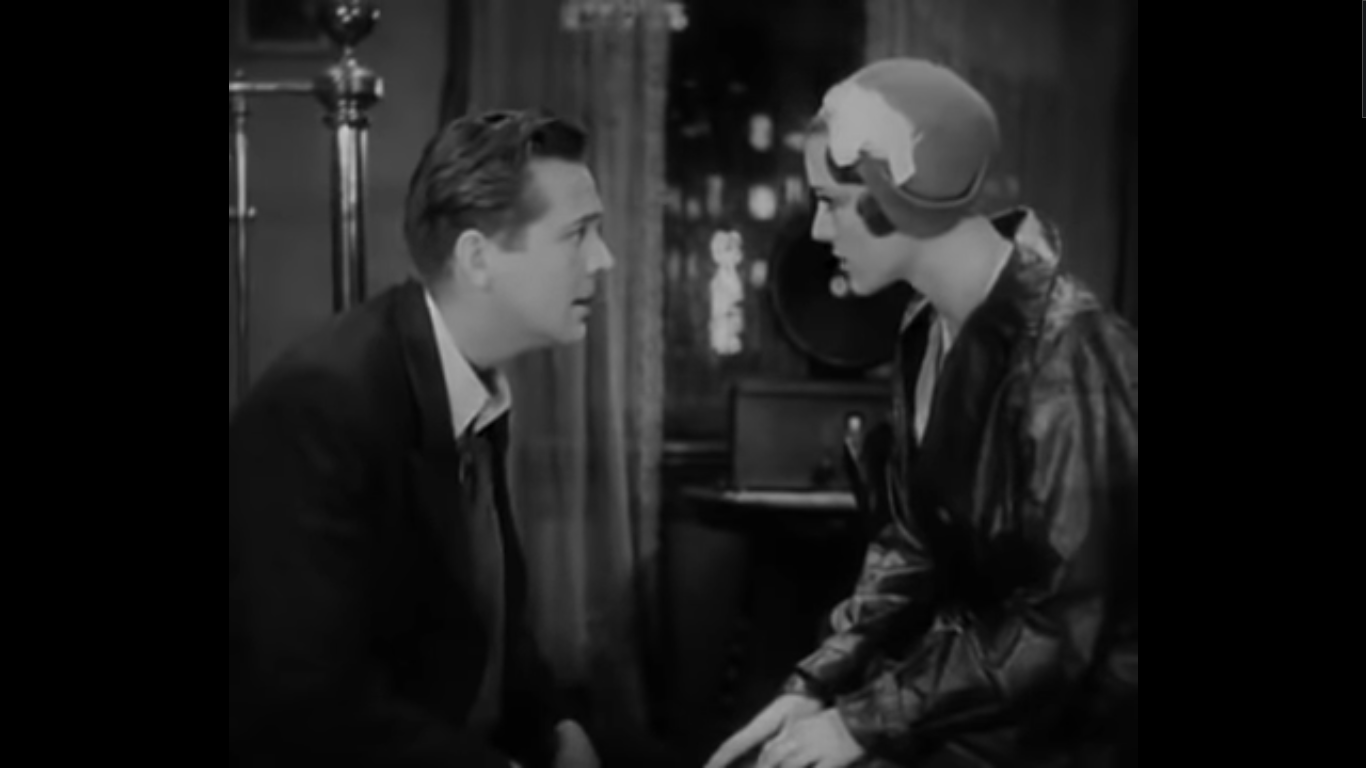
Dorothy (Sally Eilers) and Eddie Collins (James Dunn) fit into this testy Depression-era ecosystem. In fact, she’s aghast when she learns there’s a man who won’t give her girlfriend the time of day. Everything she’s learned about men tells her this can’t be true, and so she takes a friendly bet from her pal Edna (Minna Gobell) that says she can’t get a sourpuss on deck to flirt.
She turns on the charm and whips out her ukulele only to meet with a hard-edged cynic (“Listen, sister, if you don’t want a guy to salute you, take down your flag.”). But pretty soon, it becomes apparent that Eddie’s caustic sarcasm and prevailing meanness are a kind of defense mechanism.
Somehow, it’s this very friction leading to sparks, and some kind of mutual inertia develops between them. Here, already, we have entered the solar system of Borzage, as he draws his two improbable lovers together into the throes of romance. Eddie sees her home one evening to her tenement and subsequently leaves her out in the rain, missing their next date because he’s too preoccupied with his work at a radio shop. Dorothy gives him a mouthful. It stings.
The beauty of their courtship is how the acerbic nature is never fully lost, but they shed some of their claws and fangs in isolated moments, only to be vulnerable with one another. Her demonstrative brother all but disowns her for being a harlot. Eddie proposes marriage, effectively making a fight out of popping the question as he does with everything in his life. That’s just his way as he fumbles clumsily at earnestness.
While I wouldn’t necessarily recommend such a belligerent and bickering foundation for marriage, it lends the movie its get-up-and-go as they look to carve out a humble life together. Because even if we don’t want them to fail, there’s a sense that such a tenuous foundation surely will not last. So many Hollywood melodramas have been cast this way to a maudlin effect.
There’s further drama in their young marital life with a baby on the way and Eddie trying to ensure they have ample money and shelter to make ends meet. Even as their context evolves, the prevailing mood is all Borzage. Love conquers all yet again. It’s spectacular and sprinkled with bits of goodness and human decency.
I’m reminded of fathers of various temperaments pacing the floors of the hospital waiting room. Eddie spends nights out boxing to make extra dough, and not knowing where he’s going makes her teary-eyed. His wife feels abandoned on the eve of her due date. Meanwhile, he’s taking a beating, and in the clinch, he confesses to his rival in the ring that he needs to make it a few rounds more. The other man obliges by helping to prop him up.
This is not the obvious reaction in an arena of brutality, nor in a Pre-Code film. But again, it gets its fire from other places and surreptitiously sheds its spikes in the most propitious moments. They somehow ambush you and maintain this paradox of cynical reality with a heart of gold. Obviously, the title Bad Girl is sensationalized because it’s the height of irony in the hands of Borzage. He takes what looks slightly risque on the outside and imbues it with such a wealth of sensitive affection.
He was a filmmaker made in the silent era, and yet he proves himself to be evergreen because Bad Girl could not be anything other than a talkie. It’s a film about communication, even the lack thereof. Because that still counts. People like to talk. Gleeful. Angry. Belligerent. Soppy. And by the end, they’ve fired shots, professed love, shared hopes and dreams, and fallen more in love.
I’m still incredulous that Dorothy and Eddie are together at the end of the picture, but I am willing to accede to their conventional Hollywood ending because all roads seem to lead somewhere else. Given the circumstances, it feels like a greater narrative statement to keep them together. Is it unbelievable? Perhaps, but then again, love is an unbelievable force.
4/5 Stars
 4 Star Films