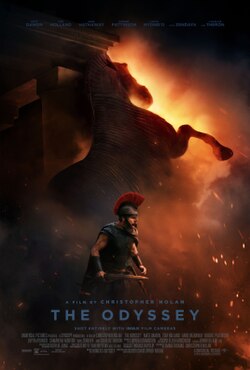
 Like many, I read the Odyssey as part of my high school education, but what remains are bits and pieces of iconography passed down through popular culture as much as the text itself. To state the obvious, Christopher Nolan’s latest film is an adaptation, and it makes creative choices that a myriad of voices have said yay or nay to for any number of reasons. But choices are necessary for any adaptation, or else it wouldn’t be worth making in the first place.
It took me some minutes to grow accustomed to the story and settle myself. Nolan lays the groundwork of a wife and mother, Penelope (Anne Hathaway), waiting for her husband’s triumphant return from the Trojan Wars. It’s been years, and she still hasn’t given up hope, even as a host of suitors, led by the duplicitous snake Antinous (Robert Pattinson), squat in her dining hall. They have designs on winning her hand in marriage once she acquiesces. To them, her husband is as good as dead, and her son (Tom Holland) is barely a threat to their ambitions. Meanwhile, the master’s most faithful servant is a blind herdsman named Eumaeus (John Leguizamo).
The movie trades in colloquialisms and a moral parlance of Zeus’s law, a simplified expression for what the Greeks would call xenia. In Judeo-Christian teaching, this might be analogous to the exhortation in Hebrews not to forget to show hospitality to strangers, because some have welcomed angels unawares. In the Greek empire of Nolan, there’s a decidedly treacherous bent to it; one must maintain honor at all costs and not give your enemy a reason to undermine you…
It truly hits its stride when Nolan’s penchant for visual ingenuity and grand spectacle is allowed to take over. We have enough exposition to be sent off on an epic adventure as Odysseus (Matt Damon) makes his journey home through fragments of flashback recounted to a surprisingly affable Calypso (Charlize Theron).
The director takes a setpiece most of us are familiar with and grounds it not simply in myth but in a reality we can understand. The horse is buried in the sand as a discarded offering, the men inside betting their lives on their foes letting their guard down. It’s a tense bit of dramatic irony as they slink down into the bowels of Troy, woozy-legged but fit enough to free their compatriots and subdue the frantic enemy at nightfall.
Another indelible image injecting the movie with visual adrenaline centers on the cyclops, a lumbering creature who is both terrifying and oddly sympathetic. A beast injured by these marauders who wander into his home. What makes these moments satisfying is not simply because they involve action; the action defines the attributes of this character and the world around him. It also becomes evident each scenario represents a perversion of the attributes at the center of the movie’s moral framework.
Nolan does his best to make deified gods and supernatural powers into phenomena moderns can understand. However, there are still monsters, an island of malevolent giants, and the enchantress Circe (Samantha Morton in arguably the most unnerving performance in the film). They take our breath away while reminding us of the durable bravery and continual hubris which are two sides of Homer’s protagonist.
Likewise, a detour to the pits of Hades and the underworld has a sense of enchantment we cannot hope to fully comprehend as mere mortals. James Remar is unidentifiable as Tiresias, a soothsayer spitting omens about their fate. The Sirens, Charybdis, and Scylla are present but feel like less of a focal point because, as entities, they no longer feel anthropomorphized in the same way.
But the serpentine scope of the journey must lead to only one place. Eventually Odysseus appears as a hooded beggar to his faithful servant, who never wavered. Then he appears to his son, who failed to find him, and finally Penelope, who struggled so mightily in his absence. Anne Hathaway plays the double edge of strength and grief with a moving aplomb. There is a magnitude and a cost to the choices a world away. They actually mean something with reverberations through time.
The archetype of the returning protagonist offers us the promise of narrative fulfillment. This is the return of the king, the arrival of Robin Hood, Luke Skywalker, or any hero you want humbling themselves and putting on the garments of the lowest to enter the mouth of the lion for a final stand. Catching their antagonist unawares.
We yearn for him to come in and bring justice — to show himself and take back what is rightfully his. Penelope puts herself on the line, offering her hand to any man who can complete her husband’s feat. And of course only one man can master it: Stringing his bow and shooting the arrow pure and true through a line of axes.
It’s an annunciation to go with the music struck with his bowstring, courtesy of Ludwig Goransson. One clear, bold note, but it’s the kind of rousing return the movie has been calling for, and the hard yards pay off as they lock down the weapons in the armory, and the father and husband looks to avenge what is rightfully his.
Perhaps it took the years away and the wisdom gained from his own transgressions to recognize what he must do. It’s true the movie offers a recognition of a breach of Zeus’s law but also atonement — giving up what is most painful and bearing the greatest sacrifice. Odysseus burned the city of Troy and desecrated the altar of Athena. There must be penance. He welcomes self-exile, vowing to ride the high seas with his reunited bride to honor his fallen men while leaving the throne to his rightful unblemished heir.
It’s no revelation, but Nolan has followed up one man who would be a god thanks to the atomic bomb with another who seemingly courted the gods, even if he did not always orient his life around their powers. There’s also a residual cost to war and a complicated relationship with decisions that cannot be retracted.
The sheer scope and scale never ceases to amaze. Nolan’s continued prerogative involves always pushing the cast and himself in the execution of these gargantuan stories. It’s the on-location environs, and the blending of technological expertise with an appreciation for practical effects. Giant IMAX cameras juxtaposed with intimate castle tete-a-tetes.
One does wonder if there will continue to be diminishing returns and where else the man can go in an attempt at larger scale and greater ambitions. Will the man who gave us Memento or The Prestige ever be content making a movie of that size that nevertheless pushes the medium in terms of narrative or performance?
I hope so because Nolan still brings people out to the cinema, and he maintains a faithful following who have come to appreciate his tentpole movies with a touch of the cerebral. He can stretch himself in other ways, and many of us will look on with anticipation.
For our sakes, I’m thankful he’s making films, whether or not he believes in the gods. Some might observe a chasm between deifying gods and defying them. However, within this universe, perhaps it’s only a matter of perception.
It strikes me how one offers a standard outside ourselves, and the other is so often made in our own image. That hasn’t changed much in a couple thousand years, even as our cultures have. It also fundamentally impacts what it looks like to love our neighbor, thereby treating them as we desire to be treated.
4/5 Stars

