Crossfire (1947)

crossfire 1.png

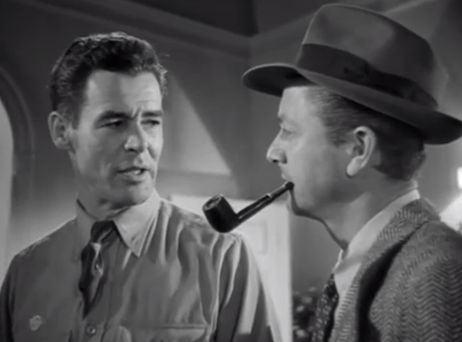
Like any self-respecting film noir, it opens with men whaling on each other amid stylized darkness. Edward Dmytryk’s Crossfire is an issue-driven picture and it’s an important one given the cultural moment in which it came into being. There’s no doubting that.

But though the imagery is spot on and we have numerous noir regulars, it doesn’t feel like a noir film in the semi-conventional sense. Maybe it’s because the issue it was looking to root out takes precedence over any of its more formalistic qualities and that’s perfectly fine.

From a practical standpoint, Dymytrk opted to shoot the film with low key lighting as it’s a cheaper set-up and also a lot quicker which allowed the picture to be churned out in a mere 20 days. However, it’s still quite befuddling how a film this short can still somehow be incomprehensible at times.

Like any good procedural it whips out a long list of characters introduced in every sequence who either have significant amounts of screentime or show up for a few moments and still manage to play a crucial part in this obscured piece of drama.

Realistically, Crossfire can be touted as the film of the three Roberts: Young, Ryan, and Mitchum. Robert Young will always be heralded as a television father much like Hugh Beaumont and so while I can never take him quite seriously in such a role as a police investigator, he certainly doesn’t do a poor job as Captain Finlay.

Paradoxically, Robert Ryan is one of those actors who is probably grossly underrated and yet as far as personal taste goes I’ve never liked him much (Though my esteem steadily rises). Maybe that simply pertains to the kind of characters he often played such as the belligerent Montgomery in this film. They are not meant to be affable and he does a wonderful job of eliciting a scornful reaction.

Likewise, Robert Mitchum has arguably the least important role of the three, but he still has that laconic magnetism that wins us over, portraying one of the other soldiers caught up in this whole big mess. Sgt. Peter Keeley is a bit of a tough guy but also ready to watch the back of his brothers in arms. He’s our counterpoint to Robert Ryan.

The minor players list out like so. The victim of it all was a man named Samuels (Sam Levene) who crossed paths with the demobilized soldiers in a bar and seemed nice enough. He even struck up a conversation with a homesick G.I. named Mitch (George Cooper) who Keeley guesses might be a prime suspect for murder.

Jacqueline White is the wanted Corporal’s concerned spouse while Gloria Grahame plays a characteristic noir dame who might prove to be an invaluable witness on his behalf, if only she’ll cooperate.

This is yet another link in the chain of post-war crime pictures where soldiers were returning home only to meet a new kind of disillusionment (ie. The Blue Dahlia or Act of Violence). A certain bar scene played over from multiple perspectives proves to be a pivotal moment, but it’s full of fuzzy recollections and screwy bits of information. No one seems quite sure what happened and the film banks on this ambiguity.

However, it’s about time to cease skirting around the obvious and say outright what the film is an indictment of. It’s anti-Semitism. “Jew-boy” is the trigger word. Though the film requires some reading between the lines, thanks to the production codes, there’s no context needed to understand what that means. It’s instantly apparent bigotry is rearing its ugly head.

As such, Crossfire shares a similar conviction with the year’s other famed issue-driven picture The Gentleman’s Agreement (1947) and it brings to mind the wartime short film headlined by Frank Sinatra, The House I Live In (1945).

But, of course, when you begin to analyze one group of people there always seem to be others still being marginalized whether Japanese-American, African-American, Mexican-American. You name it. And that’s part of what makes such a portrait fascinating. To see to what extent the lines of inclusion will be drawn up.

Though it’s evident that he’s preaching, there are still some steadfast truths coming from Robert Young as he tries to convince a soldier (William Phipps), still wet behind the ears, what he must do for the sake of his conscience. There’s a need to stand up to the bigots because hate is always the same. They hated the Irish and the Italians before just like they will continue to hate some other people group in years to come.

Even if the history gets pushed to the fringes and it doesn’t get taught in school, that doesn’t make it any less of the truth or any less of our history. It’s possible to contend that we are made stronger, not weaker when our troubled history and past indiscretions are fully acknowledged. Only then can we learn, heal the wounds, and pursue a better future together.

So Murder, My Sweet (1944) is still a superior film noir from Edward Dmytryk and probably a great deal more fun, but there’s no denying the message that’s at work behind Crossfire.

3.5/5 Stars
Detective Story (1951)

detective story 1

“Who are you, God? Didn’t you ever make a mistake?” – Cathy O’Donnell as Susan Carmichael

Counselor at Law (1933) was an early William Wyler film from the 1930s that shares some cursory similarities with this feature. Along those lines, Detective Story proves to be an exploration into the life of a cop much as the earlier film allowed us to look through the keyhole at the life of a lawyer (John Barrymore). Fundamentally they also both provide the same cross-section of society with Wyler navigating the space in such a way to tie the threads together while keeping things engaging.

Detective Story proves to be a stage play and a morality play in one fell swoop and that is decidedly both good and bad. It’s true that the crossroads of so many films and talents meet here and all share a room together.

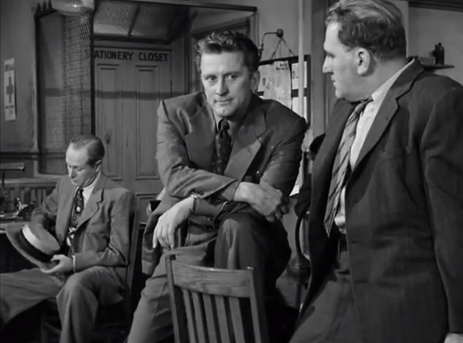
There’s another fiery role for “Mr. Instensity” himself Kirk Douglas as Jim McLeod, a man who strives to rid the streets of criminals and put them where they belong: The electric chair. He wants to be judge, jury, and executioner if at all possible. His all-out war on crime can be traced back to his lousy father. Ever since those days, he’s vowed to be everything his old man never was — not tolerating any kind of infraction of the law. It’s a thoroughly intense portrayal though it jumps off the emotional deep end a few times too often.

It’s his supporting cast that steadies him and guides the film toward something more authentic and attainable. William Bendix was potentially slated for a reunion with Alan Ladd before Douglas ultimately took the role. However, he trades out his image as a heavy for a policeman with a decent dose of humanity.

Frank Faylen is the acting desk clerk who fields all the incoming calls that come his way. Meanwhile, Lee Grant is a skittish young purse snatcher who winds up at headquarters for her first offense. Cathy O’Donnell (wife of screenwriter Robert Wyler) plays her always immediately likable ingenue role as the young woman trying to bail out her childhood friend on a charge of theft.

There are a number of others including journeymen cops, journalists, and four-time losers and then there’s McLeod’s wife Mary (Eleanor Parker). I’m not sure what to evaluate Eleanor Parker on but in the recent months, I have gained an appreciation for the fact that, good or bad, she will fearlessly commit to a role and pour her all into it. She owns a very eclectic body of work as well but Detective Story sees her succumbing to histrionics much like her onscreen husband.

Because at its best Detective Story is a slice-of-life drama that gives us insight into humanity much as Counselor at Law (1933) did. But this picture is high on the dramatics and whether or not they are completely believable is up for contention.

It’s also a fairly frank picture at that — at least for its day — though it does point out the duplicity that’s so blatantly clear.  Here a taboo is utilized as the fodder for melodrama as something so despicable. Yet in the heart of Hollywood itself, there were undoubtedly many women who did similar covering up jobs to save their reputations.

The Hays Code could try and keep taboos under raps but in doing so they were ignoring an unfortunate reality. It is necessary to remove the shrouds and let these things live on in the light.

But far from seeing this film with our enlightened postmodern sensibilities and condemning it for making such a frank subject seem sullied and unseemly, I would contend that this picture leaves me melancholy. Not for the reasons you might expect either.

I feel sorry for women ostracized and labeled as “tramps” like Mary is. I’m ashamed that there is a standard that everything must be good and pure. There is no room for grace. It’s this hypocritical nature that’s blatantly obvious in McLeod with the bitter irony coming to fruition. He became the very person that he was striving never to become.

The depressing depths of the drama suffocate any chance of a laugh by the film’s latter half and so while I’m all for fatalistic even tragic denouements in the right context, this film is so utterly discouraging and it has nothing to do with desiring a happy ending. It’s more closely related to the lens in which the film seems to use. There’s no integrity left in humanity. A world where beating hearts of flesh have been transformed into hearts of stone. That’s a very dark world to try and reconcile with.

Worst yet it does try by heaping on more drama and last minutes heroics to right all the wrongs in a matter of seconds. So we lose on two accounts. The picture doesn’t have the guts enough to dig into its disconsolate inclinations and still for almost its entire runtime it’s focused on those precise conflicts making it supremely difficult to enjoy Detective Story as much as we could have.

3.5/5 Stars

The Enforcer (1951)

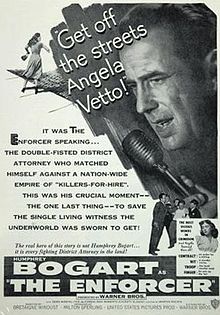
220px-The_Enforcer_1951.JPGNot that this should deter you completely but The Enforcer isn’t a particularly unique crime film by any stretch of the imagination. Still, we have Humphrey Bogart headlining the police procedural not unlike a Call Northside 777 (1948), The Naked City (1948), or Panic in the Streets (1950).
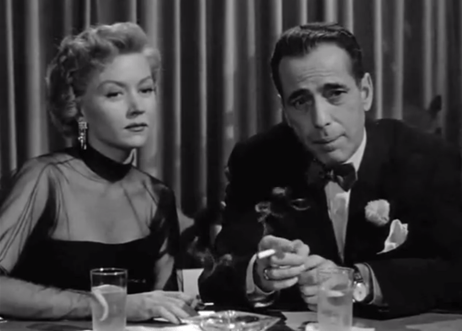
He’s the acting district attorney entrenched in the war against syndicated crime in the city. And the case he has topples like a house of cards when his one key witness is terminated. All the efforts behind four long years of tireless legwork go out the window.

They knew that it was an expansive operation with a multitude of contracts, a laundry list of hit men, and an undertaker on the payroll. They subsequently unearthed abandoned cars, drained marshes for the dead bodies, and questioned countless others who were purported to be involved. And yet it all seemed all for naught. No one knew enough or else they weren’t talking.

But Martin Ferguson (Bogart) is not about to let his case against the wanted crime boss Albert Mendoza (Everett Sloane) crumble that easily. There’s got to be another way to nab him. The script from Martin Rackin spends the majority of the time filling in all the details. In fact, he probably spends too much time before finally tacking on Bogart`s last-minute hunch almost as if it were an afterthought.

Ultimately, The Enforcer could almost be called a Raoul Walsh picture as the veteran director and friend of Humphrey Bogart took over the project when the incumbent Bretaigne Windust was taken seriously ill early in production.

No disrespect to Mr. Windust at all but the film got a leg up thanks to Raoul Walsh who directed many of the film’s more volatile sequences, capturing the action with bullets flying and fists flailing — brought to us with his usual dynamism. That counteracts some of the faulty storytelling that bogs the plot down.

The narrative structure is strikingly similar to aspects of The Killers (1946) but it’s hardly executed in the same gripping fashion. In fact, the layering of the flashbacks is hardly ideal even if it feels canonically very typical of what we often term noir. By the film’s end, whether or not the story gets told feels beside the point but nevertheless, Walsh manages to provide us with a decently tense climax that satiates some of our clamorings for a quality ending.

The film’s better assets are a few of the supporting cast members that help to add color to the procedural. We are treated to the typical menagerie of seedy characters including Ted de Corsia, Jack Lambert, and Zero Mostel. But the kingpin of them all is Everett Sloane. I can’t decide if it’s simply an uncharacteristic role for the actor or simply a poor bit of casting for the role of the boss of Murder Inc. But no matter, it is what it is.

There are also no femme fatales and very few female characters to speak of at all. For one moment, a woman is important: one Angela Vetto. Otherwise, it’s pretty bleak going. Even Bogart is not particularly interesting per se but he is still Bogart, making his scenes worth watching at the very least because he’s more than believable in any incarnation as a tough guy.

3/5 Stars

Review: In a Lonely Place (1950)

in a lonely place 1.png

Director Nicholas Ray customarily takes his material and subverts our expectations or better yet deconstructs the conventions that we often take for granted. But this is also matched with his penchant for showing a very raw and honest percolation of emotion. It causes every one of his movies to leave a perceptible toll on the audience because it’s difficult to have any other response. In a Lonely Place is another textbook example.

Here is a film with a murder plot which would normally be of primary concern. Instead, it ends up falling by the wayside to become nearly unimportant. It sounds almost callous to make such a claim since a life is at stake but then there is a bit of a detached quality permeating the picture.

A brooding Humphrey Bogart is at his most explosive as screenwriter Dixon Steele, a man with some talent, but a very odd way of exercising it. He’s an exasperating case for many in the industry, including his agent. Art Smith provides a wonderfully vivid performance as the agent nursing his ulcers while still faithfully standing by his client despite the turbulent nature of his temper. (Coincidentally Smith was featured in the earlier Dorothy B. Hughes adaptation Ride the Pink Horse).

It’s true “Dix” can be a tough man to figure out. Bogart may have played more appreciated, more iconic characters but there’s something especially raw about him here.

On top of Bogart’s performance, this is Nicholas Ray’s own examination of the Hollywood industry’s mechanisms, spitting out has-beens and flops as much as fame and fortune. There’s the continuous inner conflict between making a smash — the kind of trashy stuff that sells — and then trying to create something of worth on the spectrum of art.

If we had to draw up thematically similar films, All About Eve is a more flamboyant choice and Sunset Blvd. boasts the cynical edge but In a Lonely Place probably deserves to keep the same company with these noted classics from 1950 as a film of truly morose sentiments. It’s not simply cutting through the artifice of Hollywood. It’s trying to provide a deeper study of the people who are cogs of the industry.

After a precocious hat check girl (Martha Stewart) is found murdered it sets off an investigation by the police force. As Steele had requested the girl come over to his home to give him the plot summary of the low brow novel he is meant to adapt, just hours before her demise, he is placed on the top of the lists of suspects.

Conveniently, his neighbor across the courtyard, a bit part actress (Gloria Grahame at her most aloof and restrained), who he hardly knows, is brought in and vouches she saw him and it’s not a lie. He really was at home and he did not commit the crime.

If we wanted to, we could leave the story right there but that’s not all the film is working away at. It unravels in other ways too. In another world, this almost voyeuristic setting could have been made for Rear Window (1954) but this is not that film either.

Frank Lovejoy is the average cop with a thoughtful wife (Ms. Jeff Donnell) — a genuinely nice guy who knows “Dix” from back in their war days. He takes orders but he also has an inherent confidence in Steele as a human being. At any rate, he wouldn’t be prone to killing girls and so Brub helps to humanize this man in the eyes of the audience.

And yet there are still some troubling caveats on Dixon Steele. He owns a history of violent outbreaks but it goes beyond this. There’s a raging darkness that is part of his makeup as a character. He is tortured by hatred and by his own accompanying desolation. We can chalk it up to a number of things. His own personality. His lack of consistency. The often cruel industry that became his livelihood. It could be any number of these things or all of them.

In fact, for a film noir, the outcomes prove to be unique. It has murder but we never see it. There’s an actress who played countless femme fatales playing a slightly different iteration here. Even Bogart, though carrying a simmering temper that goes off on several occasions, is generally not a hardboiled heavy. Just a tormented screenwriter with demons to exorcize.

Beating up a college kid doesn’t go with the glorified and gritty brutality that might crop up in a Maltese Falcon (1941) or The Big Sleep (1946). It’s just callous barbarity in the normal world. Throwing phones or beating up friends in public is not normal behavior. There’s no other conventional excuse for it.

But this is Dixon Steele for you. He’s just a troubled man. Not an archetypal noir antihero. As much as we fear for the people in his stead, there’s also a mild pity reserved for him. He shows himself capable of love. He simply proves to be very ill-equipped for the endeavor.

The layers go deeper still and more personal as Gloria Grahame’s marriage with director Nicholas Ray was splintering and was finally absolved quietly during filming.

Beyond that, you get the sense, Bogart who financed the picture is playing someone, not unlike himself. Perhaps it’s the closest he ever got. Like the film, he found love in a woman, Lauren Bacall, many years his junior who nevertheless made him very happy. Sure Bogey was a success but it took him a long time to get to the top of the summit. He was a hard-drinker with a notoriously white-hot temper to match. Still, he was a romantic and an idealist in such a way we sympathize with. He’s ardently beloved today as he was in his heyday.

The contents of the story take on an entirely new spectrum of meaning with this personal context. In a Lonely Place wasn’t just an examination of Hollywood and the lives of people who could be real. In a Lonely Place feels far more transparent. It is Hollywood and these are the very people who find themselves caught up in its disillusioning grip.

Loneliness is there’s to have and to hold. They don’t need the prototypical genre conventions of graft and crime — the brand we conveniently label as film noir. There’s really little need for the more darkly cinematic overtones. They have themselves. That’s dismal enough already.

4.5/5 Stars

“I was born when she kissed me. I died when she left me. I lived a few weeks while she loved me.”