Only Angels Have Wings (1939): Hawks’ Greatest Adventure Movie

only angels have wings 1.png

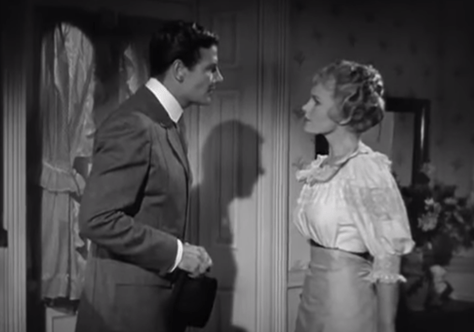
Howard Hawks always had a knack for creating worlds and subsequently building camaraderie between his characters simply by stringing scenes together one after the other. Only Angels Have Wings sets up a premise — revolving around a South American outpost — then settles in on two flyers.  But for all intent and purposes, Joe Souther (Noah Berry Jr.) and Tex Gordon (Don Barry) exist in the periphery of the story.

Despite all this, we’re instantly interested in what they have to do in this world and they’ve got their eyes on a woman (Jean Arthur) exiting a recently landed ship, only to strike up an instant connection as they’re a trio of Americans. A sequence that almost feels ominous initially does a rapid about-face to settle into something a great deal more amiable.

In truth, the introduction of a female heroine fresh off the boat in a foreign land hearkens back to Miriam Hopkins in Barbary Coast. She too was a tough character who was capable of surviving in a rough and tumble boomtown out west. Jean Arthur does much the same in Barranca. Except the difference is Arthur seems adept at showing her flaws with that quirky comic edge of hers.

The other added benefit is Howard Hawks seems about as invested in this picture as he could be due to his own intense preoccupation with big birds in the sky. His surname never seemed apter. The flight sequences follow in the path of Test Pilot exuding a certain authenticity while the narrative itself is unparalleled thanks, in part, to the entire framework built around it. The fascinating assemblage of characters is a testament to the best of what old Hollywood has to offer.

In 20 minutes he’s already enveloped you in an entire cinematic reality full of people, atmosphere, stakes, and danger. The genial owner Dutch (Sig Ruman) is slowly going broke trying to keep the establishment afloat. His last chance is to come through on a 6-month contract of mail deliveries without a failed drop.

Everything he has is riding on it but he’s a man who cares about people and their lives. It’s not merely a business endeavor. It’s about relationship and that’s why everyone likes the man. Even with this kind of impetus, it remains a harrowing life or death operation that Hawks documents with immense clarity.

Lives are still lost because flyers are foolhardy, proud, and daredevil types and yet when you put them up in a plane fighting against the elements and geography, they don’t always come out on top. Modern man and especially the modern aviator of 1939 is far from infallible.

But it’s one of the most gripping flight films buttressed by Hawk’s capacity for lulls and interludes which layer on character to the plotline. It’s imbued with the same spellbinding aura of a Casablanca or To Have or Have Not. There’s a certain ambiance pervading those classics of old and ironically, the moments that give us impressions of the world and the people walking around in them are the ones I’m most likely to imbibe. They speak in basic, visceral terms about men and women and how we cope with one another. How we emote: laugh, cry, get angry, and bury our emotions to avoid getting hurt.

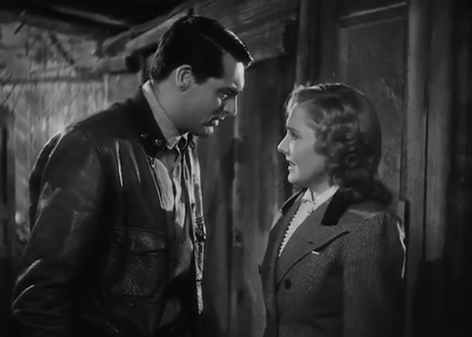
Cary Grant is hard and fierce as ace flyer Geoff Carter who runs the airmail service for Dutch, willingly deferring to him in all matters due to Geoff’s history and expertise. We get the impression our protagonist is embittered by the years of such a tough vocation. His personality at times proves as severe as the brim of his hat.

When I watch Only Angels Have Wings I remember where Devlin came from in Notorious (1946). Because Grant reveals a side of his persona like a double-sided coin. There’s something different hidden under each side and he’s a tortured soul struggling to reconcile the life he leads with feelings he is so inept in expressing. Because the danger of any type of human attachment is that the same person could just as easily be taken out of your life a moment later. Far from despising him for his callous attitudes, it makes him all the more intriguing as a human being. Because every other character brings something out of him.
only angels have wings 3.png

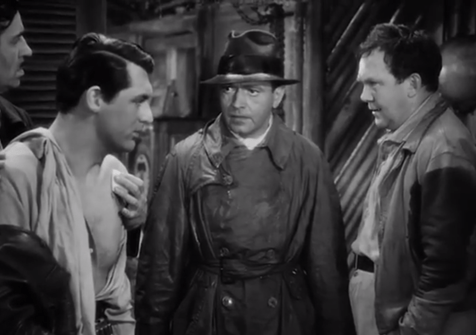
Though his career had all but tanked after immense successes with D.W. Griffith in the silent era, Richard Barthelmess has a crucial role as a recently arrived flyer who has an ignominious history under a different name. In a single moment, he broke the unwritten code of the skies, never bale out and leave your copilot high and dry. It’s followed him everywhere he goes like a Scarlett Letter.

What makes it particularly volatile is the fact that the dead man’s brother, The Kid (Thomas Mitchell), a 22 year veteran of the business, is Carter’s right-hand man. This past tragedy causes the aging pilot to seethe with anger as his ill-will toward Macpherson burns under the surface. There is a great deal of unresolved ire between them waiting for release.

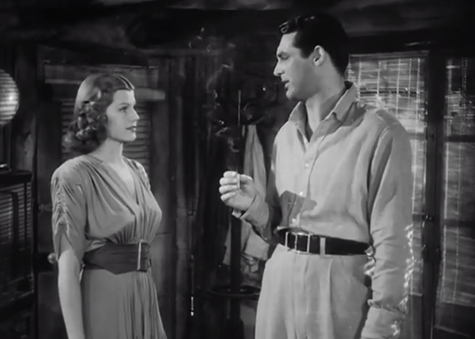
In fact, that’s the trait of many of these characters. Because Macpherson has picked up an attractive young wife in his travels. Though Rita Hayworth is in a smaller role as Judy, it’s still significant because most every player is given a piece of the pie. Her connection being the fact she knew Geoff in a former life. They don’t admit it right away but it becomes clear enough. And of course, there’s this uncomfortable chafing as Grant keeps the disgraced pilot in his back pocket to do all the dirty work. He’s handsomely paid for it but there’s no sentimentality or camaraderie.
only angels have wings 2.png

Everyone else is a part of Grant’s family as it were. MacPherson is just around for his usefulness. Carter’s relationship with the other man’s wife puts him in yet another position of power to show compassion. He surprises us incessantly and a dose of redemption explodes right out of an inferno of tragedy.

But we have yet to consider Grant and Arthur’s relationship throughout the picture, arguably the film’s most integral and constantly evolving asset. He is a man who can never be tied down; he does not share feelings or expect anything from any woman. And yet hidden away and shrouded from view are these threads of decency running through his life. Ways that he cares for people without letting his virile image slide. The final scene is a fine summation.

The pass is clearing up and despite all that’s gone wrong — he’s only got one good arm for goodness sakes and Bonnie’s about to leave him — there’s still a drive to finish what they started. But there’s a chance to make it through and save their contract and as he goes flying out the door he gives his girl a great big kiss and says he’ll flip her for whether or not she stays or leaves.

Of course, we know full-well the coin he tossed her is from “The Kid.” It’s marked with heads on both sides. She’s hurt at first. Injured by this flippancy and lack of commitment. But then she realizes, turning it over in her hands. In his indirect way, he’s saying he wants her to stay.

Why bring this up at all? As best as I can explain it, this individual scene is so beautifully restrained and nuanced in a way that surpasses other lesser films. Meanwhile, Only Angels Have Wings displays all the delectable glories of a deeply satisfying adventure film from Howard Hawks. There’s drama, romance, friendship, tragedy, and a simplicity to the action lines which nevertheless feels deeply indicative of the human condition.

4.5/5 Stars
Come and Get It (1936): Frances Farmer The Hawksian Archetype

come and get it 1.png

Author Edna Ferber in both her plays and novels had a penchant for sprawling familial tales of Americana which were indubitably fortified by social issues. Come and Get It gives the initial impression of another Howard Hawks movie released the same year, Barbary Coast (1936). In fact, that’s part of the reason producer Samuel Goldwyn wanted the director, even desiring Miriam Hopkins to play opposite Spencer Tracy. Both Walter Brennan and Joel McCrea were kept from the previous project.

But the other fact of the matter was, Hawks, hailing from affluent American stock,  was purportedly related to the real-life protagonist Barney Glasgow. He was supposed to be Hawks’ grandfather. This background is another fascinating tie-in though it was the behind the scenes antics that were almost more pronounced than the film itself.

Hawks took advantage of Goldwyn’s extended leave of absence, due to ailments, to take the picture in his desired direction, centering it around masculine adventure and love. In a satisfying casting decision, Edward Arnold is given a starring turn as ambitious lumberjack foreman Barney Glasgow. His most faithful pal is the affable Swede, Swan Bostrom (Walter Brennan), ever ready with his catchphrase, “Yumpin Yiminy.”

The world they inhabit is glorious, set against the snow-capped woodlands of Northern Wisconsin circa 1884. The timber trade is ripe and profitable. Even if the work is hard the resident workforce seems generally content.

The imagery alone is breathtaking to such a degree it feels like we are enveloped in a documentary as the trees come tumbling down and logs go shooting down the river with the furious forces of nature behind them. It is a life for those who relish the fresh air of the great outdoors and laboring with their hands. Like many Hawks films, a joint vocation is the source of camaraderie with men banding together over honest toil.

Following their final push to get the job done, Glasgow is the first to reward them with a Jamboree. The drinks are on him and everyone is in a jovial spirit. Again, we have an obvious hallmark of a Hawks picture with a communal environment we cannot help but want to be a part of. It’s infectious.

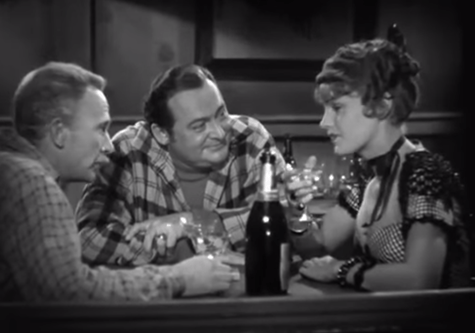
It is here where assured, husky-voiced barmaid Lotta Morgan (Frances Farmer) makes her striking debut. Full of moxie and capable of a captivating rendition of “Aura Lee,” she brings a boisterous bar to a standstill while captivating Glasgow from the first moment he ever sets eyes on her. Her song will remain a motif playing throughout the story even as the memory of her presence holds indelible weight over everyone.

The ever dubious shell game takes place but grander still is the subsequent sequence when the barroom is decimated during a brawl, not by flying fists and bodies but imminently more destructive beer trays doubling up as deadly metal frisbees. It’s in these raucous moments that love and kinship are galvanized between characters and we can understand why.

Except most of what feels Hawksian in content gives way to something else altogether; Barney forgoes the romance of a lifetime to pursue his one true love: the pursuit of wealth and power.

come and get it 2.png

The latter half of the narrative picks up in 1907. Barney Glasgow is now wealthy and successful with two grown children of his own. His son, played by Joel McCrea (once more horribly underused), is generally resentful of his father’s controlling attitude in both business and life.

Meanwhile, his daughter (Andrea Leeds) embodies a precociousness all her own, making a fine second female lead though her screentime seems minimal. She has an ongoing patter going with her father rivaling any of the chemistry found throughout the film because she brings out his most benevolent side.

But we must also talk about Lotta (Frances Farmer once more) the daughter of Swan and the now deceased barmaid. Because she immediately captivates Barney as her mother did before her. Though I relish Arnold in a leading role as he was far too often relegated to supporting authoritative figures, he does get a bit cringe-worthy by the film’s latter half.

Because the context has changed. He’s an older man now completely taken with his buddy’s daughter because she’s the spitting image of her deceased mother, the woman they both loved once upon a time. The aberrant shades of Vertigo (1959) become increasingly evident even as they try and hide under the guise of generosity and general gaiety.

He’s old enough to be her father. In fact, his son is taken with her too. They don’t get much time to forge any chemistry between them but a taffy pulling sequence facilitates the environment to muck about making a mess and trading repartee long enough for sparks to fly.

The behind-the-scenes turmoil between Hawks and Goldwyn and then Ferber’s own disappointment with the reworking of the storyline meant William Wyler was all but forced to finish up the picture. A task he hardly relished, even looking to distance himself as far as possible from the picture later on.

It’s true that his style and that of Hawks do feel diametrically opposed but it does make for a fascinating case study because it feels like there is a fairly clean break where we see one man’s influence on the story end and another man’s, meticulous and more restrained tendencies, beginning.

As such, the most boisterous and thematic elements give way to wistful and tense emotions that ironically are not too far removed from Wyler’s Dodsworth (1936), also made the same year.

If Hawks had stayed on the picture, you get the sense it would have erred more on the side of bravado and comedy. We have fist fights and a strange love triangle that can easily be seen as some kind of father-son precursor to Red River (1948).

But Wyler sets the scene in a drawing room between father and son commencing in a fist fight with a tinge of melodrama. It seems a far cry from our point of entry and even as the film winds down to come to some sort of conclusion, there is a mild tinge of regret Hawks was not able to see the film to completion. But he was a singular mind not willing for a great deal of compromise.

come and get it 3.png

One could contend not only the film but France Farmer, his latest muse who he had groomed for the part, suffered dearly. Of course, McCrea, Brennan, and even Arnold would have fruitful careers in Hollywood for years to come. It is not that this film sunk Farmer by any means but what could have been a shining achievement was slightly neutered due to the last minute personnel shuffling.

Of course, her career would take another hit when she was wrongfully interned within a mental institution in 1942 following a tumultuous episode. Indubitably her story was laced with tragedy upon tragedy and yet this film gives glimpses of her quality as an actress.

It’s this whole slew of elements compounded together making Come and Get It feel like a dark horse. It shouldn’t be good. The flaws and inconsistencies are evident and yet through some curious means, it manages to be an endearing picture channeling both pathos and virile liveliness. Those can be attributed to the directors at its core.

True, the social implications involving nature conservation aren’t resounding but it still manages to suggest the need to care for our environment in the stead of money-grubbing business. Even people who seem generous like Arnold are, nevertheless, beholden to an old way of life.

Above all, the talent comes out in spades making for a compelling portrait of the Hollywood machine at its height during the 1930s — warts and all. If there are many familiar talents, then the showcase we can be most appreciative of is Frances Farmers.

Rather than rue the fact her star never shined as brightly as it might have, we can be thankful for the visibly incandescent qualities on display, even just this once. Because, really, it only takes one picture to immortalize someone for cinematic posterity.

She is the Hawksian heroine you’ve never seen before and would never get another chance to witness. From her descend the Lauren Bacall and the Ella Raines archetypes, along with many others. It is no small wonder Hawks himself claimed her to be the best actress he ever worked with. High praise indeed.

4/5 Stars

Three on a Match (1932): The Epitome of Hollywood Pre-Code

ThreeOnAMatch.jpgThe Pre-Code era of Hollywood is a legitimate marvel because in a span of only a few solitary years was a period of filmmaking bursting at the seams with vice, corruption, and licentiousness that we would never see again until the late 1960s.

One could say that each of these elements was merely an exploitive measure to get folks in the sits. No question about it. However, that’s not to say the era is devoid of meaning nor is Three on a Match any less evocative. In retrospect, we look at something like this and it’s not simply a cultural artifact for us to engage with, one could assert just as vehemently that it was more indicative of the human condition than many later films coming out of the Hollywood mills. Scan the contemporary news columns and you might have to agree. In fact, that’s much of what director Mervyn LeRoy does.

He rapidly spans time with a proliferation of news clippings. They are not simply a montage effect but a continual storytelling device that are almost sinews to this story which must function with hyperawareness of its timescale. Ricocheting with time jumps that you almost get used to by the end and each one is out of pure necessity. Remember with 63 minutes you have to scrimp with every minute. From a historical perspective alone, it’s an absolute goldmine with cinematic images to fit right alongside the current events.

The title Three on a Match seems a foreign concept now but it comes from the old wive’s tale that if three people light a cigarette from the same match the odds are one of them will die. It is often incorrectly cited as originating in the trenches during WWI. Instead, it was the advertising gimmick of a Swedish matchbox salesman to drum up more business.

The story itself ambitiously begins in adolescence with three girls. Mary Keaton (Joan Blondell) is the wayward one who looks to be headed toward a reformatory and sure enough, she grows up and winds up in such a life. Vivian Revere (Ann Dvorak) is the purported “good girl” who ends up with a fine education and marrying a wealthy lawyer (Warren Williams) but she finds her life and her marriage dull and unfulfilling. Meanwhile, little Ruth Westcott (Bette Davis) has grown up into a pretty stenographer who nevertheless is relegated to playing the third fiddle. No matter, Davis would get her revenge in an illustrious career to come.

The root of the drama crops up from Vivian’s dissatisfaction with life because being the understanding husband that he is, Mr. Kirkwood proposes she take a trip away with their little son so she can clear her mind and come back refreshed. She jumps at the opportunity.

Adultery is such an insidious thing since you never consciously think you are going to be unfaithful; I imagine it just ambushes you as it does for Vivian. She meets a man (Lyle Talbot) who is charming and the bubbly is flowing. She has few cares in the world and conveniently has neglected her son. Whom does she have to thank for this good time? Why, it’s Mary. Except Mary has changed; she’s a different person, chiding her old classmate to think before she throws her life away. The tides have changed with the reprobate teaching the classy one something about life.

To divulge any more would ruin the surprise but there’s little doubt, it’s sordid stuff with some mild sense of morality. We have drugs, adultery, scandal, and suicide all rolled up into one tightly woven package. Dvorak is devastating in her self-destructive spiral as Blondell commands the film’s stalwart center.

The most unexpected star is little Junior who is a precocious performer, lovable in every scene he shares with his bevy of costars but also a striking reminder of how innocent children are. To neglect them is to disregard the imperative of parenthood to provide for your progeny with an unselfish, unswerving, sacrificial love.

The rest of the gang are all assigned their assorted parts that became their mainstays. Humphrey Bogart becomes the quintessential heavy in a matter of moments. Ed Arnold is the exacting kingpin overseeing everything. Allen Jenkins is another tough customer with little heart or soul.

It might do well as a companion piece to Night Nurse, which also involves little children being exploited. Joan Blondell gives a spunky turn in both even as the plots verge on the utterly ludicrous and are remembered now as much for their louche content than the actual details of their plots. Part of that has to do with how unusual it seems, especially with the laissez-faire attitude of the production codes at the time.

But also in this specific case, the Lindberg kidnapping indubitably was still fresh in the minds of the viewing public, lending some credence to the believability of such a tale. That’s the key. However absurdly a plotline might slingshot this way or that, as long as something grounds it, even momentarily, in reality, it can captivate us. Three on a Match is not a phenomenal film outright but within its means, it manages to be economically diverting.

3/5 Stars