The King of Comedy (1982): Celebrity or Notoriety

Kingofcomedy

“Better to be king for a night than shmuck for a lifetime.”

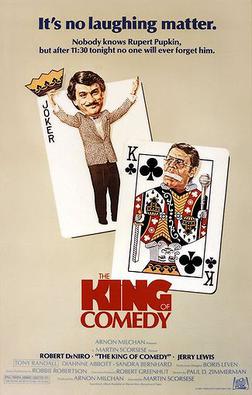
The opening moments of The King of Comedy, as iconic star Jerry Langford (Jerry Lewis), is ushered to a waiting car surrounded by the chaotic frenzy of thrill-seekers, capture the essence of celebrity in the modern age.

Jerry gets shoved about and manhandled as an obsessive young fan sneaks into his car and nearly squeezes him to death. The freeze-frame credits capturing her outstretched hands on the windowpane of his car has Scorsese’s sense of the cinematic. As Ray Charles’ “Come Rain or Come Shine” plays, we become increasingly aware of film’s ability to capture time and halt it completely.

The punchline comes in the form of one Rupert Pupkin (Robert De Niro). He’s an avid admirer of Jerry Langford in his own right, and he just happens to sneak into the car with Jerry as it drives away, leaving the hordes behind. Now he has his chance to consort with his agitated hero.

Rupert lets him know how he’s biding his time until he gets his big break. He’s trying not to be pushy, but he still manages to cross some invisible like as he uncomfortably follows Jerry all the way up to the steps of his apartment.

Lewis builds his performance out of playing it straight and a bit harried and belligerent. He feels much more close to home than one of his prototypical clowns. The buffoonery is mostly left for Pupkin. What Jerry Lewis brings is true-blue Hollywood pedigree and celebrity.

Meanwhile, Rupert has his own private delusions. For example a lunch with Jerry Langford where the old guard is positively begging him to take over the show for 6 weeks. This is the scenario he plays out in his head.

He also shows up at the bar presided over by a pretty girl — Rita (Diahnne Abbott), who he knew from school — and they wind up going out to dinner together (probably). Because at first, we question whether this is an illusion as well. Does it matter?

Because Rupert is enveloped in a world of hero-worship, although he takes it a step further. He wants to get to the top of the mountain with his heroes — to be one of them — with the same kind of praise and adulation. He’ll be the new king of comedy.

And yet we get a sense of how ludicrous this is. He is a man who’s done of up his living room with cardboard cutouts of Liza Minnelli and Jerry Langford (Lewis) to look like his own personal talk show. In the day before mobile phones, he clings to a payphone like a security blanket hoping to get a callback. Jerry’s going to call him back. He just knows it.

It functions as an extension, or a further perfection, of Taxi Driver‘s melding of fantasy and reality. What sets it apart is De Niro’s truly unprecedented performance; it feels more off-kilter and oaffish than we’re accustomed to seeing from him. He’s an alienated outsider, yes, but also a shmuck.

The scenes between Jerry and Rupert somehow are the richest for me because they remain at the heart and soul of his fantasy — his desire to be well-liked and accepted as a comedian — this want to actually break bread and be buddies with his hero. Haven’t we all been there? But for Rupert, it is a legitimate obsession.

There’s an imaginary marriage sequence presided over by his old high school teacher with the wedding march supplied by none other than Victor Borge. In another sequence, he gets thrown out of Jerry’s office after the umpteenth time only to show up at Jerry’s house with his girl in tow.

How did we get from one moment to the other? In the brain of Rupert Pumpkin, it’s not difficult to extrapolate. As this prolonged agony gets strung along, it becomes more and more uncomfortable and cringe-worthy with each passing minute. The servants let them in. They make themselves at home. Only for Jerry to return from the golf coursed miffed.

Because it becomes more and more apparent how unsubstantiated any relationship between Jerry and Rupert actually is. For the actors, it is par excellence with De Niro and Lewis riffing off each other for minutes on end — keeping this grating sense of conflict going.

It’s already been alluded to that The King of Comedy is about this kind of idolizing and super fandom, but it also examines what happens when fellow lunatics clash or worse yet join forces. In this picture, Rupert has Masha (Sandra Bernhardt). He makes every effort to differentiate between the two of them, but who else would hatch a nefarious scheme to kidnap Jerry Langford?

Of course, that’s what they do. There he is duct-taped in his chair — and they really do a job on him — he’s practically mummified, stuck to the seat of his chair. It’s the first phase in Rupert’s plan to get his face in front of the biggest audience possible. Forget about guest host Tony Randall. He’s going to be the new talk of the town, at least for an evening. If not for his middling standup, then certainly for kidnapping one of America’s most beloved public figures.

The key to The King of Comedy is how Scorsese seems to understand what it is to be the TV generation and to be raised on the medium of the small screen. Although he is considered one of the great cinematic directors of our times, he also understands the world a film like this engenders. Case and point is Rupert Pupkin’s climactic monologue.

He cuts away before we ever see it live. Instead, it is shown later from a bar over the fuzzy frequency of a television screen as it was meant to be. In this augmented reality of canned laughter and studio audiences, people can become like family, and they are household names. But there’s also something phony and uncomfortable about it if it’s done poorly.

Because it’s become more and more apparent there are people out there who are not looking to accumulate a currency of trust with their audience. They only want their 15 minutes of fame.

I’m not sure if The King of Comedy always works, but it does leave a lasting impression with its meandering road of awkwardness where Pubkin is a man who seems delusional, shrewd, and overwhelmingly conventional all at the same time. The final punchline is how he gets his wish and becomes a celebrity. Notoriety might be a better word for it, but in our modern landscape aren’t they really one and the same?

3.5/5 Stars

Dune (2021): The Archetype for Modern Sci-Fi

For being such an influential piece of Science Fiction storytelling, I must admit I have very little history with Frank Herbert’s Dune. I was aware of David Lynch’s adaptation, and I’ve recently been dipping my toes into the impressive mythos of the original novel. 

It works in archetypes that feel exceedingly familiar because they’ve helped lay the groundwork for modern sci-fi as we know it. In a contemporary landscape that’s shifted toward stories highlighting the universality of heroism, there’s something intriguing about a story willing to dig into the ancient monomyths that have remained foundational for many cultures. 

There’s the tradition of the chosen one – in this case, young heir apparent Paul Atreides (Timothee Chamalet) – who has untapped potential as well as pedigree that might make him the Messiah who has been prophesied about for generations. 

This overtly spiritual language would certainly inform the worldbuilding of Star Wars and the hero’s journey of Luke Skywalker, conceived by George Lucas and ultimately captivating the world over. This is how Dune indirectly affected my entire childhood and I see it so clearly now. 

Because Dune’s reputation precedes it and for people like director Denis Villeneuve, the passion for this material is palpable. Obviously, his aspirations are to do justice to a piece of literature while giving it a visual resonance for a new generation. 

As this is the man who gave us the worlds of Arrival (2016) and Blade Runner 2049 (2017), Dune is hardly an aesthetic surprise. I know, since he is an avid cinephile, Lawrence of Arabia is a major touchstone for his latest film, and given the indelible desert locales, the comparison seems inevitable. After all, both of these films aspire for vast grandeur with the kind of scope other films merely dream of. 

Villeneuve’s sleek metallic drabness serves him again. It’s at one time immaculate and sometimes a bit soulless. However, this is less a full-on criticism and more so indicative of epics in the 21st century. In other words, it doesn’t have the vibrancy of Lawrence or the golden hues. Still, there’s a vague kind of wonder when we watch it blending real-life locations with digital magic while also underlining this ominous sense of oppression.  

My mind drifts easily to the oddly bewitching bagpipe and drum-infused score of Hans Zimmer. Like the organ in Interstellar, this rather unique choice does wonders in providing a layered soundscape to evoke the ever-expanding world in front of us. Zimmer’s work takes the individual images and transforms them into a full-bodied experience, lending some drama and emotion to a mise en scene otherwise running the risk of aloofness. 

Equally important is how famed elements like the sandworms or bits of technology are realized onscreen. Oftentimes this can be a detriment because these visions no longer live in the mind’s eye, once a creator has brought them into reality. However, that doesn’t mean we can’t marvel both at Herbert’s imagination and also how they have been brought to us. 

Although Timothee Chalamet is not my favorite actor, he functions as a fine avatar throughout this movie. Because he is the character Villeneuve identifies with, and he is our way into a story. Paul’s father (Oscar Isaac) and his family are displaced and called upon to govern the planet of Arrakis vacated by the Harkonnen, a brutish people who gained exorbitant wealth, but not without repercussion. 

Like all the grandest stories, it has this galactic scale but maintains a level of relational intimacy. It could work in no other fashion. It’s a pleasure to see Rebecca Ferguson given such a striking role that at first glance feels so subordinate but is almost covertly imbued with so much power. Because she is a member of the line of female Truth Sayers, even going so far as to pass down their sacred abilities to her adolescent son. In some fashion, Paul is a two-culture kid, different from others, and situated to be a priestly king, blending his two unique bloodlines. This pervasive biblical language is hard to totally dismiss. 

Stellan Skarsgaard and Charlotte Rampling show up almost unrecognizably and since I have no context for their characters, I appreciated their level of menace. It makes no difference whether they are good or bad. They are not to be trifled with. Jason Momoa arguably has an easier role, but still, he must be a likable mentor figure and a formidable warrior. He handles both with casual aplomb bringing a refreshing lightness to the movie which could otherwise be a completely dour affair. 

It is these characters against this backdrop who begin to suggest the primary thematic ideas passed down from Herbert and taken up by Villeneuve. There are themes ranging all over the spectrum from familiar social and political dynamics, wars of cultural influence, and certainly religious omens. There’s is something somehow Medieval and Machiavellian about it. It is a world of royals, serfs, and fiefdoms, and stratified hierarchies jockeying for survival. 

As alluded to before, one of the most overt representations has to do with the Fremen, a people native to the desserts of Arakkis who called the sand-swept world home long before their captors came to rule it. The Fremen, identified with a mostly illusory Zendaya, are rather reminiscent of the Tusken Raiders, although they are more charismatic and given a human face. They are fierce, loyal, attuned to the desert, and they know the treachery that comes with betrayal and the fundamental struggle to survive. 

The most unsurprising spoiler might be that this is, in fact, only part 1 of what’s envisioned to be a long saga. I’m hopeful that it might lithely move through the imminent films ahead instead of totally obliterating everything in its wake like a giant sandworm. Because this is the perpetuated fallacy of many serialized blockbusters. Hopefully Herbert’s work won’t suffer the same grisly fate signified by bloated runtimes and oversaturation. If you remember, David Lean only ever made one Lawrence of Arabia, and somehow I’m content with that.  Star Wars is a slightly different story, but that’s a subject for another time.  

4/5 Stars

True Confession (1937) Carole Lombard, Fibber Extraordinaire

true confession

“Must we submit to this three-ringed circus in the guise of drama?” – Porter Hall

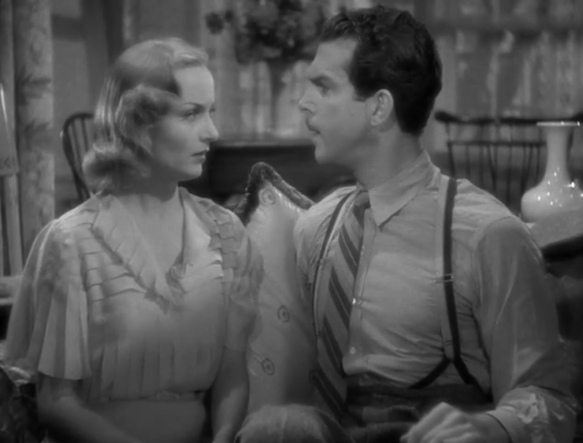
Carole Lombard is a comedienne of unequivocal talents. My guess is that it lies in that extra special dial she had. Yes, she was a Hollywood glamour girl and stylist of the 1930s — married to the King of Hollywood himself — but she also was totally at ease being absurdly silly. She would become frenzied and unhinged in a manner that feels rather groundbreaking for her generation. She was a very special performer.

True Confession deserves to be acknowledged as a truly satisfying screwball for how it uses Lombard’s talents. Because, you see, her Helen Bartlett is a woman plagued by tall tales. Her fibs take on outrageous proportions. She’s the girl who cries wolf. Quite literally, tongue in cheek. We see it in full effect early on where she tells a string of increasingly wacky fibs to keep a man from impounding her typewriter.

However, the movie wouldn’t stand up if not for her husband. Ken Bartlett (Fred MacMurray) is tirelessly honest which, in the lawyering racket, isn’t always the most lucrative. He won’t represent anyone who’s guilty and that includes the referral of their local butcher who swiped some hams.

But he has that aching desire to exert his manhood and be the sole breadwinner of the house. He wouldn’t dream of having his wife work. No, she spends her days plinking away at the typewriter trying to finish her latest story. She’s got the personality but perhaps not the prose to be a successful writer.

So she conspires with her best friend Daisy (Una Merkel) over what she might do. Her plan is to take a job as a secretary. What of it that she’s never done shorthand or that her husband will have a fit? These are small potatoes and so she takes the job. Unfortunately, sleazy Mr. Krayler is a serial philanderer and as she skips and back peddles to avoid his advances, Helen realizes she has to get out of the secretarial racket.

This might very well be the end of it. But True Confession is forever altered by what happens next. Depending on the outcome it would end up a mystery drama. Thankfully for us, it remains a comedy.

Because she returns to the office to pick up a forgotten handbag only to find the dead weight of Krayler sprawled on the carpet. Soon the police are on the scene — their bald, hoodwinked leader (Edgar Kennedy) suspects her instantly. After all, she has motive. Soon they’ve drummed up a whole story supposin’ how she fled the crime scene.

But we know she is innocent so if the wheels of justice are actually just, there shouldn’t be a problem. A happy ending is easy enough to foresee. Instead, proceedings get strung out. Helen ends in prison suspected of murder and there’s an ensuing trial in front of a judge. Her husband is going to defend her.

Here’s the real screwball wrinkle. Wait for it. She decides to plead guilty. It’s the biggest lie she’s ever told, but if it pays off, then her hubby will be the talk of the town in the courts with a fledgling career to boot. She wants to give him his biggest stage to prove his acumen even if she has to risk perjury to do it. If it doesn’t work, well, the movie never really makes us consider the alternative.

We’ve alluded to the majority of the players, but one would be remiss not to mention two more. Porter Hall is one of the mainstays of Classic Hollywood entertainment and here he turns in a fine performance as a bellicose prosecutor on the prowl.

Then, who can forget John Barrymore hitting the eccentric heights of his career (and also the skids)? Because “The Great Profile” and titan of the great acting family, was now more of a caricature.

As Charley Jasper, he’s giggling maniacally with his ready collection of balloons, his hair rather unkempt, like a mad professor in the courtroom. Why is he here anyway? Why does the story need him? It seems quite thin. I would never dare spoil this little untouched secret.

Instead, the floorshow takes center stage. Mr. and Mrs. Barlett reenact events for the courtroom crowd in a highly irregular manner, but there is something giddy and glib watching Lombard and Macmurray break into playacting in the middle of the trial. It won’t let us forget for a moment this is a comedy, and it stays true to its roots.

I have to admit there’s an unsettling irony in the comedy’s main conceit: a white woman fighting to plead not guilty for a murder that everyone assumes she committed (though she hasn’t). Of course, there’s a historical precedent in antiquity for a woman’s testimony would not be taken.

Even watching something recently like Just Mercy, a different kind of courtroom drama in tone and content, it’s a reminder of how many people, whether black or marginalized in some way, find themselves in much the same predicament, and in their cases, there’s rarely a screwball plotline to conveniently spring them out of their misfortunes.

Social critiques aside, True Confessions is an underrated screwball gem, and it does itself a service thanks to Lombard and Kennedy, Merkel, and Barrymore. However, in our current context, as we seek a renewed sense of justice in the civil space, it must also give us pause.

3.5/5 Stars

Notes: This post was originally written in June 2020