The Barkleys of Broadway (1949)

The Barkleys of Broadway was initially conceived as a reunion. It was meant to star Fred Astaire and Judy Garland, capitalizing on their successful partnership with Easter Parade.

Taking nothing away from Judy, it does feel like there’s something propitious about Astaire and Rogers getting back together one last time. Because Easter Parade is such a delight, it also makes what we missed out on a little less painful, and what we got in its place all the more enjoyable.

It’s been a decade, the studio changed, and the aesthetics are different in Technicolor, but it’s still an immeasurable pleasure seeing one of the movies’ most transcendent screen couples in yet another picture together. She was always a supernal star in black & white, but Ginger Rogers is a great beauty in Technicolor, too.

The movie opens with the credits as our stars stand on stage doing their routine as it should be. It’s just like old times. Josh and Dinah Barkley sing each other’s praises awkwardly, and their friend Ezra Millar pries them offstage before they compliment each other to death.

When the performance is over, they walk the gauntlet of all their well-wishers and admirers, signing autographs. I imagine I’ve seen this sequence countless times from All About Eve, Opening Night, and The King of Comedy. It’s like a rite of passage for the entertainment superstar.

They cuddle up in the cab full of lovey-dovey affection and effusive praise until a note of criticism creeps in and all sides blow up; it’s nothing if not a mercurial relationship. Oscar Levant is the peacekeeper and his usual mix of goofball and piano man extraordinaire, with an endless array of wry wisecracks.

His persona on film is such that it almost obfuscates the heights of his talents. The rapid-fire runs of “Saber Dance” are a tour de force compressed into a few minutes. A personal pet peeve involves actors who sit with their hands hidden behind the piano, and everyone knows they aren’t actually playing. It breaks the illusion. However, Levant, like Astaire, is so prodigious that the camera sits close by, unbroken as it admires the mastery of two artists.

Whether planned or partially happenstance, it’s difficult not to read into the meta qualities of the story, both real and imagined. The movie has a laugh playing up the tiffs between Astaire and Rogers as portrayed by the contemporary media. Whereas in reality, they seemed like two very driven people with a singular focus to do their work to the best of their abilities. They were generally well-liked and had nothing but high praise for one another. It’s gratifying to hear, though it hardly sells newspapers.

Billie Burke appears as a tittering patron of the arts who throws them a party, though they try to avoid their congenial hostess like the plague, sneaking out to the patio. Dinah meets a French playwright and admirer, Jacques Pierre Barredout (Jacques François), on her way out.

The young man strokes her ego, telling Dinah she’s wasted in musical comedy. ” You could be a great tragic actress,” he says. Her husband is distrustful of his fawning, and besides, he sees his wife as a “song and dance girl.”

He’s like the Svengali who molded her, and that image doesn’t go over well with her. She’s ready to get out from under her husband’s influence; she’s no Pygmalion creation or shrinking violet. The rest of the movie is built out of this seemingly trivial tension in the rom-com mode.

Of course, none of this conforms to reality, as Rogers had won adulation and an Oscar for her work in Kitty Foyle at the beginning of the decade, and she was largely the bigger star before they were ever teamed up. She maintained a fairly impressive film career throughout the ’40s and early ’50s. Reading into these tenuous parallels too much becomes laughable, but it is also part of the enjoyment.

The behind-the-scenes rehearsal environs do yeoman’s work in making this feel like the quintessential MGM: the studio of Freed, Gene Kelly, writers Adolph Green & Betty Comden, and all those wonderful collaborations like Singin’ in the Rain and The Band Wagon.

It highlights the love of performance and the sensation of catching this brand of tap dancing like lightning in a bottle, as if we’re on the ground floor and privy to something only a select few get to see. That’s part of the magic of how they created these worlds for their characters to inhabit, where the backstage and everything in between is blurred, and the camera’s right in the thick of it to capture it all.

The couple agrees to go out for some fresh air in the country, much to Ezra’s chagrin. While Josh plays golf, Dinah agrees to become Jacques’s muse. Thereafter, the Barkleys have a photoshoot with Look magazine right at the precise moment Josh realizes his wife has the script for the Frenchman’s play.

It becomes a send-up of the perfectly quaint and manicured All-American Person to Person fireside chat as the married couple go ballistic once again, this time tearing through their house in a rage in between camera setups. These are mostly vapid bits of fun.

The true high points come when the stars are given these incubated moments to flash their inspiration in front of the camera. “Shoes With Wings On” conjures up a storefront milieu reminiscent of the toy shop in Easter Parade. Astaire puts on a pair of possessed dancing shoes and lets them carry him away. It leads into a magical interlude where he’s joined with an army of ghost taps all stepping in time, almost ready to run him off the stage until he takes arms in a surrealist defense involving a broom and toy guns.

Ezra tries to trick his friends into a reunion, and they stand backstage at a benefit while he conducts a performance of Tchaikovsky. The man really has range, but then again, he was a compatriot of the Gershwins who famously cut so lithely between popular, classical, and jazz composition. From my understanding, they made them one and the same with no delineation between high and low art.

The Barkleys, or rather Fred and Ginger, are paired one last time with the Gershwin tune “They Can’t Take That Away From Me.” If it’s not immediately apparent, there’s actually a bit of poeticism to its inclusion. So many years ago — in 1937, in fact — Astaire sang the song to his costar in Shall We Dance.

This time around, they turned it into a dance with their typical elegance and joie de vivre. The Barkleys of Broadway is unreserved proof that they’re back, and they never lost it.

It’s so good to see them together; it’s also exactly what our hearts yearn for, especially those who have lived vicariously through them for many years. Somehow, they embodied us and still reached for heights we could only dream of, and they did it with pure class.

3.5/5 Stars
Carefree (1938)

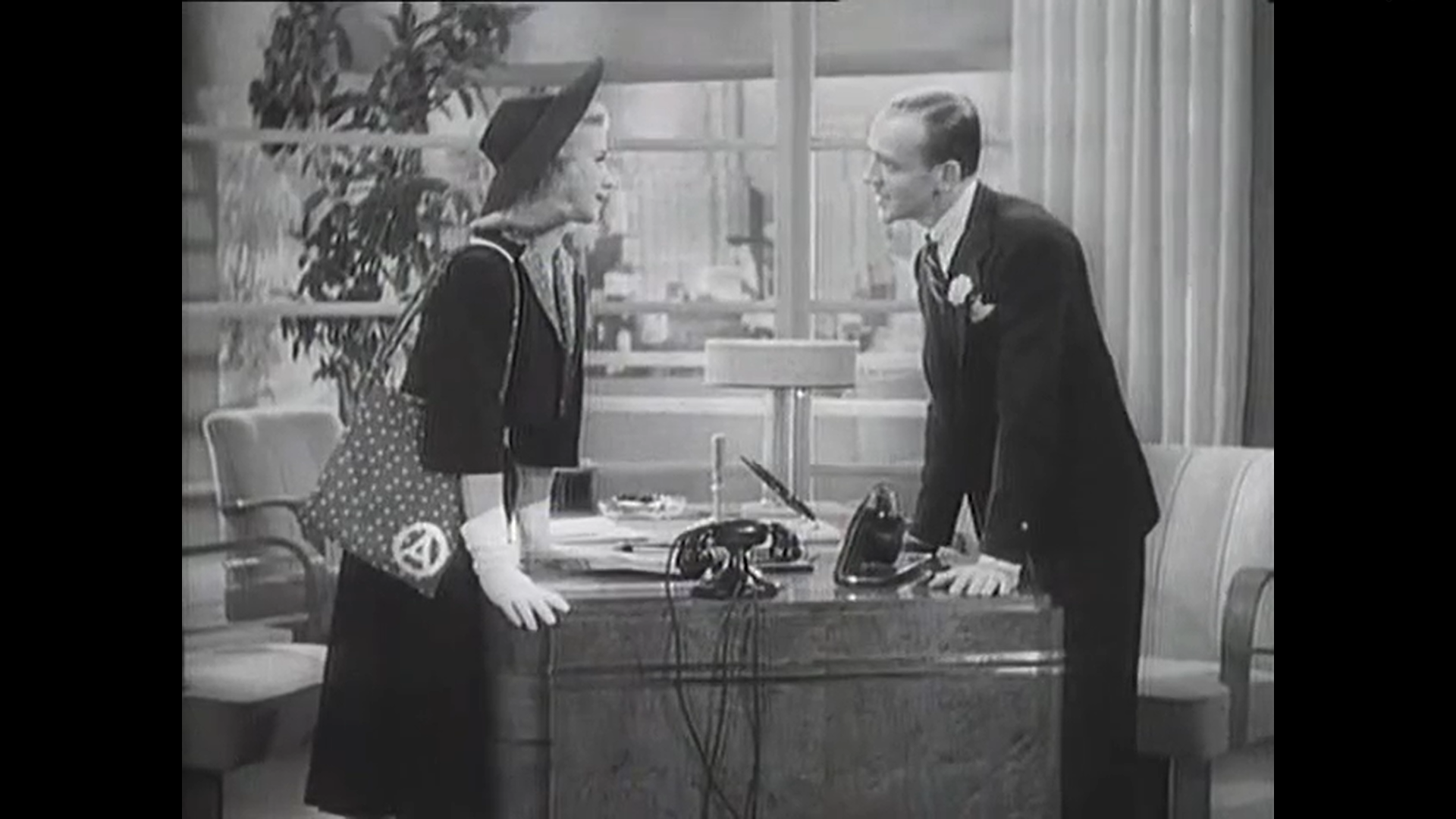
Ralph Bellamy, Jack Carson, and Fred Astaire sounds like a stellar triumvirate for a movie, and Carefree does us a favor by getting the three men together. Bellamy takes up his usual post as the other man and jilted lover, Stephen Arden. Amanda Cooper (Ginger Rogers) can’t seem to make a decision to marry him, and so she agrees to visit his buddy, who just happens to be a psychiatrist.

Fred Astaire as Dr. Tony Flagg is quite the piece of casting, and the situation gets more outlandish when she happens to overhear some of his condescending dictation about the female psyche.

By the time he calls her in for psychoanalysis with perfect candor, she’s already wise to him becoming the most wearisome patient he can possibly imagine. No one takes kindly to disparaging remarks.

With old pros like Clarence Kolb and Franklin Pangborn rounding out the cast at the local country club, you know exactly what you’re going to get. Luella Gear isn’t quite Helen Broderick as far as the wisecracks go, but she has a kind of warm, bright-eyed gameliness in her own right. Behind a certain level of propriety, as Amanda’s Aunt Cora, there’s also a dry sense of humor.

Although it feels like Rogers’s picture for the most part, a high point for Astaire is watching him make dance out of golf, looking quite competent with both as he hits balls off the tee with a rapid fire cadence perfectly in step.

There’s also a dreamscape Astaire and Rogers number within Amanda’s mind, giving license to their longest and most luxuriant kiss to date on celluloid. “I Used to Be Color Blind” would have been more spectacular and made more thematic sense if it had been filmed in Technicolor, but the slow-motion action has a novelty to it. It’s also a secret she must keep to herself: She must subconsciously love Tony, not Stephen.

Not much stock should be put into Astaire’s therapy techniques because they only serve to aggravate the situation, though this is very much on purpose. Ginger under anesthesia allows the story to play up its best screwball antics, and she was always game for a laugh and a few shenanigans.

She proved time and time again in movies of the era like Vivacious Lady and Bachelor Mother, that she was an unmatched comedienne, even when there was little to no dancing for her to partake in. Carefree ventures into the arena of near-surreal silent comedy as she effectively plays a “drunk” character bumbling nearby traffic, giving the stink eye to truck drivers and the like.

“The Yam” is a quirky piece of puff, but it’s exhilarating to watch Astaire and Rogers in one of their most wide-ranging immersive dances. Usually, we get these specified incubated perimeters in which to enjoy their dancing and marvel at their prowess.

Here, it feels like giddy performance art where everyone is drawn into the far more fluid frame with them as they pick up onlookers like an ever-growing amoeba. They move their way through the country club, strutting through the dining rooms past tables as Rogers bounces in and out of the seats with a sweep of her partner’s arms. It’s an utterly delightful outpouring from the consummate professionals.

In a subsequent scene, Astaire talks to his subconscious in the mirror. He knows he’s falling in love with Amanda, and he tries one final desperate act to salvage her relationship with his friend. He hypnotizes her and implants the idea that “men like him should be shot down like dogs.” It’s definitely not a recommended method, but it sets Rogers up for the final act.

Watching the actress skeet shooting Tyrolian hats under the spell of hypnosis is one of the more hilarious things in the picture. It’s good ol’ fashioned fun playing off Kolb’s ornery judge character. One doesn’t work as well without the other.

But there’s also a real menace, even if it’s screwy watching her tromp around the club as the men flee every which way to stay out of the line of fire of her shotgun. Astaire’s ploy worked a little too well.

He realizes he still loves her and expresses his feelings with the crooning classic “Change Partners” imbued with a kind of melancholic yearning out on the dance floor. He waits until the eleventh hour, but with Jack Carson’s help, they try to get into Amanda to thwart Stephen and make sure the right people get married on the wedding day.

There’s a subtle shift in this film within the Astaire and Rogers canon in that it leads with the screwball elements, with the musical aspects playing almost a secondary role. In other words, it breaks with their typical formula and relies on a more compact screwball structure and the capacity of its stars. But the movie also feels like a supreme showcase for what Rogers was capable of on her own.

3.5/5 Stars

Follow The Fleet (1936)

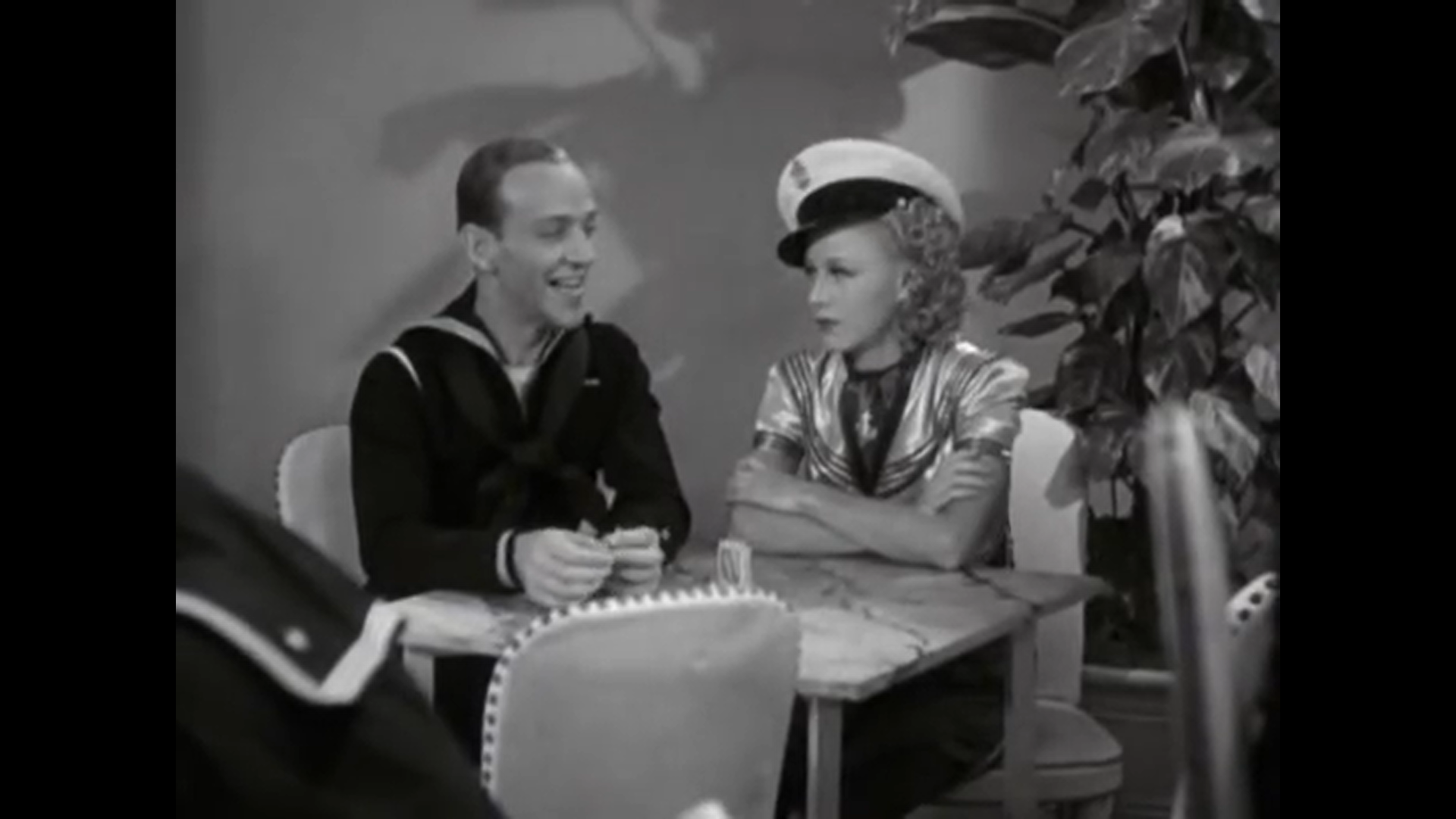
Taken in the lineage of movie musicals, Follow The Fleet feels like a prototype for On The Town, or maybe there were just more movies focusing on sailors on leave back in the day. It’s like romances set on ocean liners. With the proliferation of commercial air travel, it’s possible a whole subgenre went kaput. For now, it’s safe, and the boys descend on Frisco.

Fred Astaire stars as a gum-smacking sailor, Blake Baker. He wears the abrasiveness lightly because he was always an appealing personality beyond his graceful taps. Randolph Scott takes on the role of the best bud, Bilge Smith, as they continue their pairing from Roberta. Astaire similarly has a girl he wants to check in on…They had a falling out, and you can just about imagine who might be playing her.

As the sailors roll into the city, it has the distinct stench of a pile of pesky high schoolers infecting the place. They sneak into a local joint on one ticket, and Bilge hooks them up with a couple of paper bags of beer from the outside. All they require is the establishment’s table, and they do the rest themselves.

Connie Martin (Harriet Hilliard) plays a homely, bespectacled brunette girl who makes Randolph’s acquaintance; she needs a man to get inside, and he obliges, though he’s quick to brush her off and forget about it. Connie also just happens to be the sister of Sherry (Ginger Rogers), who’s the floor show at Paradise.

It’s the old trope we’ve known since the dawn of time. Ginger Rogers hails from the Gentlemen Prefer Blondes school. As she points out, men like blondes because they look dumb. The operative word is “look” since you would never believe someone pulling one over on Ginger Rogers.  “It takes a lot of brains to be dumb.”

Lucille Ball enlisted to make Connie look presentable. The ugly duckling arc feels dead on arrival. This movie just needed another plot to bide its time. Her new look makes a startling impression on Bilge, and we know she has feelings for him already. His problem is living a transient life; he’s also easily swayed by shinier, more affluent objects in the form of divorced socialites.

Rather like Roberta, the sluggish romance all but writes itself, making Astaire and Rogers the primary reason to stay with the picture and see it through. There’s the fun pretense of a dance-off with another couple, and then Astaire and Rogers go nuclear into another stratosphere. The scene becomes there’s, and there’s alone. The movie almost seems to forget there were ever any other dances spliced into the scene, and we do too. 

The sailors are whisked away on a moment’s notice, and the women — as the title implies — must take up pursuit! The movie requires it. Connie vows to get a boat so the man that she loves can captain it.

It’s rather hypnotic seeing Astaire tapping on deck with a whole host of sailors keeping time behind him; there’s a military cadence to it with a certain added level of artfulness. It’s like the maritime context creates a playground for him to then work within and offer us some novel hoofing.

There’s also a cruel comic irony watching him return to town trying to nab his girl an audition and derailing a “sure thing’s” chances by spiking her drink with bicarbonate of soda. His wires get horribly crossed. You can fill in the rest because Ginger’s the poor woman who suffers at his hands. Being pretty plucky herself, she’s more than equipped for some brutal payback.

These moments of “plot” are the movie’s saving grace because at least A & R’s romantic entanglements are mostly comedic. Rogers has the feistiness to make them a joy, and Astaire doesn’t have a malicious bone in his body, so the comedy comes off mostly affable and light.

The final act is comprised of putting on a show to keep Connie from losing the refurbished ship she sunk her savings into — she did it for Scott, but you hardly need to know this. Nor the fact that Blake has to go AWOL to get to the benefit in time. It doesn’t matter.

All that matters is that Fred is there to dance with Ginger, and everything else falls away. The apex of the movie is “Let’s Face The Music and Dance,” which feels like a quintessential American Songbook number that I’ve been sleeping on. My sincerest apologies to Irving Berlin.

It’s classic  Astaire and Rogers at their classy best, dancing on the deck of the ship and making us forget the sitcom fluff for something transcendent like they gave us so often. It’s a worthy place to end.

I said my apologies to Berlin, and now I owe one to Ms. Hiliard. I didn’t realize she was thee Harriet of Ozzie and Harriet fame until I was practically finished with this review. The longevity of her career in itself is quite remarkable.

3.5/5 Stars

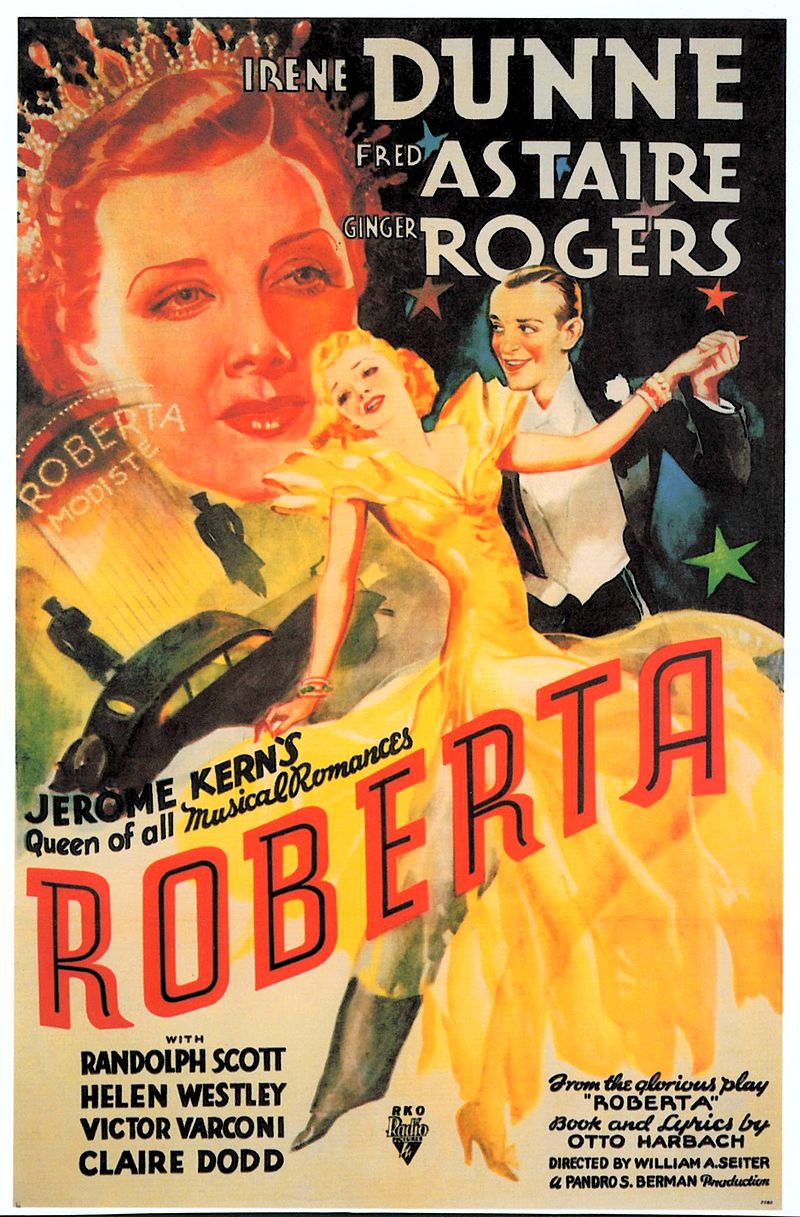
Roberta (1935)

Roberta opens with a troupe of musicians known as the Wabash Indianans who perform a wonderfully kooky organ routine in the middle of a train depot. It’s so inventive in fact, including the verbal gymnastics of Candy Candido, that they get sacked before they can even begin their gig in France. The proprietor was looking for some more exotic entertainment.

The boys need a fallback plan fast. Huck Haines (Fred Astaire) vaguely knows a girl named Lizzie, and John Kent (Randolph Scott), well, his aunt just happens to be the most famous dressmaker in the city. Only in the movies…

Time is of the essence, and so he pays the famed monoymous Roberta (Helen Westley) a visit. Scott gets stuck in the gilded elevator and has his meet-cute with Irene Dunne. It took a moment to recognize her because she addressed him in French. Stephanie (Dunne) is Roberta’s designer and most faithful staff member.

Scott is instantly smitten and goes leaping up and racing across the room just to have the chance to open the door for her. He rumbles around with the giddy energy of a colt; his aunt likens him to her favorite Newfoundland puppy.

If you’re keeping score, there’s one name that hasn’t cropped up yet. Ginger Rogers shows up as a feisty countess; her accent is worse than Dunne’s, but it doesn’t matter. She’s got the spunk to make it count. She stands at the balcony listening to the band do their performance, and when she actually gets face-to-face with Astaire, there’s really some fun to be had.

Flying Down to Rio found them coming into their own; they were sidekicks who caught the eyes of the audience with their craze-creating “Carioca” routine. With Roberta, they had already hit it big with The Gay Divorcee, and now they get to have a good time with the material without the onus of the story being on them.

They seem to relish this kind of sidekick role; it’s almost like they’re playing a level of meta comedy here because they know all the beats of the story and what it takes to have the commensurate repartee. After all, outside the film, they’ve already built up a cache of goodwill.

We really begin to understand it when they both drop the act. Because she’s not a countess but the same fast-talking dame named Lizzie he knew in a former life. Now their familiarity makes sense for the sake of the story.

In “I’ll Be Hard to Handle,” they get reacquainted with some flirtatious dancing as they reminisce about old times. This devolves into a dance-off with a slap for good measure, all captured in a rush of an unbroken take between two consummate performers loving what they do in front of us.

It feels like things are humming along. The demonstrative nightclub owner Alexander Petrovich Moskovitch Voyda, who communicates only in raised octaves, is coaxed by Lizzie into offering the boys a job this time around. Things are looking up.

There’s even a French lesson with Randolph Scott and Fred Astaire, which so obviously lays the groundwork for “Moses Supposes” in Singin in the Rain. It’s impossible to see it any other way.

Admittedly, Scott and Dunne have a rapport I like, though I’m equally tempted to say I want to see the movie with Astaire and Rogers at the reins. They almost need two separate movies because the story’s not big enough for all they have to offer. The script goes tugging and seesawing good-naturedly enough between the players, but the story almost doesn’t know how to handle it all.

It’s an embarrassment of riches, and it’s not even named for any of them. This distinction goes to Helen Westley. Then, Auntie Auntie dies peacefully — Scott and Dunne have a pact to run her fashion empire together, and John’s old flame Sophie comes from America for the obligatory complication.

She and Astaire don’t mask their mutual disdain for each other, and her entrance is great for the sake of comedy if little else. The fact that they have a bet over how her dress will be received by John pays dividends simply with the opportunity of watching Astaire’s smug face as he struts off and palms her dough.

Roberta could be a stolid affair straight through, and it is from time to time. No disservice to the lovely Irene, but her style of singing went out about 80 years ago, and I will always be enraptured by the Platters’ cut of “Smoke Gets In Your Eyes.”

I realized what made the Astaire and Rogers formula work was that they cut out the middle man: they were the floor show, the romance, and comedy all wrapped up into one. Roberta almost has too many parts.

Irene Dunne’s a star deserving top billing to be sure, but it’s easy to say the same about her costars even if it’s in retrospect. Still, there are enough delights in this one to look kindly on it.

3.5/5 Stars