
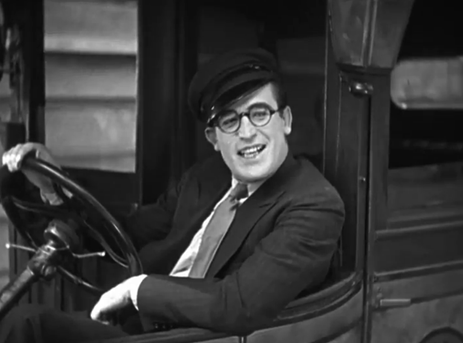
 It’s hard not to appreciate Harold Lloyd. His life was less tumultuous than Buster Keaton and during the 1920s he was more prolific than Charlie Chaplin. So if you look back at his career you can easily argue that he was not playing third fiddle to the other silent titans. He was their equal in many respects, and it’s only over the years that he’s fallen behind the others. But he deserves acknowledgment at the very least and his comedies such as Speedy make his case with rousing gimmicks and gags aplenty.
The film opens with Pop Dillon, the last of the horse-drawn streetcar drivers. He’s a kindly old man who lives with his radiant granddaughter Jane, who is faithfully by his side. But a corrupt railroad magnate is trying to buy him out, and he’s ready to go to great lengths to get what he wants. It’s about what we expect to happen, so the real entertainment factor comes with how we get there.
Enter Speedy (Harold Lloyd) a baseball-loving soda-jerk turned crazy cab driver and the sweetheart of Jane. It’s true that he starts out working the coffee counter with great dexterity while keeping up to date with the latest box scores of Murder’s Row. However, after a major blunder, he knows he won’t have a job when he gets back. Rather than stew in his misfortune, Speedy heads out on a Sunday afternoon in Coney Island with Jane. This proves to be a wonderful aside rather like in Sunrise: A Song of Two Humans, and there are a lot of great little gags being pulled by Lloyd, and others occur unwittingly. He tricks a myriad of folks with a dollar bill on a string and a crab in the pocket causes a lot of chaos. He even picks up a new unwanted friend in a hungry dog. But perhaps most of all the sequence is a fun nostalgia trip to the fair, showing off all the attractions circa 1928. It’s an eye-opening experience, and it still looks like quite a lot of fun.
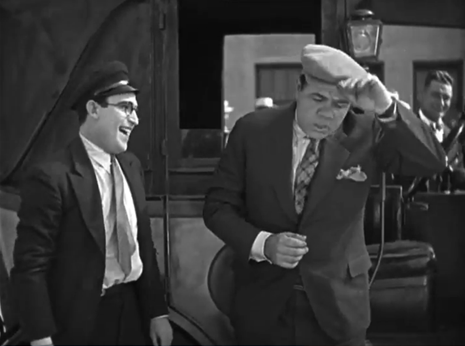 The other section of the story begins with Speedy garnering a job as a cab driver, but he has an unfortunate aptness for picking up tickets. He does, however, pick up some precious cargo in Babe Ruth (playing himself) and it leads to a wonderfully raucous ride to Yankee Stadium courtesy of Speedy’s crazy maneuvering through the streets of New York. Even Lou Gehrig sneaks in on the fun with a wry grin.
As the last order of business Speedy must save Pop’s cart from utter extinction and what follows is a rip-roaring brawl in the streets between the young thugs and the old-timers. Instead of being suspended from a clock, Lloyd must race against it to get Pop’s stolen livelihood back to its track in time. Once more he puts his madcap driving to good use.
Speedy lives up to its name and certainly justifies the popularity of Harold Lloyd. Its strengths include a plethora of sight gags that play off the audience’s sense of dramatic irony. Put them in the hands of such a nerdish icon and it spells true comedic gold. It’s Lou Gehrig approved no less.
4/5 Stars


 “On Sunday, August 13th, 1961, the eyes of America were on the nation’s capital, where Roger Maris was hitting home runs #44 and 45 against the Senators. On that same day, without any warning, the East German Communists sealed off the border between East and West Berlin. I only mention this to show the kind of people we’re dealing with—Real Shifty.” ~ James Cagney as C.R. MacNamara
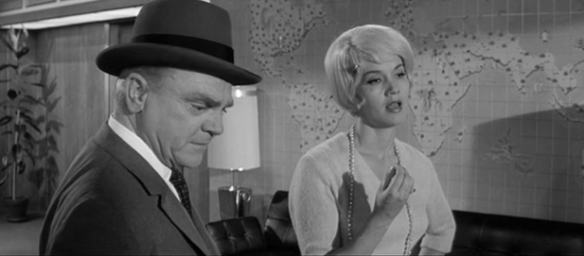 When he’s not getting English lessons or doing dictation with his shapely secretary (Liselotte Pulver), Mac is trying to swing a deal to start selling his billion-dollar beverage in the Soviet sector. He’s met by three bumbling boobs led by the portly Peripetchikoff (Leon Askin), who feel like heirs apparent to Ninotchka’s Russian trio.
 The monetized mayhem is complete with car chases, Soviet torture involving “Its Bitsy Teenie Weenie Polka Dot Bikini,” and a scramble to turn the belligerent Otto Piffl into a respectable capitalist. It’s a brilliant escapade blending social commentary and narrative hiccups as only Wilder could.


 Sabrina, Sabrina where have you been all my life? ~ William Holden as David Larabee
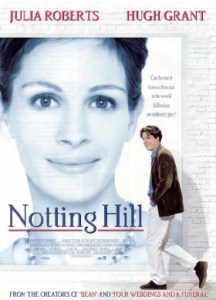 There is a scene in the film where a group of friends is sitting around the dinner table in the Notting Hill district of London, and they are having a friendly after dinner competition to decide whose life is the most hopeless. The winner gets the last delectable piece of fudge. One person sitting at the table is seemingly out of place. Actress Anna Scott (Julia Roberts). Her face is plastered on double-decker buses all down the squares. She made $ 15 million on her last film, circa 1999. You would think she’s got it made. But this woman takes her turn and shares about her own brokenness. She’s had surgeries to maintain her beauty. The tabloids rake her life over the coals, and when she gets old, she will only be remembered as the shell of someone who used to be famous.
 Disney has scored again. On almost all accounts Zootopia is grade-A family entertainment. To address the elephant in the room, the film is rather formulaic in its hero’s journey and at times it feels like we are attempting to systematically check off all the necessary moments in the rise, fall, and redemption of our spunky heroine. However, there are moments of wit and grace that begin to slowly grab hold of us an audience. It, in turn, becomes ceaselessly inventive with this metropolis of anthropomorphic animals, whether it is the rhythms of daily life or the social issues present that look strangely familiar.
