Three O’Clock High (1987)

The introduction of the main character Jerry Mitchell (Casey Siemaszko ) feels fairly standard and in line with Ferris Bueller, Say Anything, or any of its brethren from the ’80s. Late for school. Dirty shirts strewn about. Simultaneously zapping pop tarts and wet clothes in the microwave. Flat tires and your kid sister hands you a diet Coke to gargle the toothpaste you just finished brushing with. It’s quirky enough to give us some sense of who we’ll be following for the next hour and a half without straying too far from genre convention.

Still, all of this handy exposition feels a bit like a misdirect or at least suggests up-and-coming director Phil Joanou started out with one movie in mind and came up with something else along the way. More on that momentarily.

Jerry is a likable, if innocuous, dweeb we can probably imprint ourselves on and his high school, located in Odgen, Utah definitely doesn’t have the Hollywood glam. It lends itself to a different kind of visual milieu we can appreciate. All the adults in the movie for the most part are only totems to hang necessary impressions and sentiments on.

Jefferey Tambor is the closest to an actual character as a teacher who entrusts Jerry to run the student store and marvels at what a profitable business he’s managed. Otherwise, most of the authority figures and even government agents (how they always have time for teenagers is beyond me) feel like caricatures without too much premeditation.

Despite some promising introductions, most of the friends and female characters feel fairly empty no fault of their own. Jerry’s sister Brei has a chatty wit about her but essentially disappears from the movie popping up only when required.

There’s his thoughtful if slightly ethereal girlfriend (Annie Ryan) whose eyes grow luminous as she speaks candidly about spirit animals and her spirit “guide” Ethan. Don’t ask me to explain. And because Franny’s the brunette (yes, her name’s Franny), there’s also the untouchable blonde goddess Karen (Liza Morrow) who exists as a figment rather than a full-bodied character. She’s always ready to induce traffic accidents and seismic heart palpitations in our fearless hero.

Although it is Jerry’s story, it almost feels like it’s too much about Jerry and his inner psychology. He’s not the most intriguing part of the picture though we do need him as a conduit. Perhaps more could have been built out of his relationship and even his alienation from others. But it’s also necessary to take a moment to consider the movie’s tone and inspiration.

I’m not sure how to parse the fact from the fiction (this oral history is the best resource available) but supposedly this is one of the films Steven Spielberg requested to have his name taken off as an executive producer. It probably comes down to how dark it becomes though even this might lack the ring of truth.

Although it’s easy to label Three O’Clock High as a high school rendition of High Noon, it actually stands more in line with Martin Scorsese’s After Hours from a couple years prior. Given this comparison, Spielberg’s purported surprise would make more sense because this premise has all the potential hallmarks of a traditional ’80s teen movie.

Like its predecessor, I find it drags in the middle using time a bit like After Hours to give in to its most absurd and surrealist tendencies as Jerry’s world dissolves and slowly closes in around him.

One could easily say Soho in the prior film has been distilled down to the school corridors and classrooms Jerry is tied to as he sweats the hours ’til his inevitable annihilation. It does make it feel like Gary Cooper’s Will Kane when evoking the limiting factor of ticking clocks.

However, a venture to the principal’s office features the décor and camera angles fit for The Bates Motel. Later Jerry’s chased down by a security guard in the parking lot. Wasn’t the man in After Hours pursued by an angry ice cream truck? Otherwise, there’s a ghoulish school assembly accentuated by Tangerine Dream’s quintessential ’80s synths and any number of preliminary bouts laying the groundwork for his dreaded showdown.

We have yet to mention the movie’s primary villain whose psychotic reputation more than proceeds him, whispered throughout the halls and steps of the school as it is. The only reason there’s even a movie stems from Jerry’s position at the school newspaper. He’s given the unenviable assignment to profile Buddy Reveill (Richard Tyson) and one urinal encounter makes them mortal enemies for life. Nothing he can do can put off the unavoidable.

The ending does deliver on some of its payoffs by casting off any sense of moralism for a good old-fashioned bloody smackdown between good and evil without a ton of didactic consequences. Law and order are thrust aside as the adolescent masses cheer and rage sensing the brass-knuckled fury in the air. I did begin to wonder if in 80s-era America this hulking villain was a stand-in for fascist or authoritarian regimes. It’s of little importance.

Because this is only an afterthought as Jerry faces Goliath and is subsequently saved by the student body in a deus ex machina a la It’s a Wonderful Life. The lesson: It pays to stand up against tyranny and oppression in the school parking lot. More important still, boyish fantasy is kindled and nothing else exists beyond this singular moment in time. It is a kind of wish fulfillment for young males of a certain age.

Whether it was Joanou’s inspiration, screenwriters Richard Christian Matheson & Thomas Szollosi, or more likely a confluence of everything, Three O’Clock High feels more like a cult curio than an unadulterated classic. That’s not meant to be a slight, nor a total dismissal. It’s not Scorsese (it’s not even Speilberg). But it shouldn’t have to be. It deserves to be taken or left on its own terms as another addendum to the ’80s teen movie canon.

3/5 Stars

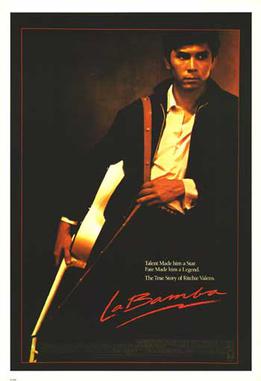
La Bamba (1987)

I must have learned about Ritchie Valens through Don McLean’s “American Pie.” Because there was a time when I was fascinated by all the musical references that seemed so oblique to my young mind. Eventually, the songwriter’s ode leads you to “The Day The Music Died” and if you know about Buddy Holly, you soon learn about The Big Bopper and Ritchie Valens.

The song “La Bamba” feels like a definitive track of a certain rock n roll era, and only now does it become easier to realize what an important cultural milestone it represents. The Mexican language went mainstream blending the rock craze with folk traditions of a people who felt well nigh invisible if no less important in the ’50s.

I do not know much about Luis Valdez, but as an emblematic figure in the Chicano movement of the ’60s and ’70s, he also gave us two of the most noteworthy Chicano movies of the 1980s. He turned his own play into Zoot Suit with Edward James Olmos, a film I was never able to fully connect with, but La Bamba feels like a more straight down-the-line biopic. He effectively brings to life one of the great Chicano heroes of the second half of the 20th century.

Lou Diamond Phillip’s vibrant performance glows with undeniable warmth and vitality. There’s not a disingenuous bone in his body, and he’s able to evoke the joy behind the microphone and the quiet fortitude that comes with his humble migrant background.

This is one of the most moving things about Valdez’s film because even almost 40 years on, these slices of life are still not always prevalent on the big screen. To see them in a period piece seems even more fitting because it’s a way of capturing the cultural moment for us lest we forget.

We see the plight and humble living conditions of migrant workers, there’s instability and broken families, but also the unbreakable bonds of extended families and communities looking out for one another.

La Bamba also has many of the beats of the biopic and since I don’t know the life of Valens intimately, I can only give conjecture on what’s fact and fiction. Part of the story involves his older half-brother (Esai Morales), who exists as the black sheep of the family opposite Ritchie. There’s the blooming of young love with the new girl in class, Donna (Danielle von Zerneck). His family and high school lives run in tandem with his meteoric rise after a record producer, Bob Keane (Joe Pantoliano), agrees to record some of his tracks.

Valens fear of flying, after a midair collision over his school, which killed his childhood friend and left him with recurring nightmares, has the ring of truth stranger than fiction. In keeping with this, the opening interlude of Santo and Johnny’s “Sleepwalk” feels apropos to represent the general mood of the era. What follows is a bit of a dream even as other moments sting with harsh realism.

There are so many narratives that could happen. There’s a bit of a Romeo and Juliet romance as Donna’s father tries to rebuff Ritchie’s sincere advances. Still, Donna remains devoted throughout the picture, and what a lovely thing is to see their euphoric joy together. The images suggest you don’t have to look like one another to fall in love. The fact the movie draws up this star-crossed romance between a 17-year-old and his 15-year-old beau feels of small consideration. It is a movie.

His brother knows how to make an entrance rolling up on his motorcycle, sunglasses on, cigarette between his lips. Or maybe this is only how we imagine him. Still, Bob’s demons could have been their own movie making him into a perturbing, abusive, drunken figure at the movie’s volatile center.

He’s effectively cast as Cain, never good enough or able to find favor in comparison to his thriving little brother. He spends the whole movie self-destructing and coming to terms with his brother’s burgeoning success. Later in life, it seems his real counterpart was able to resurrect his life and became a beloved member of his community.

Likewise, Bob Keane shows up in Ritchie’s life. We don’t really know how he got there or what all his motives are; still, there’s nothing too sinister in it. He helps Ritchie get big by recording and promoting him, and Valens is on top of the world.

It’s easy to see how all of these dynamics might have been either simplified or drawn up in such a way as to streamline the story or punctuate the dramatics. And yet I never begrudge the movie its choices, because it does feel like such a bountiful cultural artifact. The fact Los Lobos provided much of the soundtrack and even show up in a musical cameo is another notable distinction.

And the gutting, sinking feeling in the pit of our stomachs signals the dream cannot last. This talent taking the world by storm and rocking out with Eddie Cochran and Jackie Wilson will be snuffed out far too soon. So if everything else gets resolved in a Hollywood manner, our star is still going to be taken from us in the final reel. There’s no way to get around it.

McLean’s song mourned over it as “The Day The Music Died.” Thankfully, he was wrong. Yes, we no doubt lost out on years of musical output from Holly and Valens. Their young talents were undeniable, and yet their contributions to rock ‘n roll are far from dead. For their relatively short time in the public eye, they’ve cast very large shadows indeed. “La Bamba,” “Come on, Let’s Go,” and “Donna” feel like genre standards by now.

In his own way Valdez has guaranteed Valens won’t be totally disregarded (it was added to the National Film Registry in 2017), and Lou Diamond Phillips, bless his heart, made Valens far more than a hagiography of a deceased icon. He’s a young man with a warm, beating heart, a love for his family’s culture, and a love for rock ‘n roll. I can’t think of a better testament to Ritchie Valens than that.

4/5 Stars

Mystery Train (1989)

I hold an immediate affinity for the images at the core of Mystery Train: A Japanese couple (Youki Kudo and Masatoshi Nagase) riding a train. This is the ’80s so they’ve got a walkman with an audiocassette tape, and it’s blaring Elvis! It becomes apparent they are making a pilgrimage to Graceland so famously immortalized by Paul Simon. The song “Mystery Train” becomes an apropos and uncanny way to enter the story while paying homage to the King.

Jim Jarmusch always strikes me as such an open-minded and curious filmmaker. Modern society speaks in terms of diversity and inclusion, but the beauty of watching a Jarmusch picture, it’s the fact he’s not looking for these things in order to meet some quota. He seems generally interested by the stories and perspectives a whole host of characters can provide him, and his films benefit greatly from this enduring proclivity.

Regardless of where the funding came from, who else would consider making a film about two Japanese youth in search of Elvis Presley in the 1980s? They spend the first several minutes speaking a language that the primary audience probably does not understand. They likewise are bewildered by a upbeat yet motormouthed docent at Sun Records. Still, somehow shared passions for Carl Perkins, Jerry Lee Lewis, Roy Orbison et al., draw them together in inextricable ways.

There’s something perfectly fated about the whole thing with Screaming Jay Hawkins as a rather flamboyant hotel clerk aided by a youthful bellhop (Cinque Lee). I don’t know how to describe it but Hawkins has a command or a sway over the picture rather like Wolfman Jack in American Graffiti. His presence is felt and becomes so indelible in accentuating an aura. He comes to represent a certain era and a place in human form.

Jarmusch’s characters of choice often feel like sojourners, strangers in a strange land and Memphis is such a place. It is a film that features degradation — cracked pavements, garish neon lights, and portions of the world that are not perfectly manicured. What a concept. It’s almost like Jarmusch is giving us the real world albeit composed through his own cinematic lens. It’s no coincidence it has this kind of baked-in glow of Paris, Texas another film of geographical Americana captured so exquisitely by Robby Muller

It’s only a personal observation but my level enjoyment slightly decreased with each descending story. As someone who journeyed in Japan and went to one of the greatest concerts of my life in Yokohama, I feel this kind of kinship with these Japanese youths in their pilgrimage to Elvis and Carl Perkins. Also, on another level, this is a point of view we just don’t often see in movies of the 1980s or even today. Jarmusch is not using them as some kind of stereotypical punchline. He’s genuinely interested in their story and allowing it to play out in front of us.

Then, there’s Nicoletta Braschi in part two. She’s told a ghost story by a dubious stranger and gives him a tip to be left alone. She too seeks asylum for the night at the same hotel and gains a chatty roommate (Elizabeth Bracco) who is linked to our final vignette.

This last interlude with Steve Buscemi feels like it exists in the time capsule moment of a certain era where Tarrantino, the Coens, and others were making these stylized, often grotesque comedies. Elvis (Joe Strummer) gained his nickname inexplicably, but he’s also started to become unhinged because his girlfriend went up and left him. The cocktail of booze and firearms make his buddies Charlie (Buscemi) and Will Robinson (Rick Aviles) uneasy. Although it feels more like an absurd episode of The Twilight Zone than Lost in Space.

Regardless of my own preferences, Jarmusch still gives his world a sense of purposefulness. Again, it’s this serendipitous quality reminiscent of Jacques Demy’s fated films where lives cross paths and intersect in deeply poignant ways.

There’s something somehow elegant about the structure. It’s certainly premeditated and Jarmusch purportedly was inspired by classical literary styles in constructing his triptych, but it’s also a genuine pleasure to watch it unfurl.

The movie revolves on the axis of a few shared moments and places: A hotel, a radio DJ (Tom Waits) playing “Blue Moon,” and a gunshot. But it’s not like they’re all building to some kind of collective crescendo; it’s more so just a passing indication of how lives, whether they mean to be or not, are often interrelated.

Characters orbit each other and interact in these preordained ways that reflect the mind of the maker, in this case, Jarmusch. There’s something oddly compelling and comic about it, but there’s simultaneously a sense of comfort. We have order and a kind of narrative symmetry leading back out from whence we came.

Jarmusch is calling on the poetry of the ages and so in a movie that seems to have a free and laissez-faire attitude, there’s still a very clear order behind it, three distinct threads end-to-end and yet still interwoven into a tapestry that we can appreciate. Mystery Train represents the best in cinematic storytelling — with purposeful composition and aesthetics — but also a sense of aura and inscrutability.

It’s funny and yet when it’s over there’s also satisfaction and a hint of wistfulness. I wish there were more of its ilk today. The movie that’s come the closest is Paterson — another modern jewel from Jim Jarmusch. I see that film in a new light as a much older, wiser, and more forthcoming Masatoshi Nagase sits down on a bench with Adam Driver.

Again, it is a story about the human journey, how we are all travelers in some sense, and what a beautiful thing it is to relish the road because it can lead us to so many beguiling places if we take the time.

4/5 Stars

The Intruder (1962)

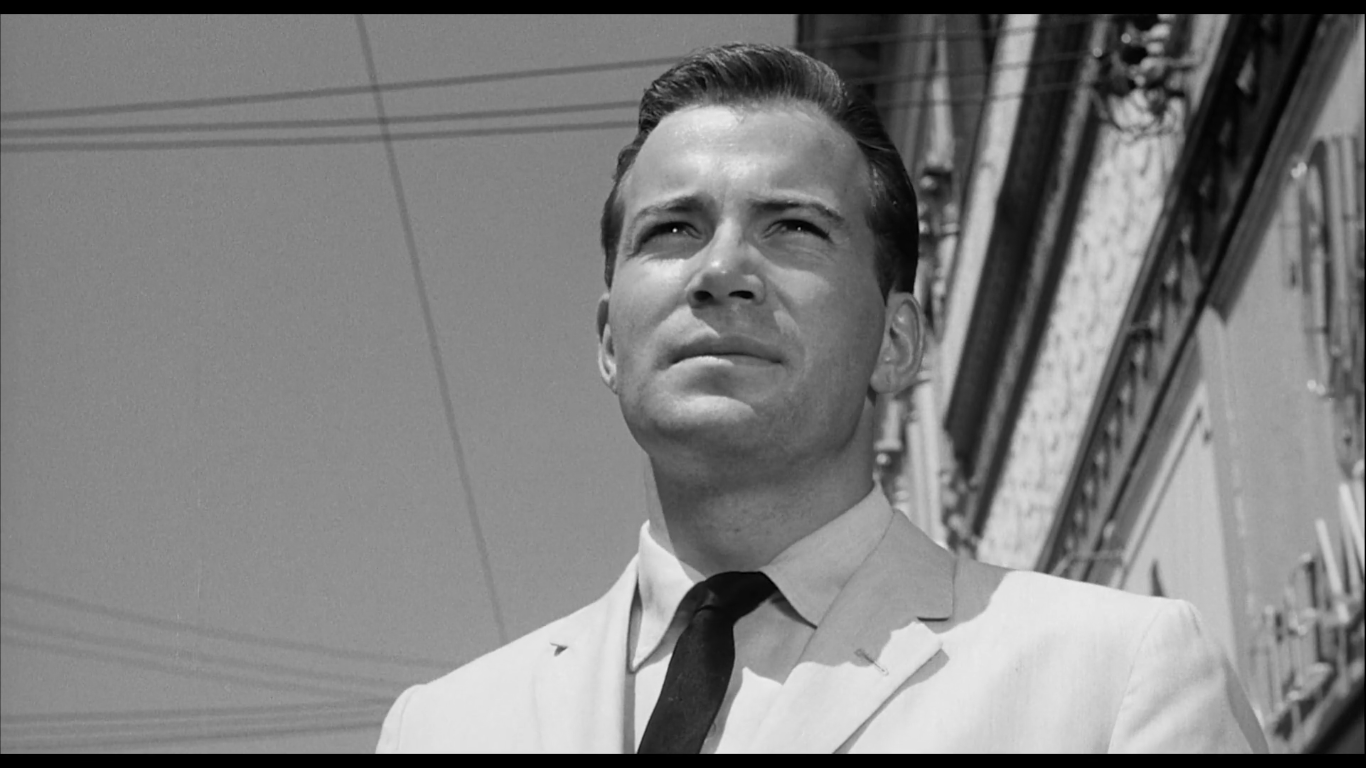
Before he became a caricature of his former self, even before the days of Captain Kirk and pop culture canonization, The Intruder is a reminder of something else in William Shatner. He still feels ripe and almost dangerous with a charisma that has yet to be calcified or even corroded by time.

The same could be said of Roger Corman at least if you only have a perfunctory understanding of his career like me. He is the master of fast and cheap entertainment turned out for profit at a rapid rate. Surely, The Intruder doesn’t fit into the patchwork of his career.

Before we blandly christen him the “King of Schlock,” a more nuanced observation seems to be in order, considering both his talents and his ambitions. Others must speak to this more knowledgeably. All I can say is that this specific film totally obliterates any preconceived notions of what we are getting.

Shatner stars as Adam Cramer, a self-described social reformer with a skeevy look in his eye to go with a cool disposition. He’s headed out on the latest bus to help the locals fight the government implementation of integration in the town’s high school. Under the guise of the freedom-loving Patrick Henry Society, he’s ready to stir up some action. Give me Liberty or Give me Death (though mostly death). In other words, a real creep.

He sets up shop at the local hotel — it bleeds with crusty southern hospitality — feeling like a stronghold for a racist status quo. He’s put up by a sweet ol’ lady while his next-door neighbors, a gregarious salesman (Leo Penn), and his flirtatious wife (Jeanne Cooper) don’t leave much to the imagination. We know what they’re doing and they don’t much care who knows it. It’s a good thing because the walls are especially thin in a place such as this.

Although the film is primarily white-centric, for a white audience, there are some black characters playing crucial roles on the periphery. One is the local minister, a man of faith who takes his calling seriously. He exhorts the youngest members of his congregation in meekness and prays over these 10 lambs from his flock. He’s well aware they are about to enter the valley of the shadow, a space no young person should have to be subjected to. Still, the letter of the law in some ways falls on their side in the face of threat and injury.

One evening on a grand old southern estate Cramer holds a rally to rile up the townspeople, spewing all sorts of epithets, and appealing to their spirit of discontentment.  The NAACP is a communist front, headed by a Jew. It’s all a sham. The government can’t be trusted and The Patrick Henry Society is tasked with preaching the truth — at least his version of it.

As we watch the masses be swayed and he skillfully plays them like a marionette with public opinion in his palm, the deviousness comes into full color. He’s a Lonesome Rhodes-type figure who uses his own magnetism to get what he wants.

When the whites, armed with their newfound ammunition, take to the streets ready to victimize a black family driving home the movie becomes too real. It’s almost like the film was overly cognizant of its time with an incisiveness toward the hot-button issues of the age. Even today it feels gutting to watch whether fiction or not. The images strike too close.

Shatner riding in a hooded caravan with a gang toting a cross through the black community is horrifying. There’s a faceless dynamiting of a church with the faithful minister left for dead. The only other time I recall something comparable in mainstream Hollywood was the mobbish vitriol in Phenix City Story a few years earlier. To Kill a Mockingbird is wistfully nostalgic in comparison. Right or wrong, The Intruder has no such illusions.

Cramer is a man who happily takes a prison sentence telling a wealthy backer (Robert Emhardt) to never underestimate a jail sentence — remember Socrates, Lenin, Hitler… How you can conflate all these men says so much about you. And of course, there’s no mention of Dr. King. This is not the kind of man to dignify a fellow reformer on the other team with an acknowledgment.

The most curious figure (aside from Cramer) is Tom McDaniel (Frank Maxwell). He’s a southern man. He’s been inculcated with the prevailing sentiments of the South, but he also seems to have a higher standard. It’s partially because he’s the herald of the local news — he has journalistic standards — but there’s something else we have to spend time with him to figure out. His wife disagrees. Grandpa wants to disown him. His daughter (Beverly Lunsford) is probably still trying to make sense of it all. Regardless, he believes the law must be carried out.

I don’t know if we ever get a clear indication of why. Although he’s not the only one we can say this about. I’m not sure if we ever get a precise reason for Cramer’s actions either. He’s not a Southerner and there’s never a clear indication he’s truly aligned with the white community, at least not when it gets right down to it. He’s not a Southerner. But he knows he can manipulate them for his purposes.

My fear is that the film is still too much the pipe dream of well-meaning moviemakers where southern guilt all of sudden turns a few solitary individuals into men and women of conscience. Maybe this is historically true. I don’t know, but for all the stories that ended like this with a life saved and a wolf in sheep’s clothing defrocked, we know that history was not always so forgiving. It is strewn with the names of men and women who were degraded, intimidated, and often killed.

That’s why part of me rumbles with a deep sentiment that must be acknowledged. It wants to cry out and warn folks not to see this movie. The inclination begins when they threaten to flip a black family’s car and reverberates again when a young white woman gets coerced into crying rape against a fellow black student named Joey (Charles Barnes).

There’s almost something indecent and profane about it as it echoes things that really came to pass. It’s this fine line I don’t know quite how to reconcile. Because I’ve rarely seen a movie this fierce and unflinching for the era, and yet in the same breath is this what is required then or now? It’s an open-ended rhetorical question. I don’t know the answer.

If the box office receipts are testament enough, the movie didn’t make much of a dent but for entirely different reasons. Roger Corman seems to have made his own implicit response. He never made another such picture again instead relegating his talents to Vincent Price Poe dramas and other such fare blessing the film world in another way. Yes, it was cheap entertainment, but also a breeding ground for some of the up-and-coming stars of the New Hollywood generation.

He did in fact make his own diagnosis of the film’s lack of success, which might be telling if not altogether definitive:

“I think it failed for two reasons. One: the audience at that time, the early sixties, simply didn’t want to see a picture about racial integration. Two: it was more of a lecture. From that moment on I thought my films should be entertainment on the surface and I should deliver any theme or idea or concept beneath the surface.”

Still, with a man’s face buried in the grass, a man fallen from grace head first, The Intruder totally reframes my perceptions of the now chubby anachronism of Shatner’s persona. I won’t say it redeems it so much as it augments it with a kind of duplicitous venom. It’s a new astounding contour to his career.

I’m still not sure if that’s a hearty recommendation or not. This is a very triggering film and a deeply onerous watch. The discerning viewer should make their own judgments. Because for some this kind of burden might be necessary. For others, it might be too heavy to bear.

4/5 Stars


Note: This review was written before Roger Corman’s passing on May 9, 2024

David & Lisa (1962)

Keir Dullea is an actor who will always be most prominently remembered for Stanley Kubrick’s 2001: A Space Odyssey. He’s Dave of pod door fame. However, part of me wants to promote him as the lead in David and Lisa because this film from Frank Perry, in its quiet empathy and emerging relationships, feels more deeply like his film.

It relies heavily on his turn as a grim young man with OCD-like symptoms. As his mother drops him off at a psychiatric center for a brief stint, he immediately carries himself as a youth too smart for such an establishment. He’s an aloof loner with cold temples and the most severe eyes. Surely, this is a story about David’s transformation.

But the ampersand in the title reminds us that he only works in tandem with another life. Likewise, Dullea’s performance gains more meaning when he is put up next to Janet Margolin in her screen debut. She causes him to change and shift even as he elicits something out of Lisa.

Since I got my first introduction to Margolin in Take The Money and Run and became instantly smitten, it’s fabulous to see her in another role that plays so exquisitely off her inherent human charms. Lisa is a young teenager with a penchant for rhyme. If we want to diagnose her, she has schizophrenia, but the beauty of the film is watching people reach out to each other, instead of categorizing each other dismissively.

Even someone like Howard Da Silva is a pleasant surprise. In the old days, he mostly played conniving heavies in film noir; here he settles into the role of benevolent authority quite easily, and it’s a fine look for him. He wears it well. David is so quick to distrust him and what he stands for. Over time, the authenticity is so apparent that even he is won over. He comes to appreciate the place as home. It’s a space to belong.

However, if I’m honest, David and Lisa is the kind of film that feels like it might be frowned upon today if we know nothing about it. Still, there’s a tenderness in the love story that I can’t quite shake. It’s disarming and totally flies in the face of expectations.

I realized that whatever way you take it, there are these kinds of overt metaphors to the film. People who are different than the society around them somehow find solace in this shared sense of otherness. He meets her with rhyming and she meets him in a way by not reaching out with human touch. The things that ostracize them also have the inertia to draw them together.

If these are idiosyncrasies, then they respect them and respect each other enough to take their predilections seriously. Meanwhile, “normal” well-adjusted people at the local train station castigate them as weirdos better resigned to the funny farm.

But even when David makes a brief return home, the perceived distance at the dinner table and the manifold hangups of his own parents, make it apparent we do not live in a society of the well-balance and the imbalanced. Those in the former category either do a better job at hiding it or they have enough money to smooth it over. Success and status can cover a multitude of social sins, at least on the surface.

There’s one particularly crucial moment where I became mesmerized with Margolin watching her sway with the metronome although it precipitates a kind of demonstrative ending that doesn’t do the story much service. In one moment of annoyance, David lashes out at Lisa only to work tirelessly to win her back. Their chemistry is so fragile, held together by wisps of gossamer thread, but that makes it all the more vital to maintain.

When Dullea scampers up the Philadelphia steps, and they share a moment so much unspoken emotion is carried with them in the scene. It’s only the two of them. She no longer rhymes. She’s fully herself. “Me,” she says.

He reciprocates by doing the bravest most vulnerable thing he can, asking her to reach out and touch him. I remember a line of prose by C.S. Lewis about love being vulnerable and this lasting image is a testament to this truth. Here the pain and transparency brim with sympathy.

David and Lisa can be characterized as a romance, although it is one where the leads never kiss, never embrace and only touch in the final frame. Somehow it’s packed with more import than many other films claiming the same genre conventions. Because what some other films forget is that love and affection, romance, they all require so much more than physical touch. It’s about warmth and stillness. Willing to open yourself up and be hurt by other people even as you stretch yourself as a human being.

For a film about psychological disorders from so many years ago, there’s a gentle subtlety to David & Lisa; it’s quite extraordinary, and Dullea and Margolin make a wonderful pair together. It’s only a shame they were not both allotted even more high-profile vehicles commensurate with their talents.

3.5/5 Stars

The Little Fugitive (1953)

The aesthetic of The Little Fugitive is made plain thanks to chalk drawing credits playing over “Home on The Range.” We are about to enter a little boy’s world with all the joys and menial problems an adolescent life engenders. The key is giving these problems credence. Because in a young life, they feel ginormous.

Joey Norton always has his trusty pistol and holster and his big brother Lennie can always be found with his harmonica. They have your typical sibling dynamic. The little brother nagging, the big brother both put-upon and protective.

There’s an initial impression from the clunky dialogue causing the illusion of the film to falter. However, everything else around it feels real and sincere in a way we are unaccustomed to seeing in 1950s American films. Then you realize the whole picture had its dialogues done after the fact and it falls into place.

Coincidentally, it does give it a European sensibility with the dubbed dialogue. I can see how a film like this might have come to Cahiers du Cinema, Francois Truffaut in particular, and lit a fire under them. This is what movies could be, and not only something they could be, but also something attainable to others as long as they had a personal story to tell.

The 400 Blows but also Breathless and Le Beau Serge, developed narratives out of spaces the directors knew intimately. It wasn’t outside the purview of their experience, and it made a stunning entry point into their respective cinematic visions as they continually evolved over time. Still, one cannot discount their origins.

In the era of The Little Fugitive, a boy’s world was occupied by very specific things: baseball, guns, cowboys and Indians, television serials, comic books. The premise itself feels like an episode of Leave It to Beaver albeit outside of the watchful eye of middle-class suburbia.

Mother has to go away to pay a visit to a sick grandparent. Lennie has to watch over his little brother, and it’s going to derail his birthday outing to Coney Island with his friends. We have a simple dramatic situation and although he’s not a bad guy, he needs to use his boyish ingenuity to find a way out of his responsibilities. A dagger made out of ice is too impractical so they get the idea of using ketchup to fake a grisly death like they do in the movies.

The trick works wonders on getting rid of a pesky brother, and the film really comes into its own as they take it to the streets, and he’s out on the lam. It seems prudent to mention Ray Ashley, Morris Engel, and Ruth Orkin, the trifecta behind the film’s conception.

Their greatest asset was a cutting-edge 35 mm camera both portable and unobtrusive making The Little Fugitive landmark for another reason. It really feels like one of the obvious birthplaces of independent cinema because we have this idea of film emerging from the studio lots out onto the streets. And these aren’t just exotic foreign locales but the humble spaces you and I frequent in our daily lives. Even these spaces can have their share of fascination for a willing audience.

It’s a cornucopia of leisure, a boy’s delight having a day on Coney Island. We get a steady stream of vignettes: photo cutouts, batting cages, hot dogs, watermelon, the beach, ball toss, and whirling carousel rides providing full immersion of a different era.

Not since Harold Lloyd can I recall such a great showcase for Coney Island. We’re even reminded recycling was a problem at the beach back in the 1950s too. Joey quickly learns he can make some loose change culling the seashore for glass bottles and simultaneously proving himself to be inquisitive and quite entrepreneurial.

I’m not sure how our little fugitive had so much money to begin with; the film doesn’t find need to explain itself, but then he figures out how he can get more and uses them on a very sound investment: pony rides. He’s positively infatuated with ponies, and it shows him returning time and time again just to get another chance to live out his dreams on the range.

Although the film is mostly kid-centric, it’s a pleasure to observe several of the adults who seem to be genuinely nurturing souls. Whether it’s the photographer (Will Lee) or Jay the ponyman (Jay Williams), they seem to encourage kids in their interests and imagination. It would be so easy for a film like this to feel severe and somehow oppressive, yet what comes off is the lightness and the joy of each of these very specific moments as experienced by a little boy.

If I’m honest, I’ve recognized a growing bias in my own film appreciation. I’m partial to films that use modest means, modest runtimes even, and still manage to transport us with stories and worlds we can relate to. I can think of no finer compliment for The Little Fugitive because it captures a moment plucked out of my parent’s generation, honed in on a very particular Brooklyn milieu, and through its images we are able to imbibe all these tactile sensations pulling us into the moment.

Although the boys at Cahiers can feel a bit arrogant and combative, even in how they dismissed much of the past and canonized the auteur-director as king, I do like the idea that they placed no undue importance on bigger, larger productions tossed out as awards bait. There’s something almost more satisfying happening in a movie like this because not so many folks will be joining the bandwagon — the fad of the cultural moment. That is the road lined with glitz, accolades, and transience.

Only with a bit of diligence and an open mind, do we get the opportunity to unearth it, and what a glorious joy it is. Unassuming gems like this make the moviegoing experience such a spectacular journey of human revelation. Because this little boy’s day speaks to so much and since I was a boy once, it resonates deeply. I won’t forget it until the next time I return to this story caught in time, where it will be waiting for me again even as I continue to change. This is the magic of the movies.

4.5/5 Stars

Beijing Watermelon (1989)

Nobuhiko Obayashi is known to a pocket of western moviegoers for his crazy, unhinged haunted house flick Hausu (1977), but as I’ve gotten more familiar with at least some of his filmography, I’ve come to appreciate his more grounded works.

Using this phrase has the danger of giving the wrong impression about him. This doesn’t imply boring or anything of the sort. Still, some of his later works are told with such humanity through relationships, humor, and often a wistful nostalgia that comes on the tails of youthful optimism.

Beijing Watermelon hardly makes a blip on the radar. I consider myself fairly well-versed in film (albeit with many noticeable blind spots), but I had never heard of it.

Still, this film spoke to me through its simple rhythms. It’s easy enough to introduce the premise and still fail to totally articulate what makes this movie such a meaningful experience for the right person. Because it a mundane slice of life tale following a grocery store owner who comes to form a bond with a contingent of Chinese students studying and living in Japan.

It begins inauspiciously enough when a poor Chinese student tries to barter with him. He’s a bit offended by it — his prices are already reasonable — but events cause him to take an interest in the young man’s life and his well-being. He meets Li and a host of local students who are many miles away from home. It feels inexplicable at first, but as time progresses, they form an unalienable connection. I’m not sure if other’s find this cross-cultural relationship to be unbelievable or at the very least somewhat whimsical.

As someone who has lived abroad in Japan of all places and relied on other people’s good graces, there was something so resonant about this scenario. It spoke to me on a profound level, and it was not in spite of the mundane nature but rather because of it.

The comedian “Bengal” who stars as the greengrocer Haruzo Horikoshi, somehow reminds me of the Tora-san character. It’s almost like he’s an extension of the Japanese comic prototype. He’s at times a buffoon and outlandish, and yet he’s imbued with so much heart and by extension pathos. If we stretch the Tora-San metaphor, he feels a bit like the Japanese everyman who brings back nostalgic reminisces of a different era. There’s something hilarious and tragic and warm about him all at the same time.

I must admit that there’s a point where it feels like the Chinese students are taking advantage of Mr. Haruzo. Perhaps it’s just a cultural difference and a way of showing good-humor and affection, but as an outside observer and someone who has a modest appreciation for Japanese courtesy I felt bad for the man.

At the same time, he continues to grow more and more accustomed to providing them discount goods, maintaining letter correspondence with Li when he returns home, and then picking up a new arrival at the airport named Zhang.

As a side note, there are two airport sequences that feel so authentic. The callow student looks downs and realizes his bags are missing! Of course, they are nearby where a thoughtful lady has set them aside out of the way. Also, a local Japanese man brags about his English prowess. Except the moment an English-speaking tourist asks for directions, he has no help to offer and sheepishly walks away.

By this point, we must ask the question: why does Mr. Haruzo feel compelled to do all this? There’s something in his constitution that makes him different, causing him to go against the tide of Japanese convention. Because what he does transcends polite niceties and keeping up appearances. Dare I say, it’s true sacrifice.

Could it be he’s slowly falling in love with the earnest Pingping? A lesser film would have played this up for the sake of drama. But while the affection is evident, it never goes further than that.

Meanwhile, his local neighbors joke that he’s caught the “Chinese disease.” If that’s so I’d probably wish I had it too. Of course, eventually it seems to derail his life. His business isn’t profitable anymore, he’s less present with his family. His long-suffering wife (Masako Motai) is trying to pick up the slack because he feels mostly absent. His kids feel ashamed by how he’s acting. Even his shaggy-haired employee vows to go to a rival supermarket where he won’t be a laughingstock.

It feels like Mr. Haruzo’s ruined — entirely thrown away his life — and soon the tax board comes to impound his belongings while he’s also detained for a hilarious public disturbance while requesting a loan. The heightened blood pressure leads to an extended stay at the hospital. Surely this cannot be the fruit of his troubles? He’s in such a dejected space with his family unsure what to make of him.

It’s a bit on the nose, but I think of that immortal line that “no man is a failure who has friends” and of course, the friends Mr. Haruzo has in his life come to his aid when he needs it most. It’s a beautiful sentiment and something I’m sure many of us recognize if we’ve ever been enmeshed in a close-knit community.

The watermelon becomes one of the substantive cultural metaphors of the film, and as someone who lived in Japan as a westerner and has spent many years working in international spaces, this film speaks to me on a deep level.

Surely you don’t need this in order to appreciate the film, but as I watch this Japanese man build cultural bridges and become a kind of local institution with a spread in the paper and then getting treated like a king by all his grateful beneficiaries, I was fundamentally moved.

I think of the people in my life overseas who watched over me at my most vulnerable or lifelong friends my parents and siblings have made when they were abroad. If we let it, film can be one of the great universal unifiers, a language unto itself that connects us and transcends cultural origins or international borders. That’s what it’s often been for me and Beijing Watermelon is such a winsome portrait of what I aspire to in my life.

I’m not sure if anyone else has made this comparison, but Haruzo Horiko feels a bit like a Japanese Mr. Chips because with his name comes a lasting legacy and impact. It turns out to be an extraordinary life.

There is one last aspect of Beijing Watermelon that deserves some comment. I acknowledged already that this is one of Obayashi’s more formally traditional films, and yet he still breaks out of narrative convention — not for want of ostentatious showmanship — but because it serves the story he wishes to tell.

I could not track down any definitive details, but Beijing Watermelon is supposed to be based off real events that happened. However, Obayashi takes this biography and gives it a Brechtian ending, somehow working with the negative space of the film and what it does not show.

Bengal speaks to us and tells us we are back on a Japanese set in a studio. He and his movie wife journey to China and yet it’s made explicit that they are in the cabin of a plane set and not an actual plane for a reunion with all their Chinese friends.

If you’re like me, you question why have this break with the cinematic reality? The movie was humming along beautifully without the distraction. But then it slowly becomes more apparent the longer you sit with it, especially considering the cultural moment and what was happening in China — the Tiananmen Square massacre of June 4, 1989 being a particular inflection point…

Because even if you are not aware of any of this, there’s something imperceptible and still intuitive about the melancholy that comes over the viewer. It’s all there in the movie both the warm feelings welling up inside of us, but also this inherent sense of sadness carried with those Chinese students as they play and sing their bittersweet song on the beach with the credits rolling against them. The postscript of the movie is what does it for me as a final rallying cry and call for greater cultural understanding:

“We dedicate this film to all our young Chinese friends.”

What an extraordinary film. I hope more people can search it out and enjoy it as much as I did.

4.5/5 Stars

CMBA Blogathon: The Last Hurrah (1958)

This is my entry in the Spring CMBA Blogathon Debuts and Last Hurrahs.

In the isolated occasions when I had to debate in high school classes those who did this kind of thing for fun and seemed most destined for politics, were all people I would never want to vote for regardless of affiliation.

Because it seemed like there was a self-selecting bias. The people who wanted, nay desired, this kind of world, were not ones I necessarily respected.

How could a decent person of moral fiber get through and win? The cynical answer is they can’t unless they are propped up by a political apparatus of some kind. However, before I sound too jaded, I still am optimistic there are good people working in government.

No one would confuse John Ford’s The Last Hurrah for a tirade against big government and political machines. This is not a Frank Capra picture. Instead, there’s a certain level of give and take, a nuance, celebrating a style of old-fashioned politics while acknowledging the need for political strategy and networks.

No director brought more of the Irish-American experience to film than John Ford and you see it from his Calvary westerns to his West Point hagiographies, and even a portrait of his homeland like The Quiet Man.

Frank Skeffington (Spencer Tracy) is in the midst of his latest and perhaps final foray campaigning for the mayorship in a New England town. His personal entourage of right-hand men in bowler hats (including Pat O’Brien and James Gleason in his final role) have seen him through everything.

My initial observation is that this is a mature man’s game. The young (including myself) seem like idiots. His son (Arthur Walsh) isn’t registered to vote, doesn’t watch the debates, and is always running off after golf or other frivolous entertainments.

Another local magnate (Basil Rathbone) who opposes Skeffington has a son (O.Z. Whitehead) who makes a fool of himself by unwittingly accepting the position of local fire commissioner. Skeffington has instant leverage against his old adversary. Then, there’s an up-and-coming appointment — a young Catholic war hero and lawyer. More on him in a moment.

Skeffington is not naïve. He knows how to play the game. He’s continually pragmatic, pressing his advantages and the alliances at his disposal and knowing what it takes to win. You don’t maintain the office year after year without knowing the rules of the game. Perhaps Ford casts him with a rose-colored, nostalgic tinge, but at least he has some scruples or at least a sense of who his people and electorate are. Because he’s been knee-deep in the community.

His most obvious opponent is an unknown newcomer named McCluskey, and it becomes apparent he feels like a caricature cutout of John F. Kennedy if the man lacked charisma and intelligence.

Of course, JFK was a famously photogenic figurehead who used Frank Sinatra jingles, his public image, along with a platform to beat out Richard Nixon in 1960 (He also hailed from one of the most influential families of its day thanks in part to his father Joe Kennedy).

Nixon himself practically instigated the political television revolution with the pathos appeal of his Checkers speech in 1952, and thenceforward the televised debate presaged a radical new kind of American politics. The rules changed.

Adam Caulfield (Jeffrey Hunter), Skeffington’s nephew, works as a sportswriter at a local paper. His editor (John Carradine) fights tooth and nail against Skeffington with an obsessive grudge, throwing every iota he has behind McCluskey so he might vanquish his mortal enemy. Adam is far more accommodating and has a congenial relationship with his uncle.

When he pays the seasoned politician a visit, Skeffington calls politics the greatest spectator sport! He invites Adam to cover the events and tells him in confidence that he wants to try and win a campaign race one last time the old-fashioned way; he’s astute enough to know his days are numbered thanks to television and other readymade forms of advertising.

Although it’s not mentioned explicitly I can imagine Skeffington admired the political acumen and rhetorical vigor of a great American stalwart like Abraham Lincoln. John Ford of course made a whole film about his early years and rise to prominence before he ever became president.

I mention this only to echo the thoughts of Neil Postman in Amusing Ourselves to Death. Our culture shifted drastically from a literary culture where arguments were well-thought-out and expounded upon in debates hours long. And yet in the 1950s and 60s, we see this concurrent shift to a visual, image-based society.

Suddenly we watch campaigns being won and lost by optics, the most beautiful people, or those with the largest media share. It’s a far cry from the past and this is part that’s being memorialized. It’s a strange thing to be reminiscing about a world cataloged most comically in a movie like The Great McGinty, but there is something rather quaint about it compared to the juggernauts of media and consolidated power at work today on a global scale. It dwarfs anything out of the past by sheer scope and reach.

The whole film might easily be encapsulated by a few adjoining sequences. There’s a quiet scene with Anna Lee. Her husband Knocko has passed and left her little to nothing to subsist on. In an act of sheepish compassion at the kitchen table, Tracy offers her a sum of money on behalf of his dead wife. It feels like a pretense he’s made up, and yet here no one sees his kindness aside from the camera.

However, he sticks around for Knocko’s wake, and it becomes an extension of his political campaign. When word gets out, everyone seems to be coming by to pay their respects too, though it feels more like posturing. These moments can be humorous, darkly cynical, and still somehow have glimpses of communal warmth.

Taken on the whole, The Last Hurrah is a grand picture with a lot of cast, story, and ambition. But all that space gives Ford the opportunity to move around in and go to work with his gaze set on humanity. It’s the communal events or moments of ritual where Ford is at his finest: dances, weddings; here it’s a wake and a funeral.

I mentioned Capra before and his pictures, Mr. Smith Goes to Washington in particular, decry the mechanism of the political machine. However, the adapted novel and surely Ford as well had a prescience about them.

He somehow bridges a gap between Capra’s cinema, Sturges’s McGinty, and the emerging landscape. Because Elia Kazan in some ways would depict our certain future with A Face in the Crowd. It offered up a harsh critique focused on a country bumpkin turned charlatan who uses television to captivate the public and wield his newfound influence for political gain.

In such a climate the old guard like Skeffington can no longer exist. Part of this is the march of time. There are aspects of him that feel archaic and ugly with his back parlor dealings. And yet in the same breath, as we look at the vitriol that is shoveled today and the proliferation of social media, it does feel almost quaint. Again, this might be naivete speaking. We so quickly forget the political muckraking of prior centuries because we were not there.

I had to sit with this film, and the longer I was with it the more it moved me. Ford does what he does best by eulogizing someone he deems to be an everyday American hero. The flaws are laid bare and still, he can be lauded as a great man by all those he groused so bitterly with all through the years. On his deathbed, before he is about to be given the last rites, the local Cardinal (Donald Crisp) comes to ask his forgiveness. They have been at odds, bitter rivals, and yet, in the end, there is grace and mutual respect.

It feels like a beautiful testament, like a bygone sentiment we rarely see in politics today. Because Skeffington does signal the end of something — maybe it’s the classical statesman or something else.

Spencer Tracy lying on his deathbed is a picture of blissful contentment, and he has the feisty spirit of an Irishman to the end. The film has all the hallmarks of a swan song, but thankfully he and Ford still had so much to offer us respectively, and in their final years they continued to deliver some of their most rewarding work.

4/5 Stars

Double Feature: Requiem for a Heavyweight (1956) and (1962)

Rooney, Gleason, and Quinn in the film version

Requiem for a Heavyweight was an early live television production that was so popular it garnered a feature-length adaptation a few years later.

It’s relatively easy to see the merits in both because although they enlisted the same director and screenwriter, the actors and the medium do quite a lot to make them feel textured and different. I couldn’t necessarily pick a favorite.

The original is bare-boned but intimate, and there’s a darker more caustic theatricality to the film version. It really comes down to preference. Here are my thoughts on the two versions:

Palance and Hunter on Playhouse 90

Requiem for a Heavyweight (1956)

This early showcase of the Playhouse 90 live TV format introduced the fragile and most sensitive version of Jack Palance. He’s a hoarse and husky-voiced journeyman boxer named Mountain McClintock.

One of his greatest claims to fame was that he was almost heavyweight champion of the world. But he’s most proud of his integrity. In 111 fights, he never took a dive. That includes his most recent bout. He got pulverized and still managed to make it seven rounds.

Between Rod Serling’s script — the writer called upon his own memories as a one-time boxer — and Palance’s endearing performance, you have the emotional heart of the tale. Because Mountain is proud and principled in his own way. He didn’t get into fighting to murder people or make a ton of money. It’s just the only thing he’s ever known — the only thing he was good at — and he took solace in it.

Now he’s on the way out. The Doc says he’d better quit before he earns more permanent damage. Somehow he’s impressionable like Lenny in Of Mice and Men. Despite his physical presence, he needs protectors and others to look after him. There are certain people in his corner he deeply trusts just as all his words and pearls of wisdom come from the mouths of others.

The real-life familial bond of Keenan and Ed Wynn is equally key because they play the two most important people in Mountain’s life. There’s Maish, his manager, who’s currently in a bit of a bind. Then, Army, his cutman, who’s more resigned to the inevitably around him. He’s seen a lot.

Keenan can exhibit a kind of gruff intensity role to role, but since I know Ed Wynn as such a jovial figure, I almost didn’t recognize him. Both of them exhibit an earnestness in their respective parts. Maish has compromised his integrity and now feels bitter toward Mountain, a has-been fighter he sunk so much time and money into. How is he supposed to get any recompense?

Mountain looks a bit pitiful walking into a job agency with no work experience and a kisser as roughed up as his. However, the attendant behind the desk (Kim Hunter) sees his goodness and drops her business spiel for something more personal.

She responds with heart, tracking him down to his favorite watering hole and vowing to try and help him resurrect his life. The bar serves as the graveyard and burial ground for all the hard-up fighters who wither away inside their own heads. Mountain might easily be headed toward this end and worst yet, he might lose his dignity in service of Maish’s debts…

We must remember what the medium of television accorded the makers. Visually, they were working in fuzzy black and white with tiny boxes of composition but also a more familial viewership. This ultimately impacts the creative choices and the film takes on a hopeful final note.

It’s fascinating to watch the production since it was being taped live and throughout I only noticed one flubbed line rushed over by a mother on the train. Otherwise, around all the orchestrating and simple sets, there’s very little taking us out of the story and disrupting the primary performances. Given the restraints, it’s quite a startling achievement.

3.5/5 Stars

Quinn and Gleason

Requiem for a Heavyweight (1962)

Ralph Nelson was the same director who filmed the original TV version. Instantly the big screen is more cinematic thanks to the subjective point of view in the ring. We see a solemn Jackie Gleason, the yelling Mickey Rooney, both standing just outside the ropes.

Then, the announcer calls out the name Cassius Clay, and there he is in all his youthful glory beating back the camera! It does feel like a bit of a gimmick, but then we finally see the face of Anthony Quinn battered and bruised and we have our movie.

I assumed the older Gleason was Army and having just recently been introduced to what Mickey Rooney was capable of in The Comedians, it seemed only too reasonable that he would play the more mercurial Maise. How wrong I was.

Quinn seems especially old for his part, but it’s intriguing to see how his character mythology was altered to fit his own Hollywood legacy. Mountain Rivera came out of New Mexico, he ditched school in the 6th grade (instead of 9th), and he’s been fighting longer than Palance’s counterpart. Still, like Palance, Quinn’s larynx sounds like it’s been beaten out of him positively eviscerated by his years of punishment in the ring.

The movie’s milieu is not too far away from The Hustler (also featuring Gleason) or the sensibilities of a TV-to-film scribe like Paddy Chayefsky. The jump to film also means it owns a sharper even more melancholic edge than its small-screen counterpart.

Maish (Gleason) is tailed and tracked out into the ring reminiscent of The Set-Up, and he’s threatened into paying up on his recently accrued debts. He needs the cash fast. Later, he willfully gets his dwindling prize fighter drunk. It’s all part of a ploy to keep him from getting a real job so he can earn money as a sideshow attraction in some trumped up wrestling showcase.

This time it is Julie Harris, who is tasked with helping Mountain turn a new leaf in his life. Her character never shared consequential time with Maish in the original version, but here they share dialogue on a stairwell adding an alternate dynamic to the picture. He says, “The rich get richer and the poor get drunk.” Mountain’s finished, and he’s skeptical of any do-gooder looking to peddle their charity. The edge of cynicism is deeply entrenched.

Also, in the previous rendition, there’s this happy denouement as we recognize Mountain entering into his post-boxing career. It’s possible for him to make something of himself and gain fulfillment beyond the ring by imparting his knowledge to younger generations.

Here it almost feels like the movie has been shifted and the focal point is Maish. Because he is the person who must come to terms with what he has done by totally denigrating Mountain for his own desperate gain.

When he’s marched out into the ring, totally racialized and trivialized, it sears with a level of pain television would have never dared. And we realize all the self-fulfilling prophesies have come true. Mountain really has become the geek, a kind of carnival show attraction, but it’s not out of his own desperation. He’s doing it for someone else. Mountain willfully subjects himself to the ignominy, but Maish is the one who must live with his conscience. I’m not sure what’s worse.

3.5/5 Stars

The Harder They Fall (1956): Bogey’s Last Film

As the saying goes, the bigger they are, the harder they fall and Toro is a big man. He’s a sculptable Argentinian bumpkin who will quickly be fashioned into a killer in the boxing ring. Rod Steiger plays Nick Benko, a shifty promoter looking to groom his latest talent and set him up for success. It has nothing to do with actual training.

First, he calls in a veteran sportswriter to stir up some good publicity. Things have changed. No one wants to fight anymore when they could go to college. It’s more like playacting than an actual sport. You’ve got to give the audience a show and that means publicity (and staging the results). Eddie Willis (Humphrey Bogart) has long been concerned with holding onto his self-respect in the journalistic profession. Now he’s finally caved to Benko’s racket because he wants to get ahead for once in his life. His coffers aren’t as full as they could be.

It becomes increasingly apparent, in spite of all of Nick’s high words and cajoling, he’s obviously no good. Eddie knows what it all means as he watches a dirty fight and the ensuing repercussions of each subsequent business agreement. Nick’s operation is taken care of by an army of hoodlums. All these faces pop up here and there, making appearances and showing up ringside or in hotel rooms. Bogart joins the king of the creeps by pocketing 10% for himself if he can keep them out of jams.

While Bogart carries the picture, I couldn’t help thinking about some of the intriguing sparring partners he has — not the big names but the likes of Harold Stone and Edward Andrews. Because the movie feels like an analysis of the entire ecosystem and why people do the things they do. An added tinge of realism is given by real-life fighters like Jersey Joe Walcott and Max Baer.

Jan Sterling appears in a role reversal playing the principled wife watching her husband slowly slip away from her as he’s swallowed up by his all-consuming job. At first, I was intrigued until she slowly evaporates in a part that does not avail her the opportunity to do anything substantial.

It’s necessary to take a brief moment to mention screenwriter Budd Schulberg too. Like A Face in the Crowd, it’s a story documenting the perils of television and media in general. Toro is no Lonesome Rhodes; he’s a bit of a stooge, but the men behind him are able to orchestrate everything to easily manipulate a response out of their target audience, and it’s all for monetary gain.

I’ve always heard mention of the collaboration between Schulberg and Spike Lee focusing on the bouts between Joe Louis and Max Schmelling. Although the younger director vowed to get the production made after his friend’s passing, it’s still reassuring to know Schulberg already had a portrait of the boxing world put to the screen. Not surprisingly, The Harder They Fall is unsentimental, and yet it still manages to humanize many of the fighters as victims of a system.

What strikes me about the film is what it decides to spotlight and what it leaves to our imaginations. We know the reason for all these back parlor deals — it’s to prop up the gambling — but the movie rarely pays this much heed. It’s simply understood. And also the movie focuses on the families and the business outside the ring. It’s as if everything between the ropes is already a foregone conclusion, and it is, so we hardly need to focus there.

Instead, it’s the drama beforehand: Chief (Abel Fernandez) won’t take a dive because his family is in the audience. Then, there’s Dundee (Pat Comiskey) an old journeyman dealing with head trauma from his last fight. He’s barely ready to face off against the new challenger, and it doesn’t bode well. Still, each fight paves the way for Toro’s chance at the champion (Max Baer) and some real promising money. This is what Nick has been striving for from the beginning.

There’s an abrasive whininess to Steiger’s whole performance that keeps everyone on edge. I can understand any complaints of the actor being too intense, but he’s also one of the primary attractions because his unscrupulous fixer personifies everything crooked about the racket. It’s always gangsters or businessmen in suits with all the power, but Steiger effectively makes these skeevy mugs into slimy parasites. He feels like a new, different brand of antagonist, and frankly, he makes Bogey and the audience sick. The movie wouldn’t work without him.

It comes off as one of the most bloodthirsty and unsentimental boxing pictures of the era because they let this boy get absolutely butchered in the ring — building him up — only for him to get annihilated. And it’s all for money.

By the end, it’s almost ludicrous. Like A Face in the Crowd or even Network. Toro gets his brains beat out; he’s fully commoditized and then sold like chattel, and he comes out on the other side with nothing and no one to look after his interests. He’s been cast to the pavement as disposable goods.

Eddie holds the only grain of decency left and with his moral character eroding, he must make the decision to finally stand up for something greater. It’s a nervy performance from Bogart because it never resorts to bravado or any grand showing. He’s an older, wearier man now, and it shows.

Cancer would take his life far too soon, but by relinquishing the gangster roles, he offers up a different side of himself that we could not have expected without an earlier movie like In a Lonely Place. He really is a great one. I realized part of the reason I was reluctant to see the picture was that I didn’t want to acknowledge his career actually came to an end. Even if it was well over 70 years ago, I still miss Humphrey Bogart to this day.

4/5 Stars