
Sleep My Love (1948)

sleep my love

It’s an alarming cold open. Allison Courtland (Claudette Colbert) wakes up on a train to Boston with a gun in her purse and no recollection of how she got there. It drives her into a fit of hysterics that riles up the whole train, though a fellow passenger (Queenie Smith) attempts to steady her nerves. We can’t blame her much since she’s been through quite the ordeal. Still, Courtland spends the entire picture trying to figure out what’s happening as does the audience.

Her concerned husband is played by Don Ameche that suave and charismatic heartthrob. It’s easy to see how he could be absolutely charming in comedy fare (ie. Midnight). Here he’s not so enjoyable. Perhaps in attempting drama, he comes off as too flat. There’s not enough definition there to be compelling. He’s just another handsome face.

Meanwhile, Allison’s evenings are haunted by a specter of a man (George Colouris) who keeps her under psychological duress with broader implications that tie him to a sultry and sulking siren and an entire plot to discredit Allison’s sanity through hypnosis and mind games. If it sounds ludicrous it is but Hollywood was mesmerized by the powers of such forces in the post-war years.

Because you see, she conveniently is the holder of a large inheritance and it seems like a lot of people want a piece of the pie and they’ve gone to great lengths to get it. Hazel Brooks continues in the same mode as Body and Soul (1947) providing the film’s femme fatale, Daphne, sizzling with avarice.

Most people are probably not accustomed to Douglas Sirk and film noir together but this movie proves it to be so, unfolding as an eery paranoia-filled drama that is very much brethren with Hitchcock thrillers like Suspicion (1941) or even Notorious (1946) along with George Cukor’s Gaslight (1944). And some of the broad aspects of psychological conspiracy are akin to I am Julia Ross (1945). However, Sleep My Love does enough to carve out its own unique path even if it’s not as prominent as these earlier titles.

Because Claudette Colbert far from going it alone finds a formidable ally in Bruce Elcott (Robert Cummings), a friend of one of Courtland’s old acquaintances the bubbly Barby (Rita Johnson). Elcott becomes quite the sleuth and a character of tremendous integrity who seems a far better fit for our leading lady than her actual husband. He’s also falling for her.

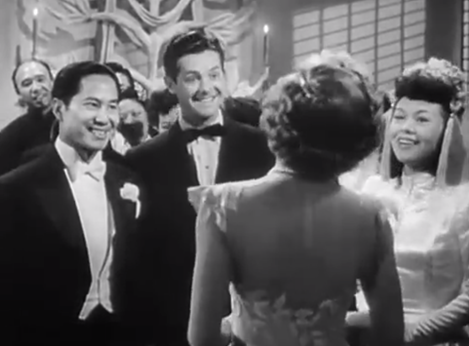
A high water mark of the film is an extended wedding sequence that is surprisingly fascinating. First off, it’s rather remarkable because it shows a wedding between a Chinese-American couple (Keye Luke and Marya Marco) and it plays it straight and true without any stereotypical sentiment. It feels like a real wedding and an authentic portrayal of this union without the necessity of needless bigotry to sully the moment.

The evening festivities prove equally joyous for our stars who form a quality bond and what feels like it could have been an unfortunate aside becomes one of the film’s most diverting sequences choosing to forego dime a dozen drama for a bit of depth.

In subsequent scenes, Keye Luke, Bruce’s “brother” from his extended time in China becomes his right-hand man as he tries to get to the bottom of Mrs. Courtland’s curious situation that turns perilous very, very quickly. It blows up in the end with a domino effect of dramatic trip wires that set off all sorts of outcomes that came hurtling to their conclusions as quickly as they began. It’s over the top certainly but no less a gripping finale if the film is given leeway in the areas of realism.

If this film is not what we would come to think of in Douglas Sirk there’s no doubt that it feels less dated than most, anthropologically speaking, coming from an intellectual man who seems to carry an open-minded and forward-thinking approach.

Likewise, the intense interest in the human psyche might have matured in the years since, but there’s little doubt that it still holds a prominent place in our modern world with its ceaseless intricacies. One could say psychological complexity is one of the reasons movies still get made today. That and a craving for romance.

3.5/5 Stars
The Smiling Lieutenant (1931)

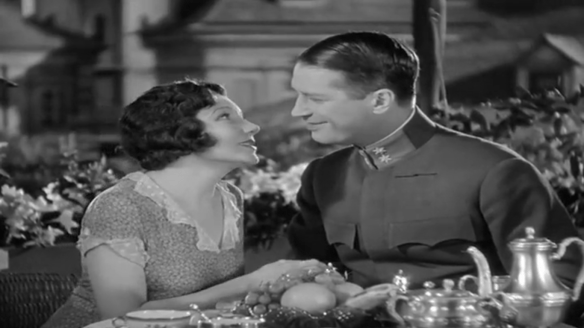
thesmiling1One would never think that one well-placed wink would change the course of an entire life or be the basis for an entire film, but on both accounts it is true. Ernst Lubitsch’s The Smiling Lieutenant represents all that is good and right about one of his films. It’s light and airy with a dash of charm and a tune in its heart. It’s light on its feet with humor and somehow maintains its self-respect, much like the man at the center of this one (Maurice Chevalier).

In fact, this pre-code musical comedy is a lot more unassuming than it has any right to be. Lieutenant Nikki von Preyn (Chevalier) falls for the talented violinist named Franzi (Claudette Colbert) and cannot contain his excitement whenever he’s around her. Except one ill-timed smile followed by a suggestive wink lands him in some hot water with the recently arrived royalty who are making a sightseeing trip around the country.

Princess Anna (Miriam Hopkins) is appalled by such a public act of indecency, but she also happens to be quite culturally naive. In other words, she hasn’t been outside the palace grounds much. In other words, she’s never known many dashing gentlemen before. Wink. Wink. You get the picture.

Nikki is beside himself but vies to take the most obvious option out. Professing his love for the princess — that’s why he winked. But she outdoes him threatening her father that she would wed an American (GASP!) if she is not engaged to Nikki. So daddy is all but obliged to follow through with the whole thing.

Of course, now we have a love triangle of unrequited love, with the Lieutenant’s smile turned upside down and his beautiful beau grief-stricken. She does the only thing she can, confront her competition and have it out with her. What follows is a slap-filled sob fest and our two heroines become real chummy real quick.

thesmiling2But Lubitsch’s final twist is completely out of left field and a completely comic inversion of what’s supposed to happen — capping off his oeuvre of song, suavity, and sensuality in high fashion.
Chevalier is the quintessential French crooner and his touch of comedy is perfectly measured by both Colbert and Hopkins. Colbert is a typical glamour girl of the 1930s, while Hopkins is also pretty, but with more outlandish tendencies. She also gives a brilliant turn on the piano!

In truth, I have long tried to put a finger on just what the Lubitsch Touch is, but it seems that everyone who has ever said anything about it comes up with a different answer. It began as a PR stunt to sell his brand in Hollywood and from thenceforth it took on a life of its own. As a filmmaker and auteur, there is certainly no one quite like him in substance or style.

If I had to try and draw up my own definition of his Touch it would be something like this: His films convey sensuality in such a way that was palatable to the American audience, while simultaneously making romance something humorous. His sensibilities are such that he can be suggestive and still refined. The true irony here is that he’s in a sense winking at his audience by the end. The joke’s really on us.

4/5 Stars

It Happened One Night (1934) – Updated

Hopefully no one holds this against me, but I have never been a big fan of Claudette Colbert. However, I will say that I am a Capra aficionado and Clark Gable is certainly a classic Hollywood star who is dynamic in this film. Thus, despite my hangups with Colbert, I can still thoroughly enjoy this romantic comedy, the so-called original screwball. It helps to have such comedic fellows as Roscoe Karns, Alan Hale Sr. (father of The Skipper) and Walter Connolly.

Peter Warne is the down on his luck newspaper man and Ellen Andrews is a socialite who feels trapped between her suffocating father and an upcoming marriage. Does this formula sound familiar? It undoubtedly is, but this was the original, all those following were impostors.

The unlikely pair begin a cross country trek towards the destination of New York. It includes uncomfortable bus rides, awkward overnight stays, a bit of hitchhiking, and eating carrots to survive.

Only in the movies could such a scenario play out and yet that is the fun because anything can happen one night or another. In this case all the caterwauling and antics lead to a happy ending. To think many people thought this film would not be very good! That was obviously proved wrong by numerous accolades. Just think this film came out 80 years ago and we are still watching it today! That is amazing. That is the power of the movies.

Peter Warne: A normal human being couldn’t live under the same roof with her without going nutty! She’s my idea of nothing!
Alexander Andrews: I asked you a simple question! Do you love her?
Peter Warne: Yes! But don’t hold that against me, I’m a little screwy myself!

5/5 Stars

It Happened One Night (1934)

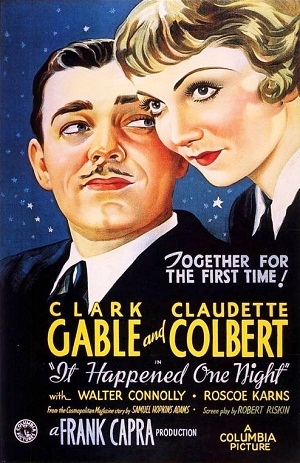
Gable_ithapponepm_posterStarring Clark Gable and Claudette Colbert with director Frank Capra, this light romance pits a sunk newspaper man with a dissatisfied socialite. Colbert feels stuck in her life with a domineering father who does not approve of her marriage, and so she runs off to get away. While on a bus she meets the recently fired Peter (Gable) and there is immediate friction between them. However, realizing she is inexperienced, Peter watches out for her and they travel together. Finding out who she is, he is even more driven to get a story and stay with her. Along the way Colbert begins to fall in love but he does not immediately react. When he finally realizes his true feelings, the situation becomes complicated when Colbert returns to her father and fiancee. In the midst of the wedding she hears of Peter’s true love and runs off to him. By that evening they are married and the “walls of Jericho” come tumbling down. Gable and Colbert both do well in this film and Capra gives us another light classic.

5/5 Stars

The Palm Beach Story (1942)

06b18-the_palm_beach_story_postrStarring Claudette Colbert and Joel McCrea with direction by Preston Sturges, the film opens with the chaotic marriage of a couple. As the story progresses we learn they are essentially broke because the husband is a lowly architect and his wife cannot do much anything. She resolves to divorce him so that he will not have to support her. She makes her way to Palm Beach by train, using her feminine charm on many men. One such millionaire is especially smitten with her. Despite his awkwardness, she continues the relationship as she wants to send money to her husband so his airport can be built. However, things get complicated when her husband comes for her and the millionaire’s chatterbox sister comes to visit as well. In order to save face Colbert’s character introduces him as her brother. Now her husband is being pursued by another woman and she is close to being proposed to. Finally, she explains what is going on leaving the brother and sister disappointed. However, there is still hope thanks to a hilarious coincidence. The film ends with there beautiful simultaneous wedding ceremonies. Preston Sturges definitely has a knack for the quirky dialogue and situations. I have to say I personally enjoyed the Lady Eve and Sullivan’s Travels more but this film was certainly all over the place.
 
4/5 Stars