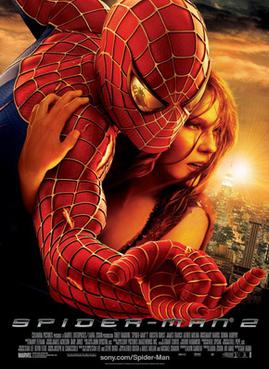
Spider-Man 2 (2004)

A version of this article was published in Film Inquiry

If Spider-Man was the template for what the modern superhero movie would become, its sequel feels like the standard bearer all future successors were asked to eclipse. I had never seen the movie before as I was young during its initial run, but the aura of Spider-Man was always around.

Sitting in a packed theater there was a sense of buzzing anticipation when the opening credits rolled, backed by Danny Elfman’s almost otherworldly score that hints at more eccentric inclinations. The Marvel monolith had yet to be fully consolidated and turned into a factory. For the time being, it feels like director Sam Raimi had free reign for fun.

Because we already have some context for the character carrying over from the first movie, the film’s instincts are correct in reintroducing us to Peter Parker (Tobey Maguire) with an opening gambit laced with levity.

We watch him racing to keep his job as a pizza delivery boy only to switch into the spider suit to beat mid-day traffic. There’s an extended bit with a closet full of mops that had the audience in stiches as he drops off the order sheepishly with the front desk.

I’m so oblivious but it does seem like Tobey Maguire has become a walking meme and a lasting internet celebrity based mostly on his Spider-Man persona. There’s something about his delivery that’s so awkward — maybe something about his quivering upper lip — or how he almost lisps out his lines of dialogue. But it’s also endearing.

And for every time the audience laughed, it was never out and out derision. They love this guy. He is their hero and they hold him aloft so when he goes slinging webs and rises again across the skyline, people ring out in audible cheers.

The same goes with the dialogue. Some of it might be inadvertently funny and yet so much of it is in on the joke. Raimi is wonderful in allowing for these incubated moments of a visual gag or an insert with a cameo part that has a reaction or a bit that’s good for a laugh. It can be about a stolen pizza in the opening minutes or even a terribly ordinary Peter stumbling away from a crash scene after he can’t catch his fall and proceeds to set off a car alarm.

This hints at part of the dramatic question at the center of this film. What makes Spider-Man mythology so popular is the nature of his superherodom as initially conceived by Stan Lee and Steve Ditko.

His story arc is grounded in relationships on all sides however rudimentary they might be. An aunt and uncle, his crush, and the alienation that forms between he and his best friend. What’s more, Peter is faced with the universal conundrum of what he wants versus what is sacrificial in the name of his city. With great power, comes great responsibility. But the words get muddier when it comes to specifics.

And the villainy is equally relatable. Albert Molina is sympathetic but also carries a gravitas with his physique and stage presence that wears the role of Dr. Octavius well. He becomes first a mentor and then an adversary for Peter — a perfect foil for what he represents.

His life’s work — creating a fusion power source for Oscorps — gets out of control during a public showcase.  In the aftermath, his mental faculties get overridden by his new mechanical arms driven by AI. He knows not what he does and becomes a public menace who wants to rebuild his reputation, and avenge the loss of his beloved wife.

Due to the strains of his Spider-Man mantle, Peter’s grades are suffering in college and he’s absent in the lives of the people he cares about most. Aunt May is about to go through an eviction and MJ’s been making a name for herself as a theater actress and model. She feels like Peter has rebuffed her and it hurts.

Peter decides to relinquish his Spider-Man suit because he doesn’t want to keep secrets from anyone; he doesn’t want to break his promises anymore. He steps back into he shadows and lives a normal life even as the crime rate begins to rise in the city

There is the real sense that there is no longer a protective hedge against crime and other antagonistic forces. He must make a decision, and at the same time his powers begin to atrophy for inexplicable reasons.

I never thought I’d get T.S. Eliot or Joel McHale in this movie, but sure enough both are featured. Peter pulls out Eliot in a NYC laundromat as he tries to wash his Spidey suit and find new ways to woo MJ. Girls supposedly dig poetry. It feels like a small Easter egg that one of my favorite high school bands had a song featured on the U.K. soundtrack inspired by Eliot’s poem “The Hollow Men.”

Meanwhile, McHale shows up as a teller in the bank who sheepishly tells Aunt May she’s not eligible for a loan. It’s one of any number of injustices that make Peter feel powerless to help the ones he loves.

From a dramatic standpoint, the gala where he’s called upon to take pictures feels like the nadir of his story so far. An inebriated (James Franco) smacks him around in a very public setting, and then Peter learns MJ is getting married to someone else; she’s not waiting on him any longer.

These are only the personal stakes, but so many subsequent superheroes have lost this reality and gotten muddled because they dealt in expositions and nebulous things that we have little to no concern for. Here it’s simple yet effective.

The action is wonderful and the visual representation of Doc Ock with his mechanical arms has a real menace that rarely takes a false step in disrupting our suspension of disbelief. In fact, the whole film holds ups though there are a few obligatory final shots that feel like gratuitous eye candy

Aside from this, each confrontation between Peter and Octavius plays like an extraordinary piece of narrative drama that goes beyond surface level pyrotechnics. It’s meant for Saturday matinees as they duel it out inside the bank, scaling sides of buildings with Aunt May in the balance, or even battling over a railcar in a chase that evokes The French Connection while still applying a Spidey twist.

What a wonderful and mysterious thing is it for Spider-Man to lose his mask, and far from castigating him or just wanting a piece of his celebrity, the people he has just saved acknowledge his youth, and vow to keep his secret. There is a neighborliness and a desire for the communal good that feels like wind under our sails.

Because while other installments about superheroes explore characters’ isolation, anonymity, and identity as vigilantes, there is a sense that this Peter Parker does not have to worry. These people are protective of him, grateful for what he has done, and he deserves their care. He deserves grace. After all, he’s only a teenager.

What’s more he has a girl who will stick by him as he looks after the city. There is a precise moment of truth where Peter is able to allow his girl know his true, full self. It’s a supreme gift for the character.

Looking back now 20 years on, Spider-Man 2 is an early 21st century depiction about the dangers of AI, but at its core it’s about the choice. Every great hero must decide what to do in the name of self-satisfaction or personal sacrifice.

The movie would also maintain the more dubious tradition of franchises outstaying their welcome. I’ve been told Spider-Man 3 jumped the shark, and yet I imagine even now there is a nostalgic patina hanging over this trilogy.

Spider Man 2 is a wonderful delight, and it’s a pleasure to see it with an audience who care about the movie so profoundly. It means something to them even after all these years. They may be older, but they come to this movie with the same reservoir’s of affection. It’s the effulgent joy of any little kid who’s ever had dreams of being a superhero.

I’ve never been into ardent superhero fandom, but now finally getting around to Spider-Man 2 after the fact gives me a newfound appreciation for my peers. I see the hype. I’m still hoping the Marvel fad has finally begun to abate for more eclectic forms of entertainment, but that doesn’t mean we can’t celebrate where these films came from.

4/5 Stars

Spider-Man (2002)

The modern superhero genre as we know it began with Richard Donner’s Superman (1978) starring Christopher Reeve. Then, there were subsequent releases like Tim Burton’s Batman (1989) with Michael Keaton or even Wesley Snipes’s Blade (1998). Also, the first X-Men in 2000 has seen many subsequent additions throughout the 21st century.

I’m no superhero cinema historian so there is plenty of room to quibble, but Sam Raimi’s Spider-Man feels like a portent of what was to come for a whole generation of superhero movies from Marvel and DC that have dominated the cineplexes since.

What I appreciate about the movie is how it’s not just a superhero movie, but a comic book movie. I mean this by how it conceives of itself. We have drama, but it’s not overly dark and oppressive; there’s room for humor and an acknowledgement that this is meant to be light and a genuine good time.

There’s an energy reminiscent of the teen movies of the 90s-2000s like Can’t Hardly Wait or She’s All That. Peter Parker’s in high school. He’s a bit of a dweeb with his nerd glasses and a nebbish persona, harboring a crush on Mary Jane Watson (red-headed Kirsten Dunst), the literal girl-next-door who doesn’t even know he exists.

Whatever people’s opinions of Tobey Maguire, I think all the ardent faithful hold him close to their hearts because of what he represents at the center of this film. He’s really the first Spider-Man in the modern era in a franchise that has now spawned so many progeny. And perhaps this is a gross generalization of the audience, but those who rally around him probably see Peter Parker as one of their own. They see themselves in him. Even if Tobey was a little old be playing a high schooler. 

The movie willfully pulls out all these dorky bits of contrivance: Peter living next to MJ, though they’ve never seemed to talk before. Likewise, his best friend (a brooding James Franco) just happens to be the son of the man who effectively becomes Peter’s arch nemesis. But we forgive these things because aside from being bitten by a radioactive spider, Peter feels like a grounded human being in all other departments.

Willem Dafoe’s turn as The Green Goblin has a Gollumesque duality to it. It escapes me which film came first, but we see both his sympathetic father figure and the cunning conscience that comes alive in him as he hopes to make Oscorps into a success. He wants to prove all the corporate suits and military officials wrong. Even 20 years on, Dafoe’s always the kind of actor who gives the material its due and people admire and respect him for it. There’s no distinction between high and low art, whatever that even means. 

Meanwhile, J.K. Simmons dives into the cartoonish nature of newspaperman J. Jonah Jameson without any hesitancy whatsoever. From his hair to his over-the-top demeanor and constant vilification of Spider-Man, he’s good for a few laughs.

But we want this broader larger-than-life quality because it fits with a world that in some ways mimics ours. Simultaneously, it’s meant to be fanciful and push us into a narrative of heightened imagination, romance, heroes, and villains.

What’s most refreshing about the film is how the drama has not yet been stricken with bathos — something that seems so en vogue now. It’s as if contemporary films need everyone to know they’re in on the joke and having a sardonic laugh at the expense of the stories and tropes themselves. We must undercut any genuine moment for fear of something being too soppy.

In Spider-Man the moments of sincerity are still there. The most evident are carried by Cliff Robertson, a revered stage actor and personality from the bygone era of Classic Hollywood. He utters the famed line “With great power comes great responsibility.” Sure we’ve heard these words so many times, they can feel like a cliché, but as he sits across from Tobey Maguire, the candor and simpatico between them is unmistakable.

I was also pleasantly surprised by the special effects of the film; they’re not always pristine and still they never pull us out of the movie completely. Raimi does a wonderful job giving us at least a few images to grab hold of. The most telling has to be the upside-down kiss between Spider-Man and MJ.

It’s the kind of visual iconography that by now feels emblematic of the film itself even as it gave a fresh face to movie romance. The key is how all involved do not scorn the moment; they still believe in the magic of the movies.

From the running time to the scope of the story, it feels almost quaint watching Spider-Man, and while there were no doubt sequels in the pipeline, it feels like it can function as a standalone movie. There’s not a lot of added dross either, but we still get a gripping story to take in and enjoy.

My final thought is only this. Principal photography for the film officially began in January 2001, and 9/11 not only changed New York’s skyline over the course of filming, it changed the film. But Spider-Man feels like one of those startling post-9/11 films. 

We often think of stories where the material is inexplicably tied to those horrible events that stay with anyone who ever lived through them. However, I can’t help seeing movies like Spider-Man or even Elf, from the following year, in light of those events. Because their themes and heart unwittingly gave the audience laughter, thrills, and soaring spectacle in the face of terror.

These are not spoken sentiments, and yet they are baked into the very fabric of what these films are. They are wish-fulfillment and fantastical fairy tales in a world that often feels so harsh and foreboding. That’s why we still flock to stories like these even today. That’s part of why people still turn out to see Spider-Man. We like to look for the heroes.

4/5 Stars

Whiplash (2014)

2b478-whiplash_posterIf ever there was the Devil’s incarnate, it isn’t Terrence Fletcher (J.K. Simmons), he’s probably meaner and harder to nail down. In the world of musicians, there is no school more prestigious than Shaffer Conservatory in New York and that’s where young drumming prodigy Andrew Neiman (Miles Teller) finds himself learning the ropes. Like most of the people there, music is his life and it’s what drives him. His dream is to be the next Buddy Rich. Most people don’t know who that is, but he does and that’s enough.

Nieman thinks he’s made the big time when he gets made the alternative drummer in the orchestra of conductor Terrence Fletcher, a man who seems strict, but still highly passionate about music. Andrew looks to prove himself and let his talent shine through.

He has no idea what he’s getting himself into. He watches with surprise as Fletcher tosses a member of his band out for being out of tune in a rehearsal of Whiplash. Except it was the other guy, but Fletcher feels it’s just as well since the guy didn’t know he wasn’t out of tune. Obviously, he was not a true musician.

Thus, Andrew gets a taste of this sadistic treatment all in the name of art and music. He gets a chair hurled at him. He gets repeatedly slapped for being off tempo. It becomes clear all too soon that Fletcher is a merciless two-faced monster who does everything in his power to improve HIS band at all costs. He never ceases berating, belittling, cursing like a sailor, name-calling, and inducing physical harm. He doesn’t care as long as it leads to results improving overall performance.

About this time Andrew awkwardly asks out the cute girl at the movie theater, and they share an awkward date at a 2nd rate pizza joint. It’s a cute beginning with some real promise. As far as family goes, his dad is a loving man, but Andrew has some real familial conflict with his relatives. They see his aspirations as small potatoes, and he, likewise, sees them as nobodies who are full of themselves. It’s mutual distaste.

Andrew’s education continues on an intense path when, by a fluke, he becomes core drummer. Fletcher also calls Andrew out saying he needs to practice harder, and it becomes a game of survival of the fittest. Kill or be killed. Dog eat dog. Fletcher has no sympathy or emotional attachment. All that matters is fielding the best band he can. He works his three drummers to the point of pure exhaustion, hands bleeding, drenched in sweat before Andrew finally gets the tempo right just to his liking.

He has his chance once more, but on the day of the big Jazz competition, Andrew runs into some roadblocks and since he is hardly capable of playing, Fletcher gives Andrew the boot. The enraged drummer tackles him to the floor. Days later he is expelled from Shaffer while a lawyer is also digging around about Fletcher’s conduct. Andrew reluctantly agrees to blow the whistle on him and he has to go from there.

By this point, the question must be asked. Who is truly insane here? Yes, Fletcher is a nightmare and a tyrant of epic proportions. But what drives someone to do what Andrew does? He drums until his fingers are so ripped up they bleed through bandages. He breaks up with his girlfriend Nicole, all in the name of progress in his career. Perhaps craziest of all, he continues to follow Fletcher until his expulsion. It got to the point that he was losing all touch with reality because drumming was everything. Completely blinded by obsession, spiraling further and further into the abyss that was consuming him.

In many ways, those two were made for each other, and one day they meet on the outside. Andrew no longer a student and Fletcher now fired from his position. Now they just want to play music for the sake of music. Fletcher needs a drummer for a jazz festival he is competing in and Andrew obliges because he cannot stay away from it forever. Of course, his nemesis pulls one last dirty trick, but it was out of this scheme that Andrew realizes himself as a true musical artist letting his hands lead him on an emotional Odyssey of snares and cymbals. For one instant he has Fletcher’s approval and the euphoria of the beats rushes over him. This is all he ever wanted.

Whiplash is a film that is squirm-inducing. Utterly painful and terrifying to watch, thanks in part to the performances of J.K. Simmons and Miles Teller. Teller is inherently likable and that’s what made his turn in the Spectacular Now (2013) so gratifying. His character Andrew is on the complete opposite side of the spectrum, however. He’s utterly friendless and singly-minded, geared towards one thing and one thing only. Teller proved that he could play this role, and it is purposely left ambiguous what happens next. He lost his girlfriend and he got expelled, but what are we supposed to feel for him? Pity, sadness or disapproval?

J.K. Simmons was just WOW… Director Damien Chazelle did a remarkable job and likewise the editing of Whiplash exquisitely fit the theme of drumming. It is completely on form with its frenetic fury to its merciless cutting. It will not give us a break or let us relax as an audience, underlying the generally insane tempo of this film. The name “Whiplash” from Hank Levy’s composition was perfect. Melodious but completely unnerving.

4.5/5 Stars