
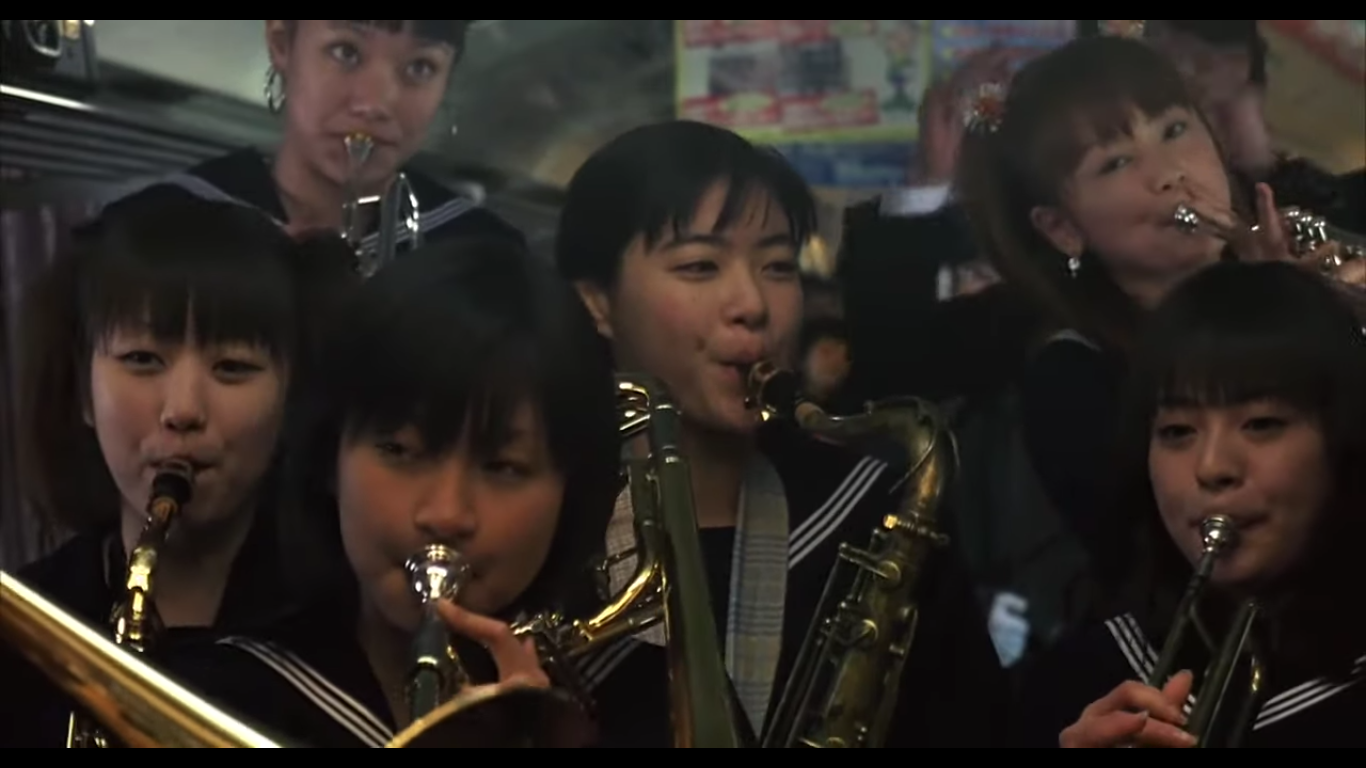
“There are two kind of people in the world. Those who swing and those who don’t.”
I’ve already talked about this phenomenon ad nauseam, but having lived abroad in Japan, worked at a school, and interacted with many Japanese people, it fascinates me to learn about their cultural proclivities.
I hesitate to call much of what the Japanese do musically cultural appropriation because they seem to totally recontextualize the artifacts we know. One prime example is “Take Me Home Country Roads” by John Denver being featured so whimsically in Ghibli’s Whisper of The Heart. They somehow take cultural touchstones we know and pluck them out of a moment in a kind of reverent homage (One peculiar counterexample might be the animatronic JFK featured in Sans Soleil).
Writer-Director Shinobu Yaguchi’s Swing Girls is a film positively swimming in teen culture. Like a School of Rock, it feels like a movie looking for a wide audience, and it will easily repay those desiring a crowd-pleaser.
It introduces its world by gladly playing into high school tropes and stereotypes. Tomoko is our primary conduit in a clique of girls who seem generally bored with school and crazy about cute boys, fashion, and the like. They’ll do anything to get out of a summer make-up class and reclaim their adolescent freedom.
When the school’s band regrettably forgets their order of bentos for their gig miles away, the girls volunteer to hand-deliver them by train. It begins the madcap craziness as they miss stops, take to walking on foot, and unintentionally bake the food into oblivion. When all the band comes down with deadly food poisoning, their failed charade is up.
It’s a bit ridiculous. Where can a movie like this go? There’s only one answer and Yaguchi does his best work leaning into the big-hearted absurdity of it all. Having single-handedly wiped out the band, Tomoko and her compatriots consider joining the one male member not sidelined. It’s yet another convenient way to get out of summer school.
As an audience, we are able to laugh at the incongruity as all these girls who have never handled a musical instrument in their lives try their hand at forming a Big Band. They’re of the assumption that Jazz is for fuddy-duddies and intellectual types swirling brandy snifters. I can’t fault them because I was of a similar persuasion until I saw the light.
Takuo (Yuta Hiraoka) sets them up with a training regimen conditioning like athletes and introducing them to the likes of “Take The A Train” by Duke Ellington and Billy Strayhorn, a song that was integral to my own jazz appreciation. It feels like this mixture of oil and water, but then that’s the entire novelty of the premise. Whether or not it’s realistic, they do get better and more ambitious.
The girls take up part-time jobs to try and cobble together some second-hand instruments. They take part in all manner of good-natured fun and games like fleeing a wild boar and engaging in a euphoric snowball fight. Still, they still have a goal to realize, preparing their audition tape for the big high school competition.
Swing Girls is a film that keeps on building on itself until the height and width of its sizable heart overwhelms us with warmth and laughter. It grows to a crescendo as they frantically try to make it to their big day, first serenading their tour bus, and then performing the real thing.
They pad their performance with renditions of Glenn Miller and then Benny Goodman’s “Sing, Sing, Sing.” This second song is noteworthy to me because the band at the high school I worked at performed this same song. I have no inclination if this choice was inspired by the film or the fact Goodman was one of the swing era’s heavyweights. The particulars don’t really matter.
Swing Girls is best in its goofiness, giving us a story easily transferable into the Hollywood arena with feel-good moments and cheering acts of redemption. There’s actually not too much romance which is actually a nice surprise. However, in it, a closeted jazz enthusiast can come out of the woodwork to fulfill his dreams, and a classroom full of dead-end girls can come together to create something quite spectacular.
It provides a new context for Japan’s long-lasting love affair with jazz music, and I was pleasantly taken with it. Wonders never cease. All I can say is I want to be one of those people that swings. I can see it bringing the utmost joy into my life.
4/5 Stars
 4 Star Films