Apocalypse Now (1979)

10713-apocnowIn this hellish adaption of Joseph Conrad’s Heart of Darkness set in Vietnam, Martin Sheen is a captain given a classified mission. He must go down the river into Cambodia to terminate a Colonel Kurtz (Marlon Brando), who has gone rogue. The main part of the film follows his journey on a boat with a small crew of men. They meet up with a hardened napalm-loving colonel (Robert Duvall), watch a USO show, and witness as well as take part in senseless killing. With the crew whittled down, Willard finally reaches the outpost of Kurtz, only to witness the horror that lies there. After waiting so long to complete his mission, Willard feels conflicted about it upon seeing Kurtz. This is one of Francis Ford Coppola’s most famous films and it truly was a labor of love since it took a long time to complete. Although their parts may seem minimal, Brando, Duvall, Dennis Hopper, and even Harrison Ford contribute. Because I read the source novel, I could appreciate the film in that sense but The Godfather is a better film in my opinion.

4.5/5 Stars
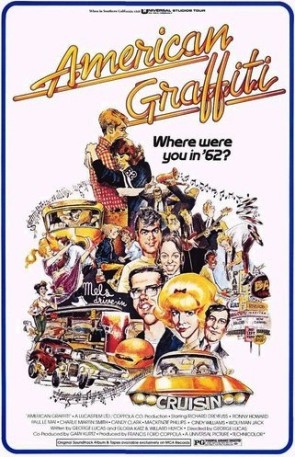
American Graffiti (1973)

Starring Ron Howard and Richard Dreyfuss with a host of others, this George Lucas directed film follows the lives of young people in California during the early 60s. It is the night before Curt and Steve are going off to college. They both want to make the most of the time left. However, Steve spends all his time trying to strengthen his relationship with his girlfriend (Cindy Williams). Curt, on the other hand, finds himself out in the town talking with girls and proving himself to a group of thugs. The rest of the film consists of the hot rodding antics of two other characters. A tough speedster (Paul Le Mat) finds himself driving around a 12-year-old girl. “Toad” the nerdy one (Charles Martin Smith), finds himself spending a wild night with a nice but peculiar girl.

With its classic music accompanied by Wolfman Jack and the vintage cars, American Graffiti is a blast of nostalgia that allows us to remember simpler times. It takes this important day in the life of these young individuals and it allows us to be a part of it. Each character has his own experiences that cause them to grow. Toad matures, Curt realizes he must experience college, Steve learns the importance of his girlfriend, and Milner realizes he really does not want to be “The King” anymore.

This film may have slower parts but that just makes it more enjoyable because then the night kicks into high gear when Toad loses the car, Milner beats up the thugs, or Curt has visions of a blonde in a T-Bird. Fittingly as he flies away to his unknown future he sees her white car cruising down the road. It was something that I had wanted to see the first time around but I had seemingly missed it. It made the ending even better.

5/5 Stars

Night and the City (1950) – Film-Noir

Set in London, this film directed by Jules Dassin stars Richard Widmark as a small time swindler and Gene Tierney as the girl he has his eye on. Harry Fabian always has big ideas but they never pan out. However, through a chance encounter he meets the father of the wrestling promoter in the area. He uses their strained relationship to his advantage in order to fight his way into the picture. At the same time a portly club owner and his unhappy wife are at odds partly because of Fabian. The con man’s luck takes a turn for the worst when the old man he met suddenly dies after a wrestling match. His son then puts a price on Fabian’s head and he becomes a wanted fugitive. One last time he sees his love and he has one last fool proof scheme. Fittingly that too falls through and he meets his demise. This is a very entertaining film and Widmark does a fine job.

4/5 Stars

Kiss Me Deadly (1955) – Film-Noir

Set in L.A., the film stars Ralph Meeker as the callous and often corrupt PI Mike Hammer, adapted from the Mickey Spillane novels. One night while driving, Hammer picks up a frightened woman who begs him to remember her. They are forced off the road by thugs and the girl is eventually killed. Hammer wakes up in the hospital to his secretary girlfriend Velda. He makes it his priority to find out what the mysterious woman was talking about. He meets up with opposition and a femme fatale, but Hammer keeps on going using strong-armed tactics. He finally tracks down a mysterious whats-it but then discovers that Velda was kidnapped. In the final confrontation he finally learns who he was looking for and he finds out the consequences of the Pandora’s box and a deadly female. This film was unique film-noir with interesting cinematography and a rather bizarre conclusion.

3.5/5 Stars

Ace in the Hole (1951) – Film-Noir

Starring Kirk Douglas with director Billy Wilder, the film follows a hard-nosed and manipulative reporter who finds himself stuck in New Mexico without any money. He takes a small job and soon happens upon a cave where a man has gotten trapped. Soon he spins it as a great human interest story and people flock from far and wide to witness the event. The buried man’s unhappy wife capitalizes on the foot traffic and the local sheriff tries to get some free publicity for the upcoming election. Meanwhile Tatum tires to draw out the events so he can get a better story and his old job back. All the while the man gets weaker and weaker until he eventually dies. Just like that everything clears out and the big carnival is over. Tatum brought the demise of another man just to get a story and he ultimately fell himself losing the story and the job he had fought so fiercely to acquire. Although not Wilder’s most well-known film, this is certainly a biting critique of journalism and humanity in general.

4/5 Stars

Criss Cross (1949) – Film-Noir

c8a9b-crisscrossStarring Burt Lancaster and Yvonne DeCarlo, this Robert Siodmak-directed film-noir revolves around a heist and a love triangle gone bad.

The film opens with Lancaster secretly meeting with his lover with plants to eventually run away together. Then he enters the bar and fights with his love’s gangster husband. However, when a policeman friend comes in, Lancaster will not press charges and non one talks. Little does the policeman know what is really going on. The next day Steve drives an armored car full of money to its destination. As he nervously drives, in a flashback he recalls how it all began.

He had finally returned home after a long absence. His main reason was to see his former wife and yet although they still had feelings for each other, she had remarried a gangster named Slim. Despite the circumstances  both lovers began meeting more often. In order to save himself and Anna, he suggested a robbery of the armored car with Slim.

Then, back in the present the wheels begin to turn and the armored car is ambushed. However, Slim does not stick to his word and there is a firefight. Steve is called a hero but he is left helpless in the hospital. After bribing the man who was to betray him, Steve rendezvous with Anna. However, all is not well and she is ready to leave him behind since Slim is obviously on his way. But she is not quick enough. This film reveals the nature of two double crosses which ends in a deadly criss cross.

4/5 Stars

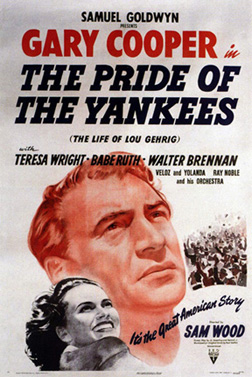
The Pride of the Yankees (1942)


Starring Gary Cooper as Lou Gehrig and Teresa Wright as his wife, this movie honors Gehrig’s life after a tragic death from ALS. From the time he was a boy, Lou could play ball but his immigrant mother wants him to become an engineer. The quiet, young man goes to Columbia and plays some ball. There he is seen by the Yankees who agree to sign him. Despite her disapproval at first his mom becomes his biggest fan. With the Yankees Lou seems slightly out of place being an introvert. Pretty soon he meets Eleanor Twitchell (Wright) however and then gains a spot as the starting first baseman. The two of them fall in love and get married as Gehrig flourishes in the shadow of Babe Ruth. With his career still going strong, Gehrig becomes captain and plays 2,000 straight games. It cruelly comes to an end when he begins feeling weak and is diagnosed with ALS. His career is over and yet in his farewell speech Gehrig gratefully considers himself the luckiest man on the face of the earth. He walked out of the limelight and died soon after, dearly missed. This is one of those truly moving films.

“I consider myself the luckiest man on the face of the earth.” You just cannot make up stuff like that. Here’s to you Lou!

4.5/5 Stars

Patton (1970)

Starring George C. Scott and Karl Malden, the film chronicles the exploits and controversy surrounding the great World War II general. Gaining fame  in Africa, Patton would move on to Sicily, and finally march toward Berlin. Patton was a colorful character who was highly religious, a war romantic, and he also had a big mouth. Despite often being tough and unpopular, over time Patton did garner the respect of many an aid, ally, and even enemy. His heroic 3rd army became famous for their exploits all across Europe. By the end of the war, Patton came out a very complex hero from a former age. The reason this film is good not only rest on it being a war movie but also based on character development. George C. Scott does a wonderful job of portraying the larger-than-life persona of Patton.

4.5/5 Stars

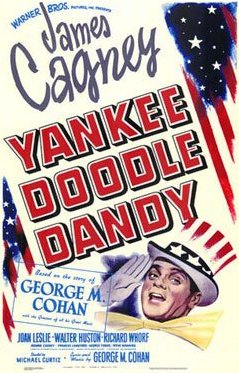
Yankee Doodle Dandy (1942)

Starring James Cagney and an array of others, the film tells the real life story of writer, singer, and dancer George M. Cohan. The story begins with an older Cohan recounting his life story. He began his career with his family in Vaudeville. Slowly he made a name for himself in Broadway and married his love. He and his partner kept making musicals and then the Cohans reunited for one last show. Eventually everyone in the family settled down before they died. The only one left was George who was living with his wife. In his final performance, Cohan gets the country to rally around the flag again as he has done his whole life. This movie has many commendable moments but there is an apparent conflict between biography and musical. Cagney for his part gives a stellar performance as the energetic and ambitious Cohan. The film also doubled as a nice piece of propaganda during World War II.

4.5/5 Stars

Scarlet Street (1945) – Film-Noir

Similar to Woman in the Window, this film-noir was directed by Fritz Lang and it stars Edward G. Robinson, Joan Bennett, and Dan Duryea. Chris Cross is a shy employee who has been working for the same man 25 years. While walking home Chris rescues a beautiful woman from an assailant, not knowing it is her brutish boyfriend. Amused Kitty agrees to have coffee and Chris who is an amateur artist, begins talking art, but Kitty gets the idea he is a wealthy painter. Because Chris is stuck in a hopeless marriage he becomes infatuated with kitty and she takes full advantage. Chris scrounges for money to pay Kitty’s rent and unbeknownst to him, Kitty’s boyfriend tries to sell the artist’s work. A critic is impressed and so Kitty masquerades as the artist. Chris finds out eventually and confronts her but the conniving femme fatale manipulates him again. Chris is delighted his work is appreciated and he is content with Kitty continuing to take the credit. An unexpected turn of events mean he can leave his wife and marry Kitty finally. However, he finds her with Johnny and after his genuine proposal she belittles him.An enraged Chris commits murder but it is pinned on Johnny. A miserable wanders the streets without a job or recognition for his art. Furthermore, he must live with his guilty conscience tormenting him until the end of his days. Woman in the Window is good but this film is more biting and powerful when it is all said and done.

4/5 Stars