It’s Love I’m After (1937): In Honor of Olivia De Havilland

Screenshot 2020-07-01 at 8.42.44 PM

There is a very significant reason to be watching It’s Love I’m After at this time. Her name is Olivia de Havilland, and by some brilliant piece of Providence, she has just recently turned 104 years old! She, of course, was in her early 20s when this movie came out and what a charmer it is.

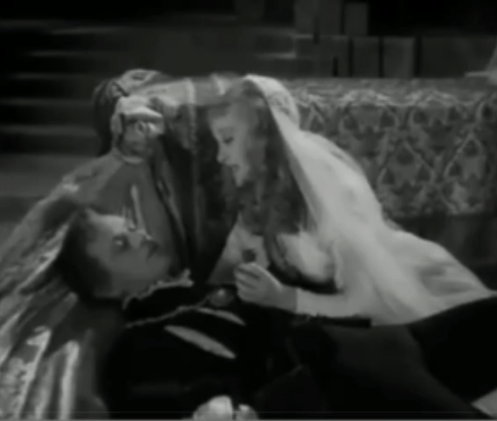
A few years before To Be or Not To Be, here is another movie hamming up Shakespeare on the stage. This time it’s Leslie Howard and Bette Davis as they act out their version of Romeo and Juliet for a rapt audience. What makes the sequence is the dueling couple whispering snide asides to one another mid-performance. Barbs about garlic breath and upstaging come out because they’re both conceited and jealously in love.

But where is Olivia in all of this? She’s up in the balcony swooning over the sublime eye candy down on the stage. She’s seen all of his performances and is positively devoted to his very essence. Her boyfriend (Patric Knowles) looks on with frustration as he’s having to compete with a rival who has never even met his girl before.

This is soon remedied when she promptly goes backstage to pay her respects. It’s all quite innocent. Basil and Joyce continue their incessant bickering from their adjoining dressing rooms, still at each other’s throats, despite the wall between them.

Then, Marcia West presents herself positively agog by the image of her idol thoroughly in the flesh before her. He’s flattered but he hardly knows what he’s doing when he accepts her compliments. Worse still, Joyce sees the young woman on her way out. Harmless or not, it adds further fuel to their relational fires.

What a delight it is to see such beloved thespians and titans of dramaturgy like Howard and Davis doing comedy, of all things, and doing it quite well in the screwball vein. After all, this would be their third picture together following Of Human Bondage and Petrified Forest. There’s no comparison.

The movie is totally overtaken by bipolar swings in fortune. First lovers’ quarrels — it’s the worst New Year’s Eve ever — then there are marriage proposals, and finally, Basil resolves to help a young fellow out.

They do have some handy support. There were few better in this department than Eric Blore, and he has a readily available supply of birdcalls and advice on his master’s matrimonial habits on the “precipice,” as it were.

Being your typically theatrical, philandering type, Basil resolves to shirk his impulses and pursue his own moral salvation. In this case, his good deed is for a lovesick fellow whose best girl is smitten with the stagebound Romeo. The actor doesn’t know it’s the same girl. How can he? No one in these movies ever stops to compare notes.
Screenshot 2020-07-01 at 8.46.48 PM

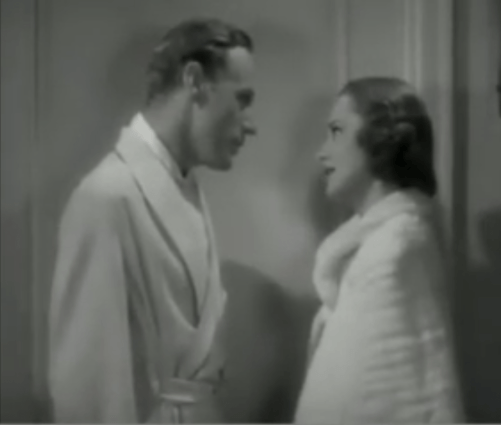
Still, he resolves to turn up on her doorstep and rudely ruffle her illusion of him. He and his man Digges (Blore) pay a late-night housecall to the West residence. Their shouts of “ire” soon become “fire” and brief pandemonium sets in as an impromptu round of “We’re here because we’re here” comes out sounding a lot like “Auld Lang Syne.”

He schmoozes his way into the house, making himself at home in the company of the avuncular father, befuddled mother, and a gossiping sister (Bonita Granville) always peeping through keyholes. But in Marcia’s eyes, he can still do no wrong. Now he’s got quite the prompting audience, and he’s all but ready to do his part.

His bit of showmanship has him playing up his image as an egotistical malcontent tearing through the guests and their breakfast table with ferocity (and some help from the Bard). Digges does his best to complain about the lack of kippers and other inadequacies. None of it congeals as they were hoping, in fact, it has an adverse effect. Marcia agrees with his every word.

As someone fed on a steady diet of P.G. Wodehouse and Jeeves and Wooster, there’s something familiar and comforting about the picture’s comic situation. Basil is no Bertie Wooster. Digges is no Jeeves, but they are stuck in the same madcap realm of romantic entanglement mixed with comedic hijinks.

Whatever Basil tries is quite unsuccessful in quelling the ardor or the affection of Ms. West. The best-laid plans all too quickly go awry and poor Digges can do little to stop the inevitable. Joyce makes her reappearance at precisely the most inopportune time. She catches her man in the arm of another. The jealous boyfriend feels affronted as he watches his girl be ripped away from him, albeit unwittingly.

The story couldn’t look bleaker and further from its agreed-upon happy ending and yet, eventually, it comes, like any good rom-com. Don’t ask me how it happens. Maybe it’s the youthful fickleness of De Havilland’s ingenue. Perhaps cinematic serendipity gets in the way. Regardless, the partners shuffle around only to get back together with their ordained.

Leslie Howard and Bette Davis are, again, madly in love, then yelling and screaming and pushing each other across the room. Digges is busy packing the suitcases only for the contents to come tumbling out as future husband and wife make up and share a passionate embrace. What light through yonder window breaks? It is the East and Juliet is the sun! End scene.

3.5/5 Stars
 

The Bellboy (1960) and Jerry Lewis The Goofball Auteur

the bellboy 1.png

The Bellboy is introduced by a witty disclaimer as a studio executive (Jack Kruschen in a cameo) explains this is a film based on fun. There is no story. No plot. Instead, it acts as a visual diary in the week of a real nut! He subsequently reels about in his chair laughing hysterically.

It breaks the normal precedence in movies, something Lewis may have learned from Frank Tashlin, and yet it also is a clever mode of conditioning the audience. With their expectations tempered, The Bellboy is allowed to excel on its own merit as something entirely unique. That it is.

What becomes evident is that we are witnessing the beginning of the next stage of Lewis’s artistic career, effectively blurring the accepted lines between major goofball and auteur.

Paramount was bucking for his next picture to be released for the summer crowds. Being the consummate professional and insanely efficient, Lewis needed only 4 weeks (26 days of filming) to crank out the movie, while simultaneously playing the stand-up circuit. He would get the movie out in time for the summer rush, and it would continue his successes at the top of the box office.

His inspiration was the Fontainebleau Hotel in Miami Beach, conveniently located in the vicinity of his current nightclub act. It proved a ready-made environment ripe for gags of all sorts. One must only remember the red-hats in Hitchcock’s North by Northwest or the shenanigans at The Hotel Del Coronado in Some Like it Hot to see the obvious potential for comedy. Lewis even asked Billy Wilder to direct at one point. Wilder fired back with the advice that Lewis should do it himself. The rest was proverbial history.

One creative element of the palette is missing: color cinematography. Lewis would rectify the situation with his next movie, The Ladies Man. For now, he has exorbitant amounts of fun with the freedom afforded him, designing a character who is a none-too-subtle nod to the titans of yesteryear.

His mute (and dumb) bellboy Stanley muddles his way through work at the hotel, getting pulled into all sorts of tasks. In one moment, he’s tricked into setting up a giant ballroom full of chairs. There’s one dizzying unbroken shot of Lewis charging across the floor disappearing for a solitary moment to bring back two chairs to begin filling up the space at a snail’s pace.

His colleagues are cackling at his gullibility only to peek in on his progress. The punchline being the chairs all set up immaculately. They are gobsmacked but we know better. It shows the power of a cut, where separate images are given so much meaning by even a brief disassociation. Lewis has gladly leaned into a sense of surrealism to augment his usual dopey slapstick shtick.

Another vignette follows the movie star Jerry Lewis (played by none other than Jerry Lewis) whose envoy is met at the hotel entrance by a host of gawking onlookers. His absurdly large entourage files out of his limousine and nearly suffocates him with their well-wishing. He’s had it with their constant hovering. The scene is capped with everyone cramming into the elevator together with similar absurd results. This gag might easily be a nod to The Marx Brothers and Wilder as well.

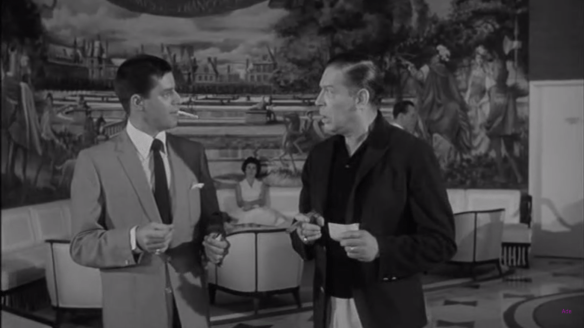
Milton Berle does his pal a favor by turning up in an isolated sequence. A moment is traded between Milton and Stanley only for the real Lewis to bump into Milton and send him for a loop. The final twist is Berle has a bellboy doppelganger of his own.

As the picture is never beholden to a plot, these loose and free situations keep on coming. Stanley might be trying to go on a dog walking detail only to get tangled up by a plethora of constricting leashes. Maybe he’s on phone duty, and it’s a bit like playing whack a mole where the call is never coming from the telephone he expects.

All the bellboys become unhinged at the sight of pretty girls, and Stanley finds himself all but maimed by an arguing couple who find a point of resolution when they join forces to beat the crud out of him. He conducts an unseen, but very raucous orchestra a la Bugs Bunny created entirely through the merits of sound design and Lewis’s own physical abilities.

My favorite sequence might be when he all but mutilates a sculpture, still wet, sitting out in the lobby for an art exhibition. Don’t ask why it was there. This is the wrong question. Just know the results are riotous.

The same might be said of Lewis all of a sudden showing up at a major golf classic just in time to flashbulb Cary Middlecoff as he’s trying to sink his climactic putt. Or he finds himself airborne and causing quite the stir after commandeering a plane.

the bellboy 2.png

These digressions are nonsensical but since it’s not faulty advertising, the scenarios succeed quite spectacularly. Because Lewis has leaned into this conceit and let his zany brain run wild with all the harebrained bits he can dream up. It does feel like the Marx Brothers at their best — at least in the sense we never go to their movie for a plot. It only exists as something the gags can hang their hat on. But foregoing the normal premises for pure comedy is to Lewis’s benefit.

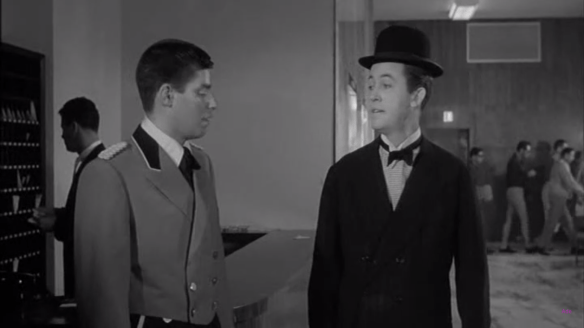
The legend goes Jerry Lewis asked one of his idols for advice on the script, naming his protagonist as a nod to him and even having a shuffling, bowler-wearing doppelganger appear throughout his movie. The mentor was, of course, Stan Laurel, who had all but stopped performing since the death of his inseparable partner Oliver Hardy. Lewis, for all intent and purposes, had died to his partner, Dean Martin, but reimagined himself bigger and better.

At its best, The Bellboy is an audacious experimental pantomime accentuated by surrealism liberally borrowing from the tradition of Stan Laurel and Jacques Tati. Sound plays such an important role in the comedy as do these continually incidental encounters. They become the origins of genuine laughs.

But there’s also this element of outrageous even impossible scenarios being played straight.  It probably has as much in debt to the animated logic of Bugs Bunny and Daffy Duck as it does to the aforementioned comedians. However, at the end of the day, this can only be Jerry Lewis. If I only had a modicum amount of respect for him before, my esteem for him only grows with every effort. I might relish his forefathers more, but Lewis still has some claim at comic immortality in his own right.

3/5 Stars