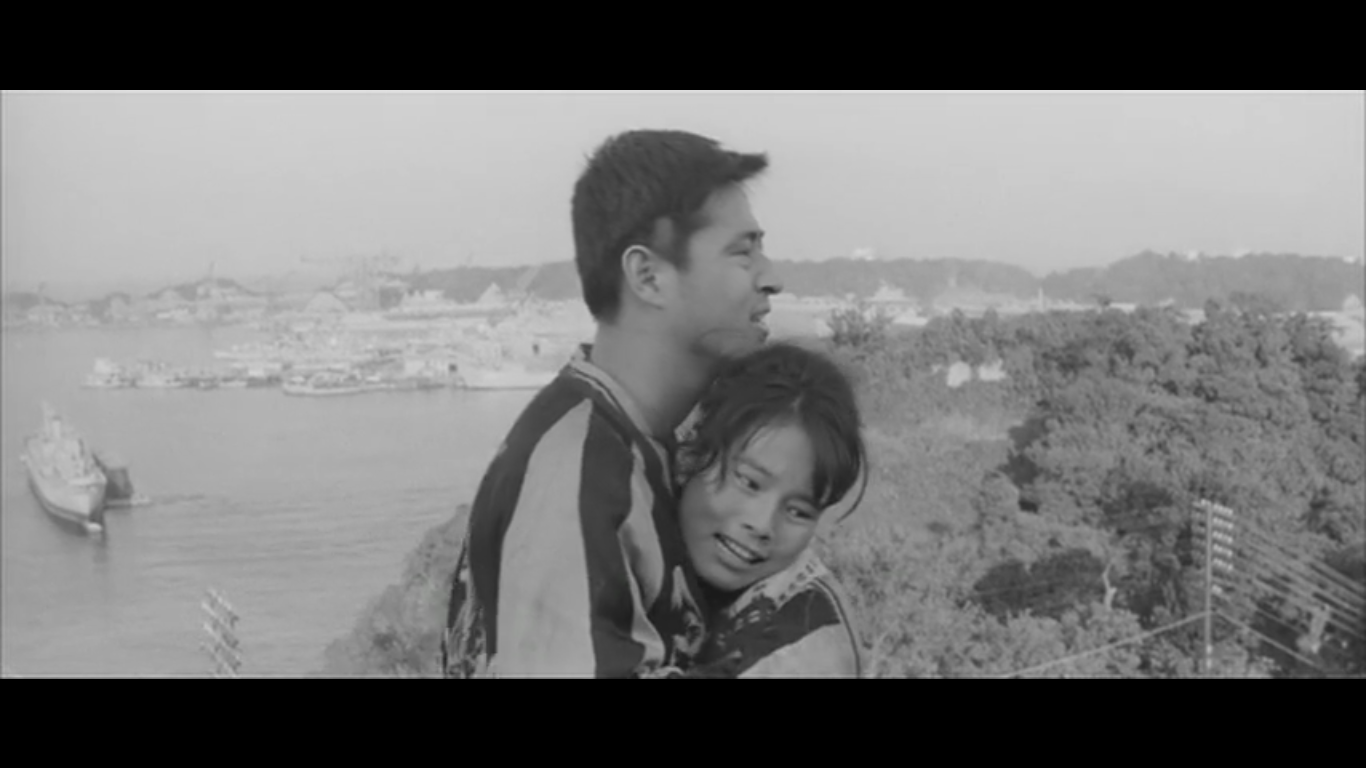
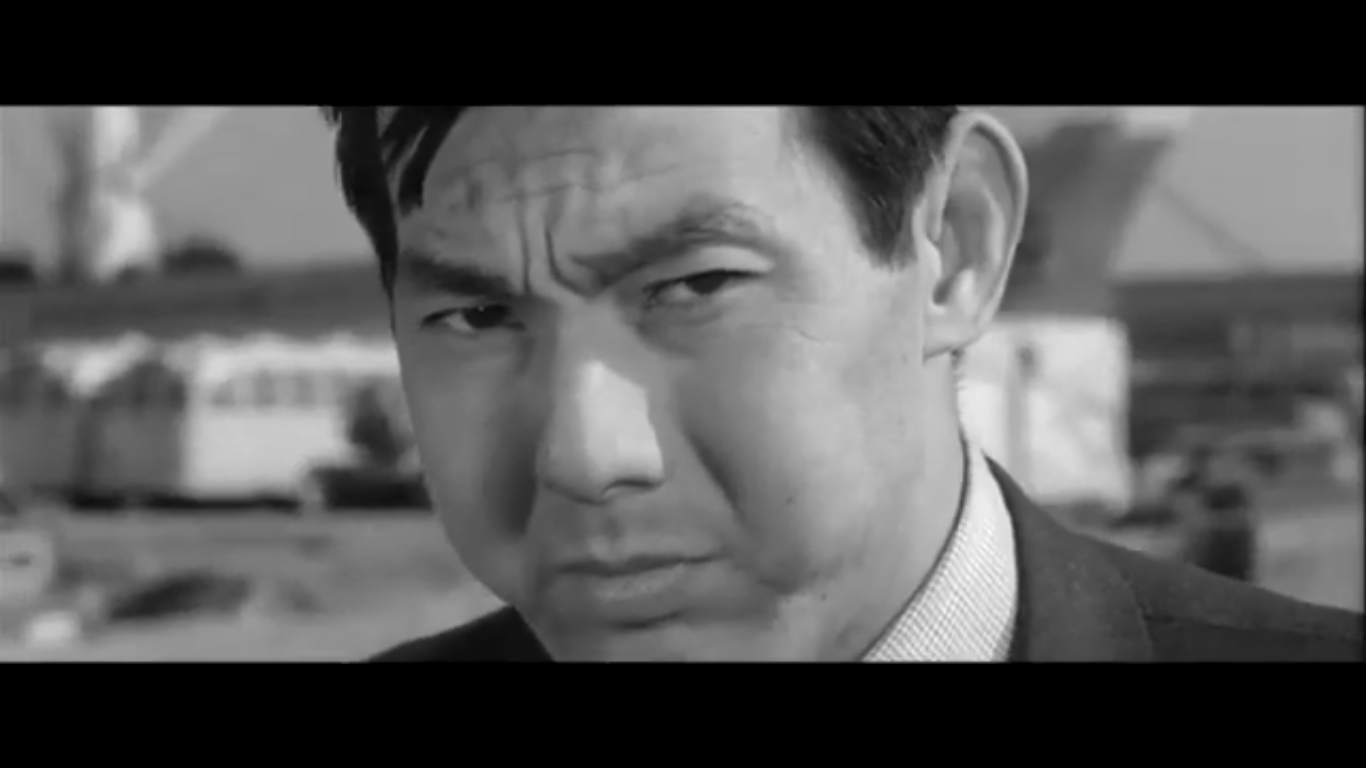
A Colt is My Passport (1967)

Nikkatsu studio’s reputation for these kinds of down and dirty pieces of noir pulp employed action and gangster plots to entice the youth market. Obviously, the influence of the American canon cannot be disregarded, and yet the films came into their own given Japan’s own turbulent history with syndicated crime.

However, A Colt is My Passport does something more with the genre archetypes. It starts with this mythical weapon, not traditionally of mobsters and hitmen, but western heroes and villains dueling out on the range. Wherever the firearm might have progressed, it always carries this mythos about it.

As such, the movie is introduced with a whistling, stringed, and partially staccato score that might as well be plucked out of a  spaghetti western. Further strengthening the ties is Quick Draw Joe, a movie Joe Shishido starred in that was also directed by Takashi Nomura. Now half a dozen years they meet again to build on their collaboration.

The initial beats are familiar if you’ve seen any of these types of pictures. There’s a target to knock off. His name’s Shimazu, and when he’s not constantly being shadowed by a bodyguard, he’s stashed away behind bulletproof glass. It’s a tough job with only one day to see it out.

In this world of guns and souped-up automobiles, Shishido, the chipmunked-cheeked cult hero of cool, somehow feels right at home. It’s all part of his work as he studies his target, sets himself up with a hotel room, and then prepares to get in and get out with surgical precision behind his sniper rifle.

If there’s a methodology here it suggests how Colt is a film built out of a regimen and the setting of its protagonist in an architectural world. He is always completely cognizant of his location and how he functions in relation to the spaces around him. Thus, it becomes as much about mood and milieu as it is focused on action and violence.

Take for instance, how the story is constantly switching contexts. It’s in a car, about getting to a plane at the airport, holding up in a hotel, then fetching a barge out of the country, and when that fails, commandeering a big rig to retaliate against the enemy.

Of course, there must be a love interest. In the subplot, Mina, a young woman who works at the Nagisakan hotel, offers them asylum from their pursuers. What draws her to them? She says the god of death follows in her wake. Her former beau must have been like them, and as she spends her days serving the riffraff and sewer rats always loitering around, she looks to take back her life in some way. This is her form of rebellion in a world generally dominated by men.

However, even with the proliferation of gangster imagery and this kind of masculine bravado, the contours are the film consistently emulate the West with its own recurring motifs. There’s a musical aside of guitar not unlike Ricky Nelson or Dean Martin might knockback in Rio Bravo (Your star is a lonely little star…but now your face is a ghost town in the mist”).

It’s a way to bide the time before inevitable showdowns while also distilling this sense of male camaraderie in such a way as to make it palpable. It evokes the loyalty forged between two men, one mentor and his pupil, who have been through so much together. He shields his partner by giving himself up.

He knows where he must go. Where else would we end up but a deserted, windswept landfill where we half expect to see a tumbleweed roll by? Instantly the urban world and streets, even the maritime port of Yokohama, all but evaporate and fade into the periphery. The entire film culminates in one definitive moment where the sides are drawn up all but prepared to have it out in an instant. While the final showdown is fairly spare, it still manages to blow the lid off the picture with its gritty cross-pollination of the noir, western, and yakuza inspirations.

It’s hardly drawn out — finished in what feels like a few suspended moments of chaos — and yet it might be one of the most monumental standoffs you’ve ever seen. As Shishido digs a hole (what might as well be his grave), then sets a charge of dynamite, which might as well be a self-destruct mechanization, and then finally fights for his life, we are inundated by the full brunt of the impact.

There’s hardly any mistaking who came out victorious, but then again it might be just as difficult to claim a hero as a man totters away from the wreckage.  I’m not altogether familiar with the etymology of “borderless action” cinema as marketed by Nikkatsu, but here it feels like one meaning is about this unabashed melding of genre and inspirations.

Shishido channels hitman, gunslinger, and jaded antihero all rolled into one. He’s got a dash of Eastwood, maybe a bit of a Melville assassin, but also a distinctly Japanese sensibility. It creates this pleasing amalgamation that finds something rather gripping in its myriad of influences. There’s an indiscriminate and still somehow an artful freedom to it drawing me in all the more. 

4/5 Stars

Pigs and Battleships (1961)

If you want to make some sense of the rise of Shohei Imamura, it’s convenient enough to fit him into the context of two of Japan’s foremost filmmakers. During his time as a university student at the prestigious Waseda University, he saw a screening of Akira Kurosawa’s Rashomon, which not only became a catalyst for Japanese film worldwide but also for young men like Imamura.

However, upon arriving in the film industry he found himself working with another acclaimed master, Yasujiro Ozu. The only problem is that Imamura’s own sentiments played in stark contrast to his elder’s fairly sedate albeit meticulous style. Imamura wanted to get into the issues and the conflicts of the times. He feels like both a  nonconformist with a bit of a rebellion in his blood and someone with an acute appreciation for humanity.

Here he positions himself as a Japanese New Wave iconoclast having some fun at the expense of his countrymen and their most prominent post-war ally: the United States. In his own words, he was an anthropologist using his films to analyze humanity in all its foibles and messier predilections.

This might be as good a place as any to provide a jumping-off point for Pigs and Battleships. It plays as the antithesis of his elder Ozu by readily showing Japan at its most pathetic with a host of men who might well be a circus of dim-witted ignoramuses in a comedy of errors.

In the opening frames, you get an instant impression of the backstreets and alleyways frequented by American sailors, bums, and pretty girls with their come-hither looks. Vagrants of all sizes can be found scampering around town messing with sailors — swiping their hats — and generally causing mischief. Some of this is organized.

This is the unruly underbelly of Japan as represented by the seaport of Yokosuka and those with a certain perception of civilized Japanese society, would do well to avert their eyes. Imamura has no intent to present some idealized or cloying sense of his homeland

Kinta is one of the ilk of street trash gaining our attention for whatever reason. He’s a lowly gangster yet to earn his stripes.  Hiroyuki Nagato plays him in such a way that his movements come off as those of a callow, entirely overgrown child. While he tries to make a name for himself among the local gangsters, he has an on-and-off fling with a local girl named Haruko.

She’s not a glamour queen, but there’s something good and decent about the naivete found in her eyes. However innocent she might be, she still chides Kinta to get out of the racket and take up a steady factory job out of town.

Whether he meant to or not, you begin to see how the Japanese New Wave was carried on the shoulders of filmmakers such as Imamura. He accentuates a certain world through a particular methodology.

Where hoodlums feel more like snickering hyenas in baggy clothing ready to pound the populous for a good laugh. These aren’t criminals given any amount of deference or import. It feels like we should scorn them even in their hijinks trying to make some money off a drove of pigs.

However, the movie is not without a shock factor. You know when a man’s head is dunked in a tank of gasoline and a thug waves a lighter in front of him ominously, he’s making the threat count. It’s easy to see the director pushing back against any post-war American tokenism. Because Kinta is found right in the crosshairs.

Where being American is king and if you can’t be white Anglo-Saxon — victors of WWII and wooer of Japanese women — at least with the gangs you get to do something cool with your life. You belong to something bigger than yourself. Anything honest and menial is frowned upon. There’s a self-contained scene when a little boy reads out loud how refined and highly cultivated Japan has been able to fluidly integrate aspects of other nations, the irony is not lost.

You only must watch what happens before and after to have a good laugh. The hiccups keep on coming. The mobsters have their hands full disposing of a body, and it feels like a bout derivative from The Trouble With Harry than any hardened crime drama. Try not to giggle with morbid glee when they find a false tooth inside the pig they’re chowing down on!

Even, the yakuza boss, that symbol of towering and lethal villainy is a sorry figure. He’s dying of cancer — looking pitiful when his little brother comes to visit him — the gang gathered around his bedside. He thinks he only has days to live and there are so many affairs to get in order. Namely, all the debts he still needs to collect!

We also meet the man known only as Sakiyama at a bar talking with a Chinese fellow. They’re involved in this pork deal between the Americans and the locals. Although the “Japanese-American” man speaks English, it’s easy enough to tell in a moment it’s not his native tongue. This actor is Japanese and so the illusion is broken, but given the carnivalesque bits of business we’ve already been privy to, it’s not completely out of place.

Because things just keep on falling apart in this ever-changing state of fateful narrative entropy. For most of the film, Imamura remains an observer, but in one specifically pointed setup, he inserts himself into the action. It happens in the aftermath of a row between Kinta and Haruko. They’re probably not getting back together, and she vows to get drunk and party with American seamen as an act of spite.

Instead, she ends up in an empty hotel room with three brawny men prepared to overpower her in their stupor. The overhead shot of Haruka and the three boisterous sailors might be the pinnacle of the film’s hysteria in this intersection of worlds and toxic schemes of life. It breaks the moment down to its most pointed elements as we spin toward oblivion and a horrible outcome that cannot be undone.

Going with its prevailing tone, Pigs and Battleships owns a final act built on total futility. However, there’s something about seeing pigs roaming in the streets that made this feel like Pamplona for porkers. It’s a hilarious image even as the film comes to terms with its own human tragedies. Ozu would never make this movie; not even Kurosawa with his more dynamic proclivities. No, this is something new.

Most important is the implicit message found in the title and much of the comedy. In the post-war landscape, Japan was very much subjugated to America, and they too became conduits of Capitalism.  However, in case it’s not already apparent, our way of life and systems come with their share of flaws. Pigs and Battleships begins to suss out the complexities of this relationship. We’d do well to consider it.

3.5/5 Stars