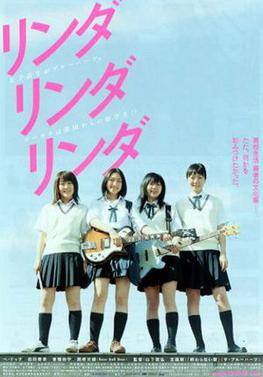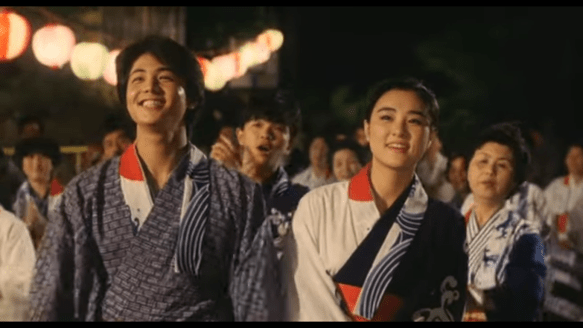
Linda, Linda, Linda (2005)

“Like a rat, I want to be beautiful. Because you have a beauty that can’t be reflected in pictures” -sung by Linda, Linda, Linda

During the grainy opening scene of Linda, Linda, Linda there’s some time spent figuring out how these characters relate to our story as two AV nerds look to video a high school girl who is introducing a school’s forthcoming cultural festival.

It’s not so important to get to know who they are as to realize they will become the bookend for the movie and the parameters of its world. Because when you are a Japanese student, “Bunkasai” really is your chance to shine in front of your peers.

Linda, Linda, Linda captures this environment better than any other film I’ve seen thus far, and it’s because there’s really an ecosystem built out. Each class has their own task, game, or food vendor that they’re preparing for. Sports teams will have exhibitions. Clubs will have booths. Bands put on performances on the big stage for everyone.

However, this canvas wouldn’t work without the human drama we come to expect with high school. One girl hurts her hand and petty disagreements lead to the dissolution of an all-girl rock band. Three of its members, Kei, Kyoko, and Nozomi, decide to form a new quartet without their lead singer. Son (Bae Doona), the unblinking Korean exchange student is quickly found as her replacement.

Some western audiences might not recognize what an odd choice Son is to be their lead singer. Japanese is not her first language. They often have trouble communicating with her (A stunted bus stop interaction brought back all sorts of personal memories from my time overseas). She has to learn all the lyrics to their setlist and she’s a bit kooky. Still, it fosters a beautiful kind of relationship.

There’s something leisurely and unhurried about the pacing of the movie. Characters are put in front of us, and yet we don’t feel like there’s some objective to be obtained. It’s about getting to know them and observing their situations.

My primary avenue to consider this film is through the filter of my own experience. I went to a cultural festival like this. There was giant Jenga and classrooms turned into rollercoasters and carnival games. We had boba, sweet potatoes, and frankfurters (while supplies last). But the best part was the music. I saw many of my students come into their own, witnessing sides of them you never see in the classroom. Raging fuzz-filled guitar solos, singers coming out of their shells, and girl guitar gods rocking out.

In fact, I was up on that stage too. Rather like Son I was an outsider. I got asked to sing a song in English and so without any musical training or a voice to speak of I agreed spending several weeks learning a One Direction tune. It’s not quite The Blue Hearts, but I’m not much of a singer. Son spends her time training at a karaoke drink bar.

If that experience was hardly a highlight of my life, I fall back on the experiences I got to witness. Linda Linda Linda has that same raucous joie de vivre we rarely attribute to Japanese culture. That’s what made it so joyous watching my students rock out to One OK Rock and Green Day.

It’s the same energy making Linda, Linda, Linda buzz with a pervasive joy. The audience imbibes the energy, cheers it on, and the musicians feed off of it. Nerves die away. They give themselves over to the music and enjoy themselves. If it’s like my school, these kids will probably never be professional musicians, but that’s hardly the point. Music has joys going beyond fame and monetary gain.

I was once taken by the idea of James Carse with his infinite games. Finite games have winners and losers. In infinite games, the players seem to be cooperative feeding into something bigger than themselves and utilizing a different, intrinsic rubric for success.

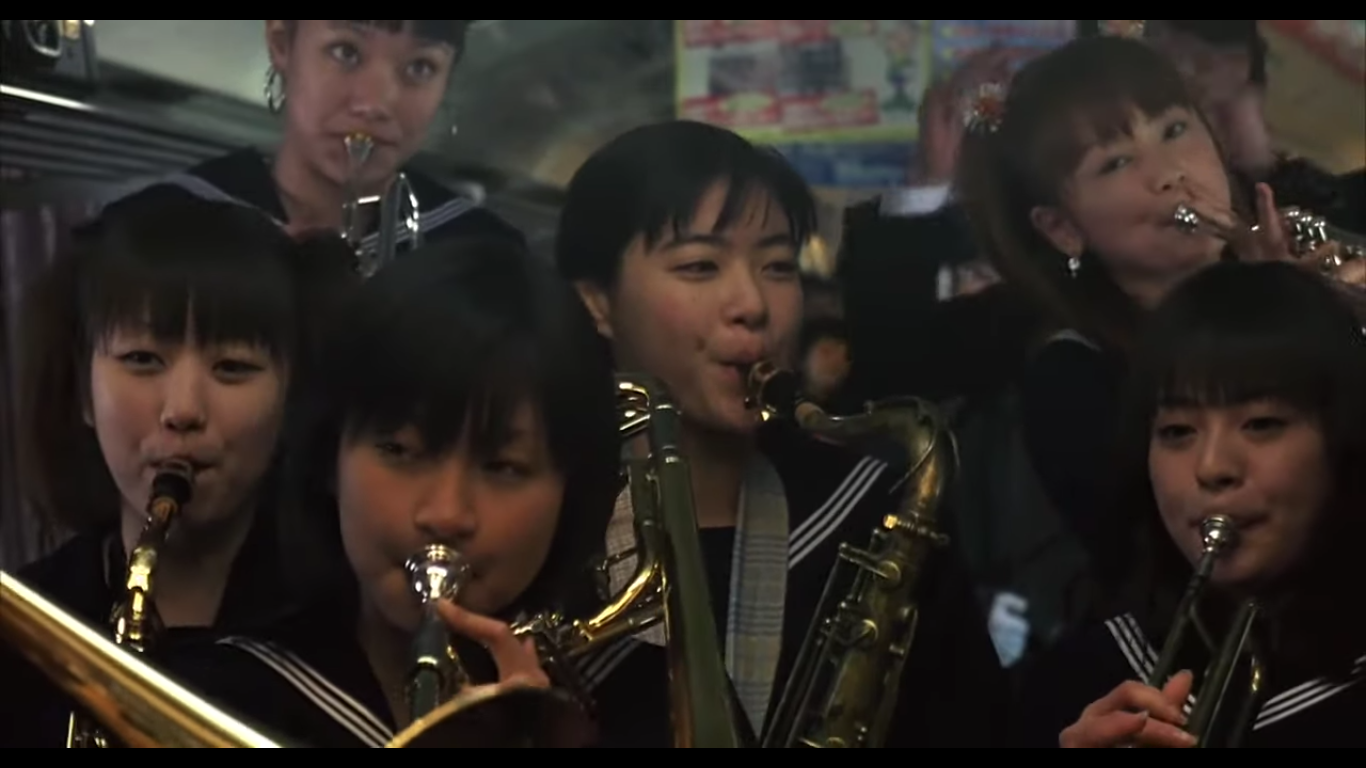
Although Linda…deviates mostly from the similar-sounding Swing Girls, what they share beyond a frantic slap-dash finale, is this performative exhilaration found most often in music. Soon enough, the festival is over and that’s the end of it.

But for a couple shining moments in the middle of the setlist, they were at the center of something spectacular. It’s easy to be a sucker for these kinds of stories when they feel so closely tied to my own fond memories. Long live Linda, Linda, Linda.

4/5 Stars

Swing Girls (2004)

“There are two kind of people in the world. Those who swing and those who don’t.”

I’ve already talked about this phenomenon ad nauseam, but having lived abroad in Japan, worked at a school, and interacted with many Japanese people, it fascinates me to learn about their cultural proclivities.

I hesitate to call much of what the Japanese do musically cultural appropriation because they seem to totally recontextualize the artifacts we know. One prime example is “Take Me Home Country Roads” by John Denver being featured so whimsically in Ghibli’s Whisper of The Heart. They somehow take cultural touchstones we know and pluck them out of a moment in a kind of reverent homage (One peculiar counterexample might be the animatronic JFK featured in Sans Soleil).

Writer-Director Shinobu Yaguchi’s Swing Girls is a film positively swimming in teen culture. Like a School of Rock, it feels like a movie looking for a wide audience, and it will easily repay those desiring a crowd-pleaser.

It introduces its world by gladly playing into high school tropes and stereotypes. Tomoko is our primary conduit in a clique of girls who seem generally bored with school and crazy about cute boys, fashion, and the like. They’ll do anything to get out of a summer make-up class and reclaim their adolescent freedom.

When the school’s band regrettably forgets their order of bentos for their gig miles away, the girls volunteer to hand-deliver them by train. It begins the madcap craziness as they miss stops, take to walking on foot, and unintentionally bake the food into oblivion. When all the band comes down with deadly food poisoning, their failed charade is up.

It’s a bit ridiculous. Where can a movie like this go? There’s only one answer and Yaguchi does his best work leaning into the big-hearted absurdity of it all. Having single-handedly wiped out the band, Tomoko and her compatriots consider joining the one male member not sidelined. It’s yet another convenient way to get out of summer school.

As an audience, we are able to laugh at the incongruity as all these girls who have never handled a musical instrument in their lives try their hand at forming a Big Band. They’re of the assumption that Jazz is for fuddy-duddies and intellectual types swirling brandy snifters. I can’t fault them because I was of a similar persuasion until I saw the light.

Takuo (Yuta Hiraoka) sets them up with a training regimen conditioning like athletes and introducing them to the likes of “Take The A Train” by Duke Ellington and Billy Strayhorn, a song that was integral to my own jazz appreciation. It feels like this mixture of oil and water, but then that’s the entire novelty of the premise. Whether or not it’s realistic, they do get better and more ambitious.

The girls take up part-time jobs to try and cobble together some second-hand instruments. They take part in all manner of good-natured fun and games like fleeing a wild boar and engaging in a euphoric snowball fight. Still, they still have a goal to realize, preparing their audition tape for the big high school competition.

Swing Girls is a film that keeps on building on itself until the height and width of its sizable heart overwhelms us with warmth and laughter. It grows to a crescendo as they frantically try to make it to their big day, first serenading their tour bus, and then performing the real thing.

They pad their performance with renditions of Glenn Miller and then Benny Goodman’s “Sing, Sing, Sing.” This second song is noteworthy to me because the band at the high school I worked at performed this same song. I have no inclination if this choice was inspired by the film or the fact Goodman was one of the swing era’s heavyweights. The particulars don’t really matter.

Swing Girls is best in its goofiness, giving us a story easily transferable into the Hollywood arena with feel-good moments and cheering acts of redemption. There’s actually not too much romance which is actually a nice surprise. However, in it, a closeted jazz enthusiast can come out of the woodwork to fulfill his dreams, and a classroom full of dead-end girls can come together to create something quite spectacular.

It provides a new context for Japan’s long-lasting love affair with jazz music, and I was pleasantly taken with it. Wonders never cease. All I can say is I want to be one of those people that swings. I can see it bringing the utmost joy into my life.

4/5 Stars

His Motorbike, Her Island (1986) and The Rocking Horsemen (1992)

His Motorbike, Her Island (1986)

There’s an immediate aesthetic artifice to His Motorbike, Her Island. Our hero is cool and simultaneously cruel representing a husky-voiced, brusque masculinity that feels no doubt appealing and equally toxic. He recounts his life’s observations through voiceover — the monochrome dreams making up his memories — and as such the movie slaloms easily between black & white and color.

It feels perfectly at home in its moment as part ’80s biker movie full of style. Some of this no doubt comes from director Nobuhiko Obayashi who always seems to have a propensity for commercial pop culture imagery. I would hesitate to call him a technician, and yet since he both edited and directed many of his films, maybe I don’t want to use the label because it sounds too austere.

His films are suffused with a vibrant energy and although the comparison misses the mark, the only reference I could think of was Richard Lester. I’d be interested in hearing who others bring up.

The movie’s premise is quite simple. Koh Hashimoto (Riki Takeuchi) runs errands on his motorcycle part time. His idle hours are taken up with a docile beauty name Fuyumi. He even gets in a duel with the girl’s older brother, who’s worried for her honor. Whether the outcome impacts his view of her or not, Koh, breaks it off. By his estimation, she’s boring (all she knows is crying and cooking).

Koh is looking for the Japanese version of the aloof dream girl, and he finds it in Miiyo. She captivates him with her confident vivacity, taking pictures of him, chatting in the onsen, and ultimately taking up his first love of motorcycles.

Their relationship blossoms when he visits her hometown out in the country during Obon, and we witness how the summer holiday is rooted in both a veneration and a celebration of dead loved ones. Koh’s captivated watching Miiyo dance during the festival proceedings. It’s something about her spirit he finds so attractive.

It also signals the film’s dangerous edges. Because if I wanted to distill His Motorbike, Her Island, down to its essence, we would need to talk about the intoxicating and reckless abandon of youth. It’s mesmerizing when it’s projected up on the screen in all its glory existing without worldly consequence of any kind.

Miiyo follows Koh and becomes infatuated by his singular passion: a 750cc Kawasaki. But it’s not just a supercharged motorcycle, and it’s not so much about an object made of chrome and an engine. It’s the adrenaline hit and emotional high of riding a motorcycle and riding it fast. It’s almost a dare for life to come at you head-on. For them, living life on on the edge like this is an obvious antidote to the malaise.

It’s both what attracts them to one another and threatens their ultimate undoing. Live fast, die young, has a poetic inevitably to it. I feel like I will need to watch the movie again down the road sometime, but there’s a pervasive sense that this motorbike, this island, this young man and this young woman take on a kind of mythic proportion.

Just like I never caught onto a perceptible rhythm of the monochrome and color, what we witness is not always an objective, tangible world. It exists in the hinterlands of memory, love, passion, and emotions just out of reach. The irony is obvious.

Sometimes, to feel alive, people need to get as close to death as possible. I’m not sure if this star-crossed, high-octane hedonism is still en vogue, but it’s easy to understand how it could seem attractive albeit misguided. There’s a hubris to it.

3.5/5 Stars
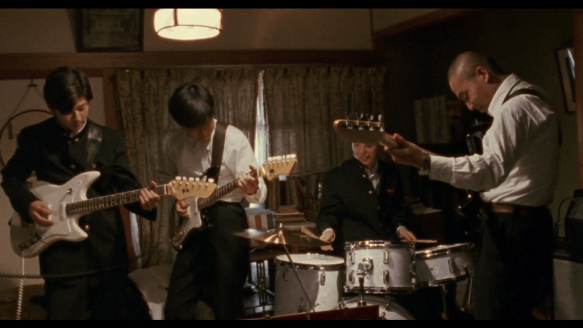
The Rocking Horseman (1992)

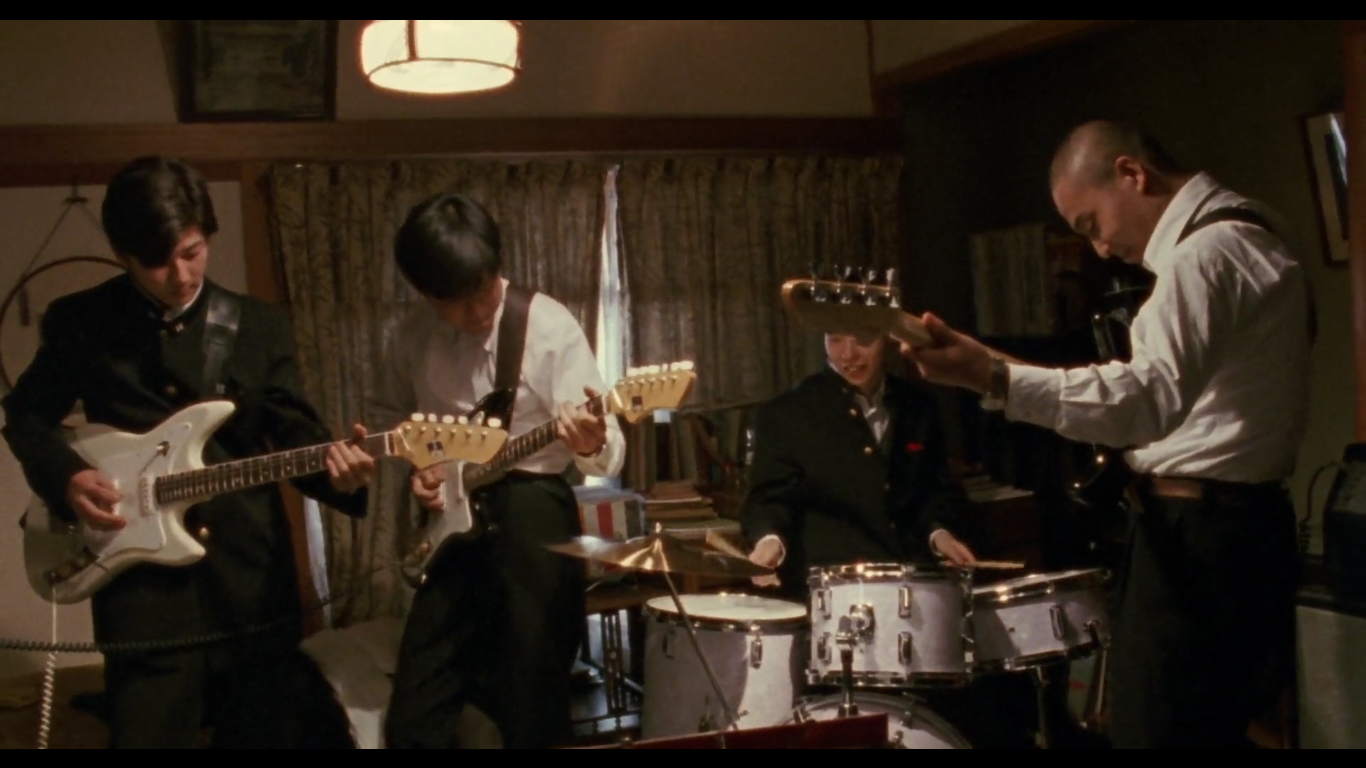
When I lived in Japan, I was flabbergasted to learn that there was a group that was bigger in Japan during the ’60s than the Beatles. It was The Ventures! This instrumental act kicked off the “Eleki Boom” as their iconic onomatopoeic glissandos (deke-deke-deke) captivated a generation of youth. These teenagers subsequently rushed out to buy their electric guitars and start their own bands during the “Group Sounds” explosion.

Although I didn’t think about it at the time, I’m a sucker for a good musical coming-of-age movie, and this landscape was ripe for such a story. Recently, when I came upon The Rocking Horsemen, I realized a void in the cinematic landscape had been filled thanks to Nobuhiko Obayashi

Fujiwara (Yasufumi Hayashi) feels like the most innocent and congenial of Obayashi’s boy heroes, a Ferris Bueller-type who instantly takes us into his confidence by not only providing voiceover but speaking directly to us.

OB’s films are easily placed in this provincial milieu outside the hustle and bustle of the big city. This gives them a kind of comfortable intimacy, and it’s only a small jump to place them in the past. In this case, Japan during the 1960s. I already mentioned that the movie covers a subgenre I have a private preoccupation with: form-a-band origin stories. That includes That Thing You Do! and Sing Street to The Commitments, Nowhere Boy, and School of Rock. What sets this one apart is the unique context and cultural moment.

Now I’ve been inculcated from an early age that the Beatles had the greatest music, but Fujiwara is coming of age with an ear raised to the admonitions of his elders. Pop music is puerile entertainment, cultural dregs compared to the sophistication of classical music. The Beatles included.

Then, his radio played “Pipeline” and he is changed forever. Any kind of snobbery quickly dissipates. The new sound assaults him as he reclines in his bedroom. There’s no escaping its force, and he converted for good, caught up in the same boom I read about. It was electric liberation.

Since a rock musician can’t look like a Buddhist acolyte, the first course of action was to grow out his hair. It occurs to me that one of the reasons I find these movies compelling is it involves some kind of youthful industry. When you’re young you don’t need to be told the odds. If you want to start a band, and that’s you’re impetus, you can go ahead and do it. No permission is necessary (parents notwithstanding).

In this way, Fujiwara meets his future bandmates. The first shares his interest in rock and turns his back on the more traditional setlist the school club follows. The rest of the members include a priest’s son, who’s the band’s source of worldly wisdom, and then a gawky dork who gets coerced into playing the drums for them.

If initially they fall together organically enough, they also premeditate how to best go about their business. In the end, they resolve to get summer jobs at a local manufacturing plant to save up to buy their instruments. These scenes are mostly transitory — only an end to the means — but as “Woolly Bully” plays over their assembly line, there’s a sense of optimism. They’re getting closer to their goal.

Ittoku Kishibe shows up again after Lonely Heart as a good-natured teacher who supplies American lyrics and ultimately offers to become their club advisor. It’s a small addition, but his tacit affirmation of their endeavors speaks volumes.

I’m fascinated by how pop culture can infiltrate and suffuse through the cracks of a society, especially in an international context. I met Japanese folks with very specified knowledge about Korn or Olivia Newton-John, Sam Cooke, Jazz or Punk music. Or think of the two teens in Mystery Train who go on a pilgrimage to Memphis in search of The King. Where does this come from?

While I wouldn’t call the general Japanese populous particularly aware of world culture, you do find these hyperspecialized niches of expertise. These boys glean their inspirations thanks to radio and import records, even older siblings who pass down a love of Nat King Cole.

A perfect example is Jan and Dean’s “Little Old Lady from Pasadena” played as our hero rides his bike through his neighborhood. It’s a totally different context from the California surf culture I was born and bred in. But it still reaches them on the other side of the world. The same might be said of The Animals, “Don’t Let Me Be Misunderstood.”

It doesn’t feel like a mistake that the first time the new band convenes and brandishes their new name — The Rocking Horsemen — they start playing, and it’s a flawless rendition of “Pipeline” (exactly like the Ventures recording). They make their debut at a show during Christmas with mixed results, but they disregard the critics and play their hearts out. What’s more, they gel and become galvanized as a group. How can you not under the circumstances?

But as school comes to a close, their journey together winds down too. Their first and last big show comes at the annual school cultural festival and with a set list including “I Feel Fine” and “Johnny B. Goode,” they can’t miss. We’ve seen this moment before in many a movie so it’s a kind of expected wish-fulfillment watching them go out.

When you’re an adolescent these are the kind of memories that stay with you. And in a final act of solidarity, Fujiwara now listless and despondent over the future, has his newfound brotherhood to come around him. They christen him their “Bandleader for Life.” So even as their journey as a band might have met its logical conclusion more than an impasse (not many make it like The Beatles), The Rocking Horsemen do have some amount of closure. The music and those relationships will never leave them.

4/5 Stars

Lonely Heart (1985)

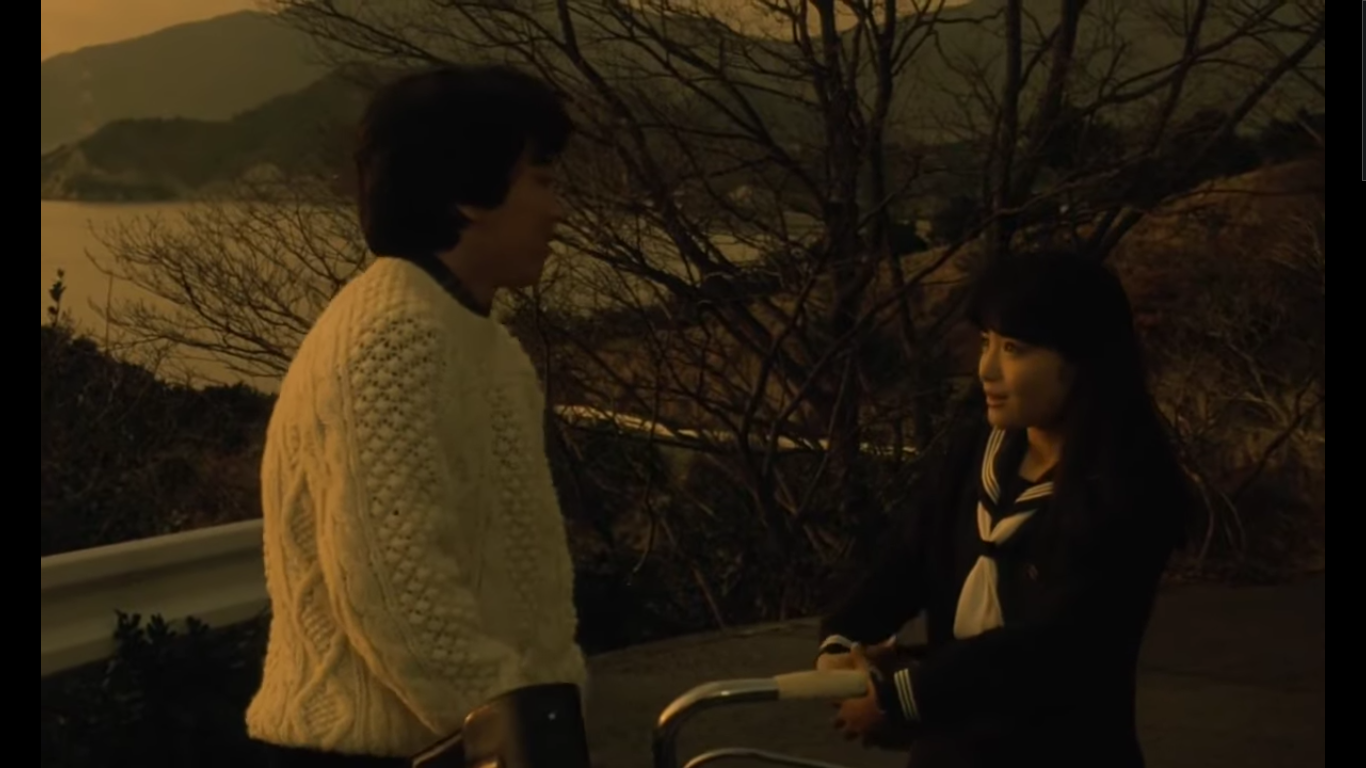
Lonely Heart is a film bathed in the golden hues of nostalgia (“natsukashii” in Japanese). It also boasts a rural landscape with a topography that’s the utter antithesis of Tokyo’s urban skyline. This in itself already evokes a certain quaintness, regardless of the story being told almost 40 years ago.

Hiroki (Toshinori Omi) envisions his world through the shutter of his camera — though he rarely has actual film to use — and so he imagines what he might capture. After school, he can be found scampering through the village streets in his school uniform with his two best friends doing backflips and cracking all manner of jokes. They have a youthful ingenuity that’s clever when it’s not getting them in trouble.

For instance, their use of Bunsen burners, forceps, and various pieces of lab equipment to cook up a delectable meal is inspired. Then, Hiroki’s friends razz him about following his father’s footsteps to be a Buddhist monk — he must give up meat lest he goes to hell for cutting corners on the road to enlightenment — and they’ll gladly eat his portion.

The next moment, they’re ushered off to the principal’s office to clean as a minor punishment. Instead, they teach vulgarities to the principal’s prized parrot and their mothers have the ignominy of coming into school to atone for their indiscretions. Hiroki’s mother is your typical portrait of a Japanese parent, at the very least because she’s always on her son to study more and pick up his grades. Their underlining failure to communicate is a universal adolescent struggle.

But his life stage is also about love, something that still feels naïve and untarnished by regrets and ample experience. He often looks through his camera viewfinder at the mystery girl, “Lonely Heart,” as she plays the piano, rides her bike, and takes the ferry home. If this was all it was, Lonely Heart might be a fairly rudimentary exploration of youth — another boyish awakening where the girl is cast as an object rather than a human being with a unique inner life.

Some of this happens in the movie with the ethereal Yasuko Tomita, but there’s also a parallel tale leaning into these themes in a more profound way. In fact, it takes them a step further. Hiroki receives a visitation from an impish ghost of a girl who materializes on numerous occasions even going so far as berating his mother and toying with her.

This seems like a curious development, but then Japanese culture has a greater tolerance for ghosts. If you’ve seen some of Miyazaki’s movies (arguably Japan’s most beloved cinematic export), you already know there’s a kind of acceptance of these things. They aren’t so much supernatural and if she’s labeled as “weird,” she’s also more or less accepted as fact.  Just as magical realism and surrealism can often permeate Japanese cinema.

This is easier to accept as I often have trouble with Japanese humor because it feels broad (whatever that means). The film is full of juvenile shenanigans and adult caricatures who overwhelm the screen from time to time blindsiding us with absurdity.

However, in juxtaposition, there are these instances of sensitivity playing out in Lonely Heart’s more pensive parts, personifying what Hiroki grapples with all throughout the film. It’s this long-lost love — the deep longing within all of us — resigning us to be these lonely creatures.

In Japanese culture, there’s also something innately beautiful about this sacrificial melancholy for the sake of some greater good or greater call. If I didn’t get my cultural signals crossed, it ties into the essence of “mono no aware” — an impermanence or transience of things. I’m not sure if Japanese culture would speak about love with these same terms, but please allow me to, even if only momentarily.

I’ve gotten to a juncture in my film-viewing life where, if I haven’t quite matured, I’m willing to take things on their own terms. Lonely Heart does not function within our western logic. If you asked me to explain everything away I’d be hard-pressed to say all the whys and wherefores. And yet something about this movie, mixed in with all its various forms and flights of fancies, left me with an indelible sense or feeling that will remain with me.

Somehow it reminded me of the more recent gem Petite Mamman. It has to do with honing in on a magical and poignant connection between parents and children. It developed differently than what I was expecting — the fantasy has a unique kind of functionality — and so by the time the movie’s over it has done work on us.

It’s offered up a quiet epiphany that we might tuck away for later enjoyment. Hopefully, if you get the chance to watch the film you’ll understand exactly what I mean. However, I wouldn’t dream of divulging that here.

3.5/5 Stars