

 In Manchester by the Sea, you can distinctly see Kenneth Lonergan once more translating some of his skills as a playwright and stage director into his film. There’s a very inherent understanding of two-dimensional space and how images can be framed in a very linear way as they would be seen by an audience taking in a stage production. But even more noteworthy than that is his dialogue which functions in remarkably realistic ways. Some will easily write this film off as the sheer doldrums because it’s fairly fearless in its pacing.
But that very structure and the things it spends time on slowly reveal more and more about the characters as if the curtain is slowly being torn away and their guts are being spilled out in front of us, in the most labored way possible.
It’s true that a great deal of the acting is an exhibition in non-emotive near anti-acting. It goes against the normal penchant for histrionics and gut-busting displays of emotion. Those crop up here and there understandably for a story that deals with such heart-wrenching topics. However, this particular study finds the majority of its most illuminating revelations in the minor moments, quiet asides, and soft tears rather than more overt outbreaks.
Sometimes it’s those very dramatic moments that catch our attention but most of the film — most of the instances that we actually come to learn a great deal about these seemingly unextraordinary individuals happens in the moments that initially appear far more mundane.
Crucial to this whole narrative is Casey Affleck as Lee Chandler. His performance is painful to watch because he himself looks so uncomfortable, despondent, and forlorn in every frame. There’s no relief for him. He never gives it to himself and he never accepts it from others. The fact that his elder brother has passed away suddenly is the inciting action that only aggravates his status quo but it’s not the main cause for his current state of being.
Because, of course, the question becomes what happened to him to make him such a misanthrope? That’s one issue because the past informs his present and stoke the flames of his continual discontentment.
The latest revelation is that he is made the legal guardian of his teenage nephew and this among all his other personal demons is the situation he must grapple with. Their dynamic stays front and center.
Together they must navigate all the responsibilities that come after Joe’s death whether it’s signing off on his belongings or setting up his burial with this insurmountable amount of grief still hanging over them. Lee willfully takes his nephew to school and band practice at one of his girlfriends.
But he’s not good at showing affection. He’s difficult and in such a contentious moment of pain they both lash out at each other more than once. But there’s still an underlying sense that they care for each other. Lee wants to protect his nephew but he doesn’t quite know how–he does not know if he will be able to bear the responsibility.
Still, others of note also crop up and play a part in the story including Lee’s ex-wife Randi (Michelle Williams) who has moved forward with her life but still feels tortured for the very way that she treated Lee when they were married. There’s so much hurt there and Lee buries that too.
His now deceased brother (Kyle Chandler) who we begin to meet through flashback is not developed quite as much but he does stand as a symbol of family and how deeply the loss of loved ones is earth-shattering. Because often these are the people who are a perpetual part of your life. You come to love them and accept that they will always but there. Even when your own life is going down the drain at least they remain. Except in an instant, their flames can be cruelly snuffed out.
The story’s visuals not surprisingly cast a vision of a tranquil seaside locale that nevertheless can be a place of bitter cold and blue-collar mediocrity. Lee would be the poster boy of this lifestyle as he spends his days as an isolated handyman janitor grinding away at life. But as with any life, we can never make preconceptions. We need to get to know someone before we judge their character. That’s what a film such as Manchester by the Sea makes us realize as human beings.
Everybody has a story. We all make mistakes. Our flaws are many. No one knows how to cope with guilt and it hurts like a slug in the face sometimes. Even if it is a taxing film and a difficult film to traverse with its share of profanity, Lonergan’s piece is still a nuanced look at what that process is like. Perhaps you haven’t experienced the death of a loved one yet but most definitely you have and you know the pain and the helplessness and the messiness therein.
If any of that resonates with places you’ve been before then Manchester by the Sea might easily speak to you because it understands some of the unassuming power in the human experience and its innumerable complexities. Unsatisfying in the end, yes, but alas that is life so often. People constantly struggling with trials, tribulations, and dissatisfaction til the end of days.
It’s after one particular scene where a very special guest star makes an appearance a man that Patrick notes is “Pretty Christian” while Lee responds that “we’re Christian too. Catholics are Christian.” And he’s perfectly correct. It’s in this passing moment that the film teases on something interesting that it, unfortunately, doesn’t wrestle with more. Spirituality and faith in a God in the midst of suffering. Maybe the characters still need time to get there and that’s okay. But Manchester by the Sea does make us empathize with other people and come to understand their stories. That is crucial if we’re ever going to live together in this world of ours. For that reason alone this story has something to offer us.
4/5 Stars
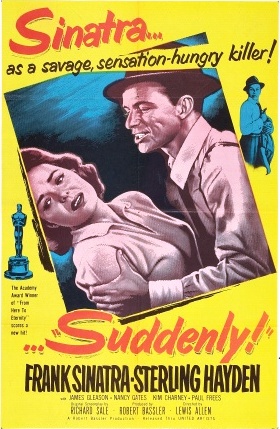 In some ways, the sleepy town of Suddenly feels like it could have easily been the prototype for Mayberry (Willis Bouchey’s appearance acting as the one actual tie-in to The Andy Griffith Show). The sheriff wanders around lazily. He knows everyone by name and they probably haven’t had anything exciting actually happen for 20 or 30 years at least. But then they go and have something bigger than Mayberry ever dreamed. No filling station robberies, or shipments of gold, or even a group of out of towners trying to case the bank. This is big. It involves the President of the United States and Frank Sinatra or rather Johnny Baron, the man who`s looking for a big payday from assassinating the commander in chief. But people generally liked Ike and so the Secret Service roll in to take the necessary precautions including cueing in the local sheriff on the particulars and shutting down the town.
 The finest compliment that can be paid to Blade Runner 2049 is that it is indubitably the most enigmatic film I have seen in ages. Typically, that’s newspeak for a film that probably deserves multiple viewings, because its intentions, much like Ridley Scott’s Blade Runner (1982) are not always clearly laid out. Especially in this day and age when we often expect things to be given to us and our hands to be held as an audience.
 Upon watching A Few Good Men for the first time, it was hard not to draw parallels with An Officer and a Gentlemen for some reason and it went beyond some cursory elements such as both films involving branches of the military. Perhaps more so than that is the intensity that manages to surge through the plot despite the potentially stagnant battleground like Cadet Schools, Courtrooms, and the like. And that can in both cases is a testament to the stellar performances in front of the camera.

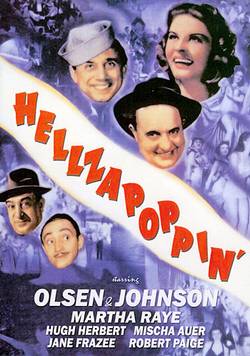 It essentially begins with a fourth wall break. That’s all you need to know. Because that gives you exactly an idea of what you’re in for with Hellzapoppin’ or rather it gives you no idea whatsoever what you’re in for but really they’re one in the same. I’ve seen the movie and I still don’t quite know what it was.
 In style if not entirely in execution The Lineup exhibits some similarities to Murder by Contract from the same year. Both films choose to take hit men as their main characters and it becomes a surprisingly intriguing way to look at a crime. Because the killers are a certain brand of sociopath who make film criminals all the more compelling based on not only on the way they carry themselves or the actions they take but the very words that leave their lips.
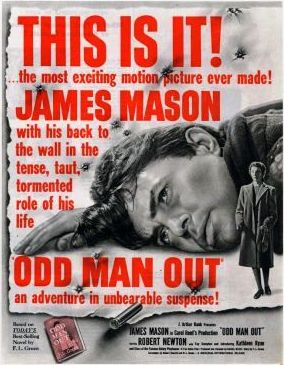 In my profession, there is neither good nor bad. There is innocence and guilt. That’s all. ~ Denis O’Dea as the Police Inspector