Unknown's avatar

About 4 Star Films

I am a film critic and historian preserving a love of good movies. Check out my blog, 4 Star Films, and follow me on Twitter @FourStarFilmFan or Letterboxd. Thank you for reading!

Greed (1924)

Greed3With some cinematic endeavors, there is simply an aura that surrounds them which informs how we look at them. Erich von Stroheim’s ambitious silent film Greed is such a picture. To this day, a full cut of the film has never been found and perhaps never will be, but it has survived in two versions. A four-hour cut which attempted to maintain the original continuity through stills and then a 2 and a half hour cut which I saw. So you could question whether I got the full experience of Greed or not, but that is almost beside the point because the essence of this film is summed up in the title. True, it could just as easily be called sin, avarice, grudge, humanity, or all of the above. But allow me to explain more fully what I mean.

The narrative follows a slow-witted man named McTeague (Gibson Gowland), who picks up the dentistry trade from a traveling doctor. He moves to San Francisco and soon becomes smitten with the cousin of his boisterous pal Marcus (Jean Hersholt). Trina (Zasu Pitts) is quiet and a bit timid around a man as intimidating as McTeague, but they make it work. Soon enough they’re engaged and a lottery ticket Trina picked up on a whim pays off handsomely. $5,000 to be exact and this is the 1920s! They’re getting on alright because McTeague is still working and his wife is very, very frugal. But Marcus feels entitled and a grudge over the money ensues. He wants part of the cut because he thinks he deserves some good fortune too. Things between him and John finally reach the boiling point and there’s no turning back. Rather than try and patch things up, Marcus decides to get into ranching and says goodbye to his formerly close friend, but not before serving up a little revenge. He sets the dentistry board on McTeague and since he doesn’t have a true credential, his right to practice is terminated.

The loss of John’s job is aggravated by the fact that Trina is increasingly stingy, never wanting to dip into her big payoff, even when they really need it. Gold in many ways has become her master, and it leads to marital turmoil. McTeague was always a big man, but usually quite gentle. But his inner fury is finally uncorked and in one angry outburst, he goes so far as to bite his wife.

Mac leaves only to come back again and the results are not pretty. Soon he has a price on his head and he makes his way as a fugitive into the desert. And thus, the finale is shot on location in Death Valley, the perfect place for a climactic showdown between McTeague and his old pal Marcus. Of course, money doesn’t help much when you’re trapped in the desert, or when you’re dead for that matter.

Obviously, greed doesn’t bode well, but this story is an interesting inversion of the typical plot line, because in this case it is the woman who has the money, and she’s the one that the greed eats away at. She becomes obsessive and even bitter about every last piece of change. But her money also has a ripple effect that reveals the pettiness, avarice, and begrudging nature that plagues both her husband and cousin.

So in order to enjoy this film, you need to have an appreciation for the spectacle that von Stroheim has developed and the commentary he has weaved through his narrative about greed. That in itself makes this film one to truly ruminate over because it suggests so much about the ugly side of human nature, and that has hardly changed in the past century.

The Sessions (2012)

220px-The_Sessions_posterI was a bit skeptical of this film at first, but I can say unreservedly that it boasts true heart and sensitivity. In many respects, it reminds me of another film about a man with a so-called disability, The Diving Bell and the Butterfly. In both, a highly creative individual is able to defy their physical barriers and truly impact the world around them.

In the case of Mark O’Brien (John Hawkes), he graduated from Berkeley destined to become a journalist and poet, the only difference with him is that for most of his life he has been confined to an iron lung that keeps him alive. It seems like an obvious roadblock to success in life, and yet not so for Mark because he faces each day with a sense of humor and even a spirituality that is impressive. He relies on his caretakers for so much and yet they enjoy helping him because he is a generally kind spirit. First, it’s the beautiful Amanda (Annika Marks), who he sincerely professes his love to and then there’s Vera (Moon Bloodgood), who while frank, is still deeply concerned with his well-being. Furthermore, the local priest (William H. Macy) is equally willing to listen to Mark’s confessions, not simply about sins, but more importantly his life on a whole.

Mark’s a very transparent individual, who attacks life with a positivity and tenacity that goes beyond the physical. Wit becomes his precious ally in facing every day, and he also takes great care in the relationships around him. He wants to live his life to the fullest, and he won’t let an iron lung impede him. Thus, he decides that he would like to try and have sex since he is still a virgin and feels that he might not have long left to live. And so, after consulting with his priest and acknowledging the sensitive nature of the decision, he tentatively decides to go for it. Cheryl Cohen-Greene (Helen Hunt) becomes his sex surrogate, and yet she is more of a therapist than anything else. She helps Mark become more and more comfortable in his own body and there is a beautiful vulnerability and openness to their time together.

The Sessions proves that there can be depictions of sex that can be as tender and sensitive as the characters involved. It’s not some vulgar act or a simple gratification of desire. It has more significance than that, just as these characters carry more significance. Father Brendan is not a perfect character just as Mark is not perfect, but we appreciate them for their geniality and light touches of humor. As for Cheryl, she does a great favor for Mark, and yet in the process she herself is deeply moved by this man in front of her. He’s seemingly so weak, so unassuming, and yet there is so much vibrancy to him.

The day Mark dies is sad for all of us and gathered at his funeral are all the people we expect to be there. The Father gives a heartfelt eulogy as all the women he touched sit in the pews looking on. The beauty of this story is that Mark finally did find love quite by accident, and he touched so many lives in the process. Though not a perfect film, The Sessions is heartfelt and that covers a multitude of faults.

4/5 Stars

Private Hell 36 (1954)

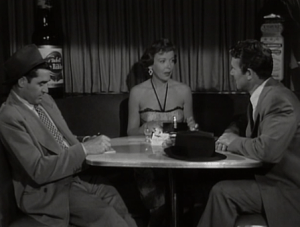
privatehell1There’s not a whole lot to it. Aside from a wonderfully pulpy title, Private Hell 36 feels like a pretty straightforward endeavor from director Don Siegel. The low budget procedural nevertheless boasts a surprisingly good cast. The tale is framed by a nice bit of narration from the sitting police chief played by the always enjoyable Dean Jagger, in a particularly compassionate role.

Our story opens on a perfectly normal night where one copper seems to quell a drugstore burgle while he’s off duty, and another cop gets it in the crossfire between rival gangs. It causes the police to go on high alert.

When some street vermin rolls into the station to get booked, he’s found with some nifty paper. Detective Cal Bruner (Steve Cochran) and Jack Farham (Howard Duff) are assigned to follow the trail of a counterfeit $50 bill that’s pinned on a killer. So it’s more than hot money now. There just might be a murder rap at the end of it. Their canvassing leads them right to the lap of self-assured night club singer Lilli Marlowe (Ida Lupino).

Farham is a relatively honest chap with a doting wife (Dorothy Malone) and a kid already. Bruner has a propensity for recklessness, and he also takes a liking to Ms. Marlowe, especially after they spend so much time together.

privatehell2The temperature begins to rise when the two colleagues get caught up in a car chase with their counterfeiting adversary. All the days casing the local race track with Ms. Marlowe finally leads to some action. In the aftermath, one car goes careening off the road, and the boys have a decision to make. They frantically begin snatching up dollar bills and they decide to go dirty and make a run with the money.
Such a plot takes the usual turns that we would expect as girlfriends, greed, familial responsibility, and guilty consciences cloud the path to the straight and narrow. The film, which was jointly written by Ida Lupino and her former husband Collier Young, is no great work of art. But there is enough character conflict and crisis to make Private Hell 36 a gratifying piece of lower tier noir.

3/5 Stars

“You know I’ve seen this all on Dragnet” ~ Lilli Marlowe

 “Save the jokes for the customers” ~ Detective Bruner


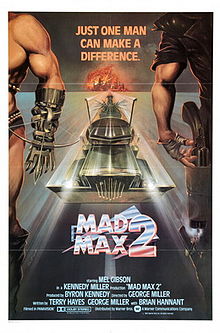
Mad Max 2: The Road Warrior (1981)

Mad_max_two_the_road_warriorNow that I’ve seen Road Warrior, the film that is the hallmark of the Mad Max trilogy, I have a little better understanding of how George Miller arrived at Fury Road. It was a brilliant, exhilarating, wild ride that fully grasped what makes an immersive action film. But to get there we have to look back. In Mad Max (1979) Miller and his crew were simply feeling around, testing the waters, and getting acclimated to their apocalyptic world. It’s interesting, but not fully realized.

With Road Warrior there is still more exploring of the Mad Max character (Mel Gibson), however, more crucially, we get the type of action that propels the franchise from being another run-of-the-mill action saga. Do you think it would carry any clout in the U.S. if there was not something dynamic about it? It stems from Max, who although a main character, seems content being in the background. He’s a man of few words, who only takes on the role of hero when necessary. He’s self-assured and confident when the need is there. Otherwise, he’s fine cruising around looking for gasoline through the wasteland with his faithful canine pal. That dog is great, by the way.

However, during one such excursion, he crosses paths with a clan trying to fend off a band of marauders. Max initially begins as a prisoner only to become an ally that the locals are wary of, because, after all, he’s not trying to be their friend. But nevertheless, after helping defend their Australian Alamo, he ultimately decides to take on the task of guiding their shipment of fuel to safety. In one of the most memorable chase sequences (a predecessor to Fury Road), Mad Max guides his load with settlers guarding the tanker while the biker gang follows from behind. Their leader Humungus offered up a ceasefire only in an attempt to double-cross, and he’s not looking to leave any survivors.

In the ensuing chaotic cross-country race, machinery gets totaled, lives get lost, and Mad Max takes a brutal beating. He gets help from the wolf child, who will end up growing up to be the leader of his people. Now he helps Max in the struggle to fend off Humungus and his psychotic crony Wez. As it turns out, it was all a ploy and the settlers continue their exodus with their precious fuel. But of course, Mad Max does not go with him and in the mind of the boy, he becomes a sort of mythos. He’s not to be fully known, only talked about and spoken of like Greek heroes of old, who have long become more fiction than fact. The eponymous character of Mad Max is deliciously enigmatic, and it certainly doesn’t hurt having a few wonderful set pieces that will make most action fans lick their lips with delight. It’s sure to taste better than a tin of dog food, and dog food was fine dining for Max.

4/5 Stars

In Bruges (2007)

In_Bruges_PosterNear the end of the film, one of our main characters questions whether or not being stuck in Bruges is the equivalent to being in Hell. However, far from badmouthing the Flemish city, director Martin McDonagh actually makes it a fascinating backdrop for a film. It’s a city full of history, romanticism, mystery, and even peril. It just depends on how you look at it, with eyes of reverence or general disdain.

In Bruges, the film, only happens because two men have to make a quick getaway after knocking off a target in London. That is the life of a hit man. Quick work and then long periods of waiting. That is the majority of what we witness, following the existences of Ray (Colin Farrell) and Ken (Brendan Gleeson). Ray is a bit of a jerk sometimes and to him, Bruges is a living nightmare. Completely and utterly dull. But then he happens upon a fantastical film set starring a dwarf. There a beautiful woman Chloe (Clemence Poesy) catches his eye and then Bruges doesn’t seem so bad after all. At least for now.

Then there’s Ken. He’s not looking for casual companionship or booze. He has respect for the arts, the places of worship and the culture around him. Both men share foul Irish mouths and a general jadedness about their profession. After all, being a hitman is a living, but as Ray finds out it’s not without its stress. Shooting a little boy on accident takes its toll, and Ray must contemplate the entire framework of his morality. Meanwhile, Ken sticks by the phone and gets a call from their fiery boss Harry (Ralph Fiennes). He gets an order, and it catches him off guard. He already has his next assignment, but now he must attempt to reconcile orders with personal conviction. These are hitmen with a conscience.

Scum of the earth, yes, rough around the edges, maybe, yet somehow they still reveal their humanity. The miracle is that through the violence, we still find common ground to relate with them. We become thoroughly involved in this tale that, while darkly funny, is most certainly moving. When all the shots are fired, what we’re left with feels like a Shakespearian tragedy sprinkled with the absurdity of Bosch. Place all of this in front of the quaint Flemish setting and you have a rewarding adventure. I also recently saw Hot Fuzz and it seems that these films could almost be watched in tandem. Aside from both being British productions, they both have action, violence, and dark humor, but perhaps, more importantly, they exhibit genuine heart. That’s something not to be taken too lightly these days.

3.5/5 Stars

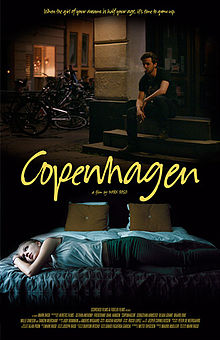
Copenhagen (2014)

Copenhagen_film.jpegSometimes you attempt to make a mental pros and cons list to try and convince yourself in one direction or the other after watching something. Copenhagen was such a film for me. Bike rides through the city. Pro. At times this film loses its steam and flounders a bit. Con.

In truth, the narrative does feel pretty thin when it comes to the main character William trying to track down his grandfather in Copenhagen. William for that matter is a foul-mouthed and generally annoying jerk of an American for most of the film. Also, the weird romantic tension that builds between him and Effy is obviously uncomfortable, but the will-they-won’t-they component is key to the entire narrative. Because essentially this is a film about a grown man finally coming to age, with the help of a very mature 14-year-old girl, who acts as his guide through Denmark.

That being said, the scenery in and around Copenhagen is obviously a lot of fun to partake of, and it truly is the perfect place to ride a bike around, day or dusk. Furthermore, with her husky voice, feisty nature, and winning charm Frederikke Dahl Hansen makes this film with her turn as Effy. True, she’s playing a character quite a bit younger than herself, and yet she succeeds wonderfully and really thrives as the winning force in this film. Because, if we don’t like her this film has little hope of rising above its narrative foibles and the utterly annoying nature of its other main players. Effy makes us like William at least a little tiny bit by the end of this story. And that’s a major compliment to her. To his credit, Gethin Anthony is easy to dislike, but that undoubtedly can be credited to his acting. His character does come around in the end too, not so much because of the quest for his grandpa, but he learns what it is to be a man and to treat others with the respect they are due. Namely in this case a 14-year old girl, and also is his best bud, Jeremy.

So is this a film I would recommend… Yes, but I tried to lay all the cards on the table because you could easily enjoy this film or just as easily find it disconcerting and tiresome. I fell into both categories at different times, but there were some truly entrancing moments that are hard to forget. Effy is almost hypnotic during her singing session in the bar. And traipsing through an art museum becomes a fascinatingly intimate study of the human form. Perhaps now more than ever Denmark will be on my travel radar since it looked like an absolutely brilliant place to spend a summer.

3.5/5 Stars

One, Two, Three (1961): Coca Cola and Communism

onetwothree1“On Sunday, August 13th, 1961, the eyes of America were on the nation’s capital, where Roger Maris was hitting home runs #44 and 45 against the Senators. On that same day, without any warning, the East German Communists sealed off the border between East and West Berlin. I only mention this to show the kind of people we’re dealing with—Real Shifty.” ~ James Cagney as C.R. MacNamara
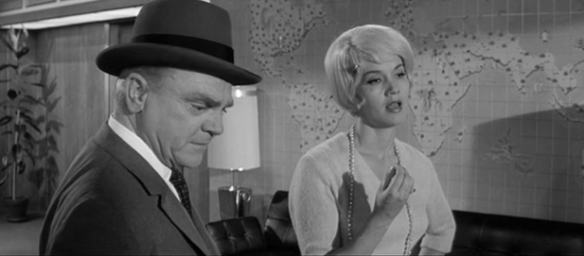
I love Billy Wilder. It’s as if he’s a lightning rod for all things controversial, biting, and politically charged, and he’s got a wicked wit. Thus, a cultural moment such as the Berlin Crisis must have been a juicy piece of material for him. Since it was, after all, his native land before the war, and he fills the frame with all the necessary touchstones. His collaborative script with I.A.L. Diamond carries a similar frenetic rapid firepower to Hawk’s His Girl Friday while maintaining a point of view relevant to that moment in time. The East Germans march in anti-American parades with signs plastered with the faces of Khrushchev and Castro. We pick out words like Little Rock, U2, Kennedy, and so.

This is really a film about Coca-Cola, capitalism, and Yankee ingenuity as it rubs up against the Soviet philosophy, where both sides end up getting poked at. It’s the arena of the Cold War played for comedic effect.

C.R. MacNamara (James Cagney) is an ambitious established Coca-Cola exec who is used to working all across the world with his wife (Arlene Francis) and children being towed along with them. He’s looking for the next big job to propel his career even higher and Berlin is his latest stop. Our first trip to his office offers a bit of the comedic corporate hierarchy of The Apartment.

There are the rather sardonic post-WWII sensibilities that the Germans are a new people, not to be implicated in the crimes — even going so far as to not acknowledge the name of an infamous Adolf. Although his heel-clicking righthand man Schlemmer furiously denies it, there’s a sense that he’s a closet Gestapo (a less crazed version of Dr. Strangelove). He cannot deny his conditioned urges after all.

onetwothree2When he’s not getting English lessons or doing dictation with his shapely secretary (Liselotte Pulver), Mac is trying to swing a deal to start selling his billion-dollar beverage in the Soviet sector. He’s met by three bumbling boobs led by the portly Peripetchikoff (Leon Askin), who feel like heirs apparent to Ninotchka’s Russian trio.

Once again underlying their entrance are the political sentiments at the time. After offering Mac a cigar, they giggle that they traded the cigars for some lousy missiles (The future Cuban Missile Crisis springs to mind). There also intent on winning the Space Race.

If these were the mains concerns of Wilder’s narrative it would be at least historically fascinating, but he gives us more. One of Mac’s higher-ups Mr. Hazeltine, based in good old Atlanta Georgia dials him up on the telephone to inform him that his little angel Scarlet (Pamela Tiffin) is coming for a stay in Germany. It becomes Mac’s duty to watch over her and keep her out of trouble. At first, things seem to be going beautifully, until Scarlet disappears only to return with a boyfriend (Horst Bucholtz) from the eastern sector. A bamboozled Mac tries to figure out how to get rid of the Commie only to find out the two contrarian lovebirds are married and there just might be a child on the way!

To add to the ruckus, Mr. and Mrs. Hazeltine abruptly decide to come visit their baby to see how she’s getting on across the pond. Being the clever capitalist that he is, Mac hatches a plan to dump Scarlet’s Soviet beau and get her back to her parents. But it’s not that easy. It means dealing with his three Communist counterparts, giving them what they want, in the form of Fraulein Ingeborg, and getting Scarlet to her parents in good health.

onetwothree3The monetized mayhem is complete with car chases, Soviet torture involving “Its Bitsy Teenie Weenie Polka Dot Bikini,” and a scramble to turn the belligerent Otto Piffl into a respectable capitalist. It’s a brilliant escapade blending social commentary and narrative hiccups as only Wilder could.
And, boy oh boy, can Jimmy Cagney deliver dialogue. He’s as dynamic as ever with every phrase and movement, snapping all the while with entrepreneurial abandon. Meanwhile, the score is constantly clapping, bouncing, tap tap tapping away in the background.

There are nods to Gunsmoke and Little Caesar all in the same scene. We get allusions to the Algerian situation, Freedom buses, Grace Kelly, Spartacus, Nat King Cole, Duke Snider, and columnist Ear Wilson — the only one I had to look up. There’s even a cuckoo clock that plays Yankee Doodle Dandy. If I’m not mistaken James Cagney was in a pretty decent film involving that song at one point in his career.

The film’s wicked wit is perfectly illustrated by the following bit:

“My father is an S.N.O.B.”

“A what?”

It’s a film that has a playful sensuality and potential rudeness that is all the while veiled behind 1960s sensibilities like Coca-Cola and baseball. Wilder was the master at subverting the norm and making us laugh the whole time. One, Two, Three is a blast from the past that is as refreshing as a sip of Coca-Cola, while also carrying a political charge.

“I wouldn’t touch the Russians with a ten foot Pole and I’m not interested in the Poles either!” ~ Mr. Hazeltine

4/5 Stars


Hot Fuzz (2007)

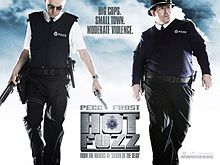
220px-HotFuzzUKposterWhen we go to see the latest action movie are we consciously thinking about what we are ingesting, what the motives of the characters are, or even the film’s title? More often than not the answer is no, because we want to be entertained, like Romans attending gladiator battles. We want thrills above content, without considering what we are being fed. In the line of these types of films are Lethal Weapon, Point Break, and now Britain’s addition Hot Fuzz.

It’s the story of probably, the most industrious, skilled, highly-trained policeman you could imagine. His name is Nick Angel (Simon Pegg) and he’s a butt-kicking, paperwork-completing sergeant, who is making the rest of the force look bad. He has the potential to be a great action hero. Enter in Martin Freeman, Steve Coogan, and Bill Nighy, and they agree to reassign him to the sleepy of village of Sanford, and all his dreams are kaput. Ambition will lead him nowhere in such a town, and it feels more like Mayberry than the locale for a great action flick.

But being as diligent as he is, Angel makes strides even before he starts his first day. Among one of his arrests at the local pub is fellow police officer Danny Butterman (Nick Frost), who also happens to be the son of the police inspector. It’s rather a strange introduction, but of course, the two of them are partners. Nick simply tries to tolerate all those around him, but it proves difficult, and he’s a little taken aback by the geniality of the locals. They all seem to know his name.

However, when a string of grisly murders takes place successively around town, Angel has what he wants, something to investigate. Again, everyone around him says it’s all been a line of unpleasant accidents. They aren’t willing to face the reality that their sleepy little town might have a murderer on the loose.

As you might expect Angel and Buttermann actually begin to build some rapport despite how different they are. However, Hot Fuzz also has a major twist that frames this entire story in a different light. And although the film does exhibit its share of violence, it also has a wickedly funny streak running through it. At times that means laugh-out-loud antics, courtesy of Nick Frost, or maybe uneasy giggles when someone bites the dust in an outrageous manner.

Edgar Wright’s film is also noticeable for its rapid editing, involving quick cuts, flying transitions, and slicing and dicing. It keeps the story at breakneck speed and yet there is a great pathos built around its characters. We actually begin to care for Nick and Danny, which is often not the case in superficial action flicks. But that’s just it. Hot Fuzz is a satirical homage to all the cop/buddy movies out there and it has its share of action, and yet there’s more to it. In other words, action films are not just skin deep. Hot Fuzz proves that resoundingly. It’s a throwaway title maybe, but not a throwaway film.

4/5 Stars

The Cabinet of Dr. Caligari (1920)

Das-Cabinet-des-Dr-Caligari-posterI’ve never seen anything like it, and I mean that in all truthfulness. The Cabinet of Dr. Caligari has the esteem of being called the original horror film, and that’s not something to be taken lightly. Perhaps I’m more partial to Murnau’s Nosferatu that came out two years later, but this film directed by Robert Wiene is really the epoch of German Expressionism. The German Expressionism Movement, after all, was not simply about painting, or architecture, or theater. It bled into the Weimar film industry as well, drifting as far away from realism as was possible at the time. Some say D.W. Griffith wrote the rules of moving pictures as we know them today, and if that’s so, then it was this film that tried to push the boundaries to the limit.

In an effort to be transparent, I will acknowledge that The Cabinet of Dr. Caligari does not engage me, narratively speaking, like some other silent films. It follows a Dr. Caligari as he presents his spectacular somnambulist Cesare (Conrad Veidt) at a local carnival. But all is not as it seems as a string of murders terrorize the town by night. Also, I was not a big on the score that accompanied this version. It was rather a discordant cacophony and it did not seem to go well with the action, but that is often a problem with silent films if they do not already have a score to go with them.

CABINET_DES_DR_CALIGARI_01Nevertheless, the images alone are striking, and it is still fascinating for the very reasons I mentioned above. It boasts the craziest sets, highly stylized, and made up of every type of angle and shape imaginable. We know resolutely that this is not reality, these are simply facades being put up to engage our eyes. It features a mise-en-scene for the ages, with no attempt to try and be the least bit objective. There’s no effort to aim for realism; none whatsoever, and that level of audacity is impressive. Furthermore, it’s mind-boggling to think that so many people and so many films were influenced by this movement. Especially in Hollywood.

Without it, we would not have 1930s horror films like Frankenstein and Dracula. There would be no Film-Noir or at least not the same moody, atmospheric creature that we know today. In truth, it was many European directors like Fritz Lang, Billy Wilder, Otto Preminger, and even Alfred Hitchcock, who channeled this movement in their own work. It proved to be so important to the medium of film and thus, it’s important to remember these roots. So maybe The Cabinet of Dr. Caligari is not as engaging today, but there is much to be admired and extracted from it still.

4.5/5 Stars

The Earrings of Madame De… (1953)

MadamedeposterThe Earrings of Madame De…, in essence, feels like the perfect incarnation of an Ophuls’ film. In fact, sometimes I forget that Ophuls is actually German because his films are full of French sentiment. I mean that not because of their cast, although we do have Charles Boyer and Danielle Darieux, but more so due to the fact that his films are about elegant, melodramatic romances that fit the decadence of Parisian high society. For instance, in Madame De… Danielle Darrieux is positively swimming in luxury, whether it means dresses, furnishings, or especially jewelry. Materially her husband Andre (Boyer), a French general, has lavished all the worldly possessions upon her. Except that’s not what she wants. At least that’s not what will make her happy. She may be obsessed with the material, but even the material which she so desires is ultimately poisoned over time. Over time Andre cannot even win her over with trinkets and gifts. She cares little for the eponymous earrings until they come from her true love Baron Donati (Vittorio De Sica).

These are the same earrings that she sold to pay off a debt. The same earrings that Andre reacquired from the jeweler and then made the rounds once more. Ophuls said himself that he was drawn to this narrative because “there is always the same axis around which the action continually turns like a carousel. A tiny, scarcely visible axis: a pair of earrings.” And really it is a fascinating plot device that ties the entire narrative together, while also seeming to reflect the utter frivolity and triviality of it all. How can these earrings hold so much weight to one person? And yet that’s only the face value, because, to begin with, they are only an object to be coveted and maybe cherished. Over time they become a token, a symbol of true love and Louise gives them away to the parish because she no longer needs them. She has some notion now of what true love actually feels like.

For the majority of the film, Andre is forever civil with her. He knows that she does not really love him, and he even has time for a mistress on the side. He handles her opportune fainting spells and little charades with grace and at times amusement. But when he gets a hint at Donati’s relationship with his wife, he does what any honorable gentlemen would do. He’s indignant of his rival and builds a huge feud out of nothing. What follows is a duel and the rest is history.

Madame De… probably does not get as much acknowledgment as it should, because Ophuls was a champion of so-called “Women Pictures,” which actually take on the point of view of women, in an industry that’s so male-dominant even to this day. Thus, Madame De… is a little different in perspective, and it tries to hide all of its tragedy behind superficiality. It makes for an interesting lesson in romance and the female psyche. Yet again the director shows his immense affinity for staircases turning them into the personal playground for his camera. He loves to twirl, pirouette, and glide just as much as Louise and Donati do as they dance the night away at the ball. De Sica is a champion director in his own right, but it was especially fun to see him in front of the camera and he seemed an apt player opposite his costars. The worthy equal of Boyer and a suave love interest on top of that. There’s nothing more romantic than Danielle Darreux dreamily repeating to him, “I don’t love you, I don’t love you, I don’t love you.” The sad irony is that those words ring true with her actual husband as reflected by a pair of earrings.

4.5/5 Stars