
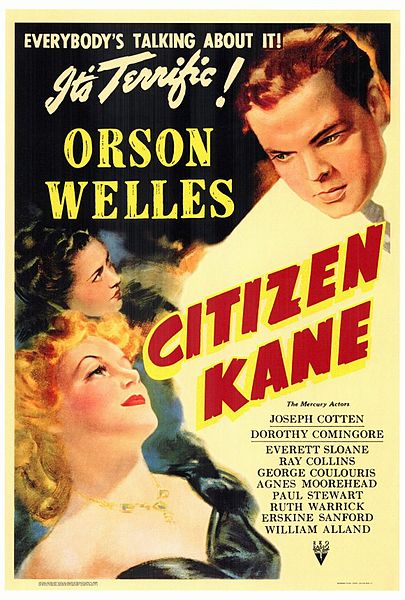
Citizen Kane (1941)

The first time I ever saw the film, I actually wrote Citizen Kane off because my hopes were so high thanks to its major critical acclaim. Those hopes were soon dashed after viewing it once, but over time I realized I needed a second viewing. This second chance allowed me to see the minute details, which can be easily overlooked or forgotten. Now I can truthfully say I have a new found respect for this film.

The brainchild of Orson Welles, Citizen Kane opens somewhat unimpressively, however it is certainly very moody and atmospheric. As the camera closes in on a great mansion, we are given a first-hand view of a dying man followed by his mysterious final word “Rosebud.” In the following newsreel, we learn the man was Charles Foster Kane (Welles), a millionaire tycoon and newspaperman. A journalist (William Alland) is enlisted to find out anything he can about Kane. First, he scours the memoirs of Kane’s deceased childhood guardian (George Coulouris). Then, he talks with Mr. Bernstein (Everett Sloane), who worked with Kane’s paper the Inquirer. He gets around to talking to Kane’s unstable former friend Jedediah Leland (Joseph Cotten), as well as Kane’s second wife (Dorothy Comingore). We learn from these accounts about Kane’s early years, his success with yellow journalism, the evolution of his first marriage, and the rise and fall of his political career. Furthermore, we find out about Kane’s unhappy second marriage that ultimately left him loveless after looking for affection his whole life. Fittingly, we are again left with the bleak view of his fortress Xanadu, and we now have the knowledge that “Rosebud” was in fact utterly trivial.

Obviously, Greg Toland’s black and white cinematography using deep focus and low camera angles is noteworthy. The framing of the narrative with different points of view and flashbacks was unique at the time. The actors age in front of us showing the progression of time and montage is used to effectively condense time. There are the overlapping and fragmentation of dialogue to create a realistic feel throughout the film. Bernard Hermann puts together a score that slowly changes along with Kane. And of course, you have the supposed basis of Kane on William Randolph Hearst. Historically, Citizen Kane may, in fact, be the most important film of all time, and artistically it is certainly up there with the best of them. I will let others decide if that makes it the very best film, period.

4.5/5 Stars

Sullivan’s Travels (1941)

63a32-600full-sullivanStarring Joel McCrea and Veronica Lake, with director Preston Sturges, Sullivan’s Travels is about a highly successful film director (McCrea) who wants to make a movie about the common man and suffering. However, he usually writes comedies and so he decides to go on the road as a hobo to try and understand the lifestyle. During his adventures he meets a young failed actress (Lake) who is about to leave Hollywood. Wanting to help her, Sully tells the girl what he is doing and they go off together masquerading as tramps. After taking a short respite, he goes on the road again, this time alone. Through a series of events he finds himself in a chain gang while his friends assume he is dead. Eventually he is freed but not before learning a valuable lesson. If he wants to relate with the poor he should give them laughter instead of hardship. I found this movie to be an enjoyable  light comedy (even though I had never heard of it beforehand).

5/5 Stars

Casablanca (1942)


Considered one of the greatest films of all-time, this well-loved classic deserves to be here. It is the hallmark of Humphrey Bogart and Ingrid Bergman’s careers. It has one of the greatest scripts of all time, and it has achieved legendary status over the years. Many consider it purely the best film ever made and in all honesty, I would never try to refute that.
The film opens quickly, and we are immersed in a world that is at the height of the Nazi terror, and many people are fleeing Europe by way of Casablanca. It is a treacherous place full of pickpockets, corrupt authorities, refugees, and some tourists as well. Two German couriers have been murdered, and some invaluable letters of transit have been stolen. That’s when we are first introduced to Rick’s Café Americain along with its cynical proprietor Rick Blaine (Bogart). A shady fellow named Ugarte (Peter Lorre) comes to him with the letters and asks Blaine to keep them for him. However, later that night Ugarte is taken into custody and things get even more complicated. 

Wanted resistance leader Victor Laszlo (Paul Henreid) is now in Casablanca, however, a Major Strasser (Conrad Veidt) has arrived from Germany to take him in. To top it off Laszlo’s wife Ilsa (Bergman) was Blaine’s old flame in Paris and it didn’t end well. Laszlo desperately needs the letters of transit to escape and he inquires about them. Soon he is led to Blaine but as he often admits Rick sticks his neck out for nobody. Laszlo shows his defiance against his enemies by leading the people in a round of “La Marseillaise” and as a result, Rick’s is shut down. 

All the memories of Paris begin flooding back, and then Ilsa confronts Rick in order to get the letters. This is possibly the most critical point in the film because the tense altercation ultimately renews the relationship between Rick and Ilsa. Rick asks her to trust him and he begins to take things into his own hands. The results of his actions created one of the great romantic and cinematic moments in the history of film. The whole film leading up to this point hints at it, but Rick truly is a sentimentalist at heart. He can live with the notion that they will always have Paris and that leads him to commit a selfless act of love.
This film holds such a tremendous presence in movie history it is quite extraordinary. Upon seeing the movie it made complete sense what all the hype was about. What more could you want than Bogey, Bergman, Casablanca, and some of the greatest quotes ever said? Do not forget the French Captain Louis played by Claude Rains or the immortal tune of As Time Goes By sung by Dooley Wilson. However, you also gain an appreciation for the other interesting characters of Casablanca, some comical, some sympathetic, and others mysterious. We have a rogue gallery of everybody under the sun from Peter Lorre, Sidney Greenstreet, German soldiers, various guests, and all the staff at Rick’s place. 

This movie has conflict and the uncertainty of war practically in every scene because at the time World War II was in full force. There are a broken romance and a forlorn hero who shows his courage in the end. As an audience, we realize the transformation of Rick into a truly great man. Ilsa, on her part, has the most radiant face I have ever seen! If you take into consideration when this movie was made, it truly is wonderful to watch. You do not need explosions and violence, only great characters and a story with both drama and humor. Up until the final moments of the movie you are captivated the entire time. Then, fittingly you are left with the two men walking off into the night with the words, “Louis I think this is the beginning of a beautiful friendship.”

 In fact, with this film, my thoughts always go back to the script. Lines like “Here’s looking at you kid,” “We’ll always have Paris,” and “Round up the usual suspects” are so rampant that you cannot possibly remember them all, and I doubt there will ever be another film that is so entrenched in American culture. Many of my favorite lines in the film are those that get overshadowed by the more famous ones. That is the sign of an amazing film that never grows old. Even those who have not seen this classic film like to think they have because the influence of Casablanca reaches everywhere.

5/5 Stars