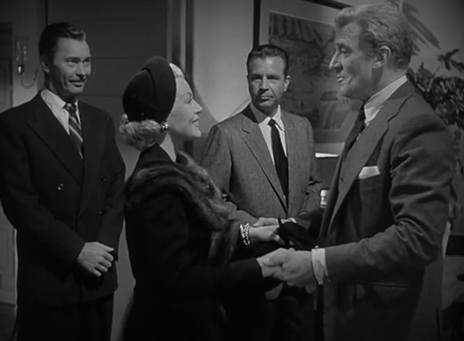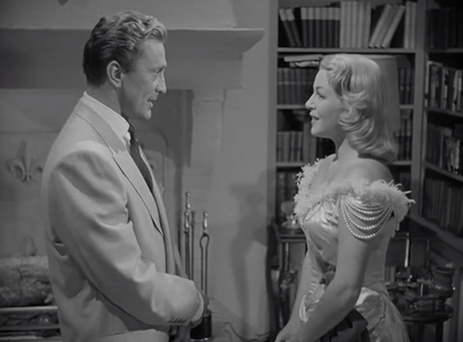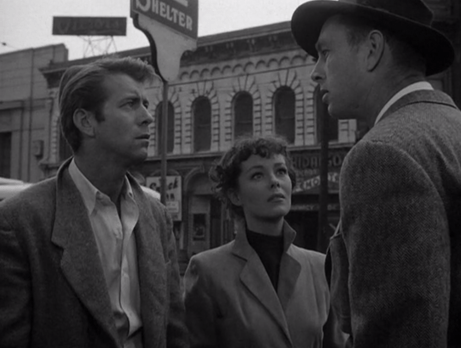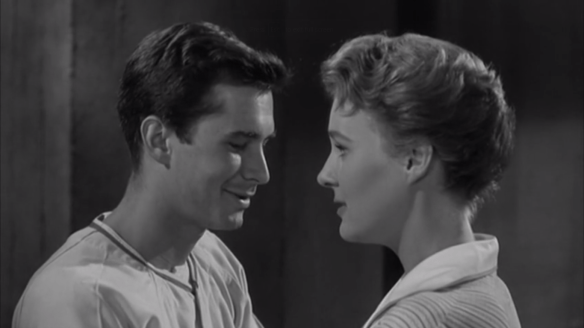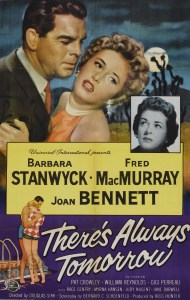
There’s Always Tomorrow (1956)

aatheres8

The film begins with that old storytelling standard, Once upon a time in sunny California…and it’s raining outside. Not a minute has gone by and the tone of the picture has already been set with this opening taste of irony. It unravels on a smaller, less grandiose scale than other Sirk pictures but it’s no less potent.

It brings to mind one of the other great masters of such films in Billy Wilder also from Germany and yet you would never get either of their pictures confused because how they go about it so so vastly different. This is, of course, another Double Indemnity (1944) reunion (a film directed by Wilder) bringing Barbara Stanwyck and Fred MacMurray back together.

I did some digging and besides the underrated Christmas classic Remember the Night (1940), the memorable screen couple appeared in a  minor western called The Moonlighter (1953). This would be their last pairing.

But back to Wilder and Sirk. The way this film looks and the subject matter strikes no exact resemblance to the former’s more caustic work and there’s also the fact that Wilder wrote all his material. While Sirk had often cohesive themes running through his stories, I’m fairly certain he could not claim script credit on any.

The true connection point and the aspect of these two emigre filmmakers that is so crucial to appreciate what they are doing is how they both managed to critique their adopted country through both comedy and drama and they do it in such inventive ways.

Here Fred MacMurray is the owner of a toy shop and a stockroom full of hobby horses and pinafores as they look to roll out their latest pride and joy Rex the Walkie-Talkie Robot. Meanwhile, after a hard day at work, he comes home to ungrateful and preoccupied kids who constantly tie up the phone lines with girlfriends and take up their mother’s time with their numerous extracurriculars.

It’s akin to All That Heaven Allows (1955) in that it places a camera to the mores of Middle-Class America. While that film was about a mother and her children’s reactions to her romantic life, this is a picture about a father and what he does with what he deems to be an unfulfilling life. He has a similar outcome. This is by no means a My Three Sons episode.

He’s feeling that age-old suffocation of suburban life, work, kids, wife, and no satisfaction with any of the things that are supposed to be the pinnacles of the American Dream. What do you do with said disillusionment? You look for an outlet.

Two tickets to the theater just about look as if they’ll be wasted when rather fortuitously an old friend shows up on his doorstep or more correctly an old flame. And on a whim, they make an outing out of it to the theater. Leaving early they end up touring the toy shop and dancing together to “Blue Moon,” a song that conjures up reminiscences and nostalgia and subsequently can be heard in refrain after refrain from that point forward.

The following weekend it happens again when Mr. Groves is looking forward to a weekend getaway with his wife although he must admittedly mix business with pleasure. In the end, his wife stays behind with their histrionic daughter and the work meetings fall through. But coincidentally he runs into Norma again and they have a lovely time talking, horseback riding, and the like.

But the wrinkle we come to expect is a surprise visit by his eldest son who takes a detour from Los Angeles to Palm Beach. It’s so very cringe-worthy and aggravated by the fact that he overhears his father and Ms. Vale talking but proceeds to leave the tourist trap without even a word to his father. He’s too vexed.

Still, MacMurray comes back from the invigorating weekend refreshed and explains everything to everyone all perfectly innocent and this works against our preconceived notions of what might happen.

The film goes further by folding over yet another layer. His son when hearing his explanation far from confirming his faith in his dad, only causes him to sink deeper into distrust. In one sense, it’s absolutely absurd (he quotes An American Tragedy for goodness sakes) and yet it’s a perfect development. Here we have the planting of seeds of resentment and doubt even in things that aren’t the truth.

Stacked upon this is the final irony that it’s the so-called “other woman” who talks MacMurray’s character out of an affair that ironically he slowly evolves into wanting. That’s a new one but also a very honest outcome.

And being the strong individual that she is, Stanwyck not only weathers the difficult conversations with her old beau with dignity but she’s equally strong when it comes to scolding his children for their treatment of him. She is the one who points out the error in their ways. Again, it’s yet another ironic development.

So yes, this is no doubt a weepie; it’s a contrived set-up with a wife who is conveniently busy and children who seem so quick to turn on the man they’ve known all their lives, but putting those preoccupations aside for a moment, what we do have is a beloved pair of stars and a director who made a living off of such fare. If you ask me that’s a quality combination and though it’s a less heralded film, There’s Always Tomorrow is still very much a worthwhile affair.

4/5 Stars
Summertime (1955)


summertime 1.png

It’s summertime and the living is easy. It makes me think of sultry summer days and cool summer nights and George Gershwin. But summertime also means travel. It did for my family when we were growing up as kids and it took us to many places near and far off. That’s what this film gives us license to do. Venture into another world for a picturesque vacation.

News that Summertime was supposedly David Lean’s favorite picture of his own work is not all that surprising when put into the context of his career. When I think of him I am quick to reference monumental epics or British narratives out of Charles Dickens but here is a picture that feels strikingly different. It’s intimate and small yet still gorgeously photographed and affecting. It’s no Lawrence of Arabia (1962) or even Great Expectations (1946) but it has no aims to be. That’s what makes it a delightful change of pace.

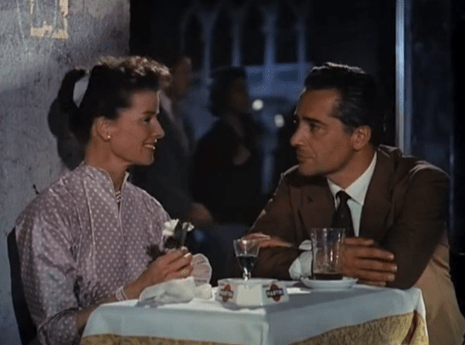
Katharine Hepburn plays an American school secretary from Akron Ohio, one Jane Hudson, who has always had a dream to travel and get out of Middle America to see the world. We see her aboard a train bound for Venice and she’s beyond ecstatic chatting up her fellow traveler and snapping pictures on her camera that’s already logged rolls and rolls of film undoubtedly, capturing the most mundane things for the simple fact that they come from a foreign land.

But there are even more stereotypical American tourists who are hilariously ignorant and subsequently stick out like a sore thumb wherever they wind up. To say the McIlhennys are slightly insufferable is kind of the point. Still, they’re hardly to be taken seriously. It’s people like them that cause Jane to want to venture to Italy to get away and allow herself to be wrapped up in the throes of another culture. I can certainly resonate with that sentiment. I feel that way now.

So, in one sense, she still maintains the awe of a tourist but manages to experience the life as if she were a local and that’s the key, boarding in a pensione and trying to get a taste of everyday life.

First, she is befriended by a spunky little boy who tries to sell her his goods and out of that grows a mutual affection for one another. She also wanders into an antique shop to buy what she deems to be a precious goblet and strikes up a conversation with the proprietor (Rossano Brazzi) who she had unwittingly crossed paths with before. This is the first of many meetings.

In a film such as this where the sets are left behind for a foreign locale, a place like Venice very easily becomes almost another character in the film because being there alone creates a dimension you would never get otherwise. Without Venice, those layers of history, accents, and textures, something magical would be lost. But with it, Lean makes something that rings with gentle passion.

The sumptuous visuals capture both the immense character and quaint waterways with their gondolas drifting lazily by. Tailor-made for romance especially between an American school teacher and a handsome Italian shopkeeper, bringing them so close together over the course of the film. The Piazza San Marco is showcased front and center in numerous sequences but even with its presence this still exists on a smaller scale than the parade through Rome that is Roman Holiday (1953). Because it readily occupies itself with many smaller scenes too.

Lean even preceded Hitchcock’s To Catch a Thief (1955) with a very similar fireworks show. In both cases, the moment signifies the strides made in the relationship and just how splendorous they are.

Summertime also features one of the most striking endings because it’s not quite as cathartic as we are used to in a love story and yet it hardly can be considered downbeat or melancholy. A lot like life, it simply is and how can you be glum anyway? It’s summertime. Venice is immaculate. Love is afoot.

It so enraptured David Lean that he would make it his home away from home. At that point, it doesn’t matter if we like this movie because as its director Lean was taken with it. That’s praise enough.

3.5/5 Stars

The Bad and the Beautiful (1952)

bad and the beautiful.png

The people making the decisions, at least some of them, undoubtedly knew that this title implied some sort of sordid melodrama, a Douglas Sirk picture anyone? And yet I do admit despite the emptiness in the title, there’s some truth to its implications. Hollywood often is this gaudy, outrageous, maniacal monster looking for people and things to gorge itself on.

Except this is no Sunset Boulevard (1950) or Ace in the Hole (1951) for that matter. It’s not quite as biting or even as tragic or twisted as Wilder’s films but that’s what comes with having Vincente Minnelli at the helm. But rather than critique that decision in any way I think someone like Minnelli thinks about such a picture in a way that Wilder never would. That in itself makes for interesting creative deviations.

First, the camera setups feel impeccable, like a Hitchcock or Ophuls, finding the perfect moments to bring attention to a shot and the precise instances to sit back and allow things to unfold. It’s utilizing a bit of a flashy framing device like a Letter to Three Women (1949) or All About Eve (1950) but in this case, it relates the story of one Hollywood producer through the eyes of the people who worked with him.

Jonathan Shields (Kirk Douglas) is a man whose father was one of the most hated men in Hollywood and also one of the most successful. Jonathan buries his father and with hardly a penny to his name looks to rise out of the ashes his dad left behind. He just might make good too. So as such, it’s another exploration of Hollywood top to bottom, starting very much at the bottom.

That’s part of what makes this story compelling as we watch an ambitious man claw his way from poverty row and B pictures using a joint partnership with another up-and-comer (Barry Sullivan) to slide his way into a gig as a big-time producer. It’s at these beginning stages where they succeed in making a name for themselves under producer Harry Pebbel (Walter Pidgeon).

For Sullivan, he is so closely tied to the business, it’s almost as if he’s wedded to the picture industry.  It’s both his life and obsession every waking hour. So when he’s done with one and waiting for the next he has what can best be termed, “the after picture blues.” He’s still trying to adopt his philosophy for women and apply it to his films — love them and leave them.

In passing, we get an eye into the bit players and the small-timers working behind the scenes just to make a decent day’s wage whether assistants or agents or pretty starlets moonlighting as companions at night. There’s even a very obvious current of sexual politics where women are naturally assumed to be at the beck and call of any higher up to pay them any favors. It’s the grimy, sleazy side of the business that continues to reveal itself in due time with connivers and drunks and suicidal wretches conveniently hidden by bright lights and trick photography.

bad and the beautiful 3

Further still, there are screen tests, meetings, rushes, and sound stages, makeup artists, and costume designers each a part of the unwieldy snake that makes up a film production. All the nitty-gritty that we conceive to be part of the movie-making whirly gig churning out pictures each and every year. They say if it’s not broke then don’t fix but what if it is broken and no one is fixing it? I write this right in the wake of Harvey Weinstein’s ousting due to a laundry list of accusations against him.

One of those involved in this beast receives a stellar introduction of her own. We meet Georgia Lorrison (Lana Turner) with her feet hanging down from the eaves of an old mansion that belonged to her deceased father. She like Shields comes from Hollywood royalty and she like him is also looking to get out of her father’s shadow.

Jonathan is derisively called “Genius Boy” and maybe he is but opportunistic might be a more applicable term. Still, when he makes his mind up, he cannot be stopped and when he deems this smalltime actress will be his next star, he makes it so.

The same goes for novelist turned screenwriter James Lee Bartlow (Dick Powell) who Jonathan is able to coax out to Hollywood albeit reluctantly and works his magic to get him to stay along with his southern belle of a wife (Gloria Grahame) who is completely mesmerized by this magical land out west. Again, Jonathan turns his new partnership into a lucrative success but not without marginalizing yet another person.

One of the most interesting suggestions made by the film is not how much Jonathan ruined his collaborators — alienated them yes — but he really helped their careers. In some ways, it reflects what happens with great men who are lightning rods and always thinking about the next big thing. They’re obsessed with ideas and connections, finding those relationships that will lead to power, wealth, acclaim, and awards. Any amount of honest-to-goodness friendship goes out the window.

But for all those who felt slighted, there’s almost no need to feel truly sorry for them because they bought into this industry with its promises and they bit into the fruit. Sure, their feathers got ruffled and their egos bruised but it goes with the territory.

For everything we want to make it out to be, it’s a tooth and claw operation and those who get ahead usually are the most ruthless of the bunch. Whether we should feel sorry for them or not is up for debate. But maybe we should because a mausoleum full of Academy Awards means nothing. A life of power will be ripped from you the day you die as will the wealth, elegance, and extravagance. It will all be gone. Then, you’re neither bad nor beautiful. You’re simply forgotten. In that respect, this films has meager glimpses of a Citizen Kane (1941) or even real-life figures like Orson Welles and David O. Selznick.

Except in the sensitive hands of Minnelli, this picture is neither an utter indictment of Hollywood nor does it take a complete nosedive in showing how far the man has fallen. It even reveals itself in the performance of Kirk Douglas who while still brimming with his usual intensity chooses to channel his character more so through the vein of charisma.

So if we cannot love or admire his dealings there’s still a modicum amount of respect we must hold for him. Everyone comes out with a shred of dignity and the film’s end is more lightly comic than we have any right to suppose. But then again, we’re not in the moviemaking business and they are.

4.5/5 Stars

Crime Wave (1954)

crime wave 1.png

The opening gambit is wonderful. It’s marvelous. You can’t blame me if I get a little…Well, anyways if you thought that squeaky-clean Doris Day could never turn up in a film noir you were gravely mistaken.

In this particular case, a jovial gas station attendant has her blaring loud on the radio right before he gets whaled on. Crime Wave makes its intentions fairly clear right from the beginning. Here is yet another arbitrary noir title that tells you next to nothing. That’s what this first scene is for. It tells everything to us in visual language.

A trio of San Quentin convicts are pulling bank jobs dotted all the way up and down the coast of California and this is just one of them. But a cop has been killed and they ran off with the cash register’s contents.

I had to do a serious double take because my eyes must have passed over Charles Bronson’s name in the credits. Seeing him young and tough as ever is like seeing an old friend — even if he’s playing a thug.

He’s an ogling and ill-mannered brute as can only have a life in such a darkly cynical world. Meanwhile, Ted De Corsia is the ringleader who has been sitting on his scheme for years now. But they need someone to call on — a new home base for their operations after one of their men gets a bullet in the gut.

Just like that, reformed jailbird Steve Lacey (Gene Nelson), currently working as an airport mechanic and married to a nice respectable girl (Phyllis Kirk) hears his old life calling. It’s the old Out of the Past (1947) conundrum. You never truly escape the specter. So he gets netted once more by his old mates and slowly dragged back into the crime world he hoped to never look back on.

But even in his attempt to maintain his path on the straight and narrow and remain on the right side of the law, one momentary lapse in judgment is all that it takes. He tells his wife to keep a pact with him. A man came to their house and that was all. He doesn’t want to be implicated any further so he leaves out the shady doctor who took the cash on the dead convict’s person. It seems such an easy bit of information to divulge but then again, the world is twisted in knots of confusion. He’s paranoid and distrusting of everyone. Perhaps he has every right to be.

Two dueling philosophies seem to present themselves from the side of the law. Police Detective Sims (Sterling Hayden) holds fast to that old adage that “Once a crook, always a crook” while Lacey’s kindly veteran parole officer seems to think that “sick men get well again.” And as the film seesaws back and forth we are forced to consider both trains of thought. The cop with no heart for ex-cons or their wives, while the parole officer entertains more sympathy. But it’s hardly enough.

However, that plays precisely in its favor as a gritty picture rooted in realism while still overlaid with a cinematic crime story inspired by a Saturday Evening Post write up. The film presents a world where the cops are as cunning as the villains and in a sense, they have to be.

It has the imprint and the contours of an L.A. that existed at one time — though now eroded and reconstructed through the years — but this is a stylized vision of it all from Andre de Toth. The streets and names might be all too real from Glendale to San Diego but the events and accents are not — overrun with stray cats and dogs — not to mention the colorful mugs of pet doctor Jay Novello (some might remember his nervous-types on I Love Lucy) and the forever crazed-faced Timothy Carey.

It becomes a sort of neorealism with the Hollywood touch even in its ending which while not a complete sellout definitely caps the film with optimism. And in that moment, maybe Crime Wave gives us a hope for the real world. Maybe cops and robbers don’t look all that different. Maybe they both are prone to corruption and vice. But maybe justice can still be enacted.

If this film was all about morals it wouldn’t be worth much to many movie audiences. Thankfully it’s a gripping picture that places us right into the scenario like all the great caper films and it gives us a hero to empathize with. The visuals are presented as a stellar piece of added everyday reality. Search this one out if you’re a fan of small-time gems.

3.5/5 Stars

Fear Strikes Out (1957)

fear strikes out 1.png

I can’t think of another actor more apt to play this version of Jimmy Piersall’s story than Anthony Perkins. History reflects a more multifaceted even complicated individual.  By other accounts Piersall could be a real cut-up; here the story is very singular-minded in how it portrays its protagonist. It’s played for the drama which it no doubt was but you get to wondering if Piersall had written the script it might have turned out to be more of a comedy.

Robert Mulligan’s film suggests there are arguably the two most important people in Piersall’s life. The first is his father (Karl Malden) who from an early age instills his boy with the onus of making it to the big leagues. That’s the goal and his father watches proudly as his boy becomes a high school star while never letting his son rest on his laurels or let down his guard. He must be constantly vigilant, continually thinking ahead, all in an effort to land a contract with the Red Sox.

He starts out in the minor leagues and there he meets a pretty nurse, the relatively unknown Norma Moore playing the ingenue and his first wife Mary. She makes him deliriously happy and vice versa as they begin to build a life together.

But the conflict at the core of the biopic is Piersall’s own bouts with undiagnosed nervous breakdowns which would be now categorized as bipolar disorder. Put in the context of the era where mental disorders were more often than not left stigmatized and misunderstood, this is actually a fairly fearless film for taking on such source material. But, of course, much of the credit must begin with Piersall himself for being willing to acknowledge it all, to begin with.

Particularly foundational to this film is Jimmy’s ongoing relationship with his father. The scenario happens so often it seems like a cinematic trope but sadly it’s also very close to the truth. It occurs between a parent and their child when they get so vicariously invested and demanding and controlling of their child’s life that they heap so much pressure on them that it becomes nearly an unbearable weight to succeed. Compounded by the fact that these parents are usually trying to realize their own failed talent and never seem to find it within themselves to give their children a pat on the back or a word of encouragement.

You get the sense it was a vicious cycle. Their father never did it for them and so they wind up having a hard time showing any amount of their affection to their kids. It’s something, in this case, that must be earned on the ballfield or in Brian Wilson’s case earned with how many hit records he churned out and composed. Maybe it’s why a parent a la LaVar Ball seems to cherish the spotlight, commanding the media’s attention even more than his boy. Whatever the outcome is, it never seems enough.

It’s purely a testament to Karl Malden’s quality as an actor that he makes Piersall’s father into a nuanced man who is not a holy terror. In fact, even when he doesn’t say it outright we know full well he is proud of his son and he even loves him. He’s not a bad man by any means. That doesn’t make measuring up to his standards any less daunting or his behavior any less damaging.

Though tender and tortured in the everyday moments, Perkins performance on the ballfield feels artificial but you can hardly blame him for lacking the posture or the swagger of a ballplayer where hitting and fielding come as second nature. He looks too much like he’s playing at it — he’s too wooden — not like he’s actually played it his entire life.

Almost uncannily it seems that I find myself at certain movies only after the subjects are gone. Piersall was still a young man in the midst of a baseball career when his story and the subsequent film was made. He passed away in 2017 at the age of 87.

Whether this story is completely true or sensationalized, there’s still an essence of something meaningful here. That we should not be ashamed of our fears and we cannot live life in pursuit of what will earn us the affection of others. It will only succeed in running us into the ground.

That’s why the moment at the end of the film is so fitting, showing Piersall playing a lazy game of catch with his dad. There’s no agenda. No pressure. You simply get the joy of throwing that ball rhythmically again and again perfectly in sync with the person across from you. I’ve done it many a time with my own father and I permanently retired from the game after being little league champions in middle school. Still, I love baseball for those very simple pleasures that it offers.

3.5/5 Stars

Shack Out on 101 (1955)

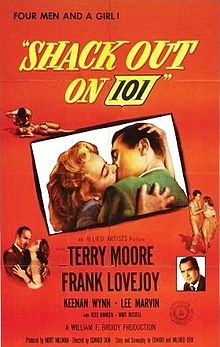
Shack_Out_on_101_film_posterLike a Cry Danger (1951) or a Private Hell 36 (1954), this low budget film noir flick is such a joy to watch because it wears what it is right on its sleeve, clear out in the open. What we get is an utterly absurd paranoia thriller that also happens to be a heaping plate of B-noir fun.

It’s a dirty, grimy picture about a dirty, grimy place. The cook behind the counter’s named Slob (Lee Marvin) and he has a dirty mind and disheveled look to match. He’s constantly at odds with the owner of the roadside shack (Keenan Wynn) and they make countless verbal barbs at each other time and again. You get the feeling that they relish jawing and putting the other man down.

Meanwhile, though the joint might not be one of the most frequented attractions there is some traffic from PCH and it brings in a few regular visitors.

The day-to-day “Hash Slinger” and longtime waitress Kotty (Terry Moore) is in the middle of a rapturous romance with a local professor Sam Bastion (Frank Lovejoy), and she’s beyond ecstatic to be going with someone who is a real man — intelligent and gentlemanly. Though recently he’s been especially occupied with work.

The traveling salesman Eddie (Whitt Bissell) with a nervous streak nevertheless remains a tried and true friend. He and George (Wynn) both made it through D-Day together and since then he always makes a habit of coming by the old place when he has a free moment. Kotty and the Professor take kindly to him too. He’s just that kind of amiable fellow.

Shack Out on 101 shines most obviously amid its small talk because there’s an invention to the dialogue that’s delightfully slovenly and colloquial. It’s full of the types of dialects, jabs, and put-downs that fill our everyday conversations in a way that feels thoroughly authentic and brings each character alive as they sit at the counter.

There might be two men standing in the front of the diner on a slow day lifting weights and talking about how muscles are for amateurs. Pecs are what real men call them.  Then they proceed to show off and compare their physical attributes. No reservations whatsoever.

Later on, they try out the latest fashions in spearfishing attire as they dream about the mythical “Pancho” who they’ll soon spear in the tropical waters off the coast of Mexico. Little do they know how close that is to the truth. Except there’s no need to go to Mexico. The catch is right at home.

When the film actually gets preoccupied with its plotting, it starts to go cockeyed and crazy. Admittedly, fallout from the Cold War must have been on everyone’s minds because, like Aldrich’s Kiss Me Deadly (1955), this picture too tries to play the nuclear angle. It’s hardly effective though I suppose it needed a broader, more concrete story to add a certain amount of intrigue and this one is complete with spies and government secrets.

Still, in the end, it comes out pretty thin. What we truly relish as the audience are not the attempts at drama but the way the film manages to make its apparent lulls invariably interesting and even how it manages to have asides at all given its infinitesimal running time. Sure, it won’t win any awards and the joint is a real dive but that’s all part of its cruddy charm. For a B-picture, this cast is quite the array of talent.

3.5/5 Stars

Silk Stockings (1957)

silk stockings 1.png

In full disclosure, though I admire Ernst Lubitsch’s directorial eye and Billy Wilder’s trenchant wit, the Ninotchka (1939) premise alone never intrigued me. But as with all the great pictures, it’s not necessarily the main conceit but the execution of the story with its own unique digressions which matters most.

That’s why having screen goddess Greta Garbo paired with the two men mentioned above is of note. They ultimately created something delightful together. And as we draw the line all the way to Silk Stockings almost two decades later, the names attached are equally important.

We can probably start with Fred Astaire who was in a period in his career that constantly seemed to fluctuate between retirement and flurries of inspired activity. In this particular case, he would follow Silk Stockings out into the theaters with a second success in Funny Face (1957) pairing him with Audrey Hepburn for the first and only time.

Though he had his initial misgivings about the material and his director, Rouben Marmoulian proved to have quite the success with Silk Stockings, which would subsequently be his last effort in a generally underrated career. He took the successful stage play and transferred it to the screen, this collaboration even featured several more tunes from Cole Porter’s repertoire while writers such as Leonard Gershe (who had already penned Funny Face) and industry veteran Harry Kurnitz worked on the script.

Then, Cyd Charisse had the seemingly insurmountable task of inheriting the role owned by a larger-than-life star if there ever was one — Garbo herself. And yet maybe it’s a reflection of my own predilections in performers but I rather like Charisse in the part not because of the acting per se but for the moments where she’s able to shed the role and become the sentient ever dynamic being she is as a dancer.

The ball starts rolling when an American film producer, Steve Canfield (Astaire) tries to coax a brilliant Russian composer named Boroff (Wim Sonneveld) to compose the score for his next film. Simultaneously three of his countrymen have been enlisted as emissaries on Parisian soil to bring him back home before he gets polluted by capitalist dogma any further. The oafish louts are eclectic talents as diverse as Peter Lorre, Jules Munshin, and Joseph Buloff.

Of course, if you know anything of Ninochtka (1939) or retrospectively, Wilder’s similar One, Two, Three (1961) you’ll know that they too get seduced by the decadence of capitalism to humorous ends. It seems there is only one person who will not fail in her mission, that is Ninotchka (Cyd Charisse), an austere devotee of the party whose only interest is observing French trivialities on a purely academic basis while making sure her comrades remain diligent in their duties. She’s a tough case to crack. It’s bound to take time and yet at some point, Canfield gets to her with a little help from “The City of Lights.”

Janis Paige enters and wows the reporters and everyone else with a tornado of flirtatious vivacity captured in the number “Glorious Technicolor Stereophonic Sound.” Like It’s Always Fair Weather (1954) before it, the musical number manages a few jabs at the direction the industry was heading with the advent and subsequent cultural boom of television. And yet in his shrewdness, Astaire lobbied for the picture to be shot a very specific way and sure enough, it got made in Cinemascope and Eastmancolor with Stereophonic Sound.

silk stockings 2.png

After shedding her dour exterior, Cyd Charisse gets arguably her finest starring spot in any film, playing opposite Astaire again following The Band Wagon (1953) and despite the constraints of her character, she fairly rapidly transforms into the free-flowing, immaculately graceful spirit we know her to be.

Fittingly, Charisse earns the film’s most emblematic scene where she exquisitely dons her first pair of silk stockings along with an entire wardrobe as she goes through her ideological transformation which subsequently transforms her very movements with carefree ease. She brings it to life moment by moment so effortlessly. In “Fated to Be Mates,”  Astaire and Charisse are featured together at their most lively as the leading man leads his partner in twirling carries and their dance devolves into a show verging on parkour and gymnastics.

Along with the amorous “All of You” to instigate his relationship with his repeatedly aloof leading lady, Astaire gets another contemporary showcase that simultaneously alludes to his rich legacy in the industry. “Ritz Roll and Rock” perfectly encapsulates this performer-extraordinaire who came out of a certain era and yet never seems outmoded even in the latest music craze.

He went out on top and continued to perform at that same level to the very end. Not every leading man can say that. Of course, the exclamation point at the end is the smashing of his top hat for all posterity. As we’ve all probably noted over the years, it’s a bit of a moniker for him and fittingly when he’s gone, it’s retired too. No one else deserves to wear the crown of the king.

3.5/5 Stars

NOTE: My entry in The FRED & GINGER BLOGATHON !


Les Girls (1957)

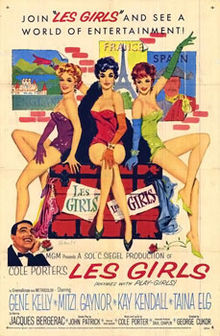
220px-Les_Girls.jpgClassic Hollywood musicals usually have a very common framework that they rarely seem to deviate from. There’s almost an accepted unwritten rule that they will function like so. Typically, there is an overarching story being told and yet the narrative is conveniently broken up by song and dance routines that not only provide immeasurable entertainment value and give an excuse for talented performers to strut their stuff but also serve to move our movie forward comedically, romantically, dramatically, whatever it may be.

Thus, Les Girls is a generally absorbing musical simply in terms of its mechanics. They stray slightly from the set formula. It’s a bit of a Rashomon (1950) plotting device. If you will recall, Akira Kurosawa’s film famously told the same turn of events three times over from three differing perspectives. That’s what happens here, in a sense, with the action being set partially in a courtroom (a first for a musical) and then the rest on the road with theater performers.

It all comes into being because of a libel suit that has broken out between two former colleagues who used to be a part of Barry Nichols’ Les Girls act that was a smashing success in its day. But following the publishing of a tell-all memoir and suggestion of a supposed suicide attempt, blood is boiling between Frenchwoman Angele Ducros (Taina Elg) and British-born Sybil Wren (Kay Kendall) who had the gall to publish such a story.

Of course, there are actually three ladies in question, the third being the peppy American Joy Henderson (Mitzi Gaynor) who rounds out the act and, of course, Barry finds himself romantically linked to each one though he specifically makes a habit of never falling in love with his fellow dancers. It proves a hard rule for him to keep but for the audience, it gives us a good excuse to see Gene Kelly share at least one moment on the dance floor with each of his talented costars individually.

This proved to be the final film score of America’s beloved songsmith Cole Porter and he provides a few moderately memorable numbers including the title track. Kay Kendall is thoroughly convivial to watch as a comedienne and performer throughout with her number “You’re Just Too, Too” being one of the most playful in the picture.

Meanwhile, the final number with Kelly and Gaynor is a blast full of romance around table and chairs. But the real kicker is feisty Mitzi Gaynor letting Kelly have it over the head with a picture frame, deservedly so, I might add. But in the end it all comes to naught, the court case is dropped and we are left with an open ending that’s winking at us. At least everyone’s happy.

Though he is not often remembered as a musical director, in some sense, George Cukor seems well within his element with the material at hand always adept at bringing together stories of behind the scenes antics and goings on between women and their men. That’s precisely what we have here.

This would prove to be Gene Kelly’s final film with MGM after an illustrious run. You also get the sense that perhaps this character is closer to the real Gene Kelly — the man who was constantly called a perfectionist and recounted later by Esther Williams to be a terror to work with. And here he still has a dose of his winning charm but there are also signs of that dancing slave driver working his girls to the bone and unwittingly romancing them at the same time. Still, there’s no doubting his inspired screen presence that underlines nearly every picture he was ever in.

It’s true that a previous iteration of the film was to have included Cyd Charisse, Leslie Caron, and Jean Simmons. That would have been an interesting combination to be sure but what we got here instead is still a stunning and at times thoroughly unconventional musical.

3.5/5 Stars


Forbidden Planet (1956)

Forbiddenplanetposter.jpgWe’re all part monsters in our subconscious. ~ Leslie Nielsen as Commander Adams
I couldn’t help but recall Han Solo’s line about the Millenium Falcon in the original Star Wars in response to Luke’s derision. After giving his pride and joy an affectionate pat he defends her reputation like so, “She may not look like much but she’s got it where it counts.”

It seems fitting that the line is used to commend Forbidden Planet because this is the film that in many ways made science fiction what it is today. It’s almost too easy to trace the line from this film to the likes of Star Wars and Star Trek and a plethora of others. But today we’re so used to the canonical worlds of established sci-fi that Forbidden Planet might come off as quaint and a bit outmoded. Still, the film has it where it counts even today.

Forbidden Planet was also unprecedented in its day because this was no B-picture. This was A-grade entertainment and that was almost unheard of at the time for science fiction, a historically low budget genre. Leslie Nielsen is given his first starring role while Walter Pidgeon plays the scientist who greets the explorers on the surface of the planet that they were sent to investigate.

But the band of expeditioners who came before them was all but decimated by some unknown force leaving only Dr. Morbius alive (Pidgeon) along with his pretty daughter Altaira (Anne Francis) who has no grasp of what life on earth is like. Commander Adams (Nielsen) is intent on staying on the planet until receiving further instructions from earth.

Still, something doesn’t sit right. There’s something off about Altair IV. A silent, invisible adversary is oftentimes more engaging than a visual one especially when it dwells very close to home and that’s precisely what presents itself moment by moment as the narrative progresses.

From their very first touchdown, this is an incredibly eery picture which manages to carry the audience’s attention for a great deal of the movie. In fact, if this was Star Wars they would have said, “I have a bad feeling about this” at least a couple times. But equally crucial is the subsequent development of the landscape around us that’s at times utterly entrancing.

The key to the film is that everyone plays it straight and serious and in this particular case it doesn’t come off as camp. There’s a gravity to it all that’s mesmerizing even in its bits of antiquity because the world is full of grand endeavors in creativity.

The electronic instrumentation provides what is purported to be the cinematic world’s first fully atonal electric score and even today each note is unnerving to the core. Whereas the theremin has somehow entered into the realm of parody these notes still seem resonant and they perform far better than any traditional score might have in the same circumstances.

At times Forbidden Planet showcases a very simple, even austere mise en scene and other times expands to almost labyrinthian proportions. The sweeping palette photographed in Eastmancolor with CinemaScope certainly adds to its allure straight out of the 1950s while still managing to take cues from stories from centuries prior, Shakespeare’s The Tempest, being the most obvious inspiration.

While not necessarily prophetic or correct in all its assertions about space travel (as far as we can possibly know) there’s a commitment to the world and a specificity to its inner workings that makes the Forbidden Planet into a fairly immersive place — a world alternative to our own that we are able to explore and I think that’s part of its unique status as a pioneering film. Because now we are so used to worldmaking and fantasies outside the realm of Earth whether it be Star Wars or Lord of the Rings or Harry Potter.

Here we see it too but it comes out of a time where most stories were human stories planted on earth or at the very least had the semblance of the reality that we know to be true here. And yet here was a narrative that dared transplant our human shortcomings to the other end of the universe in an entirely different paradigm while showing how man is his fallen nature can still make a mess of life even there. It’s a fairly powerful statement full of human psychology as much as it is about conquering new frontiers.

Robby the Robot (designed by Robert Kinoshita and the team at MGM) stands as a landmark among cinematic robots since he is his own entity as a standalone character. Far from turning on man, he’s about as useful as we might possibly think — even creating gallons of whiskey for the thirsty cook (Earl Holliman). The film was also a trendsetter in describing space travel in increments of light while miniskirts far from being a thing of the future still made a splash with 50s audiences as worn so provocatively by Anne Francis.

Through its final credits, Forbidden Planet is a special picture and that uniqueness goes far beyond its rightful place as one of the seminal explorations in science-fiction. The only thing left to say seems to be despite the iconic nature of its film poster, it has absolutely no bearing on the plot whatsoever. Still, it makes for a good piece of advertising. It must be if someone as oblivious as me is talking about Forbidden Planet over 60 years later.

4/5 Stars

Pushover (1954)

pushover 2.png

A film such as Pushover is easy to admire for the simple fact that it does not waste a moment in telling its story. As the credits roll a bank job is already in full progress laying the basic groundwork for what will unravel in the subsequent minutes.

The introduction of our stars follows soon thereafter in a meet-cute happening outside of a local theater, the pretense being engine trouble. It’s enough of an excuse for them to make a connection — two people who started the evening on their own but felt enough of a spark to wind up together.

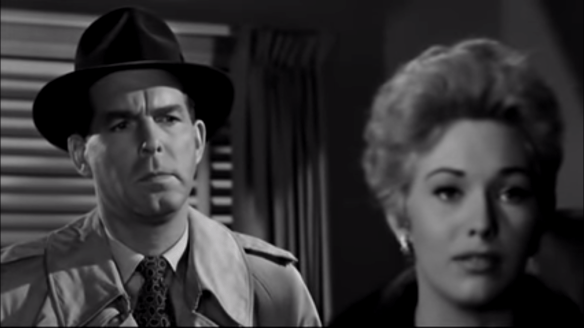
Of course, when we pull back it’s easy to realize a pretense is all that it was. Paul Sheridan (Fred MacMurray) is a cop tasked by his police chief (E.G. Marshall) to help recover the $200,000 that was nabbed in the bank job. The alluring young Lona McLane (Kim Novak) ties into it all because she was the one-time moll of wanted thug Harry Wheeler.

Thus, the police soon have her apartment under surveillance and her phone tapped for any hint of contact with the gangster. But what they weren’t counting on is for Sheridan to fall for her and put his own stake in getting back the missing money. Meanwhile, his partner Rick trusts him completely and the old vet Paddy is just trying to limp by to retain his pension.

What develops is this strange dichotomy between what is the ethical long arm of the law and what is pure voyeurism encroaching on a person’s right to privacy. Though it doesn’t explore the topic as Rear Window (1954) did that same year, there are still some interesting issues to be culled through.

Further still, despite being a policeman, Sheridan’s personal philosophy seems to be that money makes the world go around. Although he’s quite a bit older, there’s still much to enjoy about Fred MacMurray. Even if his occupation has changed, there is a sense that he’s playing another thinly veiled version of Walter Neff, that pragmatic everyman not fully prepared for playing with fire. Since that role was one of the ones that lit up his career, if this is a mere copy, it’s still a fairly enjoyable one placing him opposite Novak’s femme fatale.

There are passionate kisses that strike like lighting, some gorgeous shadows that easily help to put this into the dark recesses of the noir canon, also reflected by the number of cigarettes smoked and the loose morals that run through the narrative.

Even in her scintillating debut, Kim Novak’s voice is as husky and sultry as ever. Whether wearing her mink coats or driving her sleek wheels. Smoking her cigarettes and coolly spilling her drinks on anyone who gets fresh with her.

But she is not one of the independent strong-willed dames out of the war years. She is not Phyllis Dietrichson. She comes from a different generation and so, far from being a manipulator, it feels far more like she is willingly complicit in Sheridan’s plan as he takes the reins. In fact, it’s difficult to call her a femme fatale at all in the typical sense. It’s really the men around her who are crooked and more than anything she garners sympathy.

Phil Carey plays the stalwart cop who stands by his colleagues but he’s also no schmuck when it comes to laying down the law. The ever-active nurse next door (Dorothy Malone) who shares an adjoining wall with Lona becomes the object of his desire and it conveniently sets up parallel love stories. We now have two cops and two gals. Two romances and a line of entanglements as Sheridan tries to sidestep his colleagues and get the payoff for his own and for his beautiful new accomplice. Pushover develops into a delightfully messy piece of drama full of police corruption and avarice. But it’s a small-time story too. That’s part of its charm.

3.5/5 Stars