The Tall T (1957)

The_Tall_T_1957_PosterThe Tall T is a little different riff on the Budd Boetticher western, because it follows a former ranch hand named Pat Brennan who makes a stop at a local stagecoach way station to pay a visit to some locals before riding into the nearby town. Quickly we can see that Brennan is a little more jovial and still as tough as many of the other figures Scott has played.

He also is a first rate ranch hand, and yet after a bet with his old boss he loses his horse, because a bull throws him. Brennan attempts to catch a ride with a stagecoach with happens to be carrying two honeymooners, the timid Mrs. Mims and her stuffy husband. Reluctantly he is allowed to ride shotgun with the old time driver Rintoon (Arthur Hunnicutt) and it ends up being a regrettable decision. Mistaken for the regular stage, the four are hold up by three merciless outlaws looking for a big payoff.

They are led by Frank Usher (Richard Boone in a villainous turn), but the most deadly is Chink (Henry Silva), who seems eager to knockoff as many people as possible. And so a tense game of life and death ensues.  Rintoon attempts to fight back,  Mims agrees to go the cowardly route and ride off to try and attain ransom money. Brennan simply bides his time.

Unrest begins to build between the outlaws and Brennan takes his chance to save Mrs. Mims from the leering Billy Jack and bloodthirsty Chink. As the old story goes, the ringleader Usher is the only one left, but he has one last trick up his sleeve.

O’Sullivan’s role felt relatively minor, but it was quite fun to see Have Gun Will Travel’s Richard Boone opposite Randolph Scott. It made for a relatively interesting conflict.

3.5/5 Stars

Seven Men From Now (1956)

220px-Poster_of_the_movie_Seven_Men_from_NowAlong with Detour, Budd Boetticher’s Seven Men from Now is undoubtedly one of the greatest B-films I have seen to date. It rejuvenated the career of Randolph Scott who plays gruff sheriff Ben Stride. We are introduced to the often stoic man when he walks into a dimly lit cave during a torrential downpour. There he meets two strangers and demonstrates his skill with a gun for the first time.

For the rest of the film, he comes alongside a couple from the East, struggling to move westward with all their possessions carted on a wagon. The husband John Greer (Walter Reed), is a chipper man, but not a very adept pioneer. His kindly wife Annie (Gail Russell) loves him in spite of this ineptitude. He doesn’t say much, but Stride seems to like them both as well or at least, he knows they won’t make it very far without help. So after helping them get their wagon out of some thick mud, he sticks by their side.

They are eventually joined by Bill Masters (Lee Marvin) and his accomplice Clete, who look to make some money in the wake of Stride. He willfully explains to the Greers how Stride used to be the sheriff in the town of Silver Springs, before his wife was killed by a group of bandits when they were robbing a Wells Fargo shipment. He made it his mission to track down the seven men who took part in the act. And so as an opportunistic schemer Masters is content with riding along with Stride until the opportune moment to score a big payoff.

In this way, he helps the Greers and Stride fend off some Apache and even puts a bullet through a man before Stride gets it. If we didn’t know better, we might think that Lee Marvin has gone to the good side for once. But that’s not so. He’s full of insinuations, flirtations, and veiled threats that somehow feel more ominous than a Vince Stone or Liberty Valance. It’s not just physical brutality but he is playing perhaps an even deadlier game of mental warfare. Against not only Stride, but Mrs. Greer, and her husband.

It’s around this point that Masters and Clete make a move. They alert Stride’s nemesis to his plans and just like that two men go and ambush the veteran sheriff. He knocks them both off after receiving a wounded leg that leaves him unconscious out in the canyon. Luckily the Greers come across him and John decides to take responsibility for what he has unknowingly done. He goes into town to face the music for the role he has ignorantly taken in this whole deadly affair. After discounting Greer as weak and spineless, Masters is finally forced to recant his previous statement.

What’s left is Ben Stride out in the canyon with the Wells Fargo shipment, but with two new bandits and Masters and Clete, it looks to be a bloody finale. After a bit of backstabbing, Ben Stride stands alone in the aftermath. He has completed his odyssey and he says goodbye to Ms. Greer with a new resolve to take on the role of deputy sheriff in Silver Springs. But it’s doubtful if that is the end of his story.

4/5 Stars


The Bravados (1958)

The_Bravados_-_US_film_posterThe Bravados opens with an ominous stranger in black riding towards a town. He doesn’t say much, but his presence alone creates tension enough. He gets led into town by the local deputy and after a meeting with the sheriff, he is allowed to stick around. His only reason for coming to the city of Rio Arriba is to watch the hanging of four outlaws, at least that’s what he says. But when he asks to see the prisoners, he surveys them and there is nothing but anger in his eyes.

As they wait for the hangman from out of town to arrive, Jim Douglas (Gregory Peck) gets reacquainted with the beautiful Josefa (Joan Collins). And nothing is said about their backstory, but there is obviously something between them. He at first refuses her offer to go to church, but requests to walk her over before reluctantly joining her in the chapel.

However, back at the jail, the hangman is not who he appears and stabs the sheriff in the back with the four outlaws getting away taking a local’s daughter with them. So the town is in a fury sending a posse after the fugitives led by Douglas.

And one by one Douglas tracks down the culprits. First, ambushing Parral (Lee Van Cleef) who he shoots after the man begs for his life to be spared. Next, he takes down Taylor and hangs him from a tree after dragging him behind his horse. The posse does eventually get the kidnapped girl Emma, but Douglas is far from satisfied, crossing the border to Mexico to finish the job. He guns down Zachary in a bar and his only target left is Lujan (Henry Silva). But that’s when things change. Douglas is knocked out of his blind rage for a moment. Because this whole vendetta began after his wife was raped and murdered. He went on an obsessive quest to find the four culprits and although these four no-goods constantly denied seeing his wife, he just went after them anyway.

It is Lujan who finally makes Douglas realize he made a mistake. In this epiphany, Douglas realizes he is little different than these four outlaws, willing to kill mercilessly, even in the name of justice. He goes back to town a hero, but he heads straight for the church where he confesses his wrongs to the local priest. He is a man with a lot to wrestle with, but also a lot to live for thanks to his daughter and Josefa. Although not quite as iconic and memorable, The Bravados, in a sense, is Gregory Peck’s version of The Searchers. This Henry King western in CinemaScope is noteworthy for allowing Peck to play another morally ambiguous character. He is no Atticus Finch.

3.5/5 Stars

Heaven Knows, Mr. Allison (1957)

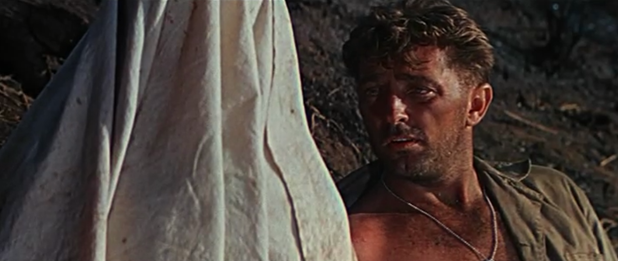
heavenknows3From John Huston comes another film about a woman of principle and a man who seems to be everything she is not. This time instead of Katharine Hepburn and Humphrey Bogart aboard The African Queen in WWI, we have Deborah Kerr and Robert Mitchum stuck on a deserted island together during WWII.

Kerr is Sister Angela who was on the island only a few days with a priest before he passed away. Now she is alone taking care of herself in solitude. That is until castaway Marine Mr. Allison washes up on her shore in a raft. For a time it is just the two of them as the Sister offers the marine food after his long, arduous journey. But after getting rest and some nourishment, he returns the favor proving his resourcefulness at scrounging up food on the island. For a while, they live in relative ease like this.

But they are reminded that the war is still going when the Japanese set up camp on the island. The unlikely pair finds themselves living in a cave together. Allison invades the camp on the sly to acquire food for them, and they continue to manage in hiding. Once the enemy is gone, the exuberant marine gets drunk on some sake and professes his love to the novice nun. Although the situation had never quite been awkward up to that point, it quickly becomes so. Sister Angela, in a tizzy, flees out in the pouring rain and winds up getting sick as a result.

heavenknows5To add to the predicament, the Japanese forces return, and back to the cave, it is. This time Mr. Allison must kill a soldier in order to get a blanket for Sister Angela. Soon the Japanese are burning the underbrush in pursuit of the culprit. It’s dire straights certainly, but then help comes.

Mr. Allison once again proves himself and regains the faith and admiration of Sister Angela. Once the marines roll in Mr. Allison is able to leave the island on a stretcher with the faithful novice by his side. They are a strange pair, but their relationship makes this story actually engaging. In a way, the life of a marine and a nun have some similarities, although they fall at completely different ends of the spectrum. In the same way, Mitchum and Kerr are adept at playing their roles to that degree. Allison is rough around the edges, a Joe Palooka type, and yet he means well. The nun is devoted to her calling, proper, and it never seems as if she could ever approve of Mr. Allison. And yet, in the midst of all the divides that seem in place, a true bond forms. It’s an entertaining relationship and these two stars,  led by John Huston’s direction, made it thoroughly enjoyable.

4/5 Stars

99 River Street (1953)

99river4This is a Sam Fuller type crime film that’s not pretty, it’s full of gritty realism, and it ends up being an unassuming little gem that is a great joy. However, instead, this film comes from director Phil Karlson pairing him with John Payne. In film-noir, boxers always seem to take a center stage and it is never (or hardly ever) the champs. It’s the near misses or the bums. Ernie Driscoll (Payne) falls into this category as well.

After his big fight and an unfortunate conclusion to the bout, Driscoll is all washed up and he and his wife know it. He relives the moment in agony and dejectedly takes a job as a taxi driver, while he tries to figure out a future without boxing. You can tell his wife is fed up with this way of life, and she’s getting awfully snappy. Driscoll is unhappy, with his marriage going down the tubes, so his only encouragement comes down at the coffee counter with his buddy Stan and the bubbly actress Linda.

Things get worse when Ernie sees his wife with another man who also happens to be a real thug. Ernie is humiliated and looking for revenge, but on Linda’s bidding, he follows her to the theater because she is in desperate trouble. He obliges and yet again he feels like he’s been made a fool of. He cannot even seem to trust her.

Ernie wants desperately to get back into the ring, against the better judgment of his former manager. But he still is caught up in the whole mess with the cunning tough guy Victor Rawlins who stole Driscoll’s wife. The man shows how little the girl meant to him in comparison to the money and after getting a payoff for a fat load of diamonds, he waits for a freighter to take him away.

Linda wants to help Ernie after what happened on the stage, but she cannot stop Rawlins. It’s up to Ernie to duke it out on the docks, and it turns into a real brawl where he struggles not to get his bell completely rung after a gunshot to the chest. It’s the biggest fight of his career and somehow he wins. Really 99 River Street sounds like a run-of-the-mill noir, but Payne’s performance is rather good. It feels rather like Edward G. Robinson in Scarlet Street where no one seems to be on his side. However, he does ultimately have two solid allies in the faithful dispatcher Stan and the always vibrant Linda. Ernie finally follows Stan’s earlier advice and whispers sweet nothings into the ear of his love. It’s a happy ending for a noir.

The cast is rounded out nicely by a wonderful group of character actors including Brad Dexter, Jack Lambert, and Jay Adler who all work as the scum of the earth-dwelling in New York. The contrast of the bubbly Evelyn Keyes with the more aloof Peggie Castle was also very effective in the film. Now I need to see Kansas City Confidential as well.

4/5 Stars

Monkey Business (1952)

monkeyb5I always was under the assumption that the screwball comedy died off in the 1940s with homages coming out years later. Is there such a thing as neo-screwball comedies? Anyways, after watching Monkey Business I feel it is necessary to reevaluate that general conclusion. Here is a film from Howard Hawks that channels a great deal of the madcap craziness that you see in his earlier works like Bringing up Baby (1938). For lack of a better term, it is very screwy indeed. Right from the opening credits, you have the voice of God (Hawks himself) breaking the fourth wall and calling Cary Grant by his real name.

Then the film actually opens, and we meet the quintessential absent-minded genius Barnaby (Grant) and his loving wife Edwina (Ginger Rogers). They are meant to go to a social gathering and yet he is so caught up in his work that they stay behind. You see he is trying to develop an elixir of youth. His experiments are of interest to the business-minded and much older Oliver Oxly (Charles Coburn), who only sees the positives of such a discovery. Barnaby tries to explain to him that it’s not so cut and dry. In fact, his work could have dire effects if careful precautions are not taken.

Little does Dr. Fulton know that one of his lab chimps got loose in his lab and tampered with some chemicals, dumping them in a water cooler. After this absurd moment, Barnaby unknowingly consumes the rejuvenating concoction and his whole demeanor takes a turn.

Soon he’s out buying flashy clothes, getting a flamboyant car, ice skating, and driving like a speed demon down the thoroughfares with an astonished secretary Ms. Laurel (Marilyn Monroe). Cary Grant even shows off his impressive acrobatic skills, performing a cartwheel and a few other tricks.monkeyb3Only when the concoction wears off does he figure out what happened, and he resolves to be more careful next time. Except next time turns out to come sooner than he was expecting when Edwina willingly drinks some of the substance so Barnaby can observe her. Just like that, she is a prank-pulling schoolgirl with insatiable energy.

Once more Barnaby takes the elixir while Edwina is sleeping off the effect. However, when she wakes up a misunderstanding leads to more mayhem as she tries to get help from Mr. Oxly. What develops is a spiral into more hilarity. Barnaby and Edwina are reunited, Edwina’s old flame is incensed, Ms. Laurel is petrified, and chimps and man alike are taking part in some Monkey Business. If none of this makes much sense then I did my job!

3.5/5 Stars

An Affair to Remember (1956)

anaffairto2An Affair to Remember (1956) has always been noted as a great American romance as far as I can ever remember, and I figured out that part of that was because it gets a mention in Sleepless in Seattle (1993). Whatever the reason, I finally got around to watching it and it is certainly an enjoyable weepy. Any film with Cary Grant as a romantic lead is usually, at the very least, charming and this one is too. He is a famed man on an ocean liner who has finally gone and gotten himself hitched. It’s big news and as soon as the ship touches down he is going to meet his love.

Quite by chance, he meets Deborah Kerr’s character and they are immediately taken with each other. Soon their friendship grows into an affectionate romance, and yet they feel uncomfortable in front of the other passengers who seem to be watching their every move with interest. They both know that once the boat reaches New York things will not be the same between them for some time.anaffairto4And so it is, but they had made one last plan to meet each other at the top of the Empire State Building. Grant makes it, but Kerr is detained for a very good reason. After seeing her in an awkward situation at the theater, Grant resolves to go see her and get to the bottom of what happened. It’s a tearful, albeit happy, reunion as they come back together.

If any of this feels familiar, like a rerun, that’s because it is. Leo McCarey actually made An Affair to Remember (1956) as a scene for scene remake of his earlier film Love Affair (1939). I never thought I’d say that I like a film with Charles Boyer more than a comparable one with Cary Grant, but it’s the truth. I’m not sure if it’s because I saw it first or that the film feels more intimate, but I really enjoyed Love Affair. An Affair to Remember is certainly elegant in color and Deborah Kerr gives a fine performance, but I was personally blown away by Irene Dunne as an actress. In fact, back in the day, Dunne worked quite a bit with Cary Grant (The Awful Truth, My Favorite Wife, and Penny Serenade).

So my advice is, go back and give Love Affair a watch. It’s still by McCarey with much of the same story so it’s really a personal preference what film you like more.

3.5/5 Stars

Kiss me Deadly (1955)

kissmedeadly1Set in L.A., the film stars Ralph Meeker as the callous and often corrupt P.I. Mike Hammer, adapted from the Mickey Spillane novels. One night while driving, Hammer picks up a frightened woman who begs him to remember her. They are forced off the road by thugs and the girl is eventually killed. Hammer wakes up in the hospital to his secretary girlfriend Velda (Maxime Cooper). He makes it his priority to find out what the mysterious woman was talking about. He meets up with opposition and a femme fatale, but Hammer keeps on going using strong-armed tactics. He finally tracks down a mysterious whats-it but then discovers that Velda was kidnapped. In the final confrontation, he finally learns who he was looking for and he finds out the consequences of the Pandora’s box in the hands of a deadly female.

Out of most of the prominent works in the canon, Kiss Me Deadly is probably the pulpiest of L.A. Noir. The images are rather like a historical time capsule of 1950’s Los Angeles with locations on Wilshire Blvd., Sunset Blvd, and even near Angels Flight. It has crisp black and white cinematography with many noticeably low angles underlying the sleekness, but also the paranoia wrapped up in this story. It arguably has the queerest cold open and ending of any noir, which I cannot help but remember.kissmedeadly2Ralph Meeker plays’s Mickey Spillane’s P.I. Mike Hammer to a tee. His husky voice perfectly fits the bravado of Hammer, a misogynistic brute prone to coercive action. Out of all the private gumshoes we’ve met, Hammer is probably the lowest — he’s a real scuzzball.

 Hammer throws women around like playthings and even his girl Velda has a double purpose. Yes, she is a lover, but she also makes a keen asset for business. As a P.I. specializing in divorce cases and marital problems, he’s not below giving business a little help. Velda willingly works on the husbands for him and he’s not above playing around with their wives. It’s a cozy little set-up.

kissmedeadly8That’s Hammer’s level and so when he gets caught up in the story of the mysterious girl Christina (Cloris Leachman), he has no idea what he gotten himself into. It’s a lot bigger than him and when the authorities throw around words like the Manhattan Project, Los Alamos, and Trinity he finally understands what its all about, but not really. In essence, Kiss Me Deadly is the quintessential film of paranoia in the Cold War nuclear age. We have a MacGuffin in the form of the mysterious Whats-it, but aside from that, we get few answers. Only a few deaths and some mighty destruction.

kissmedeadly4

Kiss Me Deadly has some great characters aside from Hammer and Velma. The thugs are played by the perpetually cross-eyed Jack Elam and the glowering Jack Lambert which turns out to be great casting. Also, the lively Greek-American Nick (Nick Dennis) is a great deal of fun with his enthusiasm and a lot of “Vavavoom!”

It’s an interesting dilemma because I have never loved Kiss Me Deadly, but director Robert Aldrich developed a film that is so persistently interesting. It was a film that was supposed to ruin young viewers for its moral depravity, sensuality and who knows what else. This film literally screams “Remember Me” and honestly I will not be forgetting about it anytime soon.

3.5/5 Stars

Christina: You have only one real lasting love.

Hammer: Now who could that be?

Christina: You. You’re one of those self-indulgent males who thinks about nothing but his clothes, his car, himself. Bet you do push-ups every morning just to keep your belly hard. 

The Crimson Kimono: An Analysis of Noir Realism and Race (2015)

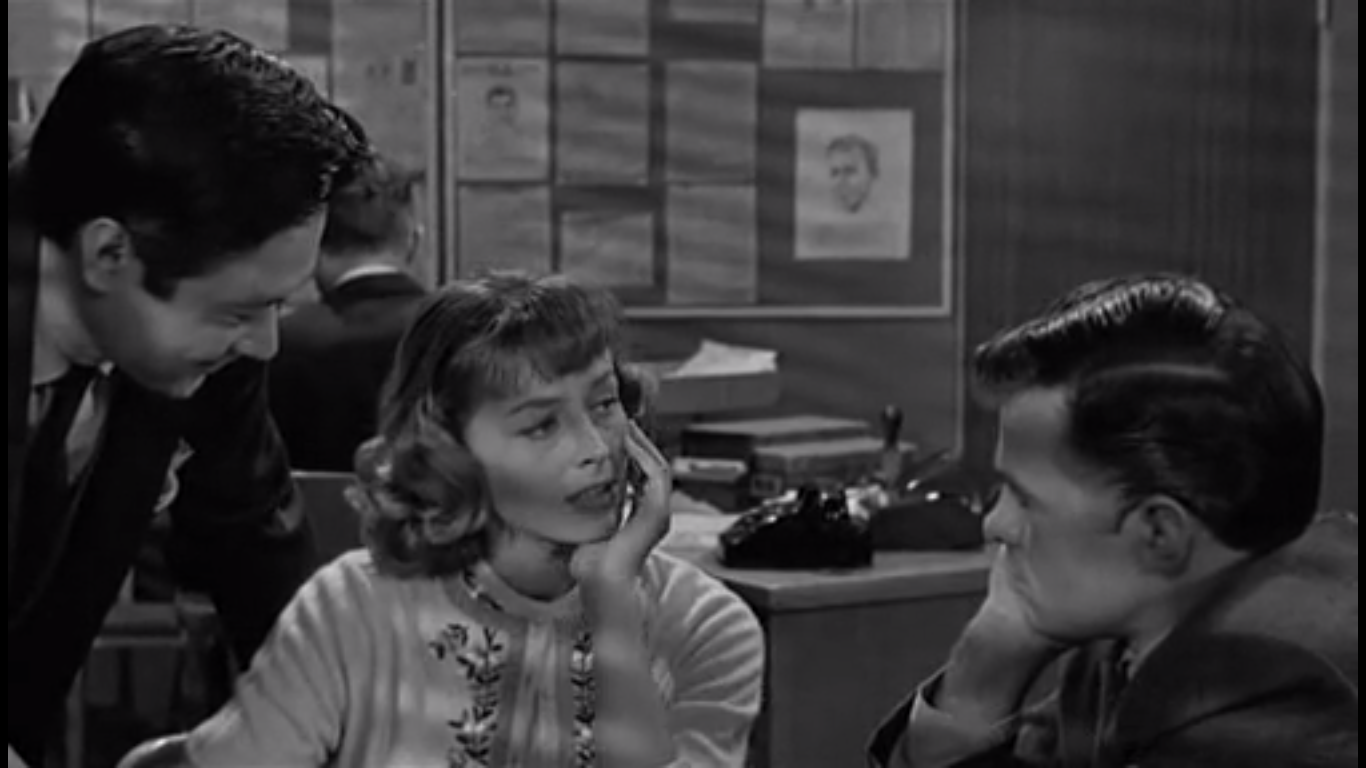
crimson kimono 1 shigeta corbettWhat makes Film-Noir intriguing is not simply the crime aspect but the fact that they are films with worldviews that are often weighed down by cynicism. Film-Noir depicts the harsh realities of human nature that few other films would ever dare to acknowledge onscreen. People are broken at their core; continually led to their own devices whether it’s greed or their own personal insecurities. These films give us a fascinating microscope by which to examine all the pain and prejudices that abound within the human condition.  Samuel Fuller’s The Crimson Kimono (1959) shares some of these qualities, acting as a realistic procedural that employs cinematography and setting to say something about the world we live in. Furthermore, it has a remarkable stance on race relations, specifically for Japanese-Americans, that was ahead of its time and has hardly ever been matched.

Through an analysis of The Crimson Kimono it becomes obvious that it is a striking film in the noir tradition, blessed with an urban realism that brings 1950s Los Angeles to life for us. As Samuel Fuller himself points out, “The thing that is most noir about Crimson Kimono…is how [he] shot it.” He was “in Little Tokyo and lots of other actual locations downtown, with cameras hiding in trucks, shooting at night with fast film because [he] could not put out lights” and as a result, the film has “a hard, gritty realistic look” (Film Noir Reader 3). When the action heads to the streets and hooker Sugar Torch is fleeing from an unseen assailant, it definitely has the gritty, atmospheric realism that Fuller was alluding to. This is a real place where we could be. These will be the same streets that Joe and Charlie will soon be hitting on their beat. Ironically, when Fuller shot the scene live he noted that he didn’t really “get much dramatic reaction.” Despite the fact that “An almost naked, six-foot-tall blonde is running for her life down the street,” nobody seemed to care and nobody looked (Film Noir Reader 3). That is the world of Los Angeles, full of indifferent masses that could care less whether something looks real or is real. It makes no difference to them because it fails to affect their existence. It is a dismal worldview, very representative of noir, but the odd thing is that Charlie and Joe are not like this at first. They are heroic, honest individuals with the duty of weighing through this noir world as part of their vocation. Thus, they oblige out of necessity and only then does it get to them. Even so, there is an argument that it is not the world, but their personal hang-ups that tear them apart.

Their investigation leads them to “Little Tokyo,” which becomes an integral locale within the context of the film and Fuller uses it effectively. For instance, in one scene Joe walks the streets with a Mr. Yoshinaga after meeting him at a cemetery. It’s a highly mundane moment and yet Fuller still manages to make it interesting. It is also less austere than the earlier scene of Sugar’s murder since banners are flying and locals are milling about the storefronts. That’s why it becomes an interesting setting for a chase sequence, taking the everyday environment and turning it into a point of drama. It reinforces the fact that Fuller seems to be more interested in the realism of common incidences compared to high drama. It’s almost as if he’s a journalist again trying to get a juicy feature story. It’s ordinary, real and it meets people where they are at.

One of the most significant moments occurs later on during the kendo match where Joe and Charlie are supposed to face off as part of the Nisei Week Festival. It’s a big deal and flyers are plastered all over the town so people will turn out for the event. Within the context of the film, it matters on several levels. The fact that Charlie is Joe’s equal suggests that martial arts are not just stereotypically Asian, but they can be universal. Perhaps most importantly their bout reveals the descent of Joe into utter resentment because he disregards all the traditions of Kendo and begins to go after his friend with a vengeance. It’s the turning point that Charlie cannot forgive Joe for and for good reason. The sequence plays out as quick cuts between masked faces, swords, dancing feet, and exuberant onlookers. Practically before we know what has happened Joe begins beating Charlie over the head and lays him out. It is such a rapid about-face that is underlined by Joe’s own insecurities, which we will get to delve into later.

The culmination of the film occurs during the festivities, with music, dancing, banners, lanterns, and girls in kimonos. It seems fitting that Fuller’s entire story leads us to this point at such a public place full of your usual bystanders. It’s theatrical while still maintaining a sense of the real world. Here again, we have a third chase scene except this time Fuller does something especially interesting with the music. During the pursuit there is a symphony of conflicting tunes going on between the bands: “One plays classic music, one plays Japanese music, one plays hot music, and so on. Whenever [Fuller] cut from the killer to the pursuer, the music changed. That gave [him] the discordant and chaotic note” that was desired (The Director’s Event). It seems like such a simple detail and yet it truly is clever in conception, because it adds another layer of realism to the scene while simultaneously utilizing diegetic sound for dramatic effect. It could be implied that the music also reflects Joe and Charlie’s own feelings of confusion and friction, which injured their friendship and Charlie’s ego. It’s ultimately Joe who has to parse through all the noise and commotion ultimately finding the truth. It’s no small coincidence that once again we find ourselves on the urban streets at night just like when Sugar Torch was gunned down. Fuller parallels that earlier scene and yet so much has changed. This time around there is a hint of hope, but a sour taste is still left in the mouth. It suggests that you cannot fully escape the darkness and anxieties that seem to engulf us because this world can never truly have a perfect ending.

crimson kimono 2

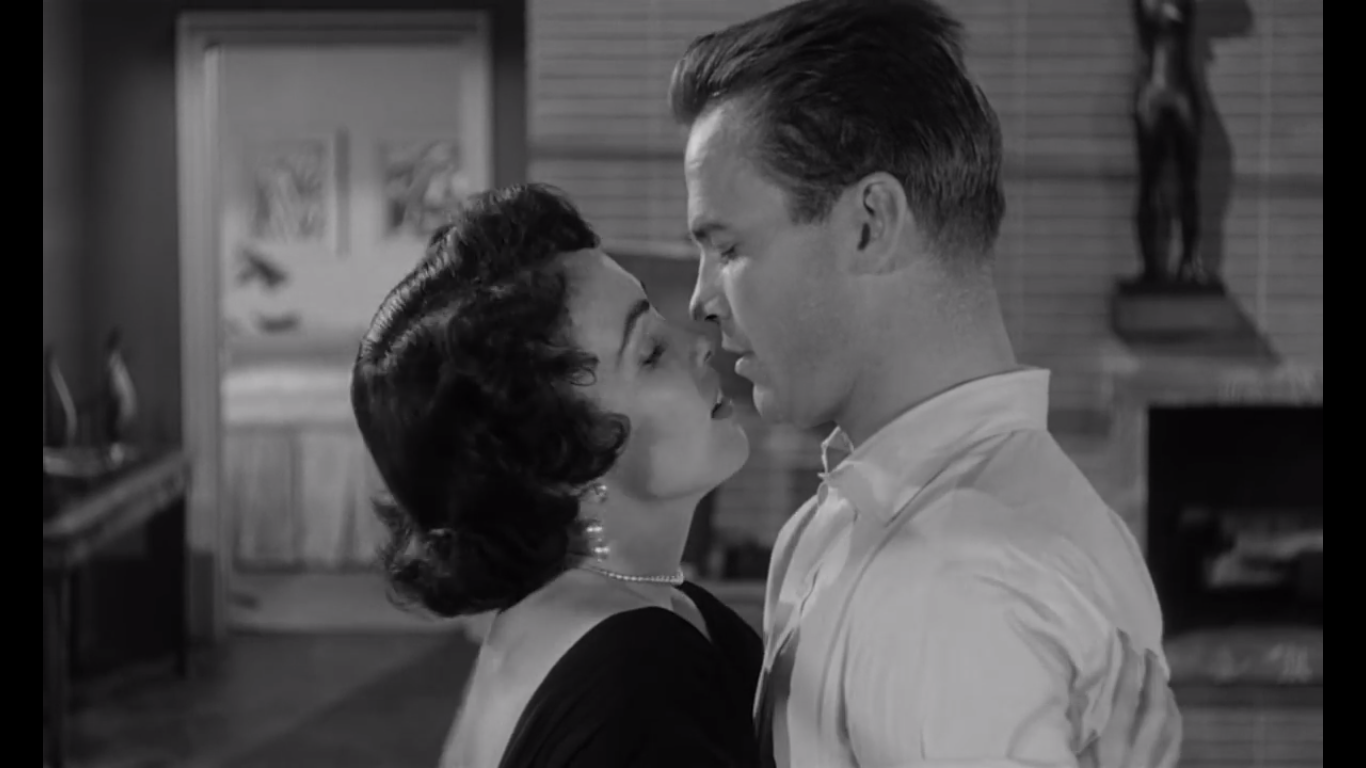
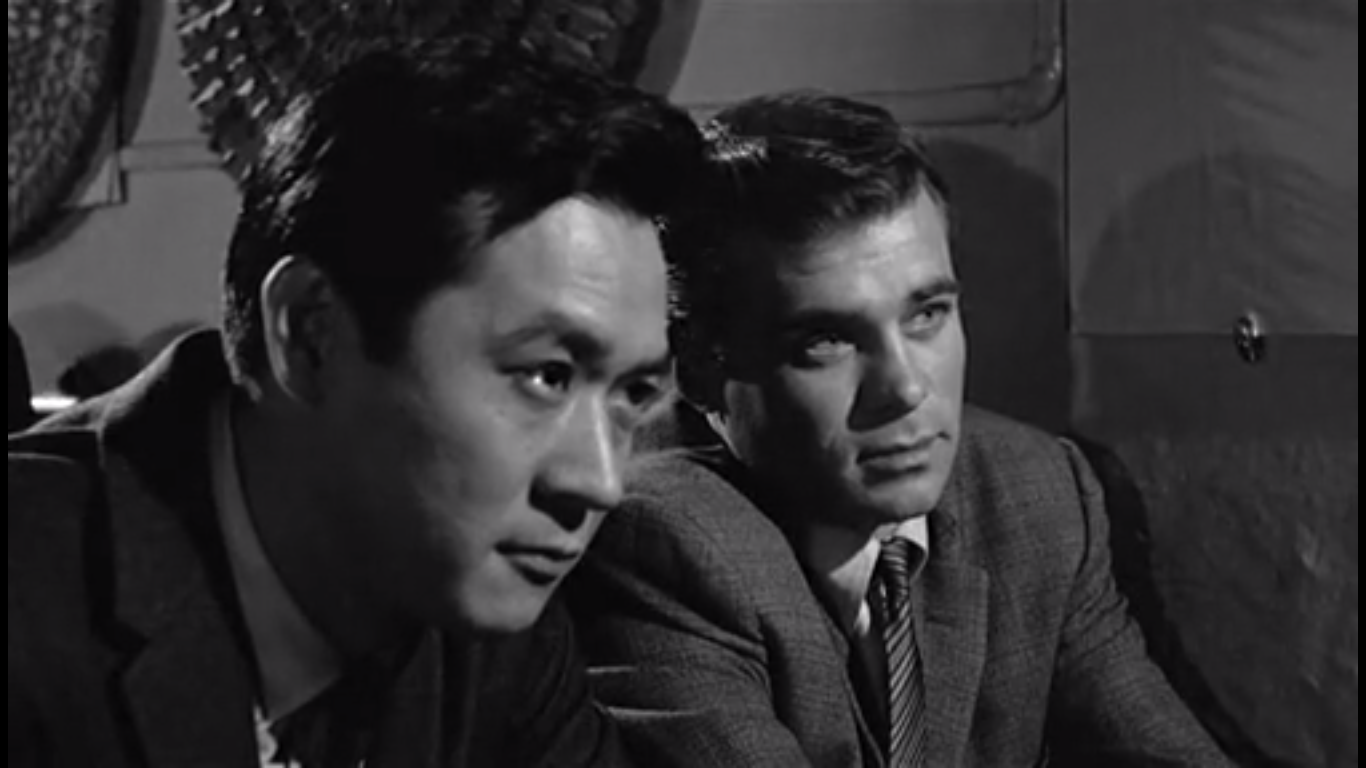
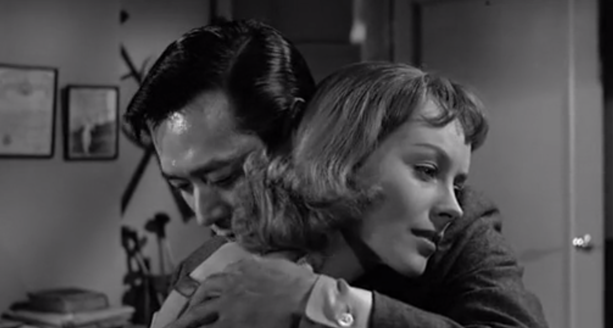
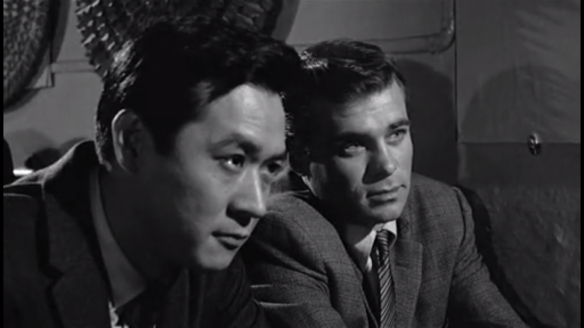
Fuller’s film has murder attempts, gunshots, fist fights, etc. However, he knows how to simplify scenes getting only the necessary elements out of them. When Sugar Torch crumples to the ground we hear the shot and that’s all we need. When an attempt is taken on Chris’s life we see the gun pointed ominously and again we hear the shot but that’s all. There’s a cut to a new scene and Fuller gives us all the details we need to know.  In a sense, it’s about an economy of images that allow this film to be short, at only 78 minutes, and still, pack a punch. It definitely was out of necessity that Fuller did many of these things which would have saved time and money, but it also undoubtedly caused him to come up with creative solutions. The Crimson Kimono like many of Fuller’s films is hardly sleek or polished and that is part of the allure. It is the opposite of typical Hollywood and it fits film-noir so beautifully. It has the same harshness as one of Fuller’s other works Pickup on South Street (1953). What it lacks in a femme fatale or Cold War sentiment, The Crimson Kimono makes up for in how it tackles romance and the job of a policeman with a subtle touch. For this reason, it may be less of a film-noir than Pickup and perhaps a lesser film, but there is still power in its story and the racial lines that it willfully challenged. It also seems necessary to acknowledge a bit of Samuel Fuller’s background, because it further influenced his filmmaking. He came from a Jewish family in New York and dropped out of school to write for a newspaper along with penning pulp fiction novels. He served during WWII and when he came back he began a storied career as a writer and director of frequently subversive “B pictures.” His versatility is especially remarkable, cycling through all types of films from westerns, to crime films to war dramas, elevating them above “B” quality. Part of the reason is that he never gave into conventions and his genuine depictions of race in films like The Steel Helmet (1951), Run the Arrow (1957) and The Crimson Kimono were ahead of their time.crimson kimono 3The Crimson Kimono is an extraordinary film historically because it depicts something that we very rarely see, especially for 1959. The late, great actor James Shigeta portrayed the straight-laced policeman and former Korean War hero named Joe Kojaku. He’s a sympathetic figure and hardly a caricature. His best friend is the Caucasian Charlie Bancroft (Glenn Corbett), who is on the LAPD with Joe and a war buddy. They are inseparable and they share a flat. Above all, the most amazing thing is that Joe gets the girl over his friend! That might be a small victory, but I have seen a lot of films to know that the Asian guy never gets the girl, especially if she is Caucasian. Sam Fuller subverts the norm and it is a major statement on interracial romance in an age when many would have scoffed at it. However, Fuller also takes immense care to look at both sides of the equation, and he allows both men the benefit of the doubt. Joe must figure out his own identity even acknowledging, “I was born here. I’m American but what am I? Japanese, Japanese American, Nisei? What label do I live under?” The question is not an easy one and it is one that he struggles with over the course of the entire film, navigating his feelings towards Charlie and then the beautiful artist Chris (Victoria Shaw).

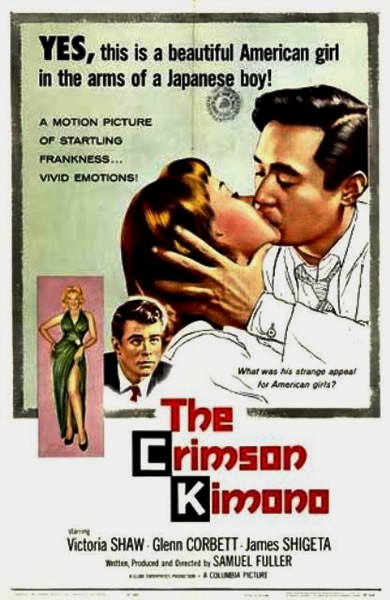
The-crimson-kimono-1959_posterRegrettably, posters for this film were highly shallow and sensational reflecting the age with taglines like “Yes, this is a beautiful American girl in the arms of a Japanese boy!” or “What was his strange appeal for American girls?” It places this character in the typical category of an exotic lover. He’s not a real man, only an enticing mysterious foreigner with strange appeal. Likewise, the title Crimson Kimono itself brings to mind oriental exoticism involving strange dress and foreign culture. This could have just as easily been a dated film of yellowface and Asian stereotypes, but it’s superfluous to judge this film by its posters and title alone. When you actually watch Fuller’s work these are not the focal points at all. As Fuller later said himself, “The whole idea of [his] picture is that both men are good cops and good citizens. The girl just happens to fall in love with the Nisei. They’ve got chemistry” (A Third Face). Chris likes Joe because he is a genuine hero, not because the other man is not. Joe is sweet and shares a love of art (piano and painting) like her. She could care less that he’s Asian just like Charlie could care less. Those are the kind of people they are.

Fuller’s depiction goes both ways, however, because while he never sells Kojaku short, he also suggests that Joe might be part of the problem. Fuller notes that he “was trying to make an unconventional triangular love story, laced with reverse racism, a kind of narrow-mindedness that is just as deplorable as outright bigotry. [He] wanted to show that whites aren’t the only ones susceptible to racist thoughts” (A Third Face). This ends up happening with Joe since he gets so caught up in prejudice, his own prejudice, that it wrecks his relationships with his friend. Charlie is not angry because Joe, an Asian, stole his girl. Charlie is understandably irritated because his best friend took the girl who he really liked without telling Charlie his true feelings. Joe makes the mistake of attributing this to a question of race, but Charlie, like Fuller, is not that shallow. His reaction is purely a human reaction that develops in any romance when two men who are equals go after one girl and only one can come out on top. It hurts no matter what race, color or creed they are. That’s just the reality and that’s the lesson that Joe does not understand at first. He seems to care too much about the race question and potentially even his identity. It ultimately damages his relationship with Charlie and we cannot know for sure if it will ever be repaired, even if we would like them to patch things up. Thus, Fuller combats racism from both angles, including minorities who might take on the role of a victim too quickly. Because the reality is, issues of race almost always get blown way out of proportion with both sides being hypersensitive. Fuller seems to have the right handle on the situation, not stooping to unwarranted stereotypes and not heaping all the blame on the majority. Sometimes everybody is at fault at least a little bit. That’s simply how life is and that’s how it gets depicted in The Crimson Kimono, with a sensitive, albeit, realistic touch. Furthermore, one could argue that it is a typical noir ending because although Joe still gets the girl it came at a steep cost.crimsonk4The Crimson Kimono is riveting from the beginning because it is such a groundbreaking and rare piece of film history. It presented on film something that we never see or very rarely see: a relationship between an Asian man and Caucasian woman. In the hands of Samuel Fuller, this unique but still mundane tale is kept thoroughly engaging. He infused his screenplay with visuals of Los Angeles and realism that makes his characters all the more believable. His camera is able to take the everyday and make it dramatic while we continue to invest in these people. It seems fitting to end the discussion with a quote from the man himself. He affirmed that “One film never really gives me complete satisfaction. Nor should it. All creative people must learn how to deal with the imperfect and the incomplete. There is no end in art. Every accomplishment is the dawn of the next challenge.” That’s what makes the films of Samuel Fuller meaningful. No one film can ever have everything. The Crimson Kimono does not have every answer on race and it certainly does not have every convention of film-noir. It’s imperfect, but it is a jumping off point for future endeavors and dialogue.

All That Heaven Allows (1955)

allthatheaven4When I first saw the work of Douglas Sirk, I was immediately struck by how well it seemed to personify 1950s Hollywood. All That Heaven Allows (1955) is little different in its opulence and superficial soap opera tonalities. Except for this one, at times, feels a little like it should be a part of a Norman Rockwell Saturday Evening Post cover. Perhaps it glides a slightly more interesting line between high society country club members and quintessential middle America.

The two alternatives are contrasted in our screen couple played by Jane Wyman and Rock Hudson.

Cary Scott (Wyman) is a well to do, middle-aged widow with two grown kids off at school. She is often lonely and always sensible when it comes to the life decisions she makes. After all, she doesn’t want the local gossip blabbing about her life to all their society friends.

That changes rather gradually thanks to her seasonal gardener and professional tree-trimmer Ron Kirby (Hudson). He is a different sort of spirit who seems to be content with nature and his place in it as nurturer. Their acquaintance begins over a harmless cup of coffee and turns into an excursion to his humble abode. Over time, Cary is introduced to Ron’s brand of friends, all charming, down-to-earth folk who live life to the fullest without worrying about wealth or societal pressures. This is what she has been looking for, and he is the man she needs. So when Ron proposes marriage she readily accepts.

Now comes the task of putting it before the kids and then showing Ron to the local snarks. The socialites are no different with their sniggering and pointed remarks. There is no mercy for Cary and Ron. In fact, they are appalled by such a scandalous romance. The children who normally are rational and kind, do not mince words with their mother. Ned talks about the family honor, the legacy of their father, and their home. He cannot bear for his mother to supposedly throw all that away. Kay, on her part, is always getting caught up in psychoanalysis, but this time all rationale goes out the window after her boyfriend breaks up with her.  Under this built-in pressure, Cary reluctantly breaks off their marriage, mostly for the sake of the children.

allthatheaven2Except she is never quite the same and never feels like she did with Ron. Cary is resigned to staying in her lavish home, while reluctantly accepting the newest form of modern entertainment — a television. Christmas time is especially hard when she runs into Ron, but then the kids come home. That’s when she realizes her grave error and what comes next is exactly what you expect, with a few small diversions. Cary turns back to Ron, who has been in a funk of his own. Following an accident that was induced by Cary’s presence, Ron is bedridden and Cary rushes to his aid. This is the life she was meant for no matter what society says of her.

It’s pretty mushy, weepy stuff in a sense. That’s the superficial level of second-rate romance and picture-perfect technicolor. In fact, All That Heaven Allows is visually beautiful in a sickening sort of way. The town is too pristine, the seasons too perfect, the snow too puffy. And yet it all seems to be an impeccable supplement to Sirk’s moral drama. Ironically, this is not a moral tale about unbridled love between a woman and her younger lover. That would make complete sense. Instead, Sirk subverts that wonderfully, by suggesting the weight of the blame is on society and the peer pressure that permeates the upper crust.

Even if this film is a little too syrupy in its sweetness, I can manage a spoonful or two because there is a greater meaning to this frivolity. All That Heaven Allows is certainly an acquired taste, but it’s worth taking a chance on.

4/5 Stars