Review: Roman Holiday (1953)

Joe: Today’s gonna be a holiday.
Princess Ann: But you want to do a lot of silly things?
The answer is yes, yes we would!! That is the beauty of this film, which plays out as a lovely jaunt through Italy with two favorites in Audrey Hepburn and Gregory Peck. With Hepburn being practically unknown at this point in time, it made her a wonderful choice to play Princess Ann. She was someone without any prior identifying roles making her young princess seem plausible. William Wyler took a chance on an unknown and he certainly hit the jackpot.
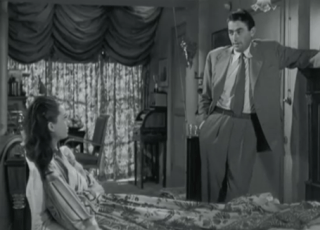
Gregory Peck on his part was always a strong leading man and an All-American type, perfect to play Joe Bradley. However, he also exuded gentlemanliness,s so despite the fact that the princess spent the night in his apartment we know nothing went on.  He had no ulterior motives bringing her to his apartment and even when he arranges to get an article out of her we know that is not who he is.
The film itself consists of wonderfully connected vignettes incorporating the Roman culture and landscape. Princess Ann leaves behind the hospitality of Joe in order to explore a bit before she goes back to her real life. In order to get that major scoop, he tails her and finally invites himself to tag along, so beginning the real fun. Princess Ann gets her beautiful locks cut by a friendly barber and buys some gelato from a street vendor.
 
Soon she takes her first puff of a cigarette, takes in the glory of the Coliseum, rides a Vespa through the hectic streets of Rome, and winds up in police headquarters with some explaining to do.They finish up their afternoon on a more thoughtful note at a wall of wishes originating during World War II.
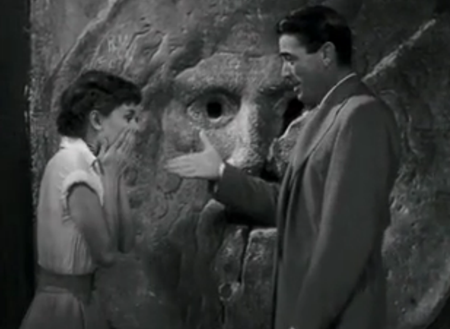
 
One of the best moments occurs at the mouth of truth, a great stone statue, which you are supposed to stick your hand in before it eats it up. In a moment of sheer fear Princess Ann or Audrey Hepburn, I’m not quite sure who looks on in horror as a screaming Bradley removes his arm and his hand is gone. Up comes the hand from the coat sleeves and the jokes on her. It has absolutely no bearing on the plot but it makes us love Peck and Hepburn even more.
 

To finish off the evening the two companions and Irving (Eddie Albert) cause a ruckus at a dance aboard a barge before swimming away to safety. There Ann finds love and a soaking wet kiss to go with it. But it is at that moment when the laughs stop and the romance begins that everything becomes all too clear. This wonderful day cannot last forever. There is a moment, after one final embrace, when they have to say goodbye for good.

This is not one of those “love at first sight” stories, but it is a different sort of fairy tale where two individuals share an enchanting day together and fall in love. Every Cinderella story must end and so does this one (Anna: At midnight I’ll turn into a pumpkin and drive away in my glass slipper). They must eventually come back down to reality with Princess Ann fulfilling his duties and Joe moving on with his career.
 
Joe’s major newsflash is not a thing anymore. The whole day means too much to him and being the buddy he is, good ol’ Irving understands that. Speaking of Irving, he deserves some discussion. Eddie Albert’s character is spilled on, stepped on, knocked over, tripped, and through it all remains the perfect buddy for Gregory Peck.  Even his little car is a riot, not to mention his inconspicuous tiny cigarette camera and his sly efforts at photography in every type of circumstance. Irving shares a great deal of double talk with Joe which somehow gets past the unsuspecting princess. However, by the end of the film, the princess is also a cohort in their memorable adventure with commemorative photos included! 
 
When Joe Bradley walks out of the grand palace he leaves content knowing that he shared something special. No one else needs to know (aside from Irving) about the fairy tale they shared and that is the beauty of it all. It is just their little secret, their Roman Holiday
 
5/5 Stars

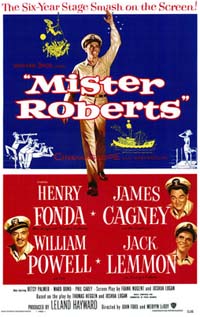
Mister Roberts (1955)

Starring an all star cast including Henry Fonda, James Cagney, William Powell, and Jack Lemmon, this comedy-drama chronicles the happenings on an unimportant boat during World War II. Mr. Roberts (Fonda) is one of the officers on The Reluctant and he is good to his men but constantly at odds with the difficult captain (Cagney). The ship doctor (Powell) is a kind and sagely old fellow while Ensign Pulver (Lemmon) is spineless, lazy, and still somewhat likable. due to an agreement with the captain, Roberts loses the respect of his men. However, when they realize what he has done for them, they honor him and help him get transferred so he can see some action. Pulver who is happy for Roberts, had tried to impress him earlier. After some bad news Pulver finally does something and it is fearless. I enjoyed this film because of the cast and its good combination of drama and comedy.

4/5 Stars

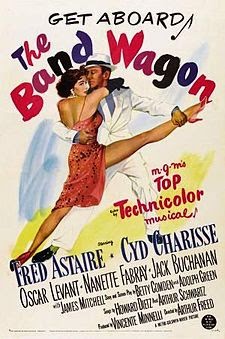
The Band Wagon (1953)

4c8bf-the_band_wagon_posterGoing into this film I must admit that despite hearing good things, I had zero expectations. I must say I was pleasantly surprised by this Minnelli musical because it was a deft and often beautiful production. Channeling the same vein as Singin’ in the Rain and The Red Shoes, this film is a spectacle in its own right. You have headliners Fred Astaire and Cyd Charisse matched nicely. Oscar Levant and Nanette Fabray act as wonderful comic relief as the wedded playwrights, who also do some song and dance. Finally, there is Jack Buchanan, as the stereotypical theater maestro Jeffrey Cordova.

It all begins with Tony Hunter (Astaire) a washed up has-been who is headed to New York for some relaxation. There is little fanfare during his arrival except coming from his friends the Martons, who have a new production for him to star in. They get the famed Cordova on board and next comes an up and coming choreographer and his girlfriend, who is none other than the young starlet Gabrielle Gerard (Charisse)

Following an initial misunderstanding, the leads finally clear up their differences and push forward to make The Band Wagon the smash hit it is destined to be. However, Cordova has turned it into a modern-day Faust and when opening night comes the after party is more like a wake.

All the players seem strangely nonchalant and then the idea hits! Make The Band Wagon over again and take it on the road. Everyone in the cast from the bottom up is excited for the second chance with Hunter at the helm. All that is except choreographer Paul Byrd.

Despite Paul’s departure, Gaby is still enthusiastic and they turn the Band Wagon into the production that the Martons had envisioned from the beginning. Tony is a success once again, and he receives a round of rousing cheers from his new family. Gaby speaks for all of them (and herself) when she says they love him and believe that the show will go forever.

I immensely enjoyed many of the numbers including: “Shine Your Shoes,” with the camera following Astaire as he frolics around at an arcade with a shoeshine man. The extras, the exquisite set, and Astaire himself all culminate in an often comical and always upbeat number that is great fun to watch. Then, of course, there is the ever memorable “That’s Entertainment,” which even spawned a series of musical documentaries, and for good reason. The words and melody are quite a catchy ode to the stage. Perhaps the most beautiful sequence in the film involves Astaire and Charisse in “Dancing in the Dark” where they positively glide through Central Park together in perfect cadence. They move not as individuals but as a poetic unit in motion. It is fitting that it was their first dance together in the film.

For never seeing Cyd Charisse in another film (except briefly in Singin’ in the Rain), I must say that I really did enjoy her performance opposite the always likable Fred Astaire. Furthermore, I am in complete agreement with her character, “I don’t think a dancer should smoke,” it’s bad for the lungs.

The cameo of Ava Garner was an odd surprise (especially due to her resemblance to Charisse). Furthermore, I never thought it could exist, but this film proved me wrong. There is such a thing as a film-noir musical! That’s The Band Wagon for you folks! That’s Entertainment!

4.5/5 Stars


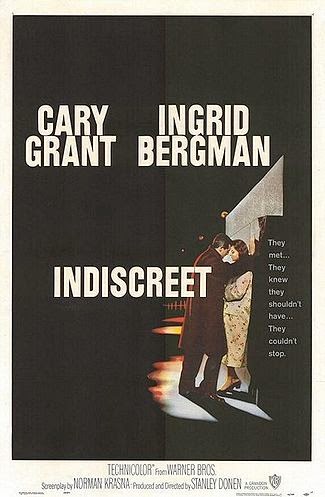
Indiscreet (1958)

020ac-indiscreetThis is a solid romantic comedy which pairs the legendary Cary Grant and Ingrid Bergman one last time. Bergman is a well-known actress who has success, but has never experienced true love. Then she meets Philip Adams, a man who literally walks up to her door since he is a friend of her brother-in-law. They become acquainted and they turn into fast friends. Bergman finally feels she has found the one and their love grows. However, the only problem is that he is married and estranged from his wife. Little does she know what is really going on and yet when she does it throws their whole relationship into jeopardy.  She has one final plan to get back at Grant and it really backfires, but in the end the two lovers get back together.

In this film it was nice to see two more middle aged stars paired. I enjoy Cary Grant with Audrey Hepburn or Grace Kelly, but I think Ingrid Bergman is more his contemporary. Some of the best sequences had to be during the ball. Here Grant shows he still has the physical comedy ability because at this time he had fell almost completely into the debonair gentleman persona. This is not a great romantic comedy but still a respectable piece from Stanley Donen.

3.5/5 Stars

Review: Harvey (1950)

Why am I so infatuated by Harvey you ask? Let me clarify that. I’m not talking about the title rabbit. Why am I so enamored by this fantastical film from 1950? It all stems from Jimmy Stewart as Elwood P. Dowd, which was undoubtedly one of the most unique and remarkable performances in his storied film career.

Elwood is often quotable (Here, let me give you one of my cards, What did you have in mind, etc.). However, I think his innocence and perpetually pleasant demeanor is what makes him so wonderful to moviegoers, like myself, and to many of the characters in this story. He has his oddities, to be sure, but a little common courtesy and thoughtfulness is something that is often lacking in this world. Elwood is the complete epitome of that kind of individual. He always has an open invitation, he constantly insists that others enter before him, he has a penchant for giving flowers, he is the king of compliments, and he can put a positive spin on most anything (I Plan to leave. You want me to stay. Well, an element of conflict in any discussion’s a very good thing. It means everybody is taking part and nobody is left out).
. 
Sure, his friend is a giant invisible rabbit named Harvey. So what? By the end of this film, I might be a little bit of a lunatic too, but after all, that’s being human for you. What makes us who we are, are those quirks that populate our persons. For Elwood it’s his pal Harvey, for others, it might be something more mundane than a giant invisible pal. 
However, I will undoubtedly keep returning to Harvey, because it is a thoroughly enjoyable film that gives us a little lesson in life, and it certainly does not hurt that it is quite funny, in a whimsical sort of way. 

As I noted already Stewart is wonderful, playing Mr. Dowd straight, but he is surrounded by an eclectic group including Josephine Hull, Cecil Kellaway, and Jesse White. They are necessary foils for his character to bump up against. Although Charles Drake and Peggy Dow are somewhat flat at times, both of them fit the sentimentality of the film just right. It’s a pity Dow was not in more films because she seems like such a lovely person on the screen. But why focus on the negative, because after all Elwood P. Dowd never would.

4/5 Stars

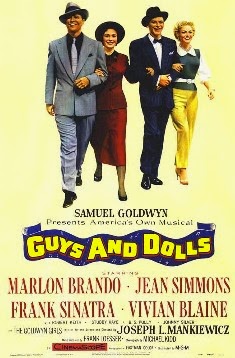
Guys and Dolls (1955)

8d99c-guys_and_dolls_movieposterHeadlining this film are Marlon Brando and Frank Sinatra as Sky Masterson and Nathan Detroit respectively. Both men are high stakes gamblers and things have heated up in town because the police are trying to crack down on a floating crap game. That’s not the only thing that turns hot though. Masterson is bet by Detroit that he cannot get a sidewalk missionary (Jean Simmons) to fly with him for an evening in Cuba. Detroit has his own problems brought on by his reluctance to marry the girl he has been going with for 14 years. All along the way money constantly switches hands and “markers” are doled out as IOUs.

Both Masterson and Detroit ultimately show their noble sides and as you would expect the guys get the dolls.

This musical certainly had its moments and it looked lavishly beautiful in color like many of the contemporary musicals. I will say that there were some great personalities here including Vivian Blaine. However, Brando seemed painfully out of his element here and I’m pretty sure Sinatra had better roles. I wonder what this film would have looked with a different cast? We can only speculate now.

Also, the dialogue almost completely lacking in contradictions was quite noticeable, but I’m not sure if that was a bad thing or not. Overall I think this one would be better for the stage than on film. But don’t get me wrong a lot of the numbers like Sit Down You’re Rocking the Boat were catchy. I will say I was surprised that Brando ended up singing Luck Be a Lady and not Sinatra. I had previously only heard the Sinatra version.

3.5/5 Stars

The Nun’s Story (1959)

b2aa8-nun_storyFrom director Fred Zinnemann and starring Audrey Hepburn, here comes a very unique film indeed. Hepburn is Gaby also known as Sister Luke, who makes it her life mission to become a Nun. She leaves behind her loving father (Dean Jagger), young love, and siblings to lead a life of solitude and sacrifice.

She learns and is disciplined at the convent, finding out what it means to “die to self.” However, it is by no means easy, because as with any human being pride and other struggles impede her progress.

Quickly she shows her skill as a nurse, and yet she is challenged to act with more humility. Sister Luke winds up not in her desired location of the Congo, but in Europe to continue to grow spiritually.

Finally, she is rewarded for her patience and goes to the Congo only to fall into her element. There she is beloved by the natives and nuns alike, while also gaining the respect of the local practicing doctor (Peter Finch) who is not a believer.

He however rightly concludes that Sister Luke is not your typical nun, because she has too much self-determination and individuality. As a good sister she tries to block out his words, but after she is sent back to the convent she must face this reality head on. World War II has erupted and the Sisters are called not to intercede on either side, but after personal tragedy Sister Luke realizes she must give up the life of the nun.

After so much loving service to her fellow man while wearing the robes, she is forced to shed them on her own accord. It is a solemn moment as Gaby once again removes her ring of commitment and walks off into the unknown world plagued by war. It is an unsatisfying conclusion but a moving ending nonetheless.

Zinnemann is often interested in the inner struggles of his protagonists and that is on display again in this film. Furthermore, his on location shooting in the Congo adds a sense of authenticity to the story. I am convinced that no actress other than Audrey Hepburn could possibly have done justice to this role, or at least no one else could have played it so wonderfully. She exudes such a sweetness and innocence it is difficult to see how anyone could every get annoyed with her. Her Sister Luke is seemingly spot on, and the lengthy film would have certainly faltered without her.

4/5 Stars

Review: Singin’ in the Rain (1952)

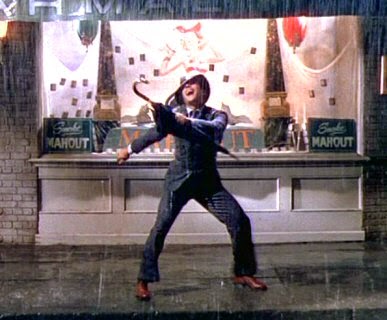
f7d3a-singin_rain I always seem to get goosebumps during Gene Kelly’s “Singin’ in the Rain” number, because each time I see and hear it, there is still a new magic to it every time. You see when I was young, before I knew all the classics, first and foremost, I knew this gem of a film. It is such a wonderful buildup to that moment with such personal favorites as “Make em’ Laugh” and “Moses Supposes.” Then you have the always popular “Good Morning” with not only Kelly but Donald O’Connor and Debbie Reynolds performing. Great stuff! There’s tireless choreography that goes into many of those sequences but it comes off so effortlessly and it brings us into the moment. There those wonderful, brief instances when you lose yourself in the music, the magic, and so on.

As the story goes, the three friends save the failing “Dueling Cavalier” by losing the simple “talkie” gimmick and making it a musical by dubbing the squeaky-voiced Lena Lamont (Jean Hagen). Cathy (Reynolds) no longer is a bit player, and she gains the acknowledgment that she deserves. Then Don Lockwood (Kelly) gets the girl who burst out of a cake. Cosmo Brown (O’Connor) is along for the ride staying with Don through thick and through thin, even calling him a cab when necessary. He’s a true friend in a million.

Although Kelly had a career with other high points (arguably never as high as this one), I am always slightly saddened that O’Connor and Reynolds never reached another apex like this in their subsequent careers. But they were both so great here, we must simply cherish this film for what it is.

Even to this day, the film holds up, and that is a tribute to the writing of Betty Comden and Adolph Green highlighting the infant Hollywood and the advent of talkies. In the same breath, it’s both a satire of the movie star culture and still a love letter to that same cottage industry. The only film with a similar dissection of Hollywood’s Golden Age is another 50s classic in Sunset Boulevard. The big difference is that Wilder’s film is chock full of drama and darkness. Singin’ in the Rain will always and forever be a light, fun musical with a lot of laughs.  It is constantly quotable whether it is “dignity, always dignity” or “I CAN’T stand it!”

Jean Hagen is always the butt of everyone’s jokes, but she is indeed very funny with the most annoying voice in the history of cinema (She can’t act, she can’t sing, she can’t dance. Triple threat). You also have other fine performers like Millard Mitchell as studio head R.F., and then appearances by Cyd Charisse and Rita Moreno who made a name for themselves as dancers in the ensuing years. And is it just me or does Donald O’Connor remind others of Danny Kaye? He not only cracks the jokes, but he is a wonderful all-around performer. Although O’Connor was undoubtedly a better dancer.

All in all, this is a timeless classic and it will undoubtedly keep that title for as long as people watch movies. Now I hope it starts pouring buckets of rain so I can go outside and stomp around in the puddles. I will let you know if I come down with pneumonia. But until that happens I’ll enjoy every minute of it. I entreat you to do the same.

5/5 Stars

Rio Grande (1950)

f5e4d-riograndeThe last installment of John Ford’s Calvary Trilogy. Not the best of him or Wayne for that matter, but it is still a worthwhile film. First, there is the tension in the paring between Wayne and Maureen O’Harra as they quarrel about what to do about their young son who is a member of Wayne’s unit. There is a supporting cast including the likes of Victor McLaglen, Ben Johnson, Harey Carey Jr., and Calude Jarman Jr.

While watching it I was just thinking how Ford has so many great looking films in both color and black and white. This one uses the latter as well as a Monument Valley backdrop to perfection. It just looks so beautiful in every shot and Maureen O’Hara does not hurt the eyes either for that matter.

Soon after Ford would pair again with a few of his stars to make another little film. Anyone for The Quiet Man?

3.5/5 Stars

The Men (1950)

2c6ea-the_menI was really drawn into this film and I appreciated Zinnemann’s realistic style in capturing Marlon Brando’s powerful screen debut. I would have rated this film higher because the topic was interesting, the performances were good, the supporting cast was respectable, and so on. The only thing is although Brando is a good actor and I really love Teresa Wright, they just seem wrong opposite each other. Wright was made for a Best Years of Our Lives and Brando for Streetcar or On the Waterfront. I will say I was surprised to see a young Richard Erdman, who is known to modern audiences as Leonard in Community.

3.5/5 Stars