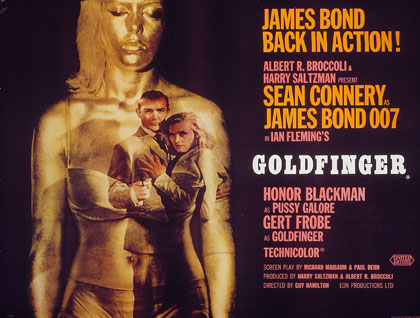
Goldfinger (1964)

fabbc-goldfinger_-_uk_cinema_posterStarring Sean Connery as Ian Fleming’s character James Bond, Agent 007, this installment has him facing off with Goldfinger. After an entertaining opening sequence, Bond is given the assignment of keeping an eye on Auric Goldfinger, a powerful man with a insatiable desire for gold. Along the way he crosses paths with beautiful women, Goldfinger’s deadly chauffeur Odd Job, the highly trained pilot Pussy Galore, and of course the criminal mastermind himself. Bond and Goldfinger battle back and forth, first with wits and then everything becomes much more sinister. Bond is taken captive as Goldfinger tries to implement his dastardly plan revolving around a vault full of gold. Needless to say, in the end 007 is victorious and he gets the girl. With Bond’s modified Ashton Martin, great action, good characters, and a memorable theme, this film is “shocking, positively shocking.”


4.5/5 Stars

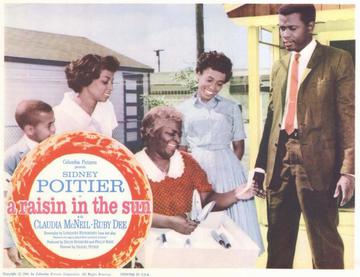
A Raisin in the Sun (1961)

d69d4-raisin_in_the_sun_1961_poster_horizontal_bStarring Sidney Poitier and adapted from a stage play, the film chronicles the lives of an African American family residing in Chicago. The whole family including the matriarch, her unsatisfied son, his wife, his son, and his sister wait excitedly for an insurance check for $10,000. The mother receives the money and resolves to use it in order to buy a nice home for her family in a white community. She then gives the rest to her son who has big plans for it. However, he loses it all leaving the family bitter and worried. In the end Walter does show his integrity and despite the bad situation, the family remains close. A great deal of this film is about the conflict of ideas and interests of the different individuals. It is also memorable since the cast is almost all African American. Poitier is good but it seems the mother steals the show.
 
4/5 Stars
 

Something’s Got to Give (1962)

e3ac1-somethings-got-to-giveWell, this is a first for me, if my memory serves me right. I have yet to do a write up for a film without having a rating to go with it. Something’s Got to Give eventually and now it has.

I honestly was surprised that this “film” even existed. I knew about Marilyn Monroe’s last film project which ultimately was unfinished thanks to her tragic death. I assumed the project was ditched and never thought about again. I certainly did not give it a second thought then. Then, quite by accident I came upon it in all its 37 minutes of glory. Apparently others had given it a second glance and we have them to thank for this unfinished addition to Montroe’s filmography.

It looks like production quality with a few missing parts and quite the cliffhanger ending. We do not even quite know the extent of the cliff yet.
However, it was an interesting look at Marilyn Monroe in her final days. You also had a fun cast of handpicked players including Dean Martin, Cyd Charisse, Phil Silvers and Wally Cox. Not to mention one of Hollywood’s prominent directors in George Cukor. It seems likes all the makings for a light ’60s romantic comedy.

This certainly was not going to be a masterpiece (It was actually a remake of My Favorite Wife (1940) and was given a face lift for Move Over Darling). That’s okay. It is a interesting piece of history in its own way.

Rating: N/A

Once Upon a Time in the West (1968)

27ccb-once_upon_a_time_in_the_westStarring Charles Bronson, Henry Fonda, Claudia Cardinale, and Jason Robards with director Sergio Leone, this is another memorable Italian western. The film follows a recently widowed beauty (Cardinale), the villainous killer who is after her (Fonda), a anti-hero bandit (Robards), and of course the man with a harmonica who is looking for revenge (Bronson). The gunman Frank commits murders, turns on his employer the railroad tycoon, and forces the widow to auction off her land. However, “Harmonica” comes to her aid and then he is confronted by Frank several times since he wants to know the man’s purpose. After a flashback we know what “Harmonica” wants and another gunfight ensues. The ending is bittersweet but the town’s future looks bright thanks to the railroad and the radiant widow. The long opening sequence sets the tone nicely for this visually beautiful film. It moves at its own pace and it has a good score and great characters including an evil Henry Fonda!

5/5 Stars

Wait Until Dark (1967) – Updated

a752e-waituntildark1This is very much a contrived plot line but it certainly is an interesting set piece surrounding a defenseless blind woman targeted because of a heroin-filled doll which fell into her husband’s possession. It sounds like a pretty ludicrous set up but Audrey Hepburn is so believable and at times pitiful that she makes the film works thanks to her performance. Alan Arkin plays an over the top terror of a man bent on getting the doll back and he procures the help of two men to play parts in his elaborate charade. He is the near perfect opposition to torture the angelic Hepburn.

Through the entire story Susy’s blindness is being manipulated and she is constantly in a vulnerable state that is extremely uncomfortable for the audience. She is fed lies and entrusts men who she should not, but she cannot know any better. Thus, we soon forget how ridiculous this whole affair is and get caught up instead in our own fears and anxieties for Susy. From that point on we are hooked and there is no turning back until nighttime comes. Susy is cut off from the world with darkness approaching and that’s when the real nail-biting begins. But that’s for you to see for yourself. I would not deprive you of that pleasure.

The cast is rounded out by Richard Crenna, Emfram Zimbalist Jr. and Jack Weston who all are decent but their roles are relatively cookie cutter. The little girl Gloria is a spunky character but  the real attraction as I said before is Hepburn. The score by Henry Mancini gives the film a thrilling feel rather like a Columbo special. If there ever was a thriller this is certainly one of them! Just Wait Until Dark, you’ll see.

4/5 Stars

Review: Butch Cassidy and the Sundance Kid (1969)


Not that it matters, but most of it is true…

The film opens with some old sepia-toned footage of a notorious gang from the turn-of-the-century and that is when we meet our two anti-heroes Butch Cassidy (Paul Newman) and the Sundance Kid (Robert Redford). Butch is the brains behind the operation (I got vision and the rest of the world wears bifocals) and Sundance is the brawn, with the most accurate gun in the West.

They make a living robbing banks and trains, but due to their lifestyle, they seldom come out ahead. Life becomes more difficult with tumult within the gang, a crackdown by the authorities and a price tag on the heads of Butch and Sundance.
Soon it becomes evident that their life of crime will never be the same with a professional tracker on their tails and a posse formed to see them hang. They are chased through hills, rock, water, and the like before finally getting away in one final desperate attempt at escape.
With one last brilliant piece of inspiration, Butch decides they should head for Bolivia to lay low, and soon enough they pack their bags and bring along The Kid’s girl (Katharine Ross) to the promised land of South America. They get more than they bargained for thanks to the language barrier and a lack of decent plunder. However, even abroad, their legend grows, winning them the new moniker “Banditos Yanquis.” The pair takes a stint on the right side of the law for once, but it somehow seems bleaker than their early days as bandits. It is evident that the hourglass is running out on them. And so it does, but not without one final glorious battle to cement the aura around two legends of the West.
I will not go so far as to call Butch Cassidy and the Sundance Kid a masterpiece because I have read too many reviews to know that there has been a great deal of division over the film. I can only speak from my own experience when I say that I quickly grew to love this story. This appreciation stems from the spot on chemistry of Paul Newman and Robert Redford. Their outlaws are not your typical thugs but lovable buffoons you cannot help but cheer for through all their screw-ups and pratfalls. Paul Newman has his ever-present mischievous smile plastered on his face, and Redford plays the cool and collected Kid to the tee. Perfect casting for the roles and to think it might have been Steve McQueen and Warren Beatty.
 
They got together again in The Sting, which was another good film, although I will always be partial to their first collaboration. William Goldman’s script can only be described as a fun romp that accentuates the comradery of Butch and Sundance. The musical score by Burt Bacharach with the inclusion of “Raindrops Keep Falling On My Head” is often at complete odds with what we have come to expect with classic westerns, but that suits the film just fine.
 
You see this is not your typical western by any means. It’s not supposed to be. Butch and Sundance are working in the twilight of the West. The horse is soon to be replaced with the future: the bicycles. Bank vaults are becoming more complex, fervor for the Spanish-American War is at its peak, and lawlessness is no longer going to be tolerated. Whether people realize it or not, this film is one in a final wave of classic westerns that finally petered out in the 70s. Now the western genre, just like the West before it, is dead. A dying breed of genre much like film-noir or even musicals.
 
That’s why Butch Cassidy works for me. People have criticized the constant change in tones, but this story never claims to be the absolute truth, and it would not be the same film if it did. This story of outlaws is not a history lesson but a legend about two infamous bank robbers. There are moments where we love these antiheroes and moments where we do not know quite what to think of them. They become disillusioned and beaten down by the changing times. Their ambush in Bolivia has only one apparent conclusion. It ended in a bloody and violent death. However, we do not have to see that for the sake of the legend of Butch Cassidy and the Sundance Kid. In one mythical moment, they regained their previous status. They went out as they came in, and they will forever be remembered as Butch and Sundance of the Hole in the Wall Gang. They have since been replaced by superheroes on the silver screen, but in their day and age, they were the original supermen — tarnished as they were.
What is amazing is that the film has not only resonated with audiences for generations, but with the leads themselves who really identified with their roles. That is perhaps the greatest compliment to its characters. 

5/5 Stars 
A Man For All Seasons (1966)

a4d49-a_man_for_all_seasonsSir Thomas More had the misfortune of getting in the way of perhaps one of the most notorious kings in history, and it proved costly. It is the early 1500s in England, and the Reformation has shaken the world but Henry VIII (Robert Shaw) has his own plans for the church in his country. He is bent on getting his marriage annulled by the pop,e because young Anne Boleyn will be much more likely to give a healthy heir to the throne.

A Man For All Seasons focuses on the position of More who at the time was Lord Chancellor of England. First, in talking with Cardinal Wolsey, More resolves not to sign the letter to the pope on the king’s behalf, because it goes against his conscience. Later, in his dealings with Thomas Cromwell, More resigns rather than to sign an oath making Henry VIII the supreme leader of the church in England.

Except there is more to it than that. More certainly was not a dissident or a rebellious political figure. Far from it. At least in the film, he is portrayed by Paul Scofield as a constantly even-keeled and gracious man in all circumstances. When a young man named Rich (John Hurt) sold More out for a high title, in a Christ-like response More has only pity for the fellow. Selling his soul for the world is worse enough, but Rich did it for Wales.

Not even the pleading of his newly-wedded daughter (Susannah York), or his strong-willed wife (Wendy Hiller) can change More’s conviction as he wastes away in the Tower of London. Sir Thomas went calmly to his death confident that his faith in his Lord would give him eternal peace. He died there for a seemingly trivial reason at the hands of men who used to be his friends. But he died with his conscience intact.

As I acknowledged, Paul Scofield is such a serene force during the storm of this film. The portly Orson Welles and Leo McKern seem to fit their roles well, and Robert Shaw has enough bluster to pull off Henry VIII. A young John Hurt turns in a fine performance as the Judas of the film and Nigel Davenport is commendable as More’s exasperated friend the Duke.

Adapted from a stage play, here is another highly acclaimed film from director Fred Zinnemann. Perhaps it is the period drama, but this film strikes me as very English and it did very well for itself. I suppose because it’s a tale that is universal and audiences love to identify with men such as Sir Thomas More. Zinnemann was always superb at capturing the inner struggles that humanity is often forced to confront, and he did it once again here.

4/5 Stars

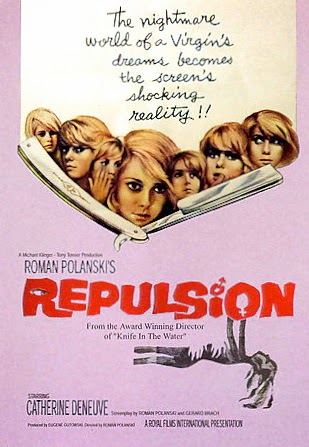
Repulsion (1965)

f483d-repulsion
Directed by Roman Polanski and starring Catherine Deneuve, this British Psychological thriller is in the same vain as Psycho. Carol is a manicurist who is often absent-minded at work and she returns home to an apartment that she shares with her older sister. She passively resists the advances of an infatuated young man and at home she must live through her sister and a boyfriend in the next room. 

*May Contain Spoilers
Then, they leave and an attached Carol cannot bear her sister to leave her alone. The next days and weeks she sinks into a unstable state and slowly loses her sanity while losing track of reality at the same time. She is sent home from work, becomes even more preoccupied, and then begins hallucinating back in her home. When Colin comes to speak with her she is still unresponsive and she unexpectedly bludgeons him to death. Then, later on the annoyed landlord comes by for his money, and then makes advances on her, only to be killed by a frightened Carol. Helen and her boyfriend return to find the apartment in disarray and Carol out of sorts and concerned neighbors come to spectate. The camera closes in on a family photo and a young Carol’s perturbing face. 

This low budget documentary grade black and white film still packs a powerful punch and the best word to describe it is probably disconcerting. Unfortunately, I had never heard of the cinematographer Gilbert Taylor, but he had several wonderful films in his catalog including Dr. Strangelove, A Hard Day’s Night, Star Wars, and of course Repulsion.
 
4/5 Stars

The Lion in Winter (1968)

ae367-lion_in_winter1The year is 1183 and the castle of King Henry II is a dark and dank place during the winter months. You would not think so by the opening moments where an energetic King (Peter O’Toole) duels his young boy John (Nigel Terry). His mistress takes in the scene from afar. On first glance, this whole scenario seems pleasant enough, but that would be far from the truth.

Young John is the King’s favorite, but his aged yet cunning wife Eleanor (Katharine Hepburn) has a special affection for the eldest brother Richard (Anthony Hopkins), who she desires to take the throne. Stuck between the two favorites is middle child Geoffrey (John Castle), who has plans of his own. Bring the French King Phillip II (Timothy Dalton) into the equation and the situation becomes even messier than before. What follows is an elaborate web of lies, deceptions, side deals, false motives, eavesdropping, and of course backstabbing. Henry and Eleanor constantly battle back and forth as their sons bicker among themselves. One big unhappy family to be sure.
Henry tries to marry off his mistress (Jane Merrow) to Richard to satisfy King Phillip, but his son will not have it. Next, Henry tries to compromise with Phillip only to learn that his sons were planning to gang up against him. Now he cannot trust any of them, and they find themselves in the dungeon. He makes a new plan to get remarried to his mistress so that he might have another son to be king, but his other sons will be a threat so long as they live. His dilemma is evident, but he cannot bear to kill them. Things seem to go back to the way they always were with Eleanor going back behind bars and Henry playfully barking at her. All’s well that ends well perhaps.

Peter O’Toole and Katharine Hepburn were certainly two titans in this film. O’Toole, whether he is roaring or confiding in his former love, does everything with purpose and bravado. He does show his soft, vulnerable underbelly at times, though, as a man advanced in years. Hepburn on her part is absolutely acerbic, oftentimes governing the tone of the film with her barbs and snide comments. And yet with her, there is also at least a few instances of true humanity. She and Henry seem to be made for each other and their boys are seemingly just as loathsome and underhanded.

4/5 Stars


Walk, Don’t Run (1966)

a64da-walk_donThis was the last screen performance of legendary actor Cary Grant and for once he is not the one getting the girl. This time he is the matchmaker in this adaption of the earlier classic The More the Merrier. Grant’s character finds himself in Tokyo during the 1964 Olympics and the only room he can get is from a young English girl. This causes some difficulty but they make it work. It gets even more complicated after Grant meets a young American architect who is competing in a mysterious event in the Games. Sir William Rutland secretly puts the two young people together. It seems doomed from the beginning but through a wacky conclusion somehow it all works out in the end. Not a great film, but a decent swan song for Grant and it is certainly fun to have the film set in Tokyo.

3.5/5 Stars