Say Anything… (1989)

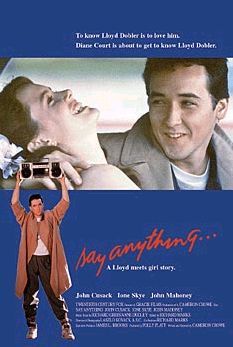
Say_Anything“How’d you get Diane Court to go out with you?”
“I called her up.”
“But how come it worked? I mean, like, what are you?”
“I’m Lloyd Dobler.”

She’s a brain, he’s not, sounds simple right? For such a basic premise Say Anything… has surprising depth. A lot of this is a credit to the performances of John Cusack and Ione Skye, along with the script by Cameron Crowe. The story is this: high school is over and the unknown future is what looms ahead. For Diane Court that means college, a fellowship in England, and the like. For Lloyd Dobler, we do not know what that means and he doesn’t either. For the moment he still has time, and he wants to use that moment to pursue Diane, the seemingly unreachable girl.

First of all, you have to understand how insane that goal is for a guy like Lloyd. He is a lover of kickboxing, The Clash, and he is an average student who lives with his sister and little nephew. Diane is the class valedictorian, doted over by her loving father, and she is a surprisingly sweet girl who dresses well and is a cut above. Not in a million years is he supposed to get her, but I said that already.

Anyways, Lloyd is a straightforward and to the point kind of guy, so he simply calls her house to ask her out. She finally gives into to his requests, and they go to a party to celebrate the end of their high school career. For him, it’s their first date, and she sees it just as a very nice evening. Diane leaves with a new found appreciation for Lloyd because he’s not like other guys. He periodically checks on her during the party to make sure she is alright and points out broken glass on the pavement for her to avoid. He is a gentleman in a trench coat, a strangely vulnerable figure.

Lloyd’s only future plans are to hang out with Diane as much as possible and as far as career plans he is not really sure. When everyone else, even his high school counselor, worry about the future, he always seems strangely, even naively, content.

Diane and Lloyd are slowly growing more and more connected and intimate. However, when Mr. Court goes under criminal investigation things begin to change. At first, everything is the same, with Lloyd teaching Diane how to drive stick shift and Diane growing more and more comfortable with him. And yet, with the familial situation at hand, she feels it necessary to break it off with him, leaving him a pen to write her with. Lloyd is especially wounded, confessing to his sister over the phone, “I gave her my heart and she gave me a pen.”

Soon enough Mr. Court’s account is cut off and in some ways, I felt strangely sorry for the man, but more so for Diane. One day Lloyd comes by with his boombox in tow, standing outside her window in one last monumental act of devotion. Nothing happens right then. Diane is still struggling with her father who it turns out has been swindling his elderly clients, but all for her future. She feels lied to and the only person she could run to is Lloyd, so she does and he takes her back.

Later on, he sees her father in prison and shares that his plan is to go to England with her, despite all the objections that come with it. The two jet-setters are together again proving all the doubters wrong. They wait for the ding of the smoking sign signaling the beginning of the rest of their lives.

This is perhaps one of the greatest high school romances ever, because it is far from the typical superficiality. Lloyd Dobler is played so wonderfully by John Cusack. You cannot help love this lanky guy who is fearlessly straightforward and willing to take a chance. Ione Skye is a bit overshadowed, but she is still convincingly sweet as the victim who finds the perfect guy. John Mahoney’s character is a despicable man and yet it is a credit to him that he actually makes us feel a bit of pity, for an instant. Obviously, the boombox scene is iconic, but I think it is the little things about Lloyd that make this film great. Every person could probably take a page out of his playbook by being honest, vulnerable, and most definitely loyal.

4.5/5 Stars

Indiana Jones and The Temple of Doom (1984)

Indiana_Jones_and_the_Temple_of_Doom_Directed by Steven Spielberg and starring Harrison Ford, this is the second installment in the popular series. The film opens in China where Indy is trying to acquire a rare jewel but he runs into problems and must struggle for his life. He escapes with the help of his little friend Short Round and an annoyed night club singer tags along for the ride.

They finally find their way to a remote village which is fearful of a great evil. The trio is then welcomed at a grand palace. After an initial attempt on Indy’s life, they find a secret passage that leads to a temple where the Thuggee cult survives. They witness horrible tings and Indy attempts to recover the stone from the village. However, they are captured and Indy is turned into a mindless worshiper, while Short Round is forced to work and Willie is prepared for sacrifice.
Thanks to Short Round’s escape he is able to recover Indy as they fight to save Willie and get out alive. A harrowing mine car chase ends in another perilous situation for Indiana and his friends. In the final showdown he is able to prevail and as always there is a happy ending.
This is certainly the weakest of the original trilogy in my mind and coincidentally also the darkest. This film did however help bring to pass the PG-13 rating. I am partial to Short Round and Indiana Jones is all we have come to expect.
3.5/5 Stars

Amadeus (1984)

bcd5e-amadeus1

A common film would content itself with developing a biopic on one of the greatest composers of all time reaching the heights of the musical field in the musical capital of the world in Vienna. A typical film might paint on a canvas paying homage to a legend who revolutionized music with his genius.

This story opens as the long-forgotten composer Antonio Salieri (F. Murray Abraham) attempts to kill himself. He gets laid up in a Psych ward where a man of the cloth visits him wishing to hear his story and so the old man obliges. It’s a story that makes light and lacks reverence thanks to its title character.

Salieri was a court composer of prestige and great admiration, but even he knew Mozart was the true master and the first day they met was forever ingrained in his mind. For being such a genius Wolfgang Amadeus Mozart (Tom Hulce) is a jerk, to put it bluntly. Spoiled, conceited, dirty-minded and armed with a cackling laugh, he is hardly the image of a musical mastermind. How could God bless this man with such talent? How could God taunt Salieri using such a man? He makes a mockery of art and yet he is the best there ever was. Salieri must have some kind of justice.

But all that lies under the surface. Mozart is brought on by his Majesty to develop a German libretto. Salieri’s tolerance for God is lost and he turns his back, beginning his passive attack. He shames Mozart’s wife (Elizabeth Beridge) and sends her off as he is looking to undermine his rival as discreetly as possible.

Mozart himself has little desire to take on pupils he deems a waste of time and instead busies himself with his most ambitious piece yet. His father comes to town and is not amused with his son’s conduct or his antics at a masquerade ball. He has none of the sensibilities of a man like Salieri, but what he does have are the talent and brilliance.

Always one to push the boundaries, Mozart’s latest piece is based on the Marriage of Figaro which was expressly forbidden by His Majesty. But due to his skill, Mozart is able to get by with bending the rules. Salieri acknowledges his genius. He knows brilliance when he sees it, but he becomes even more resolved to bring about the death of his nemesis.

After the death of his father, Mozart slowly spirals down into drunkenness and poverty. Salieri manipulates the situation even further to play on the man’s emotions and the desperate Mozart becomes mad composing a funeral requiem requested by a specter of a man. The mysterious figure is, of course, a moonlighting Salieri who no longer sees his actions as justice against Mozart but against God himself and he wants to win.

In a horrible condition, the bedridden Mozart constructs his last great piece with the help of an incredulous Salieri. But Constanze will have none of it and the manuscript remains unfinished because she distrusts Salieri. Just like that Wolfgang Amadeus Mozart suddenly passes away. He’s dead and Salieri can have no satisfaction, no piece of Mozart’s brilliance. God would not give him the satisfaction, resigning him to be the so-called patron saint of mediocrity. God supposedly got the last laugh.

This is a film that makes me want to revise the noted statement to “only the great die young” as the mediocre slowly fade into oblivion. Salieri faced a cruel demise of his own as Mozart instantly became solidified as a legend. That is the irony of life that is made clear no matter how accurate the facts are. Because in Amadeus, the facts are not the most important. Milos Forman gives us a spectacle that is as grand as Mozart’s greatest masterpieces. But this is perhaps, more importantly, a film about human nature. Salieri is a man so ingrained with internal desires.

He wants to play God. He wants all things to play out as he sees fit. His malevolence is focused on others. It is even focused on God. But, in reality, it reflects the pain of his own heart. Humanity has a desire for excellence to be fully actualized. That is a lofty goal and an impossible target. Because ultimately there will always be a hole left within us. It was so with Salieri

Mozart was one of the greatest and most well-known composers of a generation if not ever. He was not a good man (few are), and he met with death early. Salieri seemed moral and yet he himself was undermined by deep-seated avarice and covetousness. Despite still having life, the world was essentially dead to him. He thought God was laughing at him. Neither man won.

4.5/5 Stars

The Breakfast Club (1985)

54f1c-the_breakfast_clubHere is a seminal high school coming of age film that has its moments although it is not altogether brilliant. The story takes place on a Saturday when the local school is empty and five very different characters are all thrown together. For an entire afternoon, apart from your typical adventures through the halls of the high school campus, they sit in a room.

The players are as follows: A brain, an athlete, a social queen, a basket case, and a criminal. Initially they all are annoyed that they have Saturday school and there is tension between them. Over the course of the afternoon they soon open up and realize they all have similarities and despite their differences they can be friends.

There are other coming of age films that are probably better but it is certainly an interesting social commentary and a cult classic thanks in part to the song “Don’t You (Forget About Me).” Lets just face it, the 1980s just would not be the same without John Hughes (Ferris Bueller, 16 Candles, Trains, Plains & Automobiles). He certainly is not the foremost of directors, but he will not be forgotten any time soon.

3.5/5 Stars

Review: Airplane! (1980)

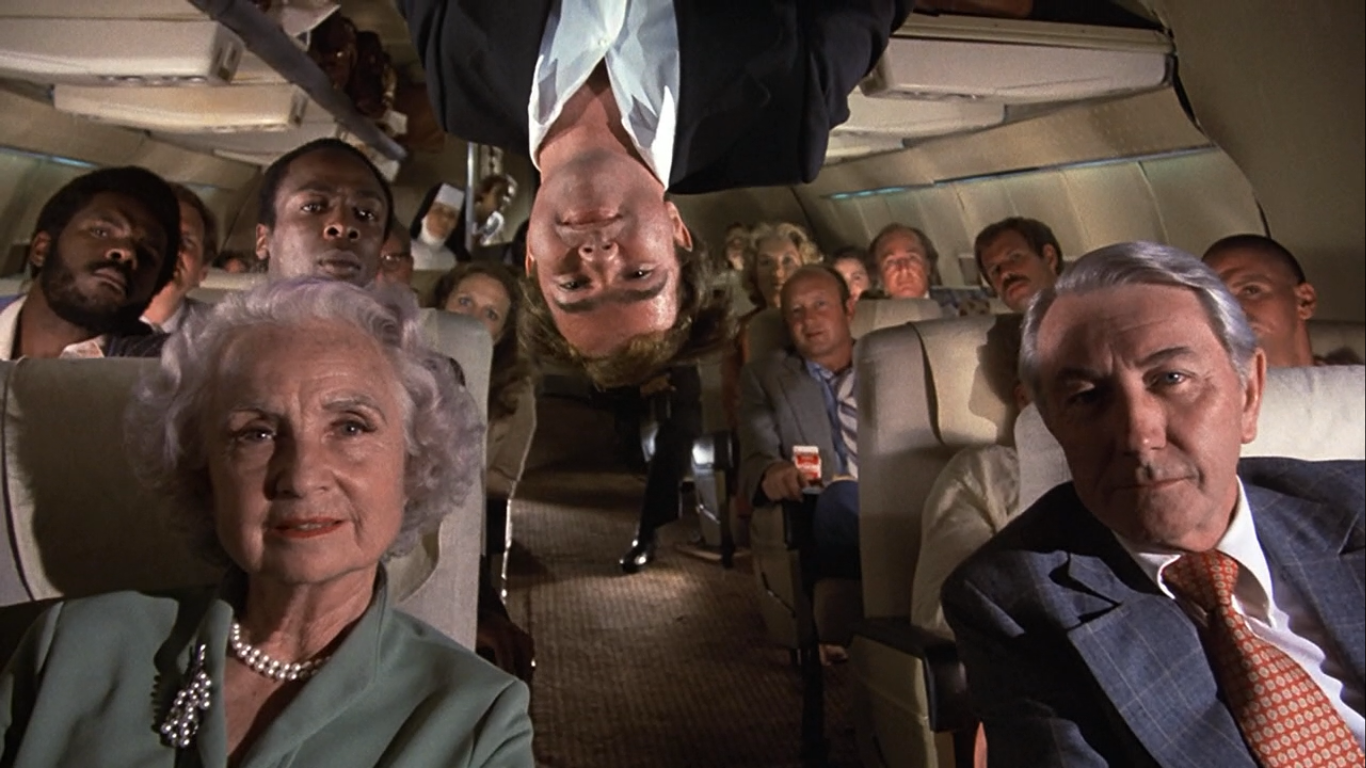
754a5-airplane2In the wake of Jaws came another film almost just as riveting in its intense thrills and human drama. Let’s hear it for Airplane! Okay, well it may be the farthest thing from a real melodrama, but that does not take away from the good ol’ fashioned fun of it all. It’s quirky. It’s goofy. And it has the prototypical ZAZ humor laden with sight gags and boatloads of puns with an accompanying score courtesy of everyone’s favorite comic composer Elmer Bernstein.

The faux drama stems from former war pilot Ted Striker (Robert Hays), who has an aversion to flying due to his devastating experiences and a drinking problem to boot. Now all he does is drive a taxi, and it has cost him his love, the airline stewardess Elaine (Julie Hagerty), who lost all faith in him because he lost confidence in himself. Things used to be so marvelous when they first met in the throes of romance and yet…

Who am I kidding? This film hardly has any plot, but instead, it’s one big excuse for often childish, sometimes innuendo-filled, off the wall antics. Seriously though, Airplane! rifts off a lot of things from gushy romances, to disaster films, and old Hollywood serials. But this plane is only a vehicle for gags. There’s a whole scene about a little girl who is deathly ill just so Captain Oveur (Peter Graves) can say over the telephone resolutely, “Give me ham on five hold the mayo.”

Then there’s co-pilot Kareem Abdul-Jabbar moonlighting as Roger Murdoch. He eventually breaks out of character following the nagging of a little boy named Joey (You try dragging Walton and Lanier down the court)! Why is he even in this film? We don’t know and it doesn’t matter because it’s hilarious.

There’s a kiss parodied straight out of From Here to Eternity, an appearance by the always loud-mouthed Ethel Merman, and even a jab at incumbent president Ronald Reagan. And of course who else would know how to speak jive with the two African-American passengers but June Cleaver or Barbara Billingsley? I’m not sure which one is funnier.

What stands out most about this film is all of its old vets playing this insanely wacky film straight. From Peter Graves to Leslie Nielsen on the plane, to Robert Stack and Lloyd Bridges down in the tower, their performances are priceless.

By the way, what ever happened to that guy in the taxi? If I’m not mistaken the meter’s still running.

4/5 Stars

“We have clearance, Clarence.”
“Roger, Roger. What’s our vector, Victor?”

Wings of Desire (1988)

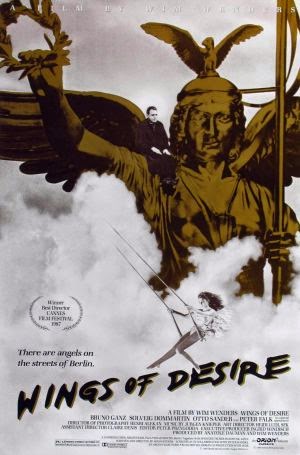
7ebbf-wingsofdesireposterDirected by Wim Wenders, this German film has almost a stream of consciousness feel. It opens over the skies of West Berlin where a couple angels watch over the humans as unseen and unheard guardians. They pay attention to the thoughts, desires, joys, and fears of a plethora of folks from all walks of life and act as unobserved comforters. These angels are immortals and although they are familiar with humanity they are not a part of it. 

Among others, the angel Cassiel observes an old man named Homer who dreams of a world of peace. Damiel on his part finds himself infatuated with an utterly lonely circus trapeze performer, and he also watches over the actor Peter Falk as he begins shooting his next film. Because of his newfound love, Damiel desires to feel what it is to be human. Aside from affection, he yearns to be able to do the little things that go along with being mortal like drinking a hot cup of coffee. Finally, determined Damiel does indeed shed his angel wings and immortality for a chance to be human. He knows what it is to breathe, to tell colors apart, and he finally does get his cup of coffee. 

Quite by chance, he has an encounter with Falk who tells Damiel a secret and encourages him in his new life. Cassiel, still an angel, tries to stop a suicidal youth from jumping, but he is unsuccessful and it hits him hard. 

In the final moments of the film, by fate, Damiel meets his girl at a concert, and they embrace as if they had known one another for an eternity and in a way they had. This film is beautifully photographed in a sepia tone that reflects the viewpoint of the angels. It is only the humans who see the world in all its glory, bursting with different colors. This film was quite fascinating, and it is the type of film I would want to make that really gets up close and personal with some many people without actually focusing on them. Furthermore, Peter Falk was a wonderful addition to this film, and he was a pleasure to watch because he gave off the impression that he was simply being himself. And I think he was.

Next on my list to see from Wim Wenders is Paris, Texas, but I would also like to explore more of the New German Cinema from the likes of Rainer Werner Fassbinder and Werner Herzog. 

4.5/5 Stars

My Dinner with Andre (1981)

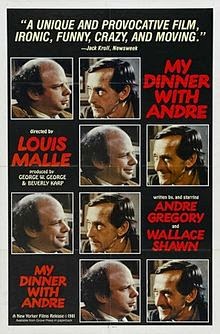
18639-my_dinner_with_andre_1981_Directed by Louis Maille and starring Wallace Shawn and Andre Gregory playing characters named after themselves, this interesting film has a relatively simple, albeit, unique premise. A writer who lives in New York goes to a dinner engagement with a man who he used to know well. 

However, he approaches their meeting with some anxiety not knowing what to expect from a man who has no doubt changed. Andre greets Wally and pretty soon they are talking about this and that as they wait for their food. Andre initially talks about his experiences abroad in Poland, Findhorn Scotland, and even the Sahara. All the while Andre experimented with spiritual encounters, met unusual artists, and took part in performance art. During his time away he was made to contemplate humanity, life, death, and many other profound subjects. 

Wally for his part describes his own life in contrast and what he thinks about his more droll existence. It includes spending time with his girlfriend, reading an autobiography on Charlton Heston, sleeping with an electric blanket, and trying to write plays. Andre on his part believes there are problems with this lifestyle because it is more like a dream than reality. 

Both men leave the meeting content and Wally rides off in a taxi ready to tell his girlfriend about his dinner with Andre. Andre Gregory represents your philosophical existentialist who is discontent with the normalcy of life. Then, Wallace Shawn is your common everyman who lives his days simply, content with simple comforts and a normal existence. Maybe not your normal dinner conversation, but after all it is a movie. This film is certainly not for those with a short attention span and I myself find this film more intriguing in concept rather than in practice. However, there are many philosophical issues here so if you are ready to ponder and sit back so the conversation can flood over you, it can be an interesting film to take in.

3.5/5 Stars

A Room with a View (1986)

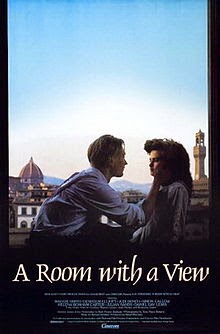
df65f-room_with_a_viewWith direction by James Ivory and a cast including Helen Bonham Carter, Maggie Smith, and Daniel Day-Lewis, the film opens in Italy where a well to do English woman is on holiday with her significantly older cousin. While staying in Italy she falls in love with the country and comes to appreciate the many different people you come across there. 

It could be a commanding author, a pair of kindly old women, or a father and son with a more open way of thinking. In fact the Emerson’s reflect the change that is coming to England while Lucy and her cousin Charlotte reflect the old Victorian way of England. They are so caught up in manners and etiquette that they never give much thought to their actual desires and feelings. This becomes extremely important when Lucy returns home to her family and the snobbish but well-meaning young man she is to marry. She believes she is in love, but then the Emerson’s come to live nearby and Lucy is in conflict, especially after an incident in Italy. 

Lucy continues to follow the norms of what she is supposed to do, and it is only after much lying to others and herself that she truly confesses her feelings. Things are not turning out the way she had expected and thanks to kindly Mr. Emerson she finally leaves the pleasantries behind for love. She returns to Italy with her love and is met with another group of colorful individuals and she once again has a room with a view. This film is obviously very English and it is made by the characters like Mr. Beebe, Charlotte, and the Emersons who all make this a pleasant film to watch. 

4/5 Stars

Die Hard (1988)

4062f-die_hardStarring a cast including Bruce Willis and Alan Rickman, the film opens during the Christmas season with cop John McClaine arriving in L.A. to be with his estranged wife and kids. He goes to an office party to meet his wife and that is when terrorists strike. John gets away unnoticed and he must wage a one man war against the criminal mastermind Hans Gruber, and his henchmen. First the police, then the FBI get involved but they can do little to remedy the situation from the outside. It comes down to the grit and determination of McClaine to take on his adversary all throughout the skyscraper. Fittingly, it all culminates with a showdown with the man behind it all. This film is definitely full of action and excitement. Several of the characters are enjoyable to watch and a handful are quite irritating.

4.5/5 Stars

Cinema Paradiso (1988)

58390-cinemaparadisoTo the casual viewer, Cinema Paradiso can seem like a plodding film, but this pacing is almost necessary since it reflects the passing of the years for one individual. It has been 30 years since Toto left his hometown as a young man never to return. Now he gets a call from the mother he never talks to, with the message that Alfredo has passed away.

The memories become coming back from when he was a young boy in the post-war years. He had a knack for getting into trouble, falling asleep as an altar boy, and getting scolded by his mother. She was especially displeased with his obsession with the movies played at the local theater called Cinema Paradiso. It is there where Toto has his first encounters with the great legends of film, but also perhaps more importantly, the projectionist Alfredo. Initially, the middle-aged man finds the boy a nuisance but slowly a close bond forms between the two. Alfredo teaches little Toto the tricks of the trade and the movie hall flourishes with packed houses all the time. You see, it was the age when movies were a family affair, and the whole town showed up to be entertained. They were the perfect escape from disillusioned post-war years. However, there still is a local priest who censors all kissing in film because after all, that’s highly objectionable. Very racy indeed.

One such night a near fatal accident occurs when the projector overheats then burns the film setting the whole projection room ablaze. Toto barely pulls out Alfredo alive and he is permanently left without sight. From that day on his young prodigy takes over the job but never forgets his mentor and friend. The boy is soon turning into a man and it means young love and a stint in the army, and still Alfredo is around for him. He is always ready to give a bit of homespun wisdom from a movie or do a simple favor. However, finally on the advice of his old friend Toto left town and never returned in order to make something of his life. 

Now he finally returns to pay his respects and the old has passed away. Some familiar faces still inhabit the town but the Cinema Paradiso is about to be demolished and the end of an era has arrived. The days of cinema halls are waning as videos and the like grow bigger. As a gift to his friend Alfredo left Toto (now Salvatore Di Vita) one last reel of film containing a montage of big screen kisses. It is less a lesson in Italian and American classics and more of a lesson in life. Our relationships matter. More on that later. 

 Cinema Paradiso made me crave watching films with a big audience because that is something modern moviegoers often do not experience. Movies were initially meant for the masses (ie. Sullivan’s Travels) and they were meant to be enjoyed in community with one another. That’s part of their magic I suppose. 

This is also a highly sentimental, highly nostalgic look at film, but as I alluded to before, it is less about film and more about the people. I tried to recognize actors and films while I saw bits and pieces of old black and white footage, but then I realized it was arbitrary because the audience members are what really mattered. As Alfredo points out in one of his last chats with Toto, “Life isn’t like in the movies. Life…is much harder.” However, the reward of living life is great despite the risk involved, and so it is necessary to leave the movie theater, television, or your laptop behind at times. Life and the relationships that fill it are the most paramount of all and although nostalgia is wonderful there is something to be said for living in the present. That is some of what Cinema Paradiso teaches us and it is a message to take to heart.

4.5/5 Stars