Before Sunrise (1995)

Before_Sunrise_posterThis is a fascinating film not just about love and romance but higher, deeper concepts altogether. Without knowing the idea already existed, this is the film I always wanted to make in my head!

Two people meeting in a place under unusual circumstances (on a train in a foreign country), and then building a bond over a single day that evolves into something really special very, very quickly.

This is exactly happens with Ethan Hawke and Julie Delpy who do a wonderful job playing two genuine people who have their own set of ideas, aspirations, fears, memories and unique personalities to go with them.

They spend an evening in Vienna and create a memorable flashbulb moment out of it. One instant that sticks out in my mind is when they are sitting at a restaurant with many conversations going on around them. However, the two of them have pretend telephone conversations with other people. Through it Jesse and Celine learn how the other feels about them. It is so beautifully captured because they do not have to say it directly, but through this roundabout way they know.

Perhaps this film sounds like a bore to some and it may in fact be because a lot of it is talking. But Linklater and his collaborators frame it in such a way that I was very much engaged. Isn’t a lot of life talking anyways? In that way it had a spontaneous, realistic feel and that is thanks to a solid script along with the candid delivery of the leads. When I first saw Julie Delphy I had no idea she was French and it took me a while to catch on. She and Hawke play well off of each other and it is interesting to be able to eavesdrop on their conversations.

Before Sunrise was a pleasant surprise because it failed to fall into many of the normal conventions of romantic comedies and instead it rose above the mediocrity to tackle the ins and outs of love and life through frank and wonderfully unadulterated conversation. I cannot wait for more of Linklater’s trilogy.

4.5/5 Stars

Good Will Hunting (1997)

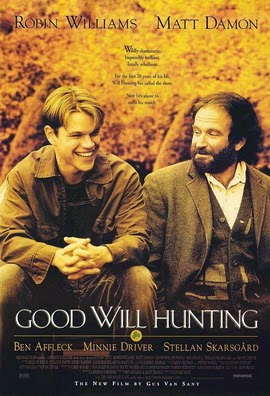
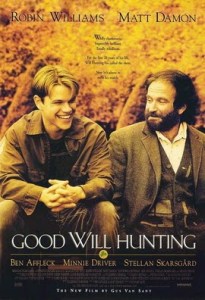
9db12-good_will_hunting_theatrical_posterGood Will Hunting is an extraordinary story on multiple levels because it is about the little guy. The trajectory of a lowly janitor being propelled to MIT genius is moving no matter how often it gets copied or imitated. It just never gets old. Then, there is the story of two young unknowns named Matt Damon and Ben Affleck who shot to fame thanks to some big dreams and a few mentors. Now they are two of the top names in Hollywood over 15 years later and they continue to be (Gone Girl and Interstellar are proof).

However, back then they were a long shot with only a solid idea for a film. It worked wonderfully though because of its core themes. It’s about friendship. It’s about romance. It’s about fear and aspirations. It’s about vulnerability. It’s about long shots making the most of their lives. Admittedly, that could be almost any film so there’s a need to bring the microscope in a little closer.

At face value Will Hunting (Matt Damon) seems like a young thug from South Boston who loves his beer, buddies, broads, and brawls. He and his friends including Chuckie (Ben Affleck) spend their days trying to make ends meet and fill the rest of their time with the aforementioned. We get glimpses of a different Will, however, a brilliant young man holding a plethora of book knowledge and blessed with a photographic memory. He’s able to philosophize rings around conceited Harvard students catching the eyes of a cute British girl named Skylar (Minnie Driver). They are a sweet couple and it seems like it might add up to something good.

Then, comes the necessarily fateful day when Will solves the unsolvable equation on the MIT wall, following that feat with a brawl fight that lands him with a potential jail term hanging over his head. It’s a strange dichotomy and it deeply surprises Professor Gerald Lambeux who quickly realizes the unassuming genius that is Will Hunting. He’s fantastic, but in order to utilize his potential Lambeux agrees to have him meet weekly with a therapist.

What follows is an absurd string of therapy sessions where Will, who wants none of this analysis, makes a mockery of his psychologists. When Lambeux’s former roommate and last resort Sean Maguire (Robin Williams) is called in it looks like more of the same.  But he is different. He sees something more and Sean is not about to give up on the kid. Their sessions begin as a battle of wills until Will’s defenses finally break down. They construct something beautiful, something real,  and in many ways vulnerable.

It is then that Sean teaches Will about true love and living life with no regrets. He had a wife who passed away from cancer, and he is hardly a big name academic, but he wouldn’t trade his life for anything. That’s enough for him. All the while, in between sessions, Will must figure out his life whether he wishes to work in the stuffy world of academia with professor Lambeux, continue living with his chums in Southie, or move forward with Skylar who is off to Stanford soon.

Sean doesn’t force him into one decision or another but he gives him personal advice. As a young man, he met a pretty girl in a bar, the same day in 1975 that Carlton Fisk hit his famed home run. But Sean gave up his seat to spend that evening with a girl and it paid off. She would be his wife for all those happy years before she came down with cancer. In Will’s eyes, and perhaps even the eyes of the audience, he was utterly insane to pass that up, but for Sean, there were no regrets. That’s enough.

On the verge of turning 21, there are so many choices, thoughts, feelings, and fears swirling around. Not to mention Will’s ugly past as a foster kid full of abuse and a heavy rap sheet. It’s the steady and pragmatic consoling of Sean where he finds relief. Sean will not be quelled in reminding him, “It’s not his fault.” That’s simply the hand he was dealt.

In another beautiful scene that is oft cited, Chuckie tells his friend, in the most genuine way that he can, that he doesn’t want Will to stick around. Because, the reality is, Will has been given a ticket out of Boston, and it would be a knock to all of his friends if he stayed around. On the day Chuckie won’t need a note. He’ll have satisfaction enough that his friend will be gone. To this day, it still feels a tad corny, but it works within the film so I will go with it.

Down the line, Sean receives a sincere note in his mailbox and Chuckie walks up the steps to Will’s place and no one answers. No one needs to say anything because they all know Will has gone to follow his dreams. Go west young man after the girl you love and take a chance. No regrets. It is the perfect ending for this film and at the same time the most aggravating.

Robin Williams was an obvious standout in this film, and it saddens me to think that he is no longer with us. I think I appreciate him most in his dramatic roles because he is so genuinely funny it comes out organically. He is a great counter to Matt Damon. Without that dynamic, this would be a far less noteworthy film. Also, the script is full of quips and a great balance of intellectual and laymen terms making for a unique story. It takes time to acknowledge the idiosyncrasies and pain that are a reality of human existence.  That’s why it hits home. Hopefully, Will as well as all of us find what we are hunting for.

4/5 Stars
The Grifters (1990)

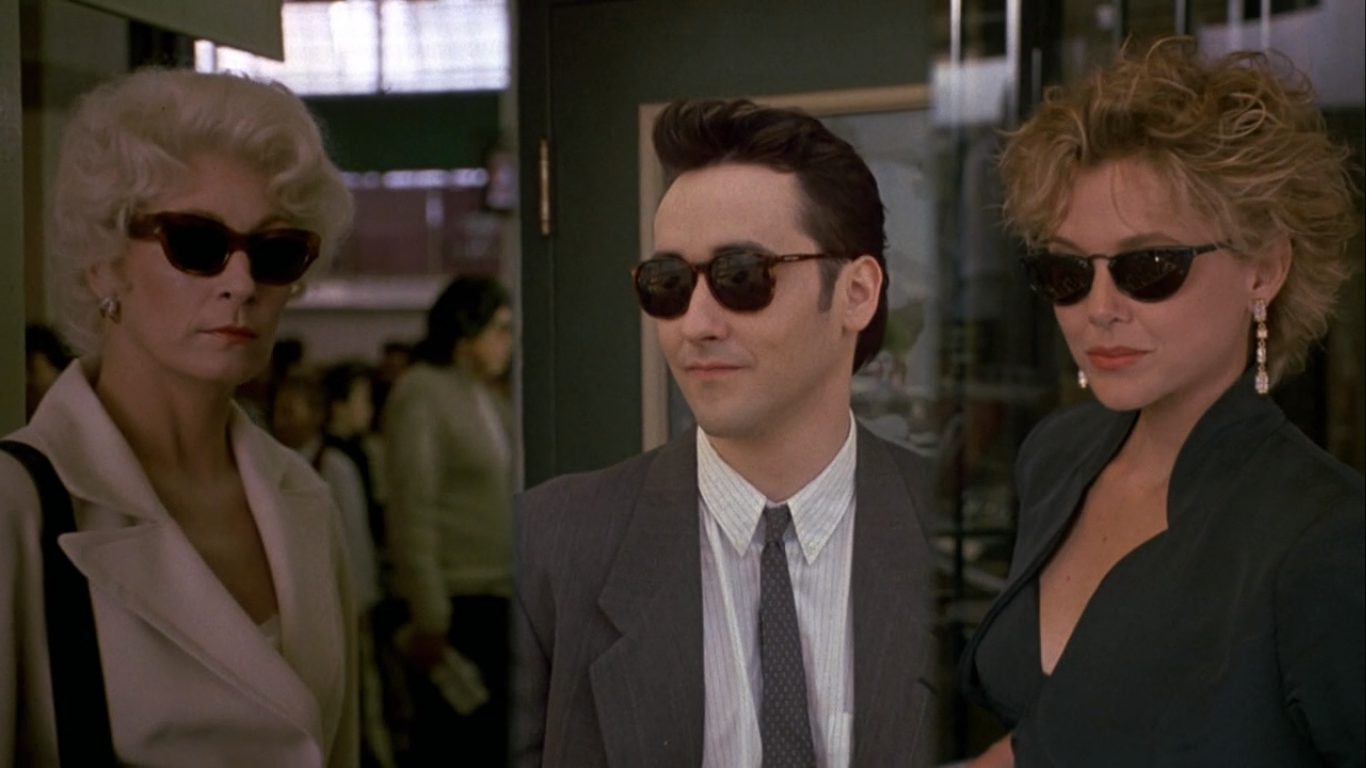
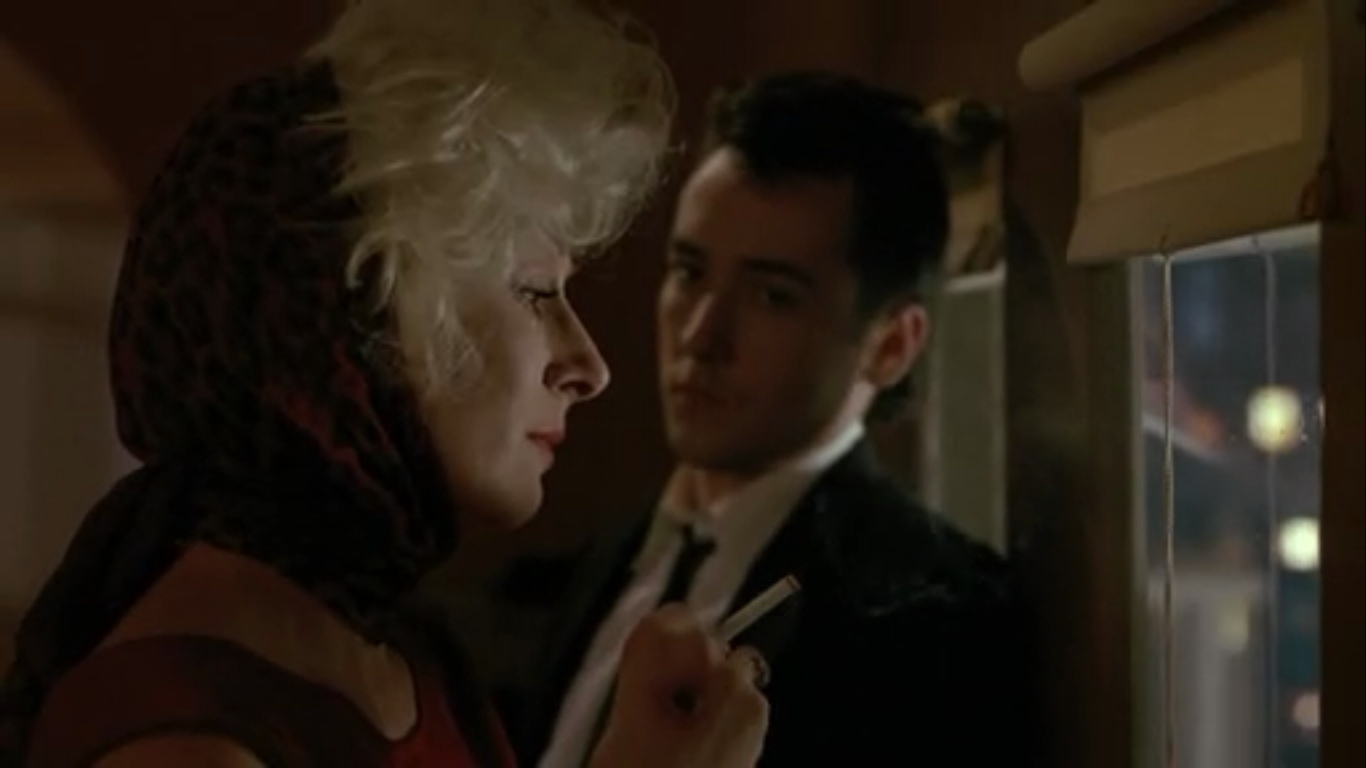
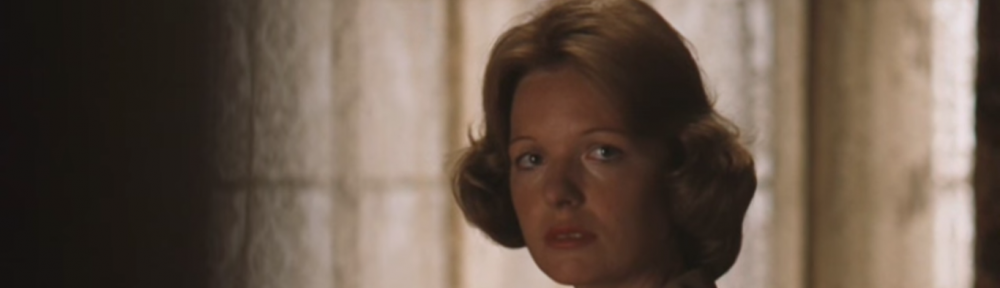
b2415-grifters1When you have Martin Scorsese producing and Stephen Frears directing you are bound to get something intriguing, and The Grifters is just that. It’s a Neo-Noir starring John Cusack (no Lloyd Dobler), Angelica Huston and Annette Benning. It’s got everything you can expect with a title like that from small-time swindling and horse races in La Jolla to deadly Femme Fatales with shady intent.

The film really has three stars in the above, but at the center of it is young grifter Roy (Cusack) who has been doing nicely for himself ever since he went off on his own. But his type of life does not come without a price. Lilly (Huston) is an old vet who has worked all the angles for a long time and now she is in the service of one tyrant of a bookie named Bobo. She hasn’t seen her son for 8 years, and all of sudden she comes back into his life finding him in need of medical attention. Their reunion is far from civil.

Then last but not least is the despicable Myra (Benning) who seduces her way into the hearts and the wallets of many men. Now she’s with Roy but before there was another con man and she is far from exclusive using her sexual wiles to get anything and everything she wants. It’s not surprising Lilly can’t stand her guts. No one could. If he’s honest not even Roy. Soon enough Lilly poisons him towards Myra and the seductress wants revenge and she seemingly gets it.

What follows involves lots of blood, lots of money, and a descent deeper towards a hellish conclusion that feels hollow and cold. Elmer Bernstein’s score accentuates the mood with a tense and altogether creepy string section.  As far as character dynamics, go this has to be the strangest triangles around. Each one of these confidence tricksters is a grifter and each one has a slightly different angle. However, when it’s all said and done only one of them can come out on top even if they didn’t want it to end that way. That’s just the way things go. There is no turning back, only running away for dear life.

The three leads played their roles to a tee and The Grifters proved generally engaging even if all the questions were not answered with loose ends still to be tied up. It also blends the general themes and outlook of noir with a setting that almost feels anachronistic at times. It’s hardly a complaint though and maybe things are better this way anyhow.

3.5/5 Stars

What About Bob? (1991)

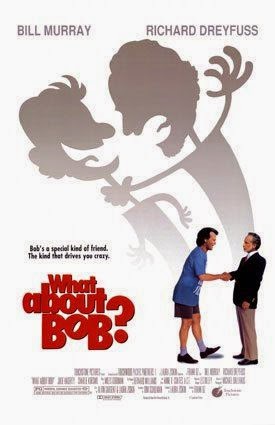
1f90d-what_about_bob_filmI was not sure I would like this film because honestly Bill Murray is not usually one of my favorite actors. However, his portrayal of Bob Wiley, a man with every phobia imaginable, is maybe his most lovable. True, he is annoying and neurotic, but he means well. In many respects he reminds me of Jimmy Stewart as Harvey because both characters were able to captivate most of the people around him. Only with Bob he got under the skin of one man and that man was his psychologist Dr. Leo Marvin (Dreyfuss). Bob tags along on Dr. Leo’s family vacation and that is where the conflict really gets started and the laughs begin. Every moment that the doctor loses his sanity continually builds up  until the stress of Bob is just too much to take! All in all this was a pretty entertaining film and I gained a new found respect for Bill Murray.

3.5/5 Stars

Jurassic Park (1993)

690f7-jurassicpark1Jurassic Park was yet another smash hit for Steven Spielberg back in 1993 and it, as well as the animatronics, stand up pretty well over 20 years later. It might feel slightly underwhelming at times, but it definitely still carries the ability to entertain.

Without giving away too much plot, although most should have already seen it, Jurassic Park plays out like a modern-day King Kong story. John Hammond (played by actor/director Richard Attenborough) is a white-haired billionaire with an eye for spectacle. He has put his money to good use (so it seems) pouring resources into a new sort of attraction. This is no Disneyland and as such the stakes are much higher.

He calls upon the services of a paleontologist Dr. Grant (Sam Neill) and a paleobotanist Dr. Sattler (Laura Dern)  to give the seal of approval on his grand endeavor. There’s also a nosy lawyer who is curious for the sake of his investors. Round out the group with an authority on Chaos Theory (Jeff Goldblum) along with Hammond’s grandkids and you have all you need.

These lucky few are the ones who get shipped out to a remote island off Costa Rica to see first hand the majesty of Jurassic Park. But rather like Frankenstein, Hammond does not know what he has created. What was meant to be good, turned sour all too quickly, except in this rendition of the story he gets a little help from a pudgy programmer who is looking out for himself.

There’s not much character development to speak of, but if you have real life dinosaurs terrorizing an island you do not need much else. Accompany it with a truly epic and iconic score from John Williams and you have something quite special and quintessentially ’90s. If kids did not want to be paleontologists before they undoubtedly did after Jurassic Park.

As Dr. Grant so aptly puts it, “Dinosaurs and man, two species separated by 65 million years of evolution have just been suddenly thrown back into the mix together. How can we possibly have the slightest idea what to expect?”

That is the general intrigue behind Jurassic Park aside from the awesome fact that we get to see a T-Rex, Raptors, and many other dinosaurs recreated. This is not necessarily a kids movie due to the intensity at times, but it definitely is meant for the young at heart. Those are the people who unashamedly love dinosaurs.  But then again who doesn’t love dinosaurs?

4/5 Stars

Shadowlands (1993)

2bfce-shadowlands_ver2Starring Anthony Hopkins and Debra Winger with direction by Richard Attenborough, this film chronicles the romance of famed Christian professor and author, C.S. “Jack” Lewis with the American poet Joy Gresham. Jack is by now a respected professor at Oxford and a widely acclaimed lecturer who often speaks on the issue of human suffering. In his personal life, he is rather reserved. He lives with his older brother Warnie and spends times with his colleagues discussing topics of all sorts at the local pub in the evenings. 

It is not until he receives a letter from an American admirer named Joy Gresham that his life seemingly begins to change. He first accepts to meet her only to be gracious, but soon their relationship develops into a close bond. Jack meets Joy’s son Douglas who is enthralled by Narnia. He even offers them a place to stay during the Christmas season, since they have nowhere else to go. Lewis and Gresham are very different people, to say the least. He is a quiet intellectual with the sensibilities of an Englishman, while she is a plain -speaking American who does not mince words. However, these differences bring them closer together because they help each other to view the world in a radically new light.  Jack learns how Gresham’s marriage is going badly and he settles to marry her in a practical union so she and Douglas can stay in England. They do not speak of it much and it hardly seems real. Joy calls him on it realizing for herself that he allows no one to challenge him. There is no vulnerability to him whatsoever.

However, then Joy is diagnosed with bone cancer and slowly but surely she begins to deteriorate. For the second time in his lif,e Lewis understands the anguish that comes when a loved one is suffering. Because, the fact is, he most definitely loves Joy, and it simply took a tragedy to make him realize it. As with any inexplicable suffering, Lewis is tested in his faith, and the reality human suffering has new meaning to him. It is no longer just lecture material, becoming a far more personal process.

Although this film is not so much focused on C.S. Lewis as a Christian theologian or apologist, I think Anthony Hopkins does a wonderful job of portraying him as a kindly and gentle man of faith. He struggles with doubts and fears like every human, but he found something wonderful in his love for Joy which ultimately changed him.

Debra Winger must also be commended because she played well off of Hopkins and even though I have no picture of the real Gresham, Winger seemed to embody her. In some ways, I found her most beautiful when she was bedridden, absent of all makeup and seemingly so pure. It positively tears your heart out watching her son say a tearful goodnight or to look on as Jack stays up with her. This is a better picture of real, unadulterated love than most films can hope to manage because it very rarely becomes a sappy melodrama instead resorting to more deliberate means. As Jack says we live in the “Shadowlands,” but amidst the pain and suffering, love seems to shine through even brighter.

This was such an enlightening film for me because I always envision C.S. Lewis as a scholar and rational thinker, which he was. But he also had a vulnerable human side and this film, as well as A Grief Observed (written after Joy’s death), prove that point. It’s hard not to feel for him and that’s part of the beauty of this story.

4.5/5 Stars

Three Colors: Red (1994)

 3a286-threecolorsred3Kieslowski’s films are mostly character driven and yet he often uses high drama to create a far more complex lens to observe his subjects. In Blue, the inciting incident was a deadly car accident. It seems only fitting that he would end this story with the catastrophic sinking of a ferry. He takes the same bleak, no-nonsense approach with little fanfare that he used before. It’s his way.

In fact Three Colors: Red as a whole is another simplistic film in plot, and yet the irony is that the film is chock full of complexity because its major point of interest is interpersonal relationships (as suggested by the intertwining phone lines shown early on). There is nothing more tangled and intricate about humanity than our relationships.

As such, this final installment is in many ways a story about love, romance, and friendship, and yet Kieslowski does not find it necessary to preach to us. He is better and more thoughtful than that, laying out the story for us to ponder and mull over. This is the story or better yet the parable he created.

Valentine (Irene Jacob) is a young student and model who is constantly an innocent and sympathetic figure with a pair of doe eyes. She is often shown in profile which continually reveals her youthful and even sullen beauty. She is even the somber poster girl of a gum campaign plastered around town. There’s a boyfriend in her life who she desires the affection of, and then there’s a brother who is hooked on drugs. In other words, life is far from rosy and secure.

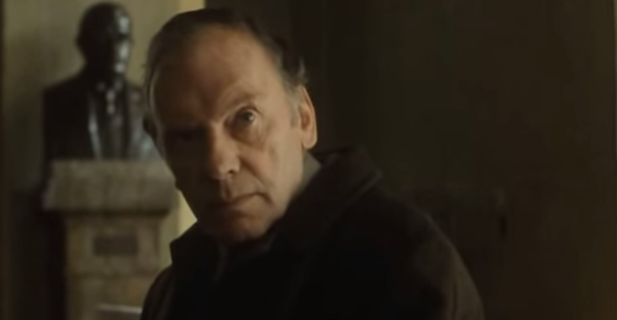
One day she accidentally runs over a dog that she takes to the owner (Jean-Louis Trintignant,) who seems surprisingly unconcerned by the event. She does the only thing she can do with a clear conscious which is taking the dog to the vet and then taking care of it herself. Soon after, Valentine finds herself walking the dog by the old man’s house once more and she discovers what he does all day. It turns out he is a retired judge, and he spends his solitary existence eavesdropping on the conversations of others (including Valentine’s neighbor Auguste).

Later, through the grapevine, she finds out that a retired judge had a suit filed against him, and she rushes to his house to assure him she had no part. He already knows because he was the one who turned himself in.

Over the next days, Valentine begins to empathize more and more with Mr. Kern’s existence. As a former judge, he was forced to make decisions far more difficult than most. In fact, why do people follow laws? Is it out of goodness or purely self-serving? Is morality all relative? What really is good and bad, because how would we act in the other man’s shoes? By this point, we see Kern’s struggle a little better.

Finally, Valentine invites her new found friend to her last fashion show before she heads to England for a few weeks. It’s a touching moment when he pays her a visit after the show, but it also reveals the pain in the old man’s past. It may be a lucky guess but all we know is that Valentine figures him out. It just shows that you cannot judge others by first impressions.

So as it goes, Auguste’s life practically mirrors that of a younger Kern, and thus, so many parallels become evident. Aside from the obvious, I only figured it out after the film was done, but they are both judges, struggle in love and the like. At the end of the film when Kern sees the news about the ferry with Valentine and Auguste aboard, the only thing we know for sure is that there were seven survivors (guess who!). In a somewhat subtle way, the trilogy is connected and Kieslowski ends his tale on a fitting note. It freezes and just like that the career of one man was done for good. A couple years later he would already be gone. But he went out on top and Three Colors cemented his legacy. I always loved the color red the best. Here’s yet another reason why.

4.5/5 Stars

Three Colors: Blue (1993)

b0ad4-threecolorsblue“Now I only have one thing left to do: Nothing. I don’t want any belongings, any memories. No friends, no love. Those are all traps.”

I once thought that Before Sunrise was the type of movie that I would want to make. Three Colors: Blue is another concept that I have often envisioned without even knowing it. In fact, I had seen The Descendants, a film with a somewhat similar story arc told from a different perspective. Except whereas Clooney’s film is full of blatant drama and intense familial moments in Hawaii, Blue is far more nuanced.

The Descendants might be a more gripping drama, but Blue has the sort of complex depiction that seems to more closely mirror reality. The grieving process involves isolation, solemness, and at times few words. The easiest way to grieve is not to feel, not to fully embrace the pain. Sometimes that is the simplest if not the healthiest way to deal with it for Julie. It’s a real world approach to the scenario, and it’s no less painful to watch — perhaps even more so.

Julie’s husband Patrice de Courcy was a famous composer who was commissioned to arrange a grand piece to be performed at concerts for the Unification of Europe. It is a great honor and we quickly learn that Patrice is quite a big deal. However, after a car accident, Patrice and his 5-year-old daughter perish in the crash and only Julie gets away alive. It is a stark, unsentimental picture, and it succeeds in changing Julie’s life forever.

After being released from the hospital she soon sells all her possessions and moves out of her family apartment to take up residence somewhere far removed from any acquaintances, including a man named Olivier who is in love with her. She has a new home and begins to sever ties to her old life. The unfinished work of her husband (and her) is trashed and that’s the end of that. In her new Parisian home, she has a rodent problem and becomes the hesitant confidant of a local exotic dancer. Furthermore, she rejects the necklace that a young man pulled out of the wreckage. Her times of solitude are spent swimming laps alone in the local pool, submerged and half-covered in shadow. Grandiose symphonies reverberate through her mind haunting her. In such moments, Kieslowski will often black out the screen in the middle of the scene, effectively interrupting the action for a few seconds before bringing us back.

Words are few and far between for Julie and when she does speak it is often brief and reserved. We are, therefore, forced to observe her without the aid of dialogue. She is certainly detached but there is a provocative side to her. Something is mystifying about her soft features, dark eyes, and short hair. She is a wonderful woman of mystery and beauty because the reality of it is, we do not know a whole lot about her. We must discover more bit by bit and she does not readily disclose information.

It is when pictures of her life literally flash before her eyes on a TV screen that the story takes its next turn. Julie learns soon enough that her husband had a mistress that he was with for a few years. In the hands of Hollywood, this would be high drama. In the hands of Kieslowski, it is far from it. Julie is still the same aloof individual she always was and even a confrontation with the mistress does not change that. She is civil and generous through it all.

Finally, she returns to her husband’s composition which she learns Olivier has started to rewrite. They agree that he will make his own work and Julie must accept it for what it is. Faces from the film float across the screen and a still solemn Julie lets out a few silent tears. The anti-tragedy is complete, a subdued, intriguing piece of cinema. Not for those with short attention spans but, I am interested to see Red and White. Kieslowski intrigues me with his thought provoking films somehow reminiscent of the likes of Bergman or Bunuel.

4.5/5 Stars

Glengarry Glen Ross (1992)

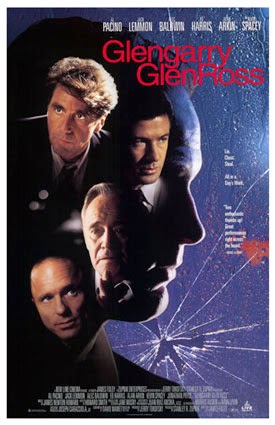
fa822-glengarrymovieIt’s a film about a despicable world which promotes despicable people and despicable behavior. That’s the world of the real estate salesmen in Glengarry Glen Ross. Here are men who use any mode necessary to close deals as they say. They finagle, lie, cheat and even steal because those are just tricks of the trade. Those who get the good leads are able to close more deals and make more bank. Those who get the leftovers struggle to swing something out of nothing. Shelley “The Machine” Levene (Jack Lemmon) is one of those struggling after many years of success in the business or racket, whichever you prefer. He has a lovely personality, rather like a hissing snake trying to seduce you before going in for the kill. On the flip side, he can be a real jerk and he is unscrupulous as all get out.

But that’s enough on Shelley. The office is run by rigid John Williamson (Kevin Spacey) who just follows his orders and does not budge an inch. Then there is Ricky Roma (Al Pacino), the top closer who is especially cynical but also a great admirer of Shelley’s skill. Dave Moss (Ed Harris) is a man with a big mouth and fiery temper not ready to sit by while other men outperform him. Finally, there’s George Aaronow (Alan Arkin) a man who humors Moss and is also fed up with his situation.

The wheels start turning when the Big Whigs send in a man named Blake (Alec Baldwin) to motivate the salesmen. It’s the survival of the fittest after all and they know what it takes to sell real estate so he encourages them to go and do likewise. His main tactics include berating, insults, and threats against their careers (They either get a car, a set of knives or the boot). Verbal attacks are sometimes more pernicious than physical beatings and that’s the truth here. They never relent even after Blake leaves because that’s the type of choice words that this environment fosters. One minute a salesman uses a polished voice to coerce a client then turns right around to bad mouth a colleague.

Moss on his part tries to pull Aaronow into his plan to steal the good leads from Williamson’s office. A desperate Levene tries to get better leads from an unrelenting Williamson as the veteran man struggles to convince clients and deal with his ill daughter. Roma, on his part, is at top form playing his client (Jonathan Pryce) and getting him to stay with a deal until it gets messed up. In the process we see all the pettiness, desperateness and corruption unleashed. The burglary goes down and it does not necessarily involve who you would think. Maybe it does. That’s not the point, though. The point is these men will do anything given the position they are in, but it’s not that simple because each one has their complexities. For instance, Levene and Roma are on very good terms and Moss and Aaronow seem very buddy, buddy. But ultimately it seems they look out for number one and that takes its toll on any human being.

The film is a biting drama brought to us through a fiery and sometimes brutal script from David Mamet, based on his play. Furthermore, the story is aided by an all-star cast of big names. Each one plays an equally despicable character. I knew Pacino, Spacey, Harris, and Arkin were up to the task because I had seen them before in tough or villainous roles. However, to his credit Jack Lemmon shows his versatility here since I absolutely despised him for once. That’s no easy task and he proved it to be possible. This film may be a black comedy, but there really should not be much to laugh at.

3.5/5 Stars

Searching for Bobby Fischer (1993)

19491-searchingfor2Josh Waitzkin (Max Pomeranc) seems like your average little boy with a bowl cut and an affinity for Legos and sports. However, soon his parents discover that he has a special gift for chess and his father (Joe Mantegna) especially wishes to cultivate his skills. He finds Josh a teacher named Bruce Pandolfini (Ben Kingsley), a former chess champion himself who looks to discipline the boy’s playing so he can be the next Bobby Fischer. He eggs Josh on with the promise of a grand master certificate once he earns enough points, and so Josh listens to his instruction. His dad enters him in tournaments that Josh wins easily and rapidly moves up the ranks, but as always happens the game is no longer fun and the father gets more intent on his son excelling on the highest stage. The trophies stack up, but Josh is missing a lot of school as well as his friends.

On the urging of Bruce, Josh is no longer allowed to play with the men in the park because they play undisciplined. Stepping back for a moment, there is the realization that this is a seven-year-old boy and yet this really happened, and it happens very often. Parents push their kids so much so because they wish for them to succeed, and they want to give them what they never had.The film deals with this circumstance sensibly with Josh’s mom acting as the voice of reason. His father is not a bad man by any means, and it is during one scene in the rain after Josh loses again that we see that. Josh sits on the curb in silence as his dad talks to him and the boy genuinely asks, “Why are you standing so far away from me?” It’s at this moment that Mr. Waitzkin realizes that he has blown things out of proportion and embraces his boy telling him that everything is okay.

Eventually, Josh goes back to playing with his buddy Vinnie (Laurence Fishburne Jr.) in the park and takes some fishing trips with his dad. Despite the initial cautions of Pandolfini, Josh goes into the biggest tournament against his greatest competition without stressing over chess. He just uses all the knowledge he has accrued and plays a beautiful game. Over the course of the game, he deviates from Fischer, winning on his own terms, the way that he wants. He may have been searching for Bobby Fischer, but ultimately he found himself instead and Josh is better for it.

The film is framed with the voice-over of Josh as he recounts the exploits of Fischer which then is juxtaposed with his own story. When the film came out back in 1993, Josh was still playing in his early teens and Bobby Fischer had come out of solitude to finally beat his old rival Boris Spassky. Both were master chess players, but with two very different stories.

This is certainly a feel good story, but it has wonderfully nuanced characters that make it a step above other such films. Max Pomeranc is wonderfully innocent and unassuming with his big doe eyes and a slight lisp. Kingsley and Fishburne on their part give two worthy performances as his two starkly different mentors with dueling strategies. It is, however, Joe Mantegna and Joan Allen who have the most important roles as Josh parents because their hopes and struggles are universal for all parents. We can empathize with them and the life they want for their son. It’s then the film becomes about far more than chess. It’s about family, friends, and being true to yourself.

4/5 Stars