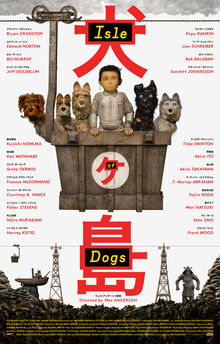
Isle of Dogs (2018)

IsleOfDogsFirstLook.jpgIt only became apparent to me after the fact that Isle of Dogs sounds quite close to “I love dogs.” You might even say there was a certain amount of forethought in this play on words. However, the pun only works in English as the Japanese pronunciation of the comparable kanji is “Inu ga shima.” Here we have the inherent beauty and simultaneously what some would deem the problematic nature of Wes Anderson’s latest film in a nutshell.

It’s necessary to lay out how I come at Isle of Dogs because it does contribute to how I perceive it. I’m Japanese-American. I’ve lived in Japan. I know some of the language though it’s an admittedly meager amount. However, I’ve invested in the culture and care about its people and fostering cross-cultural bonds. That’s part of the reason I was drawn to live there for an extended period of time, more than any pop culture infatuation with anime and manga. In those regards, I’m very much American. I also revere Kurosawa, Ozu, Mizoguchi and all the rest as most cinephiles do. There you are.

Wes Anderson is someone that I genuinely admire for his aesthetic though I would never necessarily sing his praises needlessly. He doesn’t need me to defend him nor do I look to. Still, when I consider Isle of Dogs I do not see a superficial homage. As with everything he does Anderson’s film feels fairly meticulous and the stop-motion creation is phenomenally precise. Beyond that, it’s infused with Japanese tradition. Certainly, there are markers that some might deem superficial like Taiko or sumo or cherry blossoms (さくら). They are all present. 

Thus, I do worry about people who have not interfaced with Japanese culture or the people. Specifically, the character of Tracy (voiced by Greta Gerwig), the foreign exchange student, feels problematic. I’ve met some folks like her where they let their own personalities take control of every situation and there seems to be no sensitivity or give and take. 

Because they don’t seem to have any sense of the culture they are in or at the very least they expect others to play by their rules. Hence why many Americans including myself are only fluent in one language. An example springs to mind of Tracy wandering into a bar and hollering at the man behind the counter in English that she wants chocolate milk. Then she berates a Japanese scientist (voiced by Yoko Ono) for not doing anything in opposition to the rampant government corruption. Again, in English. 

It was fascinating that I watched the film with an audience where the majority were Japanese so they were not ignorant of their country like Tracy or I might be. But how about viewers in another pocket of the world or even back home where I come from? The audiences saw a different movie altogether with different nuances and connotations.

Some people have noted rightly that a lot of the Japanese dialogue is lost because as the opening disclaimer notes: “The humans in this film speak only in their native tongue (occasionally translated by bilingual interpreter, foreign exchange student, and electronic device). The dogs’ barks are translated into English.” Except for the dogs, that’s a large margin for error.

Even the words of the little pilot, the intrepid boy Atari (voiced by Koyu Rankin) are all but lost on the dogs who don’t speak human and for me as well because, again, my Japanese leaves much to be desired. But the bottom line is that he almost always intuitively knows what the pack of alpha dogs is doing. 

They have a connection. He is looking for his faithful guard dog Spots (voiced by Liev Schrieber) who has been cruelly deported by his distant uncle Mayor Kobayashi in his effort to rid the dystopian Japanese city of Megasaki of infectious dogs. Spots was the first of many canines to be deported to the putrid rubbish pile of Trash Island. There you have the film’s plot but it relies on the fact that the boy and the dogs work together.

It goes back to that core tenet of society that dog is man’s best friend. And strip away any amount of visual artistry or cultural layering and that fact remains universal. Kobayashi is a cat person and we surmise his decision was merely a vendetta against canines (going back generations) more than any scientific evidence would suggest. 

To be honest, it never feels like Anderson is putting out a giant placard with film references at least not like Tracy with her megaphone. If anything the film conjures up one of Japan’s great national heroes the faithful dog Hachiko. Any traveler to Tokyo will recognize his statue in Shibuya but he is a cultural icon — emblematic of the same bond expressed in this story.

It’s still an Anderson film and as such, I never get emotionally connected with the material (actually maybe I take that back; stop-motion dogs suffering is heartbreaking to watch) nor do I gel with his very personal idiosyncrasies all the time.

But somehow, though the film’s cultural representations and relationship with Japan are flawed, nevertheless it left me more impressed than anything. It seemed like a degree of care was taken. And in the end, this story of canines has moments that unquestionably do resonate with me.

I thought I would have more problems with all the quality voice talent distracting from the story itself and it happened at times where I was stuck on Jeff Goldblum or Bill Murray but more often than not it didn’t seem like one voice stole the show. It was a story that involved many voices.

Some that we are able to understand, others that we can only gather bits and pieces of. But for me personally, rather than that being a deterrent I find it fascinating that the same film can play differently for different audiences and that native Japanese speakers can be in on the movie in a way that I never could.

It’s not that we don’t deserve to know that part of the story necessarily or need to be singled out because we don’t know the language but isn’t that one of the confounding things about culture and language? Oftentimes we don’t understand one another and need to find points of mutual understanding. Things get lost in translation and I think one could make the argument that this happens in Isle of Dogs purposely.

Certainly, Wes Anderson doesn’t know Japanese culture like the back of his hand. In an interview, he said he’s been to Japan some but his references were namely Kurosawa, Miyazaki and the woodblock prints of Hokusai and Hiroshige. And yet if that is true, it still feels as if he’s surrounded himself with some voices different than his own even if his typical ensemble is in place.

We have Kunichi Nomura with input on the script and voice duty for Mayor Kobayashi. More include Akira Takayama, Mari Natsuki, Akira Ito and then better-known names like Nojiro Noda, Yoko Ono, and Ken Watanabe. That’s not to mention the countless other Japanese contributors whose names scrolled by with the end credits.

Admittedly this is only my perception of the film but when I watch it, I never feel like it is assuming the primacy of the English speaking audience or if it is then that assumption gets slyly subverted. I mentioned already that the character of Tracy often speaks in English, in her opposition to Mayor Kobayashi or to the man serving up drinks at the bar counter.

The implicit understanding is that the Japanese characters understand the English being spoken but they choose instead to respond in their native language. So they have met us half way but have we met them? Learning Japanese is difficult, maybe even impractical, but growing our cultural literacy comes in many forms that would only assist in deepening our ties with one another. Only later did I realize that Tracy, the “white savior” as it were, essentially fails in her attempts. If anything she needs the help of an audacious Atari, his guard dog, and the nameless hacker from her school. Without them she is powerless.

As is often the case, certain people use their voices and assertive personalities to push themselves into the limelight unwittingly but those people would be nothing without the taciturn heroes who willingly stay in the periphery until they need to stand up. While Tracy turns me off slightly in fiction and in real life, it’s the others like Atari that resonate with me. Just as the tale of dogs in both camaraderie and loyalty rings a universal note.

However, I realize only now that I didn’t talk much about the actual mechanics and formalistic aspects of the movie but I’ve spoken my peace. Do with it what you will.

3.5/5 Stars

Note: Two articles that I found interesting on this topic were the following: What “Isle of Dogs” Gets Right About Japan and Justin Chang’s Isle of Dogs Review
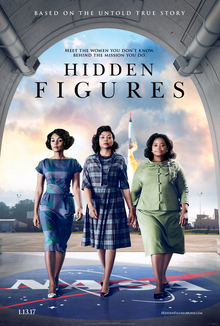
 

Hidden Figures (2016)

Hidden_Figures,_2016In some respects, this feels very much like a paint by numbers biopic that takes us through the many paces of such a narrative. The rise, fall, conflict, and self-actualization of our heroes that navigates us to the film’s conclusion.

But this is also unequivocally a story that necessitated a telling for the very fact that stories like these have been hidden for decades — swept under the rug if you will. Because first and foremost Caucasians were usually the ones at the center of the master narrative of history and namely white males at that.

In one of my courses in university, the term of intersectionality would have undoubtedly cropped up in conversation right about now to denote a doubly marginalized group (African-American women). Feel free to consider the term if you are so inclined because there are others who can probably bring a lot more to the table on issues of gender and race and oftentimes those are very necessary conversations to entertain.

However, I am more interested in the actual story in question and so I will jump right to that topic. At its core, there are three women who you have probably never heard but that’s only a part of it. It’s that and the fact that they were integral cogs in something truly extraordinary.

Our first person of note Katherine Johnson (Taraji P. Henson) who is promoted to the Space Task Group, given the pressure following the Soviet’s launching of Sputnik and Johnson’s unreputed skill in analytical geometry. She moves from her own segregated division to an environment full of passive-aggressive bigotry and whites-only bathrooms. In her home life, she raises three daughters while falling in love with a handsome National Guardsman (Mahershala Ali).

The firecracker among her friends is Mary Jackson (Janelle Monae) who has aspirations to finish her schooling so that she can become a full-fledged engineer. Lastly, is the sagely one, Dorothy Vaughan (Octavia Spencer), who has seen a great deal of the world and continually shows tremendous qualities of leadership over her segregated branch which she leads with a self-possessed wisdom. One would gather these skills would apply well to any arena and so they do eventually.

For our parents’ generations events such as Neil Armstrong walking on the moon and the Challenger Explosion left an indelible mark on society and it was all for the sake of exploring the great unknown of outer space. Those later triumphs and, yes, even the tragedies would not have come into being if it wasn’t for some of the unsung individuals who got John Glenn off the ground in 1962 as we desperately tried to counter Russia’s Sputnik successes.

There’s also a slightly refreshing reversal of the age-old supporting character archetypes where this film dares to put its white characters in secondary roles while still giving them a decent amount of importance in the overall trajectory of this narrative.

Kevin Costner is the most rewarding supporting character as the head of NASA who is looking for results more than anything and that causes him to push past the accepted walls of racial hierarchy not necessarily because he’s trying to make a social statement but because he wants to get the job done. Skin color has no bearing on whether or not someone is savvy and can get John Glenn into the wild blue yonder.

Jim Parsons part does not stretch the boundaries of his Sheldon Cooper image but it is underlined by a bit of prejudicial malice as is Kirsten Dunst’s turn which no doubt adds a touch of realism representative of the defacto bigotry of the era. Meanwhile, Pharrell Williams score of sorts while somehow anachronistic undoubtedly imbues these three women with a spark of energy following every step of progress they make with NASA.

The film’s decidedly punny title aside, Hidden Figures is still full of joy even if it’s only a minor pleasure as a film. Because in some instances it doesn’t seem to take its material all that seriously and sometimes that is more refreshing than a dour and self-important exploration. Still, it takes itself out of the running from among the greatest biopics for that very reason. It’s a bit too formulaic and probably too tongue-in-cheek with historical events. Certainly this cannot take away the full impact of this history or the enjoyment value of the film. We should do well do appreciate them both.

3.5/5 Stars

I, Tonya (2017)

I,_Tonya_(2017_film)Sufjan Stevens released a song not too long ago as an elegy to Tonya Harding. Being the modern-day folk poet that he is, he cast her as a tragic hero, championing her as a definitive portrait of an All-American girl, larger-than-life, unapologetic, and ultimately beaten back by society at large.
I will date myself and say that I don’t remember much about Tonya Harding because I was barely born when she was in the public spotlight. So, I come at the events as an “impartial” observer or at least one who lacks any clear understanding of what her story was really like in the heat of the moment.

Thus, Stevens’ song and this film, I, Tonya, were necessary for me as obvious mechanisms of empathy. Emphatically the film proves that Tonya Harding — at least for me — cannot be cast as a hero and I don’t necessarily think that she was expecting that. But what has been done on her behalf is equally vital. Finally, it seems like others have been willing to speak up on her behalf in telling a more multifaceted even sympathetic side of the story.

Her life and times as detailed in Craig Gillespie’s film functions as a nearly absurd black comedy as it plunges into familial discord and moments you could hardly make up if you tried. But what we would do well not to forget is that this is a dramatization of someone’s life — someone with inherent worth even as she’s being berated and abused by a mother and then abused by her husband and finally raked over the coals by the mass media.

If anything, this film is an indication that Tonya’s life does have meaning. The flaws are there but also present is immense trauma and the subsequent tenacity that made her the first female skater to ever land a triple axel.

Screenwriter Steve Rogers’ work employs slightly pretentious talking head moments and fourth-wall breaking monologues that were used in a similar fashion to Experimenter (2015), except it’s hardly a gimmick and there’s a great deal of resonance within the madness of narrative dissonance with a smattering of different perspectives colliding.

Because Tonya’s story really is recalled and remembered in so many different ways by all sorts of people with their facts conveniently conflicting. First, there’s Tonya herself (Margot Robbie) who was the skating prodigy by the age of 4 and despite a lack of education, her enduring work ethic made her one of the finest American skaters to ever grace the ice.

Allison Janney is as acidic and foul-mouthed as they come, pushing the envelope as Tonya’s ultra-vitriolic mother LaVona who never seems content, continually berating her daughter in all regards because every penny she makes as a waitress goes into her lessons. Love is not in her lexicon.

Then there’s the infamous Jeff Gillooly with Sebastian Stan donning that regrettable mustache as the awkward boyfriend who no doubt loved Tonya at one point and yet still embroils her in an unhealthy and abusive relationship. His slobbish oaf of a friend Shawn Eckhart, who fancies himself a counterterrorism expert of some kind, is a surprisingly authentic caricature. He’s got grand delusions of how they will sabotage Nancy Kerrigan’s chances in the Olympics by unleashing an onslaught of psychological warfare.

Jeff condones the plans but soon he’s shelling out $1,000 that disappears after Shawn gives it to a pair of dubious contacts. Little does he know that this will devolve into “The Incident” after Shawn okays a hit and an equally vacuous nobody, Shane Shant, injures Kerrigan with a police baton. They’re so inept that the FBI is soon on their trail. First, it’s Shawn, then his fingers point to Jeff, and finally, Tonya is implicated. Right here we have the clearest embodiment of both the real-life farce the and tragedy of Harding all rolled into one.

The extensive soundtrack is utilized not only as casual character development but an instant accessibility point in denoting either an era or a mood. In fact, it’s one of the few constants in a story that regularly hurtles back and forth between different points of views, time frames, and the like. Hearing Norman Greenbaum, Fleetwood Mac, Supertramp, Chicago, Doris Day and a whole host of others offer instant touchstones throughout.

For these very reasons I, Tonya is the most inventive biopic in narrative terms that I can remember since Brian Wilson’s story told so evocatively in Love & Mercy (2014). There is a similar exploration going on here as we try and make sense of someone who has gained, in this case, so much notoriety whether it was totally deserved or not. And the beauty of the picture is that it never fully divulges the truth because in so many words “the truth” in the lowercase sense is relative and like innumerable pieces of history how are we to say that we have the definitive answer?

The media’s part in all of this feels almost damning and yet we cannot condemn them without condemning ourselves too. Some David Letterman footage articulates the ubiquitous reality that Tonya Harding became a punchline in the wake of the Lillehammer Olympics in 1994 even as she received a lifetime ban from skating. Should I feel sorry for Tonya Harding? I’m not sure. Regardless, it’s a sorry affair.

Though it starts to paint some layers of Harding’s backstory and her working-class roots rubbing up against the protocols of standardized perfectly primped and costumed female figure skaters, that’s not necessarily the film’s allure. It gets its zing, admittedly from the almost soap-operatic twists. And yet with anything, if that is what gets you to stay and kept the media involved in the story for such a long time, maybe it’s good that time has passed.

Even as the script tries to put the pieces together it can hardly succeed perfectly though it does give us something to work with. Again, it all comes down to some form of greater understanding. But then again, Tonya Harding probably doesn’t care about what others think about her or about anyone trying to mount a defense on her behalf. So be it.

Now, all that seems left to make is a Nancy Kerrigan movie. Yes, she was cast as the perfect ideal, Snow White on Ice, but as with any media fixation, it cannot always serve true justice nor capture the hardships in a person’s life. Tonya Harding, Nancy Kerrigan, and nearly every other person on God’s green earth is a testament of that. As Sufjan puts it only God knows what they are.

4/5 Stars


Tonya Harding, my star
Well this world is a cold one
But it takes one to know one
And God only knows what you are

Just some Portland white trash
You confronted your sorrow
Like there was no tomorrow
While the rest of the world only laughed

Triple axel on high
A delightful disaster
You jumped farther and faster
You were always so full of surprises

Are your laces untied?
What’s the frown on your face for?
And just what are the skates for now?
Tell me which is your good side?

Are you lonely at night?
Do you miss all the glory
And the mythical story
Of the Olympian life?

Yamaguchi in red
She had high rise and roses
And red-carpet poses
And her outfit was splendid

Nancy Kerrigan’s charm
Well she took quite a beating
So you’re not above cheating
Can you blame her for crying?

Tonya, you were the brightest
Yeah you rose from the ashes
And survived all the crashes
Wiping the blood from your white tights

Has the world had its fun?
Yeah they’ll make such a hassle
And they’ll build you a castle
Then destroy it when they’re done

Tonya Harding, my friend
Well this world is a bitch, girl
Don’t end up in a ditch, girl
I’ll be watching you close to the end

So fight on as you are
My American princess
May God bless you with incense
You’re my shining American star

~Tonya Harding by Sufjan Stevens


After The Storm (2016)

after the storm 1.png

There is a phenomenon in Japan called hikikomori (pulling inward). It mostly applies to 20-somethings. But in 2017 an article came out in The New York Times to document a different and yet somehow similar occurrence.

Many older people risk the chance of dying alone if they have no family because many live without a network of community and neighbors while in such proximity might still leave them invariably isolated. I have lived there for an extended period of time, granted as a foreigner, and yet I could feel the weight of such an environment

Thus, the dutiful grown children worry about their parents, about being the good son or the good daughter. Ryota’s mother is a wonderful lady. She gives him a playful slug in the stomach, tells him to his face he’s a horrible liar but always in love. Quibbles ensue between siblings over taking advantage of their mother’s good graces since she lives only off her pension following the death of her husband years back.

And yet there is a certain relish in these core relationships because even if it’s not a perfect picture you get the sense that mother and son care deeply for each other. It’s the films most gratifying interaction watching Hiroshi Abe and Kiki Kirin play off each other. Menial events take on the utmost meaning because they manage to color the characters in honest ways and the film has many of these seemingly inconsequential moments. That’s a product of its pacing.

For people who haven’t lived in Tokyo, preconceived notions of it might come from the likes of Lost in Translation (2003). Personified by ultra-hip areas like Shinjuku, Shibuya, and Harajuku touted for their nightlife and shopping. But there are a lot of other places too as director Hirokazu Kore-eda suggests. The Tokyo made up of suburbs, apartment complexes, and more ordinary landscapes. The Nerimas and Kiyoses of the world.

Coppola’s film worked because it was going for the perspective of an outsider. I enjoyed After The Storm immensely because it has the attention to detail and the touches of a local — someone who has known this terrain intimately.  I distinctly remember the first time I ever came back to the states knowing I would soon be returning to Japan. And in that moment I no longer felt like a tourist but someone with a new sort of understanding. It’s crucial because it changes your entire outlook and what you deem important. The big moments aren’t as relevant as the day-to-day.

Abe’s performance is so exquisitely rendered because while the picture is by no means a comedy his various ticks, expressions, even his lumbering figure are humorous without ever truly meaning to be. And they are organic moments that never feel forced. In other words, they are human and so despite his shortcomings, there’s something that resonates about him. When we look at his life we see a bit of his restlessness. He’s still not the man he wants to be. He realizes that.

His ex-wife is seeing another man. The rich new boyfriend feels like a universal trope that doesn’t need much explanation. Meanwhile, Ryota rarely gets to see his son, only on prearranged days were he pays child support. He’s notoriously bad on making their meetings on time. That and other reasons are hints to why his wife left him. That doesn’t mean he doesn’t hold onto some wistfulness, especially where his son is involved.

Though once an award-winning author most recently he’s taken on a job as a private investigator. He says it’s only temporary — research for his latest project — but it’s been going on far too long. He’s started getting used to it and so have his coworkers.

The film’s point of departure and ultimate revelation, if there is one, comes in the wake of a typhoon. Again, living in Japan you understand that this is a fairly common occurrence. But it’s the regular person’s side of Tokyo away from the bright lights.

Trying to field lost lottery tickets in the swirling downpour or shielding oneself inside a slide at a park watching the debris fly by is enough of a diversion because the intent is to consider not so much environmental changes but how our characters change.

Of course, implicit in the translated title is that there is something new (あたらしい) about life. And yet when we get on the other side of the storm it’s difficult to know. That would be the form of a typical film. To make the before and the after drastically different. Here the characters have changed — no doubt — but externally their behavior seems all but the same. The development is incremental and internalized.

I appreciate that. In life, there is rarely a megaphone to announce change for us. Sometimes it’s imperceptible to the eye. It’s even notoriously difficult to acknowledge some changes in ourselves. And yet we know they are there. Because to our last breath, we are indubitably a work in progress. We will never be perfect. That’s part of what makes life and this film thoroughly intriguing. What’s more is that it still glimmers with a certain hopefulness.

4/5 Stars


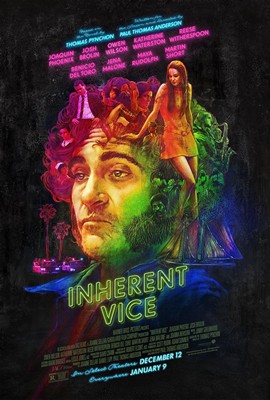
Inherent Vice (2014)

Inherent_Vice_film_posterIt’s not something you think about often but stoners and film noir fit together fairly well. Why more people haven’t capitalized on this niche is rather surprising. Think about it for a moment. Film noir in the classic sense is known for its private eyes, femme fatales, chiaroscuro cinematography, and perhaps most importantly a jaded worldview straight out of Ecclesiastes.
Some of the greats are also notorious for utterly baffling plots that come to no clear conclusion. Still, rather than chocking it up to faulty storytelling, these unfathomable aspects only lead to a greater ambiguity. Thus, you can imagine what occurs when our point of reference is on something. You take something that is already indecipherable and make it absolutely impossible to discern reality because there’s no sense of knowing what is actually real even before funneling down to specific plot points. Inherent Vice is precisely that film, a neo-noir bathed in rays and full of dopers.

Paul Thomas Anderson makes this affectionate and supposedly quite faithful adaptation of Thomas Pynchon’s novel connect most obviously through voice over. It captures a certain rhetoric — the poetic lyricism that manages to anchor the plot in some bewitching way — while also providing a great deal of latitude in storytelling which the narrative gladly capitalizes on.

This private investigator, Doc Sportello (Joaquin Phoenix),  is a benevolent stoner. His girl Shasta flutters back into his life and like they always do she comes as the bearer of bad news — a flower child in trouble with a lead for him to follow before she disappears into the night. Being a private eye he follows up the loose threads but he’s not necessarily a good private eye or a generally judicious one and that doesn’t bode well.

It’s pointless to try and tie everything together. In fact, this is as good a time as any to disclose that Reese Witherspoon, Benicio Del Toro, and Owen Wilson all show up but it’s almost possible to forget about them.

Doc investigates some vague leads about one real estate owner Mickey Wolfmann who has disappeared, gets word of a mysterious syndicate called the Golden Fang while searching after a member of a cult, and subsequently gets hired to find a missing husband. His worst enemy and greatest ally simultaneously is Detective Bigfoot Bjornsen (Josh Brolin). All the cases get resolved without the least bit of satisfying closure.

Still, the incomprehensible plot highlighted by absurdities is almost something that needs to be expected from a film such as this built out of the tradition of The Big Sleep (1946), The Long Goodbye (1974), and even Harper (1966). It’s another knowing riff off of the private eye pictures of old.

The bottom line being that precise malaise. It’s easy to lose it amid the stoned out status quo, characters medicating themselves on smokes and drugs and drink. They seem happy enough. At the very least they’re not torn apart by anything. And yet the very fact that Doc in particular witnesses so much — unveils so many things — and remains despondent is indicative of the whole story.

It’s an understated chill comedy that is meant to mesh rather ironically with the film noir world and like Altman’s film before it, there’s this lovely incongruity that works so well. All highlighted by the very fact that we fail to truly discover what is fact and what is fiction.

Everything is taken in stride rather nonchalantly by Doc who ambles along with his various leads in the relaxed manner that will remain his calling card. His attempts at scribbling down notes only result in random word clusters. But, and I hesitate to say this because it might give the wrong impression, in some sense, it does feel like we’ve seen this humor before in Airplane! (1980) and The Naked Gun (1987).

We like Doc. If he wasn’t high all the time, he’d probably be a pretty nice, cognizant, charming fellow but his response to all that is around him is rather pathetic and pathetic in the way of a dog with his tail between his legs. Flailing to the will of corrupt cops or allowing the vices of others to rule the day. But then again, what is he supposed to do in this world? The everyday villains are too many, the mountain to overcome is too high, and so he slowly sinks back into his fog. It’s a nicer, more comforting place to be than the world at large.

Cross that with Neil Young’s ambient jams in “Journey through the Past” and “Harvest” or the laid-back radio plays of 93 KHJ including The Cascades, The Association, Sam Cooke, and Kyu Sakamoto and it goes down pleasantly. As do the agreeable touchstones of Adam-12 and “Three Hour Tours” on primetime television.

It provides the film with a bit of the nostalgic haze that still manages scintillating vibes of sunny Southern California. But no one need remind any of these characters that this is the same beach paradise that saw the egregious murders committed by the Manson family, the shooting of Bobby Kennedy, the Watts Riots, and so on and so forth.

Taking a hit can sustain for a momentary high. Embracing your girl in the pouring rain can remain a fond memory. Music can float through your brain lazily. Television makes a nice diversion. The pursuit of money and power can drive a life for a while. But surely life is more than all of these — the things we use to mask the hurt and the pain we are subjected to as human beings — the numerous distractions in this “postmodern” world of ours. Surely there’s gotta be more…

4/5 Stars

Avengers: Infinity War (2018)

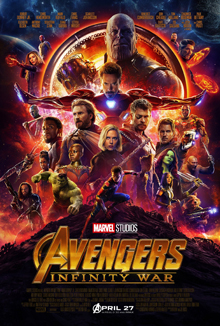
Avengers_Infinity_War_poster.jpgEntering into the latest Avengers blockbuster I felt like I was missing something thanks to a cold open that places us in an unfamiliar environment. It’s a feeling that has come upon me on multiple occasions previously.

Not only because as a mild enthusiast I’ve missed a stray entry here and there but I also easily forget interconnected events and after a certain point, why bother? We have come to accept there will always be another Marvel movie.

Yes, this is the culmination of 10 years that began inauspiciously with Iron Man in 2008 only to balloon into a skyrocketing phenomenon that will not disappear any time in the near future. Superheroes like Iron Man, Captain America, Thor, Hulk, and so many others have reemerged as integral parts of the public consciousness. And many fans have been waiting with bated breath for this day and they will wait again and again for future movies like it. That’s an established fact. Regardless, they can breathe a sigh of relief and thoroughly enjoy themselves with this realization of all their dreams up on the big screen. It will hardly disappoint.

To describe the plot of Infinity War is almost arbitrary as SPOILERS in this day and age are guarded against like the plague but here is a nibble anyway. Thanos (Josh Brolin), a being who has long been alluded to, is finally on the scene. The opening sequence is a microcosm of what he hopes to do on a cosmic scale, leveling half of the remnant left over from Asgard.

As a supervillain, he has a vision for the world that’s not too unbelievable. He seems to have been acquainted with Thomas Malthus’ work (even unwittingly so) while holding a contorted view of what empathy is. What others term mass genocide he deems an indiscriminate mission of mercy — killing half the universe’s population will mean resources are more widely available for everyone else left alive. He proves to be one of the most interesting characters within the narrative for the very fact we have barely met him before.

Infinity Stones also become of utmost importance again as Thanos must add them to his collection so he can rise to the stature of a demigod and dictate the outcome of all life with the snap of his finger. That’s some kind of power! The stones themselves are exquisitely color coordinated. One is safeguarded by Dr. Steven Strange (Benedict Cumbertach), another is implanted in Vision (Paul Bettany) and fiercely protected by his girlfriend the Scarlet Witch (Elizabeth Olsen). The Soul Gem brings Thanos back in contact with his two stepdaughters Gamora (Zoe Saldana) and Nebula (Karen Gillan) with grave consequences.

Everyone else who makes an appearance (and at times a lightning-quick cameo) relies on a viewer’s running tabulation of everything up until this point in the MCU. And though you’ll probably enjoy seeing these characters that you have some familiarity with — and you even laugh throughout — there is a sense they are only vague contours. There are too many of them for the resonance to run deep and personal. It really only works if audiences have bought into the machine and already have some background with these heroes in place. The scarier thought is if viewers do not. Infinity War would be void of any meaning. All flashes of imagery, destruction, and hyper-frenetic editing. Any other actual amount of personality would be absent.

Some people live and others die but to confess I didn’t much care whether any of these characters perished is one of the most unfortunate realities of the movie. It’s not that I know they are coming back necessarily or anything of the sort. I admit to being fickle. I can’t remember why I should care about these characters. Because for some so much time has passed since I had any connection with them. To watch them become collateral damage has little resonance with me. I’m numb to it.

I won’t make allusion to archetypal literature like Hamlet or film references like Star Wars or Harry Potter because in some ways that would denigrate that material. Am I being a bit harsh? Perhaps I am. In fact, it was Hary Potter and The Deathly Hallows (2010) we have to thank for this current reality followed close behind by The Hunger Games and The Hobbit. Stories like these coincidentally begun the practice now popular in the industry.

It was no longer about simply having sequels but milking a movie for all it was worth — breaking them up into pieces — making films that were meant to be a part of a greater whole.  It’s not a film so much as a commodity. Differing from the earlier examples like The Godfather movies or even The original Star Wars trilogy — those were pictures that very much could stand on their own merit. Not that they were not enriched and more fully realized with their later installments but we could consider them alone.

Infinity War comes out of this philosophy where a film was never meant to be taken by itself. Everyone knows it. The producers, the directors, the actors, and the audience.  By now as a collective assemblage of viewers, it seems like we’ve been cowed into submission.

I for one watched the movie and never quite relished it — there was nothing all that new or novel — and yet I was never bored per se. However, even my newest favorite superhero Black Panther felt like he was now fit into the Marvel mold. Nothing surprised. Nothing ignited a deep-seated exhilaration inside me. A Stan Lee cameo comes and goes.

Though the picture does promise action and verbal sparring which it delivers handily. In fact, if you consider the screenplay by writing duo Christopher Markus and Stephen McFeely, they do an admirable job with both the monumental juggling act and crosscutting of multiple storylines. The same can be said for the other dynamic duo directing, brothers Joe and Anthony Russo who must perform the same type of orchestration that would have buried a single director in his grave.

Still, there is an uncanny feeling the picture is made up of two kinds of scenes. You have action sequences packaged nicely with all the trimmings and CGI to your heart’s content. Then you have in contrast many stagnant sequences with all these big names standing around in a single location talking it out usually over some point of conflict, sprinkled with a few jokes or exposition that feels all too familiar. The well-timed comic relief disguises how run-of-the-mill everything is.

That’s what’s Marvel has in many ways perfected. In this regard, there’s nothing lacking and if it’s what you signed on for now 10 years ago (without even realizing it) it takes little hesitation to say you will be satiated at least until the next Marel movie and the next installment of Infinity War in a year’s time.

However, I couldn’t help but leave the experience feeling slightly lackluster about the affair. Because in many ways Infinity War is the culmination of a generation of films and really the emblem of where Hollywood continues to head. Sure, we have yet to get the second half of our story but if this is any indication of what we have to look forward to in the future, it does look like a fairly blasé fate at that. Though the jokes and the pyrotechnics are present in full force, there is little magic — that certain amount of intangibility lifting entertainment above the mediocre and allowing it to capture our imaginations. My only question is — as someone unread in Marvel comic literature — what could the Deus ex Machina possibly be?

3.5/5 Stars


Coco (2017)

Coco_(2017_film)_poster.jpgIt only serves to show where my mind goes when I watch a movie. I couldn’t help but think of Harry Chapin’s elegiac and stirringly heart-wrenching tune “Mr. Tanner” as I was ambushed with some of the most revelatory notes of Coco. The most meaningful line out of that song relates how music made our eponymous hero “whole.” I feel the same guttural satisfaction blooming out of this picture.
Coco proves to be a film about many things. This is a film about music melded with family. The wholeness that comes out of music when you do it for sheer love and passion. Because you couldn’t live without picking up a guitar or throwing back your head to sing. Serenading family or penning a love song is just an extension of who you are. If you know anyone like that you can thoroughly appreciate what we have here.

In the best ways, it’s also about when families and our passions and the traditions that we’re taught to live by and that are passed down to us seem to collide — wholly impervious to any type of reconciliation on first glance — yet still somehow capable of fitting together.

Our hero Miguel (voiced by Anthony Gonzalez) is a precocious boy who lives with his family in Mexico as part of a shoe-making matriarchy where they have long been taught to despise music because their no-good great-great-grandfather left his family behind to pursue his dreams as a musician. The conflict is created right there.

Visually it’s another inventive landscape for Pixar to play with under the helmsmanship of Lee Unkrich because though the setting and storyline are planted in the present world of Miguel’s family, it’s infused with rich undertones of Mexican tradition. Not least among those is “Dia De Los Muertos” or “The Day of The Dead.”

Except instead of taking that as a mere tradition or a cultural practice the film translates that into a fully animated reality as Miguel experiences the “afterlife.” There the spirits of his ancestors exist in skeletal form making a yearly pilgrimage to commune with their still-living relatives. Family is still of the utmost importance to their lives and the most tragic reality is to have no one left to champion your legacy.

The hero’s journey laid out before Miguel is direct and compelling so we know what he is up against. He must receive the blessing of one of his blood ancestors before sunrise or else spend his days forever in the land of the dead. Even now he’s slowly losing more of his definition a la Back to the Future (1985). The stakes are obvious and his inner conflict stressed by the very fact that his relatives will only provide their blessing if he gives up his true love: music.

There’s so much else that could be lauded in the film for how it dares to explore its setting much in the way Inside Out (2015) did. It boasts some clever reversals akin to those found in something like Toy Story 3 (2010) and plays on the themes of hero worship in a similar fashion to UP (2009) with Miguel being charmed by mythical singer Ernesto de la Cruz (Benjamin Bratt). It’s also a bit of a Ratatouille (2007) tale of someone pressing against the currents around them to realize their individual gifts. But far from being to the detriment of the film, every one of these similarities is a genuine compliment. Could there be too many themes even? I’m not sure.

However, the idea I was most taken with deserves a bit more explanation. I’ve purposefully refrained from talking about Coco until now. If you were like me you probably assumed that our hero was named Coco or something like that, without giving it much forethought. However, we soon find out that she’s the fairly senile great-grandmother of our main character.

Because a major aspect of this film has to do with this idea that can best be described as transgenerational memory — where we pass down our recollections of the people that came before us to the younger generations. It’s no small coincidence that the lynchpin track is called “Remember Me.” Because in digging into his family’s personal narrative Miguel develops a deeper bond with his great-grandmother. It’s striking how even as we grow forgetful our long-term memory, the entrenched recollections of childhood or even muscle memory, often stay with us. That’s precisely how it is with Coco and Miguel aids in keeping her memories alive.

In these moments I could not help but reminisce about one of my favorite musicians Glen Campbell who passed away just this past year. He was a high profile casualty of Alzheimer’s and yet during his last tour though he could hardly remember the words anymore to his most famous songs, his fingers were just as nimble on the guitar frets as they were as a young man. Amazing. One of his final tunes was the brutally honest admission “I’m Not Gonna Miss You.”

And I mention it in passing only to suggest that if the idea is that you will only be remembered if other human beings remember you then that’s a terrifying world to be subjected to. As a writer that means that I will fade away unless someone actually unearths some of the mindless drivel I penned and shares it. If I’m single it means I better find someone quick and start a family so my children can not only pass on my gene pool but keep my name.

Even the pervasive theme that two people’s love for each other will live on forever, though a nice sentiment, still rings slightly hollow. Not to be a nitpicker but eternity is a long time. Even a blazing meteor burns out at some point. So if you’re like me maybe Coco will get you to think long and hard about your mortality. I’m not sure the answers are that easy to come by but they’re necessary to consider nonetheless.

In the context of this life at present, Coco fittingly rewrites the negative admonition to never play music with a more positive call to never forget family. Taking the restrictive and making it ripe with promise. That’s something most of us can probably get behind and share with our kids and grandkids as the years go by because we won’t be on this earth forever. The question remains, what do we do if we aren’t so lucky?

4/5 Stars


Black Panther (2018)

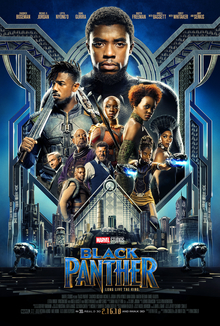
Black_Panther_film_poster.jpgFor some Black Panther might be a stellar actioner, consequently, brought to us by a visionary director, Ryan Coogler. It’s top-tier as far as Marvel movies come; there’s little doubt. For others, I completely understand if Black Panther rocks their entire paradigm because there’s so much of note here. The box office seems to confirm that just as much as the dialogue that has been created in its wake.
What’s so revolutionary about this addition to the cinematic landscape is that this is not simply a superhero movie created by a predominantly black cast and crew but that their very heritage is so crucial to the roots of the story. The identity and complex history of Africans and African-Americans is wrapped up in the very sinews of the narrative. A whole diverse patchwork of ancestry and generations of culture is meticulously infused into the African nation of Wakanda.

Many may have forgotten that in an earlier Marvel installment the king of the 3rd world nation of Wakanda was killed in an act of terrorism. His son T’Challa proved to be next in line to the throne as long as no challengers arose from any of the five tribes that encompass the country. In such a case the two warriors take part in a ritual combat.

Far from just having intricate primordial traditions, the nation has also long-harbored an immense secret. Under the pretense of an archaic nation, they have built a technologically advanced empire around the versatile metal vibranium. In order to keep its properties protected, they have foregone sharing it with the world at large. Already you begin to see one of the primary themes running through the film. With great power comes great responsibility. How you choose to wield it is of vital importance especially when the world around you is hurting.

I have long been a fan of Ryan Coogler and Michael B. Jordan and the partnership continues to impress. Coogler somehow managed to take a Marvel franchise film (which we’ve had too many of) and turned it into a radically personal picture. It works on both levels — arguably catering to all audiences.

His female characters are imbued with tenacity and still a capacity for great good. Lupita Nyong’go is a perfect example as the lifelong sweetheart of the ascending king T’Challa because she has left her homeland to help the oppressed in less fortunate lands. She jokes that she would make a phenomenal queen one day because she’s stubborn but it’s the truth.

Meanwhile, the king’s mother (Angela Basset) is stately; caring deeply for her children while his sister (Letitia Wright) is feisty and blessed with the ingenuity of an inventor. She’s the Wakandan Q if you will. And there’s Okoye (Danai Gurira) the fearless leader of the all-female royal guard. Far more than an assassin, she is guided by a sense of honor and loyalty that splits her right down the middle.

Many people will be happily surprised by a soundtrack that synthesizes original music by Kendrick Lamar with a score by Ludwig Goranson (Community) infused with distinctly African instrumentation. It makes for a satisfying marriage in music. But no less impressive are the intricate costumes and set designs which develop this appealing aesthetic of the old with the new. Coogler’s team seems to have a very keen awareness of both which is refreshing.

When Black Panther falters at all the problem is simply due to repetition. After 17 other entries, we can hardly blame a film like this for doing something that’s seemingly derivative even momentarily. It’s inevitable. Because if you’ve seen one fight scene between two agile, armored superhumans you’ve seen them all to some extent.

And yet this picture does so much more within that framework that’s moving because there’s a certain ambition and an innate understanding of what movies are capable of. They can help us cull through crises while still maintaining the exhilarating guise of a superhero action flick. It’s true that at times it feels like we are watching a Bond film only rejuvenated with more diverse characterization.

Like the best films in that franchise or any other really, the villains are noticeably tempered in a very particular way that is stimulating. Yes, multiple bad guys, and when I say that I mean that each has unique shading giving us different looks. Andy Serkis is the chortling international arms dealer who seems small scale and yet he’s made dangerous. There’s a distinct edge to him.

Even more important is Erik Warmonger (Michael B. Jordan) because he acts as T’Challa’s character foil. As we find out, they have a lot more in common than they would have been led to believe except Warmonger has more sinister intentions. The joy of Jordan’s performance is that the character is high-functioning, charismatic, and actually poses a threat as we see on multiple occasions. But no matter how twisted or misguided he might seem there’s still some level on which we can understand his lifelong resentment. Also, let me just say it now. From his clothes to his swagger, he just looks cool…and supremely confident.

Meanwhile, fellow tribesmen such as M’Baku (Winston Duke) and W’Kabi (Daniel Kaluuya) do not necessarily have sworn allegiances staked out and so that gives them some agency to shift the tectonics of the story this way or that. Again, they have a certain amount of power that gives them an undeniable presence.

Like The Winter Soldier or Civil War (arguably my favorite Marvel entries thus far), the villains are compelling because they invariably feel planted in the real world or better yet they’re made up of friends and family. There’s nothing more disconcerting than people who aren’t villains at all and yet they still go in opposition of you.

Thus, Ryan Coogler has succeeded in constructing a layered story that might be one of the few Marvel films I would gladly pay a second viewing to. It hinges on so many issues with consequences for our contemporary landscape. Again, with great power comes great responsibility.

It deals with the afterlife as represented by the ancestral hunting grounds where first T`Challa and then Erik commune with their fathers to receive insight. For the former, it means reconciling with his father’s own failures during his lifetime so he might not make the same mistake. For the latter, it means connecting with his own father about their joint Wakandan heritage which Erik never knew first-hand living in America.

Black Panther calls into question themes of isolationism as much as it does a complicated history of colonialism. Look no further than the African artifacts exhibit in the History Museum and you can plainly see that we are still grappling with the same issues planted in the same past. Far from dismissing it, we would do well to continue to entertain a dialogue. The roles that museums, archivists, and archaeologists play in all of this are important too. Suddenly, even for a brief instant, I’m starting to second-guess Indy’s obdurate assertion that artifacts belong in a museum. Where do we draw the lines on such an issue while not unwittingly promoting colonialist traditions? I don’t quite know.

The final words of Warmonger linger in my mind as well:

T`Challa: “We can still heal you…”

Warmonger: “Why, so you can lock me up? Nah. Just bury me in the ocean with my ancestors who jumped from ships, ’cause they knew death was better than bondage.”

His words sting, as they should because so much truth dwells right there. I have always struggled to reconcile those very things because for being a nation made of immigrants the African-Americans are nearly the only ones who did not come to The Promise Land of their own volition. The handprints of such a reality can still be spotted in our world today.

There are deep roots that are set in place. In the History Museum corridors, you see documentation of a muddied past of colonialism. Then, in Oakland (Coogler’s hometown) along with basketball and Public Enemy you see obvious signs of social decay and problematic issues of drugs and gun violence.

The fact this is actually put out there is nearly a relief and a necessity. However, and this is a big however, there seems to be an underlying hopefulness that we can somehow live together. Marcus Garvey once proposed blacks recolonize their native country and that in itself brings up other issues of cultural identity.

Erik Warmonger is right at the center of that with African descent and yet longheld ties to American society. What do we label him? I’m not sure we can. I’m not sure we need to. That’s for the individual. Regardless, it’s a work in progress. Messy no doubt but hope is still present.

Like Fruitvale Station (2013) before it, being rich in black culture by no means suggests that the film is completely exclusive in the same regard. Far from simply being a token white person, Martin Freeman is allowed to be a hero just like his counterparts, and anyways maybe for once, it’s okay for the Caucasian characters to take a momentary back seat if only to allow other voices to speak.

What we are left with as King T’Chala addresses the United Nations is not the sense that one people group is better than another or the new should overthrow those who have long been in power but that we should find those points of intersection — the things that unify us.

“Now, more than ever, the illusions of division threaten our very existence. We all know the truth: more connects us than separates us. But in times of crisis the wise build bridges, while the foolish build barriers. We must find a way to look after one another, as if we were one single tribe.”

It’s a fitting summation because this is a film that draws up different tribes, turns people against each other nearly in an instant, while constantly rearranging factions and who holds the keys to the kingdom. If it’s resolved in the end it’s only a fragile peace at best and if we are to maintain that we need far more than vibranium. We need a heavy dose of human understanding and empathy.

We can acknowledge our past failures as a society but must never allow them to shackle us for good. Mistakes are meant to be learned from. It’s when we’re not willing to learn and to change, that dire straits look inevitable. I hope for our sake that the film’s call-to-action might still stand true.

But the film itself is also an imperative to take deep abiding pride in your heritage and who you are as a human being — unique just as you are. Thus, it seems utterly misguided to desire a future world where we do not see color. Instead, we might yearn for a day when everyone can look at the rich strains of human diversity and proclaim “It is very good.” Where we can survey that same world and see that every color, creed, and tongue is finally one tribe instead of many.

4/5 Stars

Fruitvale Station (2013)

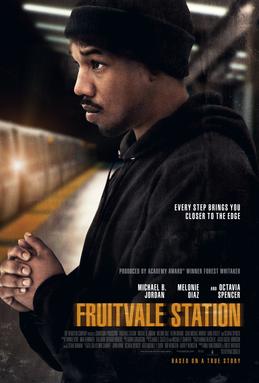
Fruitvale_Station_poster.jpgRyan Coogler is from Oakland, California. He was attending USC Film School in 2009 when Oscar Grant III was shot near the BART station. From those experiences were born his first project. He envisioned Michael B. Jordan in the lead role. Thankfully his vision and the casting came to fruition.
I appreciate smalltime gems like Fruitvale and Short Term 12 (which both came to by attention at the same time). Maybe they are very intentionally crafted into these intensified dramas with heightened bits of reality but there’s also something meaningful in how they are able to tell smaller scale stories in an economical way. That in itself is an art just like making a cohesive blockbuster is an art.

The allure of the picture comes in putting us in the moment. Coogler works in capturing the final hours of Oscar Grant’s life which would seem mundane and unextraordinary if it weren’t for how they were capped off. It’s a film that breeds a certain amount of empathy because the camera is always over the shoulder, at the hip, or in the most intimate spaces putting a lens on what is happening.

But when the picture turns tragic there’s this undeniable sense of immersive drama while still crafting a story that connects to all of us. It feels as if all facets of Oscar’s character are put up to the light.

Because if you put up the magnifying glass to each of us you soon realize that we don’t always act the same way around everyone. When you see Oscar in his different interactions each person brings out something else in him. And he is very much a people pleaser.

What the story offers up are these perfectly manufactured moments (some better than others) to capture the contours of a single individual. None is fake per se — a facade if you will — but oftentimes various interactions bring out a certain side of someone. The lady attempting to have a fish fry and struggling miserably appreciates Oscar’s genial nature to call up his grandma and get her help. There’s the entrepreneur who has created his own web design business who thanks Oscar for finding a bathroom for his pregnant wife. Even the dude who comes to Oscar to pick up his smokes.

They are hardly central characters but each interaction serves the purpose of the story. However, this is not solely a film for the African-American community though it was an important story to tell.

Coogler in the way he purposefully draws up the narrative seems to be suggesting that it is for all of us. It’s not about color as cut and dry as black or white. It’s not even about good versus evil. It’s about issues of race and violence and injustice still clearly visible in our world. But not in a way that makes one party out to be the hero and completely demonizes another.

We connect with Oscar no doubt but we see his flaws as much as his humanity. He’s gone through a long stint in prison. His temper smolders dangerously as much as his spirit is generous to his friends. He rather immaturely covers up his troubles at work. But he’s 22 years old. In fact, maybe its just that. His flaws are his humanity.

And with the law enforcement we see the brutality but what is just as prevalent is fear and confusion. In the heat of that moment I’m not sure what I would do. All I can do at this point is give the benefit of the doubt and mourn the loss of a human being taken from this earth far too quickly in the worst circumstances possible.

Its true the fateful moments — seen in real cell phone footage at the beginning and reenacted later on — are full of chaotic tumult that we can’t quite understand. What’s even more haunting is the fact that Coogler got permission to shoot in the very locations where Grant was fatally injured. In that specific sense, the film couldn’t be more authentic.

One of the sequences that resonated was the communal prayer in the hospital corridors. It’s true you can read someone’s character in the times of pandemonium but also immediately following. It’s in the turbulence where Octavia Spencer takes charge in the best way she knows how and probably in the most effective way. Because there’s a helplessness in the air. This is one way to keep things together.

It’s one of the films most unifying moments for me because amid the torrent of understandable anger and apprehension it establishes a singular instance of calm in the wake of such emotion.

The film ends much as it begins with footage of the real because that’s what this is in a sense. Reconstructed, undoubtedly stylized and put back together with inevitable human biases as it may be, I appreciate its efforts. The intentions seem candid and the results speak in such a way that though calling out this brutality is more concerned with making Oscar into a version of a human being not just another thug or a victim to be pitied in order to rally a cause.

Didactic films get tiresome but Fruitvale Station rarely feels like that. Its platform undoubtedly is a social one and yet the director quite adeptly makes sure his narrative resonates on an individual less austere level.

Of course, to form a truly robust, well-informed opinion of the events more accounts would be necessary but as a film there is definite quality in this production. I still hold that Ryan Coogler and Michael B. Jordan have one of the best collaborations going on in movies right now. Here’s to hoping they don’t let up anytime soon. I’m eager for more stories from them. I think many other people are thirsty for them too.

4/5 Stars

Thor Ragnarok (2017)

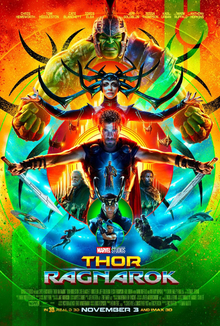
Thor_Ragnarok_posterMy heart lept in my chest when I heard that Taika Watiti (What We Do in The Shadows) was going to be helming the latest Thor movie. Because it’s hardly a well-kept secret that Thor has essentially been the weakest of all the Marvel threads (Hulk’s individual film excluded).

So once more Marvel has done an impeccable job of keeping lukewarm bandwagoners such as myself mildly interested. Benedict Cumberbatch as Doctor Strange. Brie Larson in the upcoming Captain Marvel movie — another personal favorite. Then, we have Ryan Coogler directing Black Panther with one of the most glorious casts in recent memory. They make their product so alluring despite my general lack of interest in the perennial juggernaut.

But back to Thor Ragnarok which goes far beyond the quip-filled, light-hearted humor that Marvel has often boasted, to great success, I might add. Even with its darker moments and strains of drama, there’s little doubting that Watiti’s brand of near insouciant humor is alive and well. Exhibit A is the very fact that we are reintroduced to Thor (Chris Hemsworth) as he swings precariously from a rocky prison encased in chains about to be executed by a fiery conflagration of a villain.

In case you haven’t realized it already what we are about to be served up is a comedy about an apocalypse. Oxymoronic as it may sound, the film all but pulls it off. Still, more explanation is in order.

Thor returns to Asgard only to begin quibbling with his black sheep of a brother Loki (Tom Hiddleston) just like old times. They call on their father (Anthony Hopkins) whose imminent death is less an ending and more a god-like dispersal. There are other asides involving Dr. Strange (Cumberbatch) and yes, we even found out a little bit more about the Hulk and what Bruce Banner (Mark Ruffalo) has been doing the last couple years.

Being the weasel that he is, Loki’s always betraying his brother and Thor winds up getting captured by a former Valkyrie (Tessa Thompson) who has taken on the life of a slave trader, bringing in fighters for the Contest of Champions. Thor is destined to be the newest attraction on center stage.

Watiti most obviously makes his general tone felt in the film through his own character Korg, a giant rock monster who is more like the Michelin Man than The Thing. Watiti’s understated voice coming through so clearly as he matter-of-factly talks about the not uncertain death that awaits nearly everyone. But he’s also handy for a few rock, paper, scissor jokes as well.

Jeff Goldblum is probably the film’s other finest creation for his own brand of oddly perturbing flippancy with gladiatorial violence and hedonistic relish of death matches. But in the same breath, The Grandmaster also happens to be probably the funniest addition to the cast for those very same reasons.

In fact, it’s these themes touched on briefly that are most crucial to drawing conclusions about Ragnarok. It’s deeply entrenched in issues of death and mortality, violence and warfare. By no small coincidence, the main villain brought to the fore is Hela (Cate Blanchett) who helped Odin build his kingdom and has come back to rule it as her own. It’s not a particularly inspired creation but what did we expect? It is what it is.

Meanwhile, Led Zeppelin’s “Immigrant Song” is the film’s favorite hard-hitting tune to conjure up for perfect trailer sound bytes to crosscut with the action at hand. Whether it serves any other purpose aside from just being a bit of retro-cool is probably beside the point.

There’s a line that seems apt for such a film that I couldn’t help recalling. It goes like something like this, “We laugh at death because we know that death will have the last laugh at us.” It’s one thing to make light of death as a coping mechanism and as an outlet to grapple with something we don’t completely understand, quite another to completely dismiss it. Because the far easier road is to try and evade dealing with it altogether.

The usual CGI extravaganzas and spectacle aside, there is something still to relish in this movie. What I’m trying to say is that Thor Ragnarok is a deathly funny superhero film. In spite of the usual tiresome amount of pyrotechnics, random cameos, and overzealous action sequences, there is an ephemeral and still a delightful enjoyment to be found in this picture. It no doubt bears the imprint of Watiti while still wearing some of the tiresome Marvel tropes.

The one theme it does suggest most overtly is that “Asgard” was built on past indiscretions, bloodshed, and violence. But moreover, the mythical nation is not simply a place. It’s the people that make it up. And in the wake of an apocalypse, it’s some amount of solace. That and Jeff Goldblum giving the commoners a pat on the back. It’s always good to undercut solemnity with another punchline following the credits.

3.5/5 Stars