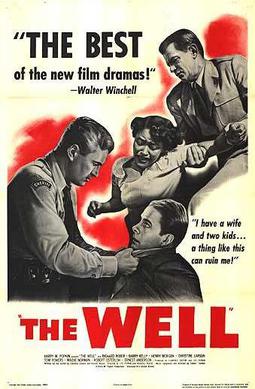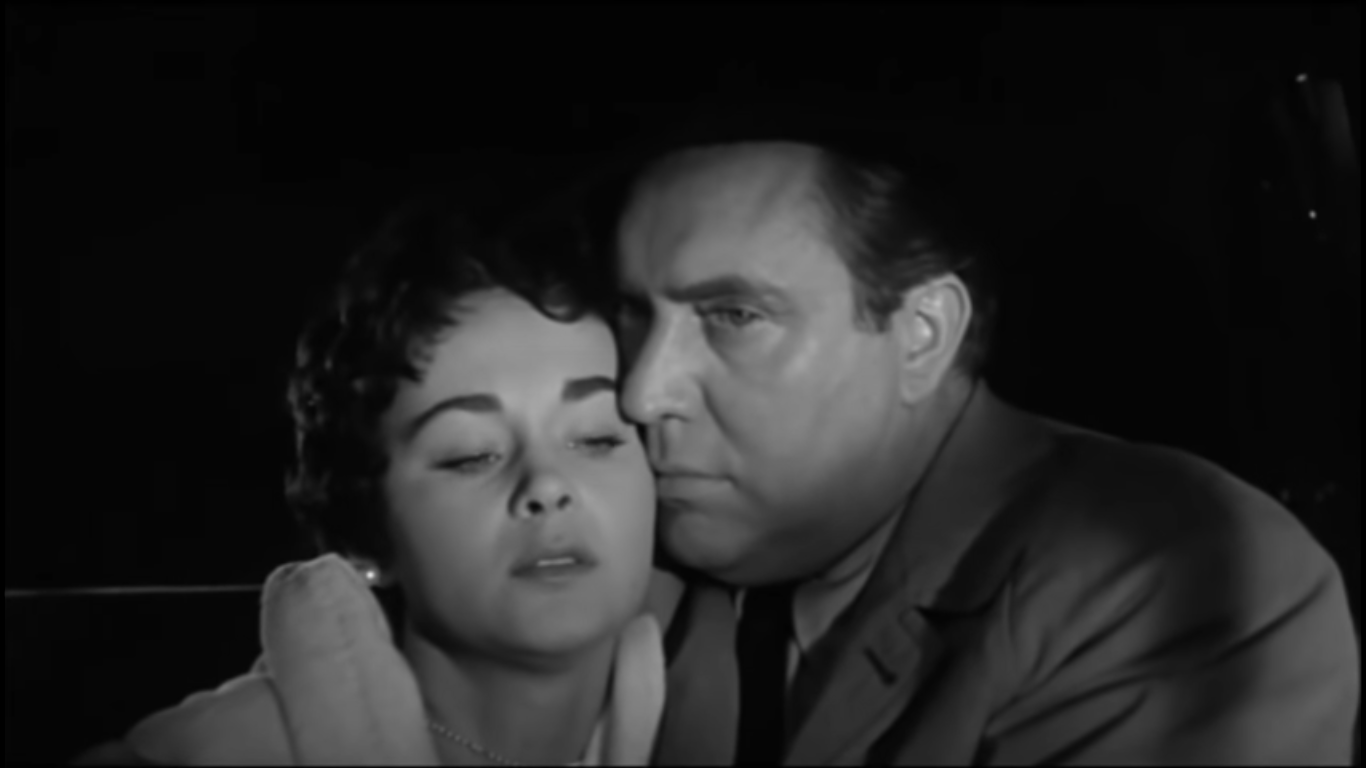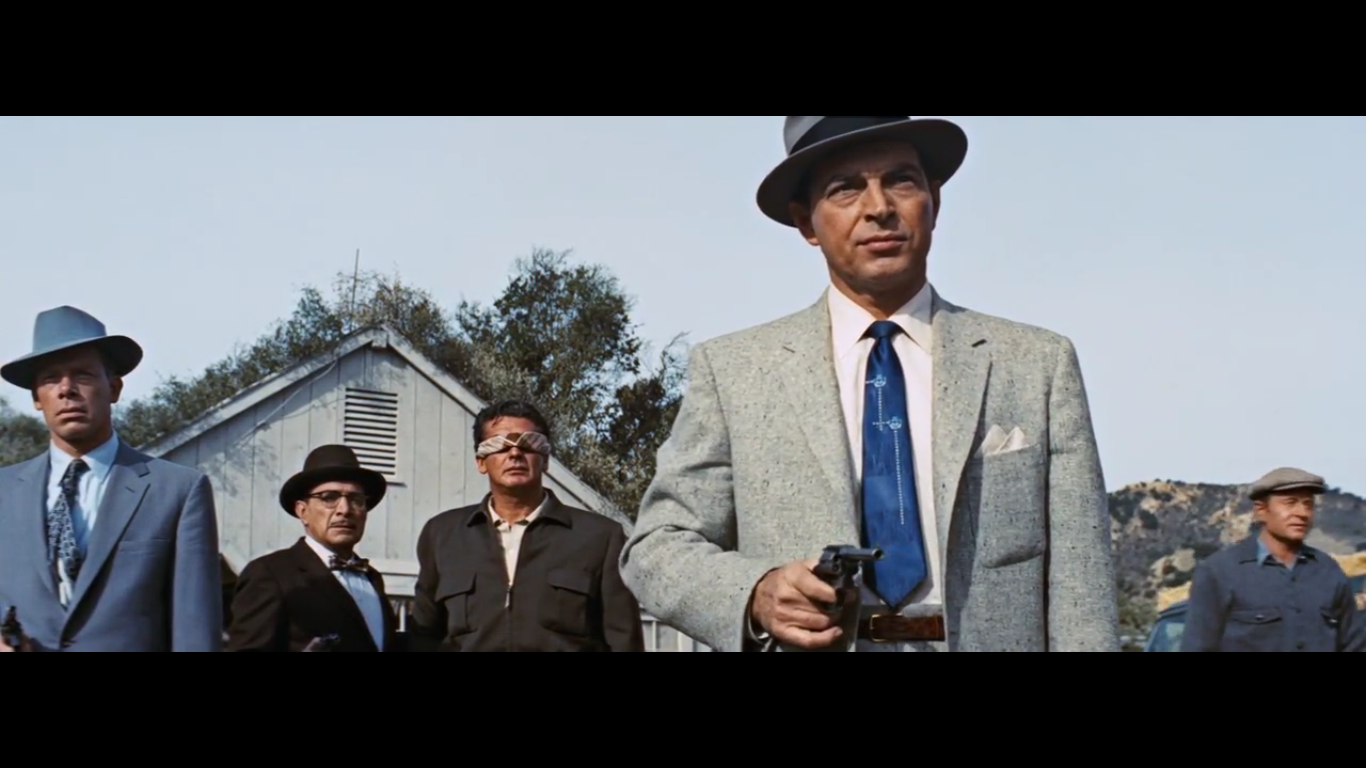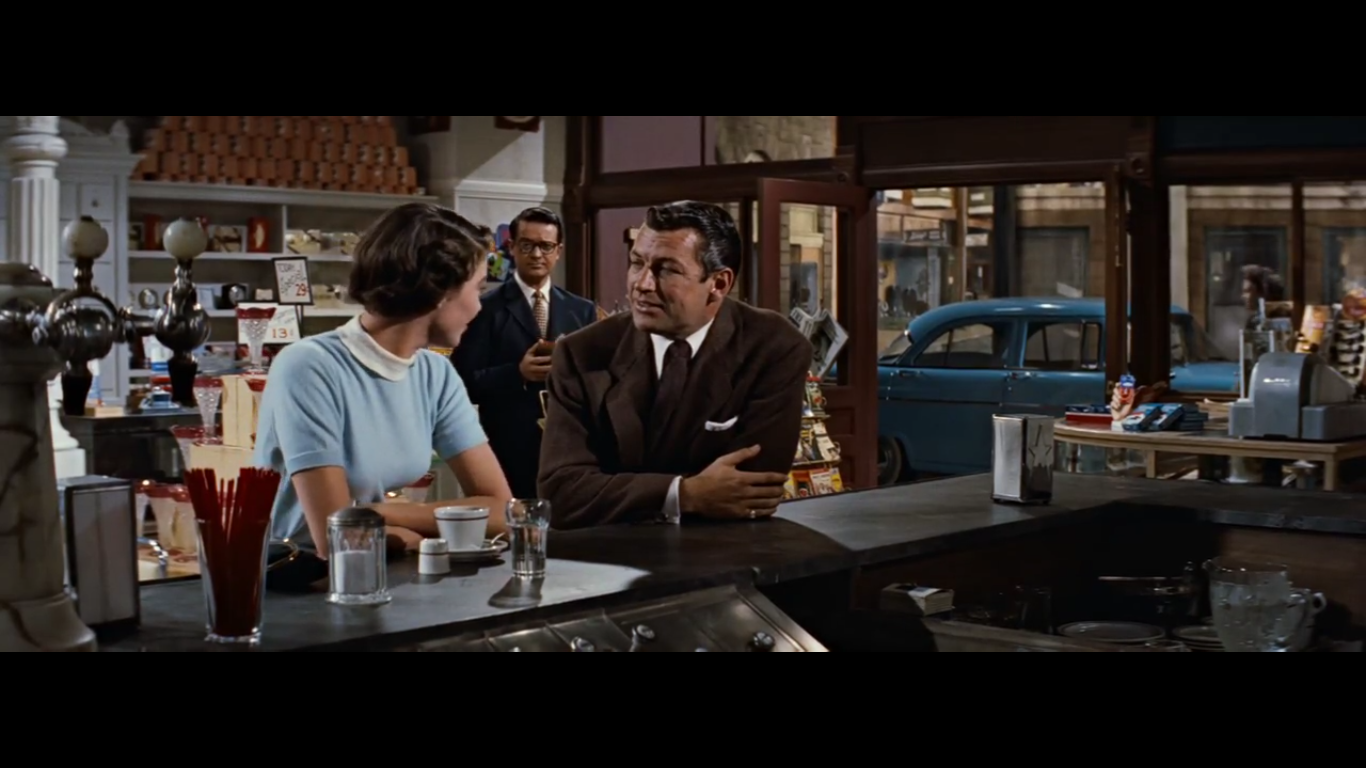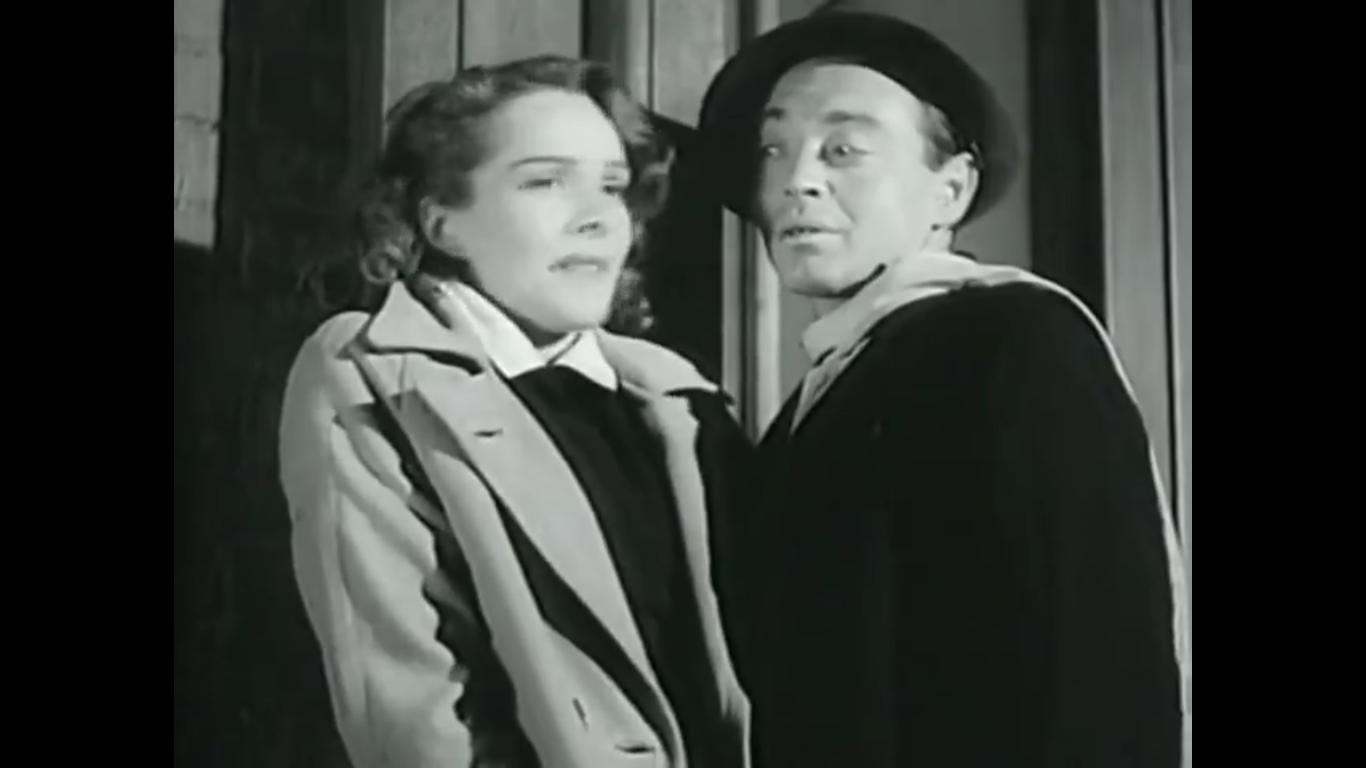
The Well (1951): A Noir about Racial Tension and Resolute Hope

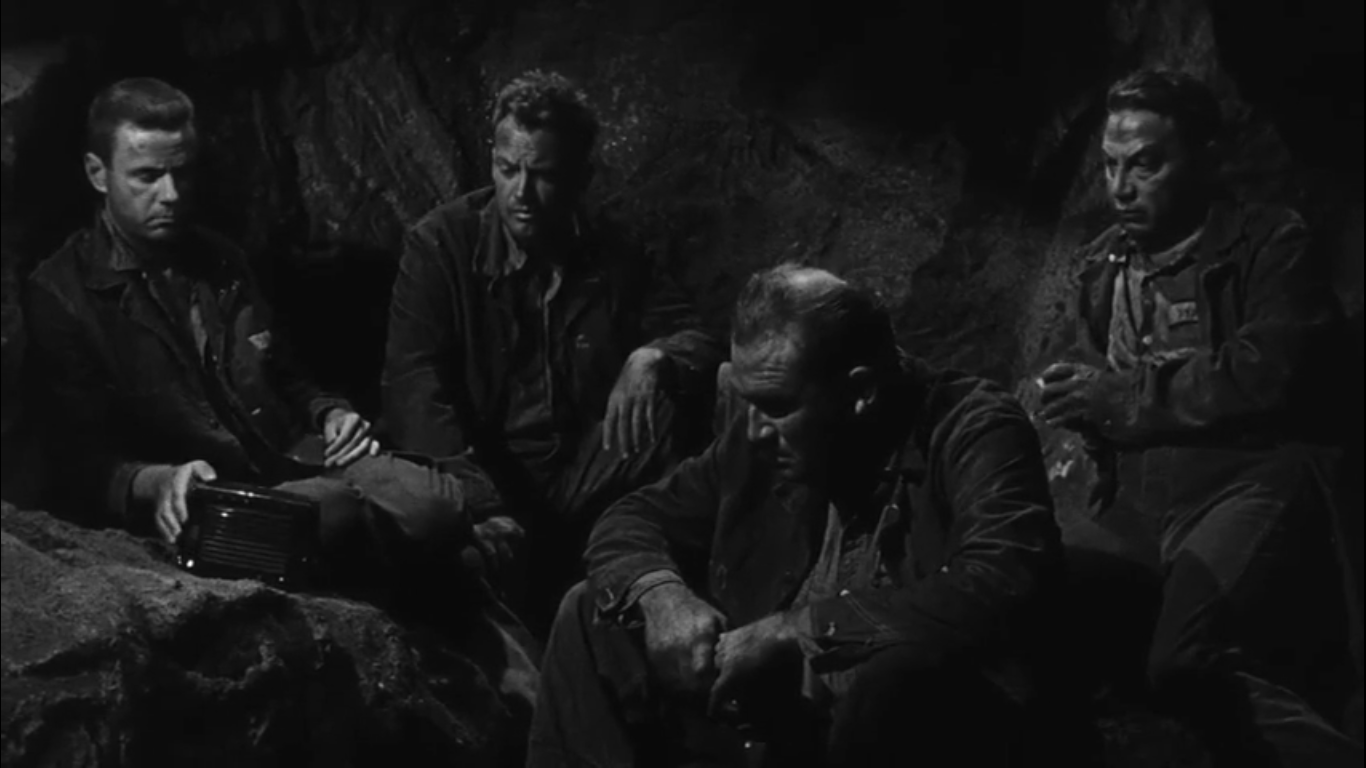
The film opens when a little black girl named Carolyn tumbles into a well buried beneath some weeds. There’s a melodramatic handling of the material, but already we see something rather uncommon with the period noir. Normally black characters live on the periphery of film noir if they exist at all.

Here Martha (Maidie Norman) and Ralph Crawford (Ernest Anderson) reach out to the local Sheriff Ben Kellogg (Richard Rober) when they learn their 5-year-old daughter has gone missing. They become the emotional center of this local drama with greater implications. As an aside, it’s a pleasure to see Ernest Anderson once again.

Those who recall him in This is Our Life (1942) will remember him to be a performer of tremendous intelligence and dignity. It’s only a shame the impediments of prejudice meant he never had a more sterling career. This film acts as a small recompense.

Upon closer inspection, The Well has shades of some other movies like Captive City or Phenix City Story where there is an adherence to faux realism as we kick around the beat meeting people, and getting to know the world they call home.

It’s fascinating to witness how this inciting incident — the disappearance of little Carolyn — sets the story in motion with Russell Rouse and Leo C. Popkin slowly turning the screw. Because it’s true there’s something rather insidious about this movie causing it to wheedle its way into our psyches.

It feels more relevant and more compelling than many of the old procedurals because of the subject of the case. It’s not just about a crime, but it’s complicated and made more tenuous with this added layer of racial tension, a very real issue even today.

Being a lifelong MASH aficionado, there’s something pleasing about Harry Morgan playing a central role as mining engineer Claude Packard. It’s quickly corroborated that he may have been the last person to see the girl; he’s a stranger from out of town, and curiously enough, he bought her a flower before sending her on her way.

It doesn’t take a genius to put all the pieces together and the racial element along with circumstantial evidence quickly brings the out-of-towner under the observation of the police.

The rumors quickly make the rounds throughout the neighborhood. In one brief vignette, a group of black students sits at a library conversing about race prejudice and a white man accused of a crime against a black child. It’s easy to forgive the blatant quality of this scene because it feels entirely unique for the era. I’ve never seen a moment like this before. But it’s not just a matter of the film feeling ahead of its time. After all, a lot can happen in 70 years, and values can change, though many things like racism feel deeply entrenched.

Still, there’s a complexity to the film that feels quite groundbreaking with something to speak to our current moment. Rather like Sam Fuller’s The Crimson Kimono, it’s a film about race, but it takes a somewhat nuanced approach.

The dramatic situation is obvious. Here there’s a white man being held for a crime against a black girl. The added wrinkle is that he didn’t actually commit a crime, but that doesn’t impact how the execution of justice is perceived by all bystanders on both sides of the racial line. It’s so easy to buy the message, “You can get away with murder if you’re the right color” because we’ve seen it play out so many countless times.

It’s also true Claude’s uncle is the highly influential businessman, Sam Packard (Barry Kelley) who runs a local construction company. He’s prepared to pay bail for his relation regardless of guilt or innocence. He doesn’t seem to care what the man did even as Claude vehemently pleads his innocence. If you’ve ever seen Kelly in another picture, he slides so easily into this role accentuated by his corpulent build and a pair of beady eyes.

From the outside looking in it’s so easy to view this as a miscarriage of justice where the authorities are steamrolled and wealth and privilege are able to get a white man out of anything. We’ve seen this before too.

At this point, retribution is all but expected, and it escalates with each successive confrontation between the divisive factions of blacks and whites. Once a tipping point is reached it’s like a never-ending feedback loop descending into chaos and quickly stoking the fires of unrest.

It strikes me how the mob is always going after the individuals in an almost faceless fashion. And both sides do it. There’s never a familiarity. It’s always swift and unfamiliar. But this kind of violence and hatred only breeds in anonymity where others are dehumanized and not dealt with as other human beings. It makes it easier to disassociate and perpetrate acts of malice.

It’s easy to gather the rest of the film is paved with this kind of violence. A full-blown riot is set to blow up the town and overwhelm any semblance of law and order. A movie like this also shows how the borders around language were so contrived. So many words were banned from motion pictures and yet the N-word flies so easily. It always catches me off guard, especially if we’re used to the normally manicured veneer of Classic Hollywood.

There are so many moments I can’t forget, but most of them are small observations. Take for instance, once when a white officer has a black kid up against the wall; he’s battered and bleeding, and he’s one of the perpetrators.

It turns out he was brawling with five white kids who the officer didn’t find a need to bring in. He gets a look from his superior and proceeds to get reassigned to phone duty so another officer can take this battered boy to the hospital. It’s a moment like this encapsulating something damning about law enforcement and the wheels of justice.

Part of me was expecting the film to detonate. With everything we witness, it’s all but inevitable. I’m hesitant to admit it, but I almost wanted it to. Instead, we get something else that’s closer to what we need. It feels like a near-timeless denouement because I need it as much today as audiences did back in 1951.

It shows people trying to help each other and trying to patch things up and figure things out. This is the hard work of reconciliation that’s not glamorous or easily cobbled together in a few solitary moments. And The Well’s also not a cloying feel-good balm to make all the bleeding hearts feel their work is done. It can’t patch over all the lingering wounds and racial tension. Not even time has done that.

Still, even as I mentioned Kelley is so easily identified and cast as a villain, the film uses this to say something more. He’s no saint, but he’s also a human being.

Billy Wilder was apparently interested in bringing the story to the screen in some form. I can see the parallels between Wilder’s Ace in The Hole/Big Carnival and this movie. However, whereas Wilder’s penchant is always toward portraying opportunistic cynicism, here we see something vying for the communal good.

Because of course, someone finally stumbles across Carolyn and that well. The movie switches directions as quickly as it starts. The whole town including mean old Mr. Packard and the accused Claude rally together their resources to rescue that little girl because there’s a chance she’s still alive and that’s all they require to act on.

That little girl becomes so crucial to this story representing so much more than her individual little frame. Forgive me, but I couldn’t help thinking about how George Floyd came to represent something else entirely in June of 2020.

I won’t try to come up with comparisons. All I know is that this movie deeply affected me, and I hope and pray that we might live in a world reflected in the rescue of that little girl. Because it says so much. If that little girl is alive now, over 70 years later (either in the film’s world or ours), I would hope she might stand as a beacon of what can be done.

What would it say about our towns if we were willing to go the extra mile to save the lost, the least of these, and the people who look different than us? It would suggest each of us has innumerable worth regardless of our skin color. It’s part of what makes us unique and individual.

These are not faceless beings lost in the masses but people known and loved. And what if it was not lip service or political PR, but actually lived out in our every day because it was the right thing to do. This feels like the movie I needed right now.

4.5/5 Stars

Note: I originally wrote this review in November 2021

Shield For Murder (1954): Edmond O’Brien Gone Bad

In a movie like 711 Ocean Drive, Edmond O’Brien proved himself capable of being a cad over the course of his performance. With Shield for Murder, there’s no buildup or pretense. He establishes himself as a stone-cold killer right from the outset before we even get a peek at the credits. It’s a tough, uncompromising introduction and to his credit, he sells out to make his role of Barney Nolan one of his most memorable.

Having seen a decent number of his performances, I consider this a compliment because more often than not, he turned in spirited even gamely performances. Whether starring in B-grade features or supporting in A-listers, he had a knack of bringing something enviable to his parts — something you don’t soon forget.

In Shield for Murder, he’s a veteran cop with 16 years on the payroll. One of his colleagues (John Agar) is the first to the crime scene, and he gives Barney the benefit of the doubt because he owes the man his life. In truth, he idolizes him, and for very good reason. Barney’s the man who picked him off the street as a boy and straightened him out. You can’t just overwrite that history in a matter of minutes.

For the time being Barney is in the clear. After all, he’s on the side of law and order. At the police precinct, Emile Meyer brings a level-headed, no-nonsense stability to the role of the police chief. An in-office journalist provides a worm’s eye view of life inside the station’s walls. Being a veteran on the beat, he holds a jaundiced eye and remains skeptical of the crooked cop when everyone else believes in his integrity.

If noirish pictures require corruption and duplicitous activity in the shadow hours, then there also seems to be a prerequisite for female counterparts. The way the camera lingers over a scantily-clad Marla English looking herself over in the mirror almost feels indecent. It’s like another leering face.

What it does do so effectively is create a kind of instant juxtaposition. Because Patty Winters is the picture of innocence. English who was only 19 at the time, has such a warm face and this moment suggests a hint of insecurity more than any amount of vanity.

When we find out that she’s Barney’s girl, suddenly, their attraction fits together, and we can understand how they gravitate toward one another. They both hold something that the other does not. Even as her jealous beau orders her to give up her spot as a cigarette girl, he whisks her away to a model home.

Barney shows it to her proudly. It’s pre-furnished and the kitchen is full of all the latest appliances for modern living. They go to the master bedroom. It’s almost scandalous again, but they are so genuine and happy. This is the very evocation of the 1950s American Dream in suburbia. While he’s not rich, he’s a proud man. The money he acquires and buries on the premises are so he can take care of her. Never mind how he got it.

And yet that’s just it. If the pre-credits are like a violent sock to the gut, providing a first impression of this man, then all the humanizing events that follow cannot totally redeem his character. Surely there is a sliver of good in him. He hasn’t always been this way, but there’s also a sense it cannot make up for his sins.

First, it’s the bookmaker he shoots in the back. Then, it’s the deaf and mute witness left for dead on the stairs. These moments punctuate the story, and they act as staves between Barney and his friends. He’s driven away from them — holding secrets from them out of necessity.

In one memorable extended scene that feels a bit like an aside, Barney sits at the bar downing drinks. There’s a platinum blonde sitting nearby, who doesn’t speak for a moment. Carolyn Jones plays the woman, and she’s an effective foil for Patty — an alternative for the moment. They share a Spaghetti dinner, except Barney isn’t hungry. Instead, he pummels the two tails a local kingpin has set loose on him and leaves the family joint in a shambles.

The final act can only go one direction, and it’s the road of devastation. He becomes a wanted man on the run from his own colleagues, and the man leading the investigation is his best friend; no matter how uncomfortable the current situation , it cannot be any other way. It’s too late. Out of desperation and fear Barney wants to take Patty away. She doesn’t recognize the gravity of the situation. She becomes emotionally traumatized as he flees the scene.

Everything choice going forward only buys him more time. He dons his old policeman duds as a disguise. He seeks refuge with Richard Deacon, who’s hardly the criminal type. He’s busy poring over his academic textbooks as the desperate cop looks to broker a trip out of the country.

I’m pleased to say the finale actually works a bit better than the crescendo of 711 Ocean Drive, if only for the fact it localizes the action and makes it more accessible to all of us. We are able to understand the threat of the gunfight in such an intimate and ordinary setting. He has it out with a gunman at the Union Heights indoor swimming pool in a sea of shrieking bystanders.

But he must make it to his money at all costs. These final solitary moments we have with him totally crush any idealistic notions of the great American dream in post-war society. It blasts a hole right through the entire thing.

While Shield for Murder is blunt in its symbolism, there’s something rather poetic, even fitting, in how it chooses to wrap up the tragic trajectory of a cop who’s gone sour. He’s the good man — formerly a straight arrow — who watched his dream crumble around him. We see it firsthand. It’s brought on by his own aberrant desires.

However, thanks to O’Brien, it has everything you expect, nay demand, in a gritty crime picture totally immersed in murder and corruption. When the end titles come, they feel earned like the movie has delivered on the fatalism we want. There’s little that pretty or polished about it, and in the annals of noir that’s more than a good thing.

The star makes it more than worth the price of admission (especially in the 1950s). There’s probably not a sweatier protagonist, and in a noir film that plays like yet another compliment. He makes us feel his anxiety as well as his deceitfulness.

3.5/5 Stars

711 Ocean Drive (1950): Joanne Dru and Edmond O’Brien

It serves the filmmakers to begin with an opening crawl about how organized crime tried to halt production of the movie, and they would have succeeded too if not for the bravery of the police on set. Whether or not it’s true, it plays as easy publicity for the film to feed off of. Today it feels needlessly trite.

Regardless, there is no movie without Edmond O’Brien. He’s more than up to the task as an electric wiz who works for the local telephone company. Mal Granger is a fairly likable guy; he’s free and easy with his money when a pal needs some help. In fact, he’s maybe a bit too free. His one vice is the horses, and he and his bookie know each other on a first name basis.

It’s Chippy (I wish we had more movies with Sammy White) who gives him big ideas: he can take his know-how and really go places. He’d be in high demand! Soon the connection is made, and he’s doing a lot of electrical work for Vince Wallace. Barry Kelley was made and no doubt typecast for playing seedy, slightly paunchy shysters. In this picture, he has an army of men relaying all the info from the race tracks.

Granger helps amplify their reach as they build a vast network that radiates out across Southern California. As purely a historical lesson, it is intriguing to watch O’Brien as he unfurls the latest technological gadgetry circa 1950.

They get so successful that the gangster’s legitimate business, Liberty Finance, catches the attention of the police. Soon enough one ambitious telephone repairman will be on their radar as well. Because he’s beginning to realize how important he is — he starts getting ideas of his own — he wants his due.

Although he has some faithful stalwarts around him like Chippy and Trudy (Dorothy Parker), it’s not a benevolent business. Because with every stride he makes, there’s always competition. The film’s next invention is an eastern syndicate run by a slyly imperious Otto Kruger. He moves all the chess pieces without taking part in any of the dirty work. He manages it all quite well with Palm Springs business meetings on the West Coast when needed.

For having prominent billing, and why not, Joanne Dru is quite tardy to the picture. We meet her in a nice hotel bar. She’s waiting for her husband (Don Porter), another underling in the syndicate, who has the task of wooing Granger. Their offer to cut him into their operation also comes with a veiled threat.

He’s not dumb, but he also sees the path of least resistance and with it exponential dollar signs. The pretty girl doesn’t hurt his eyes either. It hardly matters to him if she’s married. He starts shouldering in on the territory with his usual tenacity. It’s what sets him apart and simultaneously never leaves him satisfied.

The most sympathetic characters in the movie, Chippie, Trudy, and Gail, all have a threshold for contentment. Mal will never be satiated, and it’s his undoing. I didn’t note the parallel until this very moment, but he’s rather like King David if only for the fact he covets after another man’s wife and looks to end him. There is no going back.

Taking a page from Hitchcock, we are given a climax at a novel location. Granger tries to flee with his woman while the police pin them down near Boulder Dam. It’s a rather run-of-the-mill conclusion with running around, chasing hither and thither, and plenty of gunfire. It’s been done more expressively, but it gets the job done.

More than anything, we can appreciate the movie as a vehicle for O’Brien, as he was always an integral even ubiquitous noir character rather like Richard Conte. Here he’s given a different angle. We see his ambitions, his avarice, and ultimately, the corruption that overtakes him.

He’s still got a geniality about him and Dru surely helps to bring that out. Still, you’ve probably never seen him like this — at least if you were an audience member in the early ’50s. While it’s not top drawer, for those fond of O’Brien and Dru, it’s worth a look. Within the context of a fairly staid framework, you have characterizations drawing out the most enjoyable elements.

3.5/5 Stars

Killers of the Flower Moon (2023), Martin Scorsese, and Robbie Robertson

We just lost Robbie Robertson and being an avid fan of The Band, I was genuinely affected by the loss. The relationship between Martin Scorsese and Robertson is hardly a secret from The Last Waltz to their many film score collaborations, but Robertson also has Native American heritage through his mother.

He’s not Osage — his mother was Cayuga and Mohawk — and yet there is a sense he’s as close to this material as anything his friend has ever made. The film is instigated by oil gushing out of the Osage land instantly making them the wealthiest people per capita in 1920s America. Robertson’s composition punctuates the moment taking center stage with a driving blues riff. It announces the introduction of the movie onto the scene and Robertson’s influence is felt over the entire picture.

The Osage murders have never been a focal point of history, but thanks to David Grann’s book and Martin Scorsese’s subsequent film hopefully more people become aware of this searing chapter of American history.

I heard Scorsese talking about coming at the story from the inside out, and I think what he means by this is finding the core of the story. He was not interested in an FBI procedural from the point of view of the good guys, although Jesse Plemons shows up about 2 hours in to help rectify the miscarriage of justice.

There’s something more fundamental here. You see it in many of Scorsese’s movies from Goodfellas, Wolf of Wall Street, or any of his gangster pictures showing the traditional villains in an intimate if not entirely sympathetic light. He always seems to return to this because this was his childhood — he grew up in a neighborhood with these sorts. By the world’s standard are they corrupt? Yes, but they aren’t personified evil. They act as complicated characters full of charisma, humor, and whatever else.

It feels like this is his gift as a filmmaker. Because we don’t always like these people, but he was never interested in a black hat and white hat morality. Perhaps that’s why he did not make Killers a more traditional Western because this would not be true to the ethos he’s had since the very beginning.

We meet Ernest Burkhart (Leonardo DiCaprio) as he comes to live with his uncle (Robert De Niro) who encourages him to get close and marry into an indigenous family so he might gain access to their oil head rights. Soon after Burkhart develops genuine feelings for the local Osage Mollie (Lily Gladstone). It’s this weird dance — this strange tension — between a traditional love story and people who seem to be taking advantage of a situation, whether it be a paternal influence or just a twisted, morally bankrupt constitution.

Also, I was considering how the movie does become a kind of woman-in-peril movie like we used to see in Old Hollywood albeit with a slight wrinkle. Because of course, the dramatic question revolves around how all of Mollie’s family members become sick or die under dubious circumstances.

There is nothing to stop the onslaught, and there’s an inclination that Ernest is bringing her downfall even as he seems to want to insulate his wife from harm. He also has no qualms about admitting his weakness for money or further capitulating to his uncle’s bidding whenever he’s called upon. If that sounds needlessly ominous, that’s because it is.

Watching DiCaprio is an experience. I was trying to figure out if he was chewing up the scenery, and yet he makes up for any moment that feels like acting through his utter lack of vanity. He could have played the white knight Texas Ranger, and yet here he is as this money-grubbing ignoramus who fumbles his way through criminal activities while still resolutely loving his wife in his sad and dismal way.

Certainly, it’s richer with subtext, but it requires someone prepared to eschew glamour and Hollywood masculinity. Ironically DiCaprio represents all these things and still manages to upend them so we forget them even momentarily. His hair frames his head like Alfalfa and his lips are almost permanently in a downward pout. We don’t know what WWI did to him only that he has a busted gut, and he’s looking to his uncle for work.

De Niro is such an unsettling figure with his insidious brand of charity-turned-malevolence. King is one of those individuals who claims to love these people and is set up in their community doing nice things for them while simultaneously taking advantage of them at every turn.

He’s not purposefully evil; instead, he feels a God-given justification to acquire their wealth because he is spiritually and racially superior — at least this is what he’s deluded to believe. It’s not spoken so much as felt with every undertone of his being.

It strikes me that Scorsese had Joe Pesci in The Irishman go softer and quieter and he thus became menacing in an altogether new light after years of being mercurial and bellicose. Here De Niro does much the same, toning down his usual fire or even the anger of his and Marty’s youth into something more subtle and still equally effective. It’s a role for an actor who is fully confident in his instrument and his abilities.

It’s this kind of villainy that’s so unsettling because it feels so real and present. It lives in the ambiguity, and it does feel like Scorsese has made a wise film for the 21st century. However, don’t think for a minute that I’m saying that this evil is ambiguous. Much of what we witness is abhorrent, and yet how these people in the same breath can commit murders and somehow live in community becomes the queasy soil we must contend with. There are the active transgressions that feel the most egregious, but there’s something equally pernicious about complicity, sins of omission, if you will.

Lily Gladstone is such a powerful emotive force in this movie because if Leo’s performance is one way, she is his perfect scene partner by maintaining such a calm equilibrium; there’s a regality to her that’s not easy to break and yet she’s not an unknowable stoic. She loves deeply and with Ernest and her family, we see both her affection and her deep sorrow when they are ripped away from her one by one. The movie requires her strength to hold it together and instill it with resonance.

On a side note, there’s a scene early on where Mollie shares a moment talking with her sisters — they’re laughing and observing her man Ernest from a distance. She affectionately nicknames him a “coyote,” but through the whole scene, they laugh and chitchat in their native tongue. There’s something so meaningful about it.

Oddly enough, it reminded me of how John Ford hired the Navajo as extras in The Searchers — a film with an incisive and controversial reputation. I have no way of corroborating this, but apparently, they cursed and made jokes in their native language on camera. Of course, the primary audience in 1950s America wouldn’t know this. Killers of the Flower Moon is a very different sort of movie, and here the Native actors are brought closer to the center (if not entirely) so we all can be in on the joke.

There is an uneasy joke of a different kind when the film’s epilogue is summed up by an old-timey stage production out of the age of serialized radio shows. Normally we see these moments played out in stunted lines of courier text over black, and yet Scorsese and screenwriter Eric Roth make them visual and somehow native to the film’s world.

Until this moment we’re still invested in the story, and it’s difficult to recognize what Scorsese is doing, but he uses the meta moment to comment implicitly on framing such tragedy as entertainment. Isn’t that what he’s doing after all in so many words? If you wanted to be pragmatic, you could make the case he’s created a $200 million project to sell tickets.

However, it becomes more than a technique or an intellectual treatise when he steps out on the stage in the flesh. It’s not merely a cameo, but a cornerstone of the picture as Scorsese himself utters its final lines. There he stands in all sincerity letting the studio audience and all of us know that Molly died in 1937 and no mention of the murders was ever made. They were effectively erased from historical memory by the dominating culture. We’re so good at doing this.

The final shot feels like a Busby Berkeley aerial, but it focuses on the Native Americans pounding their drums in an emphatic ceremony. It’s a drum for Robbie Robertson. A drum for Mollie. And a drum for all the Osages who lost their lives in utter anonymity without justice. I will miss Robbie Robertson dearly, but it’s a fitting film for him to take a bow on. He receives a remembrance in the credits.

If Killers of The Flower Moon is not Scorsese best then it is still a film rich with emotion and deeply important stakes. I’m not sure I’ve ever seen a story put to screen like this on this kind of scale. In his hands, you can sense the care and this means a lot. Somehow he always finds this imperceptible line between the profane, violence, and some core truth. The first two repulse me, and yet in his films, their depiction often leads to an inherent awareness of our broken natures as human beings.

He never asks easy questions and I believe that comes with honesty, and it’s part of the reason he’s still one of our premier filmmakers. He’s still curious and the questions he asks with his films are ones he’s still wrestling with now 80 years on. They’re universal.

4/5 Stars.

Sudden Fear (1952): Joan Crawford in Peril

I had no prior knowledge of what Sudden Fear was about, and I was relatively taken aback to see a film set during a stage rehearsal. You have your lead actor in the middle of a passionate soliloquy. This is Jack Palance getting a go at a more substantial role. Then, there’s the writer and authoritative creative mind behind his current material: Myra Hudson (Joan Crawford).

They are immediately at odds because she proposes to give him the axe and being the artistic force that she is, she makes the decision stick. He’s not her idea of a true romantic lead. This level of occupational animosity feels like a portent for something to come — what it is exactly we don’t know yet.

It starts out fairly innocuous when the writer and actor reunite. It’s quite by chance. They get awfully chummy on a train to San Francisco cutting through the awkwardness to play poker and share a drink together. The story trades the New York atmosphere for the West coast and with new geography comes new developments in their story together.

Her rejection of his casting was nothing personal, and she grows fond of him. He in turn gets brought into her life little by little. One moment in her office, he’s caught up in the swells of her poetry and speaks it back to her through a fancy dictaphone.

Crawford’s reaction shots are evocative, on the verge of something as if she’s just about ready to run over to him for an embrace. She’s been moved, but the dividing line between reality and fiction, or at least stage acting, is not something a writer should so easily confuse. Still, emotions get muddled.

What follows are interludes of pure ebullient joy appropriate for a budding couple. It’s hard to describe but amid all of this, there is also a mild sense of unease. The feeling is perfectly encapsulated by the moment when the newlyweds trek down to the water’s edge together only for the man to say just how dangerous the drop below looks to him. It’s something for us to put away for later consideration.

It seems apropos that the introduction of Gloria Grahame would almost instantly act as an augur of total noir. Suddenly, the movie has its twist toward the shady and undesirable. It’s the shift one waits for and relishes just the same. And this is just the beginning.

Some part of me wants to proclaim Sudden Fear the crowning achievement of the woman in peril subgenre or at least the greatest of the San Francisco iterations, though there are others like House on Telegraph Hill (I’m conveniently leaving Vertigo out since it’s mostly from the male perspective). Regardless, it has to do with laying the dramatic groundwork as well as fully utilizing the reputation preceding Joan Crawford.

Because Grahame and the scorned Palance not only know each other, they have a history, and Myra Hudson is a part of their plans. However, it hinges on the dramatic irony. Their target finds out what’s going on.

Voices amplified and booming out into the open space sends her back peddling against the walls in sheer horror. It’s her slice of domestic bliss being totally annihilated in one instant. Then in her distress, she loses her one shred of definitive evidence. From there we’re sucked into her dilemma as all rationality quickly evaporates. We don’t have time to care.

Obviously, everything in the movie is between actors; this is not reality. However, it’s intriguing to think about how the level of performance shifts. Palace is playing an actor, but then Crawford finds out his true intentions, now she must put on a performance of her own and so they are both playing parts within the movie to satisfy one another. The question remains who will break first in this charade. Because it must end at some point.

If you care about spoilers, my discussion of Sudden Fear might be a letdown, but for me, it feels like a picture wrought with tension more than relying on secret keeping. This is how we can make sense of it and appreciate all its mechanisms working on us as an audience. It’s so important for these women in peril movies that there is some level of identification or at least empathy for our lead. In this case, Crawford.

The whole ordeal weighs on her because she’s not trained to be an actor, and yet she takes to her role whether it’s snooping around an apartment or touching up her penmanship. Her final performance is almost as premeditated as any crime might be, and there’s some pleasure in watching it play out.

There are an array of these subtle intricacies executed in front of us for our viewing pleasure. A brief glance. A note left in a glove. The emblematic shot is the shadow of a clock hand swinging like a metronome across Crawford’s incomparable face. There’s an inevitability of what’s coming next…

I’ll double down on my early championing of Sudden Fear as a superlative woman in peril movie. However, my reasoning developed a new layer. What makes this movie particularly thrilling is not the fact Crawford is set up solely as a victim. Actresses whom I admire like Joan Fontaine, Barbara Stanwyck, Audrey Hepburn, and Grace Kelly all faced similar fates in the movies.

The difference here is how Crawford takes matters into her own hands, not just in a last-ditch struggle for survival or a convenient turn of events. She’s prepared to end others just as coolly as they wanted to end her. I’m not sure if it’s believable, but it’s a stunning transformation nonetheless. We must also recognize this is not really who she is. Her core humanity is made very plain.

Only after the fact with some space do we recognize the vortex of this entire story. There are no policemen or your typical authoritative experts. No helpers. Bruce Bennett and Virginia Huston are no use (even future P.I. Mike Connors is negligible).

It’s really a cat-and-mouse game with three characters and no innocent bystanders. Sudden Fear feels lean and gaunt because the thrills are directed very intensely and there’s not a lot of expositional fluff. That’s what the introduction was for. In the end, it’s pure noir drama with a kind of blistering doom.

4/5 Stars

A Kiss Before Dying (1956): Technicolor Noir

A Kiss Before Dying signals its intent with a score befitting a light musical or frothy romantic comedy headlined by youthful heartthrob Robert Wagner. For the uninitiated, the story is based on Ira Levin’s novel and remains all but prepared to plunge into the depths of deceitful drama. This happy pretense only remains for an instant.

The first scene of Gerd Oswald’s picture is between two people we would come to know quite well. Joanne Woodward is turned away from the camera and the handsome profile of Robert Wagner is on full display. They share an intimate conversation as she bawls, and he tries to comfort her. The word “pregnant” was a trigger in 1950s society and so much of the dialogue dances around, but the point gets across clearly enough.

This young woman has gotten pregnant, and she’s not married to her young man. They’re still in school. If you’ll allow me the first of many comparisons, Bud Corliss (Wagner) feels like a less conflicted take on Monty Clift’s protagonist in A Place in the Sun. As a sociopath and a man of ambition, he is an even fiercer aberration of the Horatio Alger archetype. He has no intention of remaining with this girl even as he continues to soothe and placate her.

It’s true that premeditated collegiate crime feels so involved in the 1950s. There’s no worldwide web so Bud nabs a book from the school library on toxicology and sneaks into the chemist supply room to mix a deadly cocktail for his girl. His objectives are explicitly clear.

Mary Astor is almost unrecognizable a generation after her greatest successes as Bud’s mother, but she’s still got spunk. Jeffrey Hunter feels a bit out of place in the picture. It’s true his holding court with a pipe throughout the entire movie is not the most believable bit of business for him. If I’m getting my dates right here he is the same year he was cast as young Martin Pawley in The Searchers.

Whether it’s purely bad casting or the fact he gets shoehorned into a convenient role as a college lecturer and part-time police detective, it’s a shame he was not set up for greater success. Regardless of his handsome face, he usually displays an incisive earnestness propelling him into more interesting territory. It plays rather like the inverse of Wagner’s turn here since Wagner pushes past his outward appearance to give us a brooding performance full of palpable malice.

If there is an element of A Place in the Sun in the movie, then the pessimistic adolescent worldview, specifically in the classroom, feels reminiscent of Rebel Without a Cause‘s Griffith Observatory scene. In a brief classroom discussion of man, reconciling predestination and free will and theological determinism, there’s this same sense of young people having no idea what to make of the philosophy they’re being force-fed. At their worst, they totally disregard its bearing on their lives.

Then, Joanne Woodward’s unceremoniously tossed from the picture. One wonders if it’s her early exit or the fact that it was an early film credit that made her rate the performance lowly.

Regardless, the most obvious touchstone going forward is a bit of Psycho. The intrepid sister (Virginia Leith) of the deceased starts by joining forces with a man to get to the bottom of the death, though she lacks the plucky fire we might easily attribute to Vera Miles.

As a fairly curious filmgoer, I’m always drawn to performers I’ve never been familiar with before. My own viewing habits have a way of fastening onto new faces that intrigue me — often those who I’m unfamiliar with — but they carry the screen in an impressionable manner. Even in a picture like Violent Saturday, Leith turned an eye with a performance that stood out. Here it’s generally amicable but never electrifying.

The film also has two moments that might be considered dramatic “setpieces,” and they both feel generally corny. They lack the Hitchcockian ingenuity, the unrivaled commitment to the vibrant theatricality of Douglas Sirk, or the impassioned emotion of Nicholas Ray. It really is a shame because otherwise, buoyed by a gorgeous palette, the movie suggests all sorts of kinetic energy.

A lot of it flows directly from Wagner, who is delightful front to back as a conniving devil. I only wish there might have been more of Astor and George Macready and that Hunter and Leith were put to better use. The same might be said of Woodward who was on the road to bigger and better things.

We’ve seen this story done better in so many other forms. I’ve listed many of them off quite shamelessly all throughout my discussion; here is part of the core issue. How can you begin to compare A Kiss Before Dying with all these bona fide classics? How do you even begin to compare it with its source material? Instead, if we allow ourselves to remain present, and invested in the individual experience, A Kiss Before Dying is a tantalizing Technicolor noir.

3.5/5 Stars

Violent Saturday (1955): Richard Fleischer Heist Movie

“It’s so stupid and pointless to be alive in the morning and dead in the afternoon.”

There’s a lovely contradiction in crafting a De Luxe noir in Cinemascope. It’s visually luscious and still shot on the kind of cheapo budget Richard Fleischer was able to make sing early in his career. This fits its ambitions as a bit of a genre hybrid.

The town of Bradenville is butted up against the mountains with a prominent mining industry. They also happen to represent everything that’s good and decent about an American town in the 1950s. Stephen McNally appears to be one of their ilk, just returned to town on business by bus. He chats up the desk clerk at the hotel and settles into his room.

However, anyone with any familiarity with McNally, knows he must have an angle. True to form, he will shortly be joined by two accomplices as they plan out their robbery of the local bank. The train goes hurtling down the tracks toward town with Lee Marvin and J. Carroll Naish.

It’s a visual cue that feels rather reminiscent of Bad Day at Black Rock, and in some general sense, the comparison is not too far off base. For one, we have the return of both Marvin and Ernest Borgnine. The former is a sickly thug in gray, who doesn’t go anywhere without his inhaler, while still burning with that typical sadism. Borgnine, for his part, has a rather twee role as the patriarch of an Amish family. It’s true the crucial element of the plot revolves around these three criminals convening in the hotel to case the local bank and lay out their plans to break in.

However, there’s also this sprawling, rather unnerving gravitas to the whole scenario. The story introduces a number of key figures throughout the town, and it does a fine job of building out the world from there to make it feel alive and expansive beyond just a handful of main players.

Bespectacled Mr. Reeves at the bank (Tommy Noonan) holds down a reliable job. Like much of the local male population, Nurse Linda Sherman (Virginia Leith) has his heart all aflutter. It doesn’t matter much what she’s doing. Sylvia Sidney is a librarian who has fallen on hard times with the bank threatening her with punitive action.

Victor Mature is a family man who helps run the copper mines alongside the company manager (Richard Egan), who has a troubled marriage. He spends more time with a bottle than with his wife. She in turn can be found on the golf course with a dashing gigolo (Brad Dexter). It seems ridiculously easy for such a patchwork to feel convoluted and yet it rarely loses itself.

Because the pieces always feel attached and deeply entwined in the town’s buried indiscretions. And I’m not just speaking of the clandestine heist. You have the moment when a thief and a peeping tom out walking his dog meet on the street late at night outing one another.

In another scene, the local siren and the equally alluring wife have it out over the man who now lies in sleepy inebriation on the couch of his gorgeous mansion. These mini-conflicts aren’t the point of the movie in so many terms, but they leave an impression adding up to a kind of tableau that’s ripe with all sorts of sordid bits of drama. It’s a world where children get into fights in the streets and small-town love feels tainted.

In one of its most sublime moments it takes a drugstore, that beacon of Middle America you often see represented in pictures like The Best Years of Our Lives and It’s a Wonderful Life. They’re a local watering hole of sorts and in this film, it serves to tie all the movie’s various strands together in one moment of choreographed synthesis.

From thenceforward we see it all unfold. The tension is a bit like watching all the plates spinning and not wanting them to fall while at the same time realizing a bank robbery is about to take place. The moment arrives and it gives off all the alarms. However, there are other moments built into it. Take how one of the bank robbers — the bookish one — hands a feisty kid a piece of candy, and it quiets him down. He performed the same act on a train with a group of Amish. These are the types of touches allowing you to recognize the humanity and something beyond the mere cookie-cutter objectives of a movie script.

It’s a horrible thing to realize lives we’ve come to understand if not totally appreciate are not sacred. They too can be snuffed out like any of us. Nor does it desist with the violence. In its day, it was probably deemed graphic. Whether or not that remains entirely true now, Violent Saturday is another one of the old movies that actually lives up to its name as much as can be expected.

Victor Mature and the meek Amish patriarch played by Borgnine must hold their own against the three bank robbers after being locked away in a barn silo. In a different time and place, they might throw out the key that the bandits needed and then they would go their separate ways. However, the very sinews of the characters whether its their religious sentiments or moral fibers, make it imperative that they stand up against this evil even if it’s not the devil himself and only a group of man overtaken by avarice and human corruption. In some small way, they redeem or at least preserve the American ideal. They are projected as heroes to the awe of the neighborhood kids.

The only perceivable letdown with the picture might be the way it wraps up. In some sense, it gives us more than we need in terms of denouement. In others, it leaves us guessing, but even in this, there’s something apropos about the movie sinking back into this status quo of post-war America. It gives the illusion of everything being patched back together like all those folks in the hospital, but you never know what future threats will present themselves. Until then, some men get to live as heroes and others have to grieve irreplaceable losses. It doesn’t seem fair.

4/5 Stars

The Long Haul (1956): Diana Dors and Victor Mature

Although it was distributed by Columbia, The Long Haul is a bit unique from your typical Hollywood offerings. Victor Mature is an American G.I., who settled in England with his English wife following the end of the war. He has a cross-cultural marriage in a post-war landscape and since this is a British production, you have an American as the outsider.

While Victor Mature often comes off as a pretty face, even a plastic one, movies like The Long Haul offer him something to work with, and he gives it an earnest turn. There’s also some audience identification for the sole fact he is one of us (I’m speaking as an American), and if you’ve ever lived anywhere where you felt out of place, it’s easy enough to relate.

The Long Haul is also subtly a movie of family favors. Even as his bride is hesitant to leave her home country for the purported prosperity of America, she gets Harry a job with her uncle’s trucking company. There aren’t many prospects and it’s tough work, but he doesn’t have much choice if only to placate his wife.

It also turns out to be a dirty business, run more like a black market operation than a legitimate business and those with the most brazen tenacity are the ones who get ahead. Right at the center of the racket is Joe Easy (Patrick Allen).

As far as characters go, he’s probably the most intriguing with his lascivious, take-no-prisoners mentality. Again, he’s a heavy not unlike what we’re accustomed to seeing. Still, it’s up to the performer to make something out of it, and Allen has a brutal kind of conviction that makes him a worthy adversary. He’s not the kind of man you want to cross.

Harry does it unwittingly and finds himself thrown out of the man’s office in the presence of his sympathetic moll (Diana Dors). She’s with Joe, and also finagled a job for her brother — he’s off a stint in prison.

Sans the interludes of out-and-out melodrama and complementary scoring, there’s a lot to enjoy about the world in a noirish sense. We watch Mature as he is handcuffed, trapped in a life and a world he cannot get out of, and he finds himself doing a deal with the devil.

He tries to do the right thing, but the prevailing forces against him all seem corrupt. At the very least, the most powerful cogs are handled by the most devious hands. Over the course of the movie, he vies for the affections of the blonde draped in furs. She’s treated like a tramp, and Dors, while not given a whole lot that’s novel, tries her best to make the part a bit more fragile. She does garner some sympathy caught between all the loveless shows of affection.

Although it’s probably the weakest of the lot, it comes out of a solid tradition including They Drive By Night, Thieves Highway, and even Wages of Fear. The Long Haul of course offers its own British flair (if not exactly Liverpudlian).

The beginning of the end comes when he agrees to take one final load. They are racing against the clock whether it be creditors or the police, and they are forced to take the road less traveled. Their giant cache of furs rumbles through the woods, the rocky passages until it’s finally derailed in a stream. As the wheels come off, we’ve reached a tipping point. The uneasy alliance between Harry and Joe is terminated for good.

Depending on how you look at it, Harry is either aided or hampered by a conscience. Despite all the chaos, there is light at the end of the tunnel. He has a taxi with Lynn headed to the coast. They can catch a boat to America and begin a new life. But he’s not a selfish man. His heartstrings still tug at him — no matter the state of his home life — he feels compelled to be there for his son. The beautiful blonde watches her own plans crumble around her.

While Mature’s protagonist maintains his own private sense of integrity, it’s crucial in adhering to the tenets of noir. Heartbreak is the only answer, and there’s a dour question mark for an ending. While it’s nothing spectacular nor particularly original, there is some enjoyment gleaned from Mature and Dors being cast as tragic companions. In a cutthroat world, it just wasn’t meant to be.

3.5/5 Stars

Yield to The Night (1957): J. Lee Thompson and Diana Dors

“For the night is already at hand and it is well to yield to the night.”

There’s immediate traction to Yield to The Night’s opening visuals. We look on at pigeons scuttling about, outdoor waterfalls, and Diana Dors’s heels clicking across an open plaza. Of course, we don’t know it’s her.

J. Lee Thompson’s introduction is almost Hitchcockian in how he utilizes the feet as a kind of synecdoche for the whole body distilling the action down to its most basic form. Because soon enough those feet make their way to an apartment belonging to a fashionable woman about to go inside.

In the chaotic sequence that follows, she gets shot in the back as Dors makes plenty sure her victim is dead in her tracks. Her first closeup almost crushes her face or closer still her face overwhelms the screen and she stares down at her handiwork. She’s just murdered a lady in the street. Riddling her in the back with bullets. There’s no doubt that she’s dead as the frenzied onlookers rush to the scene.

What makes the moment so effective is how purposeful it is from the outset, punctuated by this terrifying act of violence. However, what makes it even more startling is the fact we have no context. Is Dors good or evil? Is she on the side of justice or lawlessness?

Surely she has a reason for what she did. We half expect a flashback right about now — this seems like an opportune place if not the most original. Instead, we get the credits and the story keeps on moving forward.

Hilton’s in prison, but whether it’s a sign of the British civility in the prison system or only a result of the movie mills, there’s something rather congenial about the whole set-up. It’s not exactly Buckingham Palace or Balmoral for that matter, and there are bars like any prison, but the wardens, lawyers, and priests who all cycle through seem like generally decent people.

Hollywood alternatives like Caged or even I Want to Live! in one form or another feel like harsher, less forgiving films. The tone of Yield to the Night functions out of its own dissonance. As a fitting development, Mary’s story materializes in fragments, and it actually becomes a fairly absorbing way in which to take in the narrative.

The presumptive flashback actually comes a few minutes later than expected. Mary Hilton formerly worked in a beauty shop. One evening she encounters a particularly jovial client at a club. He’s at the piano when she sees him. His name is Jim, and he gives her the pet name “Christmas Rose.” She became madly devoted to him even as his own demons and self-destructive habits find him dallying with other women.

His primary romantic partner is a rich socialite named Lucy, who remains faceless and nearly unseen throughout the entire movie. For not having an overt showcase, she certainly holds a major sway over the picture as she effectively dominates and cripples Mary and Jim’s relationship. Mary loves him madly, but he can never be tied down to her, preferring the benefits the other woman affords him.

The ensuing bout of voiceover is a bit much, but there’s a pleasant gossamer quality in Dors’s readings — the lightness in her voice — somehow it juxtaposes with her place as a murderess, and in some small way, it humanizes her.

Back in the present, she receives a number of visitors. Her kid brother, a genial lad who is looking to lift her spirits joins their quibbling mother for the visitation. She’s trying to come to terms with how the girl she strove to raise the right way could end up like this.

Mary also gets called on by her husband Fred. He comes faithfully, leaving work to come check on her.  Suddenly it becomes plainly evident the reason they are separated is on account of Mary. He seems like another decent sort of chap, too decent in a way. He bores her and so there is a defined distance between them. It’s depressing to witness.

Finally, there is Mrs. Bligh, who feels like yet another embodiment of all the benevolent souls.  She’s a kindly old lady, a lover of flowers, and a prison reformer. What she also provides is a social conscience. Strangely, all this goodwill from both the attendants and visitors only emphasizes the disconnect between the warmth of all these people and the punishment at the other end of the hallway.

But the final stroke has to be how the movie foregoes any form of serpentine plotting and focuses in on an individual life in torment. It becomes a far more intimate meditation. Mary is caught in a debilitating cycle of unrequited love, watching her man destroy himself for another woman, and it tears her apart. She’s powerless to save him. The only flaw in the picture might be the suspension of disbelief, that is, how likely would someone rebuff Dors for someone else, albeit someone with higher social standing?

Otherwise, as we bide our time alongside of her in the confines of her cell, constant light streaming in, and guards playing chess, we are introduced to her every monotony. It builds a level of sympathy you can attain no other way. Dors is known as a great glamour girl — Britain’s answer to Marilyn Monroe — and yet when we see her stripped of all pretense, it’s a startling and impressive showcase of vulnerability.

In her own words, the actress acknowledged it was “the first time I ever had a chance to play such a part. I was very thankful to Lee J. Thompson for having faith in me. Until then everybody thought I was just a joke, and certainly not an actress to be taken seriously, even though I knew within myself I was capable of playing other roles.”

She exhibited emphatically she was far more than a pretty face by delivering some emotional resonance as well. One is reminded of the telling exchange with the Preacher.

“This day I shall be with thee in paradise. I think those are the most beautiful words in the Bible.”

“If you believe them.”

It sums up her entire experience. He is a man of faith and he burgeons with hope — hope for her, even in death — in spite of her shortcomings in this life. But her conception of the world doesn’t allow her to believe this. All she has is the melancholy and the pain stockpiled from her romantic heartache. Her outlook more than fits the shabby interiors of the film. It’s a dreary world to be privy to, and it’s just as depressing leaving it behind. Yielding is not in her nature. It doesn’t come easy to many of us.

4/5 Stars

The Burglar (1957): Dan Duryea and Jayne Mansfield

The Burglar is instantly established with a pleasing visual geography. In fact, this kind of pervasively engaging visual landscape is constantly being reinforced, and in his first feature, director Paul Wendkos shows off his perceptive eye. Though he was a workhorse in television, it does lead one to wonder how an industry can so easily canonize certain names and so easily forget others.

But let me take a moment to laud the talents of Dan Duryea. He is such a fantastic bulwark to build a film around. He’s never one to garner prestigious fare, but all the pictures he was allowed to anchor have a certain predetermined grittiness to them that makes them feel inherently watchable. By now he’s older and not as sturdy as he used to be. But that face and his demeanor are still very much the same.

Jayne Mansfield had yet to reach meteoric stardom when the film was first made, although it was re-released a couple years later to make a profit off her newfound celebrity. What a stark and thrilling contrast it is to her usual bombshell image in the likes of A Girl Can’t Help It and Rock Hunter. It feels reminiscent of Marilyn Monroe in Don’t Bother to Knock or maybe Niagara.

When glam girls are allowed to be something more than just a pretty face, it can be remarkable because we see them less and less as objects and more like human beings. Their emotions touch us, and they feel real with problems and issues in drab black and white as opposed to luscious shades of Technicolor.

The Burglar is conceived in such a depressing world. It opens with a Newsreel about Sister Sarah a pseudo-religious figure who lives lavishly thanks to the goodwill of some of her faithful benefactors. This subject in itself feels worthy of more dissection, but it’s really only an opener.

We realize of course this is all pertinent exposition. Nat Harbin (Duryea) and his cronies plan to get within the iron gates of her mansion and run off with as much as they can. However, they know they only have 15 minutes to pull the job while Sister Sarah watches her favorite news broadcast. That’s not much time barring any further complications…

It’s such a sweltering opening full of tension and real dramatic heat. Surely, the movie cannot maintain this kind of fervid criminal activity for the rest of the movie. Of course, it can’t and part of this is the function of the story.

They get the loot but now they must wait it out — we watch their nerves and relationships unravel around them — as the authorities begin their search. Except it feels less and less like your typical police procedural. It has more going for it — partially thanks to David Goodis’s script.

The pieces don’t all fit together seamlessly. They sort of bump up against one another and slide into place. It’s not always taut, cogent, or particularly pithy, but there’s an inbred existentialism and weariness dancing around the corners; it’s difficult to shake.

This melds quite well with the grungy, sweaty cinematography that feels suitable for the burgeoning TV market. At one time it can be both claustrophobic and artful in its construction of mise en scene. It’s the antithesis of decadence, but that doesn’t mean the frame isn’t packed with intriguing visual landscapes.

Martha Vickers also gets her second noteworthy femme fatale role a decade after The Big Sleep — too bad she couldn’t be bequeathed more of them. She had a knack, and it’s no different in The Burglar, although she doesn’t show up until well into the movie.

Simultaneously, the manhunt continues and Nat finds himself being tailed by a shadowy stalker who seems to have a far more private interest in what they are doing. If neither one of these threats comes to fruition, then the gang will probably end up imploding out of mutual distaste. Though they work together out of necessity, they also come to loathe each other’s guts, especially in such close proximity under constant duress.

Duryea is protective of Mansfield, but it’s more of an obligation than affection. He’s made a vow now buried in their past somewhere. He sends her off to Atlantic City for her own safety, but as the movie bowls over, he has no recourse to follow her there, regardless of the danger he brings in his wake.

Coney Island-like atmosphere provides a wonderful visual contradiction to play off the criminal elements that hold the impending tinge of noir-filled doom. It uses the shrieks and ghoulish attractions of a carnival show like many of its great noir predecessors — Brighton Rock, Lady from Shanghai, Woman on the Run, and Strangers on The Train all spring to mind. It certainly deserves at least a mention in this company.

Duryea and Mansfield make full use of the place going from the boardwalk to a house of horrors to a water show, and as the benches clear out and they’re left alone in the cavernous space, it signs the end of the story with one fatalistic final act. Of course, it feels like a foregone conclusion. These pictures rarely end another way. The inevitable catches up with them.

But what I will remember indelibly are some of the individual shots. The Burglar has some of the most epic perspective shots I can recall in recent memory. They punctuate the film like many of the close-ups, and we are left with something so resolutely impactful. It feels like a flawed diamond in the rough. It’s the kind of unwonted gem you won’t soon forget even as the blemishes slowly fade away.

3.5/5 Stars