Tokyo Story (1953)

42390-tokyo_story_posterThis critically acclaimed Japanese film directed by Yasujiro Ozu has a relatively simple plot having to do with a kind elderly couple going to Tokyo to visit their adult children and extended family. They are excited to see the big city but it is not quite like they had expected. Furthermore, all their relatives and family have very busy lives making it difficult for them to spend time with the couple. The eldest son who is a doctor and then a daughter who owns a salon decide to send their parents off to a spa. Unhappy, the elderly couple return to Tokyo but they feel like they are imposing. Finally, the two of them head home and there the wife becomes ill. Because she is dying, her children do decide to visit. However, after she has passed away it seems they all too soon forget her and go on with life. This film is an interesting study of the void between generations. It also uses realism and focuses on the manners of the Japanese without fully criticizing them.

4.5/5 Stars

Ikiru (1953)

4b946-426px-ikiru_posterDirected by Akira Kurosawa and starring Takashi Shimura, this drama is loaded full of irony. As the film opens, right away we learn the protagonist has stomach cancer, except he has yet to find out. He has spent 30 years of his life working at a monotonous job as a bureaucrat. Only after he discovers that he barely has 6 months left does Watanabe-san actually begin to live his life again. He tries the night life of Japan and it does not satisfy. Then he starts spending time with a lively, young worker that he used to know. All the while he thinks about telling his son about his condition but he cannot bring himself to do it. However, Watanabe-san finally finds a way to leave his mark on this life. And yet 5 months later he is dead and his fellow bureaucrats seemingly dismiss his accomplishment  Through a series of flashbacks they ultimately realize what he really did. I found this film to be powerful because this idea is so powerful. It makes me question if I am really living my life to the fullest extent.

5/5 Stars

Rashomon (1950)

Directed by the famed Akira Kurosawa, the film starts off with two men eventually joined by a third. Both seem very melancholy and they explain this is because of something that happened three days earlier. Apparently a bandit met a husband and wife on the road and raped the wife with the husband being killed. However, this event is shown in four different accounts all varying greatly and we never learn what is fact and what is actually fiction. Because of this horrible event, one of the men who is a priest loses faith in mankind. The film ends just as it began with the two men alone under a pagoda watching the driving rain. However, an act of kindness quickly renews the priest’s belief. Kurasawa’s film certainly has an interesting plot device and camera work. Historically, it is also important because it introduced the world to Japanese cinema

5/5 Stars

Stray Dog (1949)

Directed by Akira Kurosawa and starring Toshiro Mifune and Takashi Shimura, the plot revolves around a rookie cop who has his gun swiped on a trolley in Tokyo. The young man is obsessive about getting his weapon back and after reporting the missing gun, he walks the streets looking for answers. His searching leads to a gun racket and after a crime is committed the rookie partners with an old vet on the case. They eventually wind up at a baseball game and begin searching for a man named Yusa. Another crime is committed and now the pair question a reluctant show girl. The older Sato follows the trail of Yusa and meets with trouble. Finally, the girl talks and the desperate rookie searches for the mysterious Yusa. In their final showdown he rights everything and retrieves his gun. I found this film-noir very atmospheric with post-war Tokyo and heat and humidity that you can almost feel. The two main characters have a solid chemistry because only together can they catch the Stray Dog.

4/5 Stars

Throne of Blood (1957)

Directed by Akira Kurosawa, this film is an adaption of Macbeth placed in a Japanese setting. Two great warriors come before their lord to be honored but before they arrive a spirit gives them a prophecy. One of the men who was initially loyal, decides to take the throne for his own after hearing the prophecy and being goaded by his wife. Soon he has become an overconfident madman bent on defeating everyone. Again the spirit in the forest gives him a prophecy that all but ensures his victory. However, all too soon his good fortune ends and that’s not all. This film has some slow parts but many of the images are very striking and atmospheric while the ending is also enjoyable. This is arguably the best adaption of Macbeth to film.

4/5 Stars

Ben Hur (1959)

Ben Hur, directed by William Wyler and starring Charlton Heston, tells the tale of Christ in connection with the young nobleman-turned slave, Judah Ben Hur. We follow Hur as a friend turns against him and he and his mother and sister are imprisoned. Soon he is doomed to a life rowing on a galley but on the way there a kind , mysterious stranger gives him a drink to quench his thirst. It takes a few years but Hur’s fortune turns and he is no longer a slave but a great chariot racer. The time comes to seek revenge and he beats his former friend in the ultimate chariot race. However, his victory is shorlived since he learns his kin are now lepers and the man who showed him kindness years before is now to be crucified. Returning the favor, he gives the suffering man water before He is hung on the cross. Despite the man’s death, miraculously his mother and sister are freed from leprosy. This epic is monumental and tells a wonderful story intertwined with the Gospel.

5/5 Stars

Citizen Kane (1941)

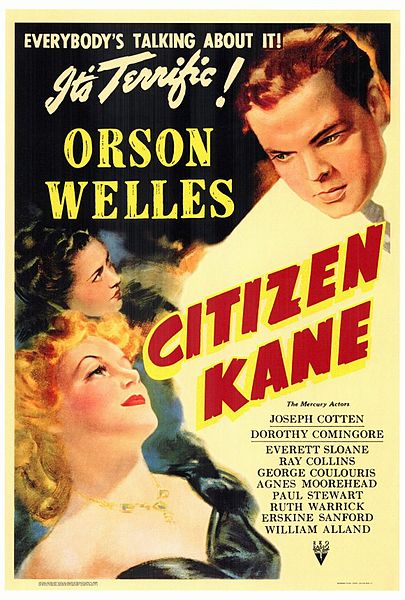
The first time I ever saw the film, I actually wrote Citizen Kane off because my hopes were so high thanks to its major critical acclaim. Those hopes were soon dashed after viewing it once, but over time I realized I needed a second viewing. This second chance allowed me to see the minute details, which can be easily overlooked or forgotten. Now I can truthfully say I have a new found respect for this film.

The brainchild of Orson Welles, Citizen Kane opens somewhat unimpressively, however it is certainly very moody and atmospheric. As the camera closes in on a great mansion, we are given a first-hand view of a dying man followed by his mysterious final word “Rosebud.” In the following newsreel, we learn the man was Charles Foster Kane (Welles), a millionaire tycoon and newspaperman. A journalist (William Alland) is enlisted to find out anything he can about Kane. First, he scours the memoirs of Kane’s deceased childhood guardian (George Coulouris). Then, he talks with Mr. Bernstein (Everett Sloane), who worked with Kane’s paper the Inquirer. He gets around to talking to Kane’s unstable former friend Jedediah Leland (Joseph Cotten), as well as Kane’s second wife (Dorothy Comingore). We learn from these accounts about Kane’s early years, his success with yellow journalism, the evolution of his first marriage, and the rise and fall of his political career. Furthermore, we find out about Kane’s unhappy second marriage that ultimately left him loveless after looking for affection his whole life. Fittingly, we are again left with the bleak view of his fortress Xanadu, and we now have the knowledge that “Rosebud” was in fact utterly trivial.

Obviously, Greg Toland’s black and white cinematography using deep focus and low camera angles is noteworthy. The framing of the narrative with different points of view and flashbacks was unique at the time. The actors age in front of us showing the progression of time and montage is used to effectively condense time. There are the overlapping and fragmentation of dialogue to create a realistic feel throughout the film. Bernard Hermann puts together a score that slowly changes along with Kane. And of course, you have the supposed basis of Kane on William Randolph Hearst. Historically, Citizen Kane may, in fact, be the most important film of all time, and artistically it is certainly up there with the best of them. I will let others decide if that makes it the very best film, period.

4.5/5 Stars
Midnight Cowboy (1969)

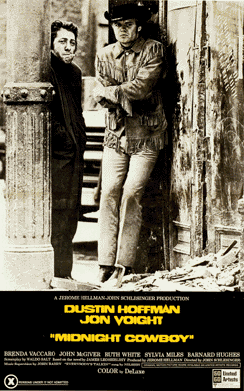
The film stars Jon Voight as a naive Texan and Dustin Hoffman as Ratso Rizzo, the bum who initially cons him and eventually befriends him. Voight comes to New York expecting to make money off of rich city women as a male hustler. However, his callowness leaves him broke. That’s when the crippled, coughing, stealing, and nasally-voiced Ratso invites him to stay in Rizzo’s home on a condemned lot. Because they are both just trying to survive on the streets of New York, they befriend each other. When they are not walking the streets, stealing, or trying to bring in money, they talk and we slowly see into the pitiful lives of Joe and Ratso. Since winter has hit, Ratso gets ill so they decide to head out to Florida. On the way Rico (as he wanted to be called) spent his last breath. Both actors have powerful performances and Nillson’s Everybodys Talking is a nice added touch to the soundtrack.

4/5 Stars

All the President’s Men (1976)

89d88-mv5bodaxmtc4odcxnf5bml5banbnxkftztcwndy0ntaymq-_v1-_sy317_cr80214317_Starring Robert Redford and Dustin Hoffman, this political thriller follows two young investigative journalists as they try to uncover the truth after a mysterious break in at the Watergate Hotel. The Washington Post is the only paper covering the issue that many have dismissed as an isolated event. These two men try to follow all the leads they have but they reach a dead end since no one seems willing to talk. However, with the help of the anonymous source Deep Throat, tireless searching, and a few witnesses, the pieces begin to come together. Little do they know the extent of what they have happened upon. Ultimately, their story about Watergate would lead to the scandal that ended in Richard Nixon’s resignation. This is not only an intriguing film, but it also holds tremendous historical importance.

4.5/5 Stars

Goodfellas (1990)

Starring Ray Liotta, Robert De Niro, and Joe Pesci with direction by Martin Scorcese, the film follows the true story of Henry Hill and his life as a mobster. Early on in the 50s Hentry began doing work for the influential mobster Paulie (Paul Sorvino). He began skipping school and slowly begins making a lucrative living with the mob.  Soon he meets Jimmy Conway (De Niro) who loves to hijack trucks as well as the foul-mouthed, quick-tempered robber Tommy DeVito (Pesci). Over time Henry becomes successful after an Air France robbery and eventually he gets married to a woman named Karen (Lorraine Bracco). However, Henry gets caught up in a murder and he also starts seeing another woman. He still has problems but he begins a lucrative drug trade and the Lufthansa heist is pulled. The heat is on and Henry is eventually caught and decides to rat on his friends. He is then forced to live life as a nobody. I appreciated the period music, voice over, tracking shots, and freeze frames. The language of DeVito and others is tiresome but it shows how inherently corrupt they are.

5/5 Stars