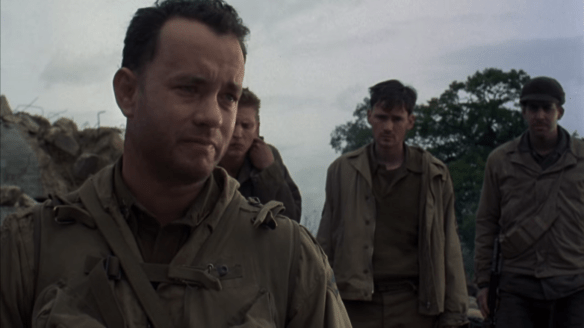
Saving Private Ryan (1998)

saving-private-ryan-1There’s something remarkably moving about the beginning of Saving Private Ryan. I’ve only felt it a few times in my own lifetime whether it was family members recognizing names on the Vietnam Memorial tears in their eyes or walking over the sunken remains of the U.S.S. Arizona at Pearl Harbor.  It’s these types of memories that don’t leave us — even as outsiders — people who cannot understand these historical moments firsthand.
And that’s why Saving Private Ryan is a truly breathtaking, at times horrifying, and wholly visceral experience. Words cannot actually describe the visuals on the beaches of  Normandy at Omaha. The utter chaos, death, and tumult engulfing the scene — above and below the surface of the water.

The cast includes a number of memorable players including Tom Hanks, Barry Pepper, Giovanni Ribisi, Vin Diesel, Paul Giamatti, Matt Damon, and even Nathan Fillion. And yet it’s not about any one man or even a singular act of valor. Even Private Ryan is only a starting point of a far more universal tale.

It’s also easy to say that this is a film cheapens life in the number of bodies that are blown to bits and slaughtered seemingly needlessly on screen. However, it’s even more difficult to acknowledge that in one sense life is cheap — transient to the extent that our bodies are not indestructible. We are fallible beings and breath so easily leaves our lungs and no time is this more evident than in the wake of war.

One sequence that springs to mind involves two surrendering men who, on first inspection, look German and sound German. The men under Captain Miller’s (Tom Hanks) command gun them down and they do it with smiles on their faces. This, after all, is the enemy, pure and simple. Except they were not “Nazis.” They weren’t even Germans, but Czechs (based on what they say). Men who historically had been captured by the Nazis and press-ganged into military service. And in the end, they get shot by Americans. Even the undertones of this scene point to the fact that their lives were so easily snuffed out, without even a second thought.

So, yes, life seems cheap in this film in the physical sense, even from just one example. But it is granted a great deal of depth and richness in many other ways. Families and brothers. Comrades and compatriots. Personal convictions and disillusionment in war revealed through the many characters we come to know. All of that bleeds out of this film along with the blood from the bodies.

In that sense, it’s all difficult to watch and Spielberg never intended this to be easy going.  I cannot speak for others but within the intense moments of bloodshed, the lulls in the action, and unrest within the ranks, there’s a solemnity developed.

War is at times the everyday. It’s indescribable and inscrutable. But Saving Private Ryan’s suggests that there are certain things that we hold onto. High and lofty things such as liberty and freedom that are often so easy to discount. They seem easily besmirched, dragged through the mud by all of our human inadequacies and evil. But perhaps that makes them even more important to hang on to, because just like life, these ideals are worth the fight, though they might so easily be lost. It doesn’t make the wrong right or cover up all the pain, even found within this film, but it latches on a tiny bit of good within a whole lot of messiness.

It goes back to the basic implications of the film’s main conceit — the task of saving one man — Private James Francis Ryan (Matt Damon). It’s  representative of not only the entire war but each and every one of us as we traverse roads of tribulation. Every story, whether wartime or our own, deserves an ending with some type of salvation. Because Saving Private Ryan is imbued with so much more meaning. Our human experience is wrapped up in it. There is no greater love than a man giving his life for his friends. But imagine if you are dying for the freedom of others or even the preservation of someone who you hardly know? That’s what happens in this story.

That’s why when elderly James Ryan comes back to Normandy so many years later, there’s a gravity to the situation. This is by no means a corny piece of Hollywood drama. It’s the ultimate act of love that he has received and he can hardly comprehend it, just as we as an audience must grapple with it too. In that way, Saving Private Ryan is indubitably affecting not simply as a war drama but an epic human narrative. It pertains to all of us.

The profound and terrifying thing about this gift that he has received through the sacrifice of so many others is that he cannot “earn it.” Because, in this sense, life proves to be far from cheap. There is no way to earn that back. There is no way for us to live a wholly “good” life or be completely “good” people. The whole entirety of the film tells us otherwise. Still, we can live our life with a sense of freedom knowing that cannot be expected of us. A life of purpose is all that can be asked of us. It’s that kind of purpose that makes Saving Private Ryan continuously compelling.

5/5 Stars

The Birds (1963)

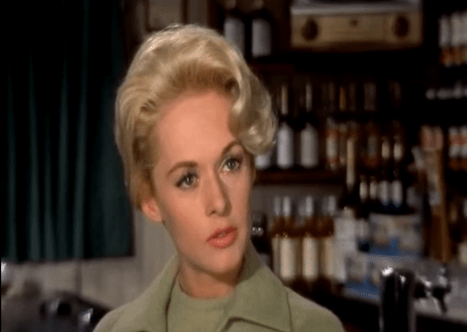
thebirds1The Birds is about all sort of birds. The ones we are acquainted with initially are actually a pair of humans. Lovebirds you might call them. Except they don’t know it quite yet, but the moment Melanie Daniels (Tippi Hedren) and Mitch Brenner (Rod Taylor) meet in a pet shop, the sparks are already flying — the birds too.
In this way, the film opens with a love story as you might expect between a grounded lawyer and a cultured woman who nevertheless has somewhat of a reputation. She matter of factly plays  “Deux Arabesques” by Claude Debussy on the piano (I had to look that up), but she’s also been involved in an unseemly ordeal at a Roman fountain. Her daddy’s a big shot newspaperman. She’s the kind of gal who elicits whistles from passersby and skeptical looks from protective mothers. The film has both types.

But if The Birds ended as a simple love story it would be a rather tepid affair altogether, not to mention faulty advertising. But Alfred Hitchcock the unequivocal master of suspense could never be accused of such a thing (other things possibly). He injects the storyline with an impending dread and a continual payoff that makes the Birds a tense horror classic even to this day putting the emphasis on his major assets. The first being his antagonistic ornithological forces cycling in and out of the narrative menacingly. The second strength is his impeccable use of panoramic locales.

Much like Douglas Sirk, Hitchcock knows how to use the glossy palette of Hollywood to the nth degree and it becomes one of his main attractions taking his favorite spots in Northern California once again — this time the idyllic Bodega Bay — and developing them into the perfect canvass for the drama he draws up.

A short story from Daphne du Maurier (author of Rebecca) provided the inspiration rather than true source material, however, Ed Mcbain, a reputable writer in his own right,  crafts something that’s still quite compelling. It proceeds like you might expect from a normal romantic drama. There’s the meet-cute, the flirtatious repartee, the woman pursuing the man who catches her fancy. Beautiful skies, sunshine, and love in the air. There’s a younger sister (Angela Cartwright), an old flame (Suzanne Pleshette), and a mother (Jessica Tandy). Each looks at this new woman with an entirely different perspective.

But upending the typical progressions The Birds becomes a grim thriller as the bird populations including crows, seagulls, and even sparrows become belligerent. Invading homes, causing havoc, and terrorizing the general population. Melanie and Mitch become our intrepid heroes but it’s almost easy to lose them amidst this churning force of nature.

In one particular scene inside the iconic Tides restaurant, all the locals trade talk about the current state of affairs. It becomes very obvious that there’s a great deal of fear and confusion. What’s at hand is almost apocalyptic as one drunkard wildly quotes the Bible out of context and a didactic bird expert tries to assuage any concerns. But none of that dialogue can possibly mitigate what happens next. A fire starts. The birds rain down in waves of fury. People are chased hither and thither. Melanie first looks on from the restaurant, fights her way to a telephone booth and somehow reaches safety. Others were not so lucky.

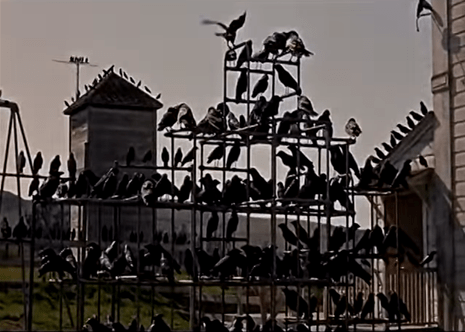
thebirds2Most assuredly, the film benefits from long stretches of wordless action. The most striking example involves a murder of crows gathering on a jungle gym near the schoolhouse. Never before was the name of their posse more applicable.  And while the narrative lacks a true score, the unnerving screeches from the birds is sound enough to send chills down the spine of any audience.

At different times both Cary Grant and Audrey Hepburn had the potential to be in this project, but perhaps it’s better that they were not. Although Hitchcock essentially tortured her and ultimately ruined her career, Tippi Hedren gives a sparkling performance here that is nevertheless overshadowed by her many adversaries. After all, it’s not her name in the title. The same goes for Rod Taylor a handsome and adequate actor but he’s not the main attraction either. However, to its credit, the script does at least devote time to several of its supporting characters to develop their contours, namely the schoolteacher Annie (Suzanne Pleshette) and Mitch’s skeptical mother Lydia (Jessica Tandy). But that’s not what keeps us watching or what keeps audiences coming back over 50 years later. No one knew that better than Hitchcock himself.

4.5/5 Stars

Pandora’s Box (1929)

pandoras_box_filmThe Greek gods created a woman – Pandora. She was beautiful and charming and versed in the art of flattery. But the gods also gave her a box containing all the evils of the world. The heedless woman opened the box, and all evil was loosed upon us.
It’s often extraordinary the international platform that silent films afforded their stars. Pandora’s Box is one of the now lauded pinnacles of Weimar cinema and yet its main starlet — its acclaimed cover girl — was an American. With her bob hairstyle and vivacious sensuality, Lousie Brooks became synonymous with the Lulu character she portrayed in this film. It was this persona that caused her to rival other noteworthy contemporaries including Marlene Dietrich and Greta Garbo.

Except she differed in that Hollywood was not her first choice. Hollywood was not what made her a star. In fact, she shied away from that route, instead opting for other avenues altogether. That’s how she wound up partnering with director G.W. Pabst in not only Pandora’s Box but another classic, Diary of a Lost Girl. Then when she had enough she retired from the trade allowing her legacy to be championed by film aficionados years later.

The film in itself is really a bit of a parable taking inspiration from Greek mythology and sectioned off into Acts like a stage play. Pandora’s Box, is of course, the titular object that released all the evils into the world leaving only hope behind. The parallels are planted early on as Lulu lives life with a flirtatious vitality but that’s precisely what leaves a wake of destruction in her path. She woos every man who comes her way, a dancer and performer for all who will lend an eye. As of right now, she is the mistress of a well-to-do businessman named Schlon but he realizes that he needs to protect his image.

He plans to marry another woman but Lulu finds a way to unwittingly needle her way back into his life forcing his hand and ultimately winning him over again. But the conquests that come her way never last and she truly is a destructive temptress — a landmark femme fatale — she cannot help but flaunt her sexuality. She’s energetic, pernicious, meretricious.

The turning point of the film comes at Lulu’s trial sequence for the deed that she unwittingly perpetrated. The prosecutor stands over her wagging his finger as she’s veiled in somber shades of black. Her journey could end there but instead, she is granted another reprieve and escapes with two companions to London.

Not being bogged down by Production Codes of any kind, Pandora’s Box plays with some surprisingly frank themes most obvious of those being Lulu’s overt sexuality as well as adultery, prostitution, scandal, and so many other taboos. However, what makes the film quake with emotion is the very fact that Lulu is hardly an evil individual. Misled, immoral, and destructive yes, but it’s easy to feel sorry for her. Hers is the ultimate tragic narrative because while she assuredly ruins other people, she’s only injuring herself even more so. She dredges up so much hurt and elicits so much violence. All her attempts at love are only met with brutality.

Through it all, we follow faithfully even though we know from the outset it’s all for naught. And that’s a credit to Louise Brooks’s portrayal because there’s no doubt that she has that special something that makes you turn an eye and look. Her performance runs the gamut of emotions so uninhibited, lively, and free. There’s a universal vim and vigor to her that still feels fresh to this day in an otherwise archaic mode of filmmaking.

The amazing thing is that she probably could have been a bigger star than she actually was. She never really realized the potential that she had like a Dietrich or a Garbo but that’s not what she wanted. Still, the notability came her way anyways. Sadly, real life and the cinematic seem closer than you might expect. Her life was hardly as tragic as a film but you wonder if she ever found love chasing after men as she did.

4.5/5 Stars

Review: East of Eden (1955)

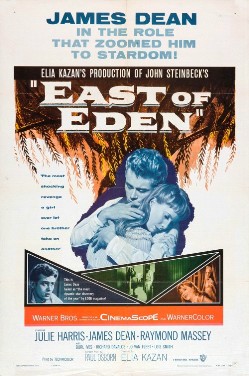
east_of_eden_posterEast of Eden. It was John Steinbeck’s epic work. Showcasing a familial narrative sprawled across his familiar locales of Salinas and Monterey over the turn of the century. But as a film, it rather unwittingly became James Dean’s. He wasn’t even a star yet. He had been on the stage and in a few small roles on television. His performance as Cal Trask was his first film role and the only one that ever got released during his lifetime. As his following two films, both premiered after his untimely death (curiously not all that far away from this film’s setting).
Director Elia Kazan utilized Technicolor and the harrowing perspective of Cinemascope to paint East of Eden with vibrant colors and rather unnerving angles. It’s also true that Kazan, known for evoking intense performances from actors bread on the Method,  was more inspired than perhaps even he realized when he cast Dean. The actor’s body movements. His moody histrionics. His angst emanating from those piercing eyes of his. Even his terminal sadness channeled from his own real-life desire for his father’s love. It’s all within the role of Cal Trask and takes away any doubt about who the focal point of this film is.

And for some, this might be a rather glaring problem with the film. Kazan’s adaptation of the latter half of Steinbeck’s novel focuses on the Cain and Abel dynamic between brothers Cal and Aron as they vie for the affection of their father Adam. For the film to work, each of these characters should be on equal footing. And it’s true that the film is a pendulum of emotional turmoil. It’s positively charged with virulent intensity. First, it’s Cal who is angry and isolated as he tries to discover the whereabouts of the mother he never knew. Meanwhile, his brother Aron (Richard Davalos) is happily in love with his girl and readily defends his brother against any criticism.

But as Cal tries with all his might to win the affection of his father by any means possible, things begin to change. No, his father never exhibits the type of pleasure in him that he so desires, but in his struggles, Cal becomes closer with his brother’s girl — gaining her sympathy.

As time passes, the U.S. is teetering on the brink of the Great War and still, Cal cannot earn his father’s love and his brother becomes more and more jealous. As Cal comes into his own, showing a certain amount of industry and thoughtfulness, it seems Aron becomes more withdrawn and cold. And still, Adam loves his “good son” the best.

James Dean’s performance is spectacularly engaging. I would argue it’s not a morbid sense of curiosity that draws us to him as a tragic hero. But he truly had a special ability to control entire scenes with a glance or some slight movement. Like a Brando or a Clift, he had a certain ability to tap into something that classical actors couldn’t quite touch. Whether it was realism or not is slightly beside the point because they live in characters who are charged with real emotions. It makes Dean’s role as Cal Trask almost palpable. You can feel all that is going on inside of him.

It’s the fact that Dean is so memorable, that brings to light just how much some of the other roles pale in comparison. Davalos does a fine job in his first film, but he cannot balance the scales weighed down by Dean. Raymond Massey on his part is a fairly flat actor not given to anything altogether interesting. It is Dean who elevates Massey’s role in a sense (even though Massey despised the younger actor). Furthermore, Julie Harris is a reputable performer with great heart but she somehow seems miscast (perhaps she’s too old for her role). And Jo Van Fleet gets into the film with a few integral scenes but even she does not have enough time to neutralize Dean.

Perhaps it’s because of the now iconic screen tests of Dean and Paul Newman working off each other, but part of me wonders if Newman in the role of Aron could have done anything to counterbalance Dean. Part of me rejects this hypothesis because Newman never had the same type of melancholy or intensity that Dean was able to muster. He was the likable one. Still, it’s an interesting supposition that in no way takes away from the phenomenal way James Dean burst onto the scene in 1955. He was an explosive supernova of talent — unfortunately for us, he was snuffed out far too quickly.

4/5 Stars

Blue Jay (2016)

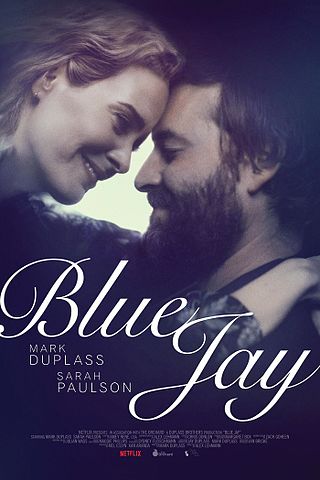
Blue_Jay_film_poster.jpgAre you leaving room for Jesus?~Amanda
You know it. Catholic school forever.~Jim

Is it true that nostalgia always feels like it should be in black and white? If that sentiment is true there’s a rooted purpose in Blue Jay’s muted black and white tones that run deep. So often we consider it as a gimmick in the modern film spectrum but here it works.

This is a story of boy meets girl again. Now they are both 20 years older no longer naive high school sweethearts and he’s lost his mother and she’s now married to a man many years her senior. They’ve moved on you might say as is customary with those living life. But this day they run into each other at the local market. The stage is set for a fulfilling reunion.

However, in the opening interludes, we don’t know anything about either of them. Jim (Mark Duplass) with his scruffy ensemble and Amanda (Sarah Paulson) with her knit cap. For us, both of them have a clean slate but for the two of them meeting again is a mixed bag of emotions.

In these moments, it seems like all parties involved with the film are trying to make everything as unbearably awkward as possible. Is this the way movies work? A script must always acknowledge the sheer awkwardness of it all, creating certain pretenses, and piddling around with what characters are actually thinking. Is it simply a mean trick of a screenwriter to try and pull us into his story, in this case, Mark Duplass, or is there actually some truth to it all?

Are people actually this awkward in real life? Heaven forbid we actually act like this when we’re together or worse yet with someone we have a crush on. I can answer that rhetorical question almost instantly as a multitude of cringe-worthy moments surge to the fore. So yes, there’s probably some truth here and yes, Duplass is drawing us in. Of course, the final joke is that the film utilized no script at all only simple character arcs to arrive at its conclusions.

Still, these moments are only the setup. It’s not Blue Jay at its best. The film comes into its own as time progresses and the contours of the two characters become more evident with every memory they manage to conjure up and every little thing they do together that takes them through their old routines. They stop at the local liquor store and the proprietor (Clu Gulager) with his cowboy hat welcomes them in like old times. Whether or not they know his unassuming roots in western television lore is another thing altogether.

Then, they make the rounds of Jim’s old family home, the house of his deceased mother which is left pretty as it was when he was still a teenager. Piled high with treasures, clothing, trinkets, romance novels, and other artifacts from that long bygone era known as the 1990s.

They let the nostalgia waft over them as they reminisce together, playing their admittedly dorky version of “House” as Mr. and Mrs. Henderson and exhibiting the funkiest ’90s dancing as two of the whitest kids you know. But they accept their quirks and how dorky they are. That’s the fun part as they remember their younger days.

It’s in these wistful and yet still somehow carefree moments that the film recalls one of my favorite lyrics,

Here’s to the twilight
here’s to the memories
these are my souvenirs
my mental pictures of everything
Here’s to the late nights
here’s to the firelight
these are my souvenirs
my souvenirs

I close my eyes and go back in time
I can see you’re smiling, you’re so alive
we were so young, we had no fear
we were so young, we had no idea
that life was just happening
life was just happening

In the final stretch there some big reveals, there’s some of the drama we were expecting, some of the histrionics that we were wary of from a film such as this. After all, they’re in a confined space together with so many emotions still dwelling inside. You wonder about the old dichotomy that men and woman can either be married or unmarried. They’re never just friends because the boundaries become too difficult to maintain. The self-restraint too difficult to manage even in the most self-controlled of us all. After all, metaphorically speaking, a man can’t scoop burning coals into his lap without burning himself.

But we’ve come to care about the characters enough that’s there no sense that this is some shallow attempt to play with our emotions and get a rise out of us. Somehow it feels like a less flawed iteration of Your Sister’s Sister because it’s frank but never purposely crass and more than its predecessor Blue Jay feels true blue and sincere. It’s a more intimate even heartfelt drama that wins its audience over.

These characters deservedly earn our respect and even in the modicum amount of time they do well to build a rapport with their audience. They do the heavy lifting by opening up and we are called to respond accordingly. The tears and the laughter are intermingled. The regrets with the reality. The way we perceived things would look farther down the road and how they look now. I guess you could say that it’s the blue jay way–reflected precisely by the path this film takes.

It’s the memories and the dashed hopes it starts to pull out of the closets back out into the open. It’s joy. It’s laughter. It’s pain. It’s heartbreak. And as is usually the case with life the ending is unwritten. That’s why they’re still making films like this, now until the end of time.

3.5/5 Stars

Review: 8 1/2 (1963)

8.5 1.png

Is the subject of this film a religious one? – A Religious Leader 

Yes, well, in a manner of speaking. – Guido

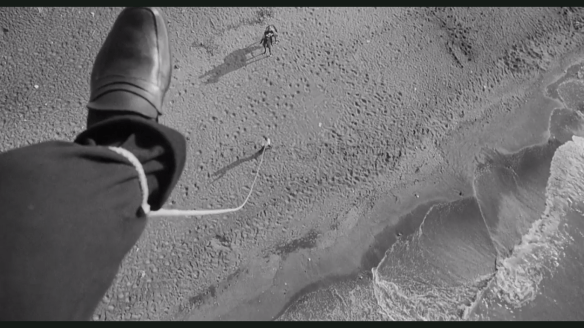
It famously opens with a dream. Our main character stuck in a silent traffic jam, completely disillusioned by the scene around him until he’s able to escape everything inhibiting him and soar into the upper echelons of the atmosphere. But it hardly lasts. Soon he finds himself tethered, being brought back down to earth.

8.5 2.png

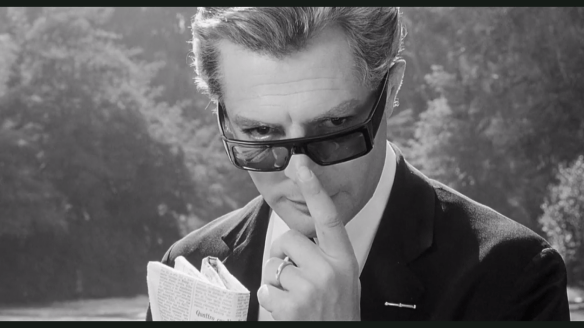
Our protagonist of sorts turns out to be Guido (the famed Italian icon Marcello Mastroianni), a film director who is going through a spell of director’s block. His most recent activities include an extended stay at a luxury spa at the behest of his doctors. It’s also early on in the film that someone asks him if his next film is also going to be one devoid of hope. It’s a very quick statement but in some sense, it sets the groundwork for Fellini’s entire film.

And it is a very personal film and a fascinating exploration of the art of filmmaking — the thing making it the most compelling is the strange suspicion that parts of Fellini himself dwell inside of Guido. Perhaps Guido shares a bit of his philosophy and stance or more precisely Fellini is like his main character.

The film within a film soon becomes evident and in that sense, it’s also a personal picture. Its title being derived from the number of pictures the Maestro had directed thus far. And numerous meta qualities come to the fore, most obviously when Guido is going through the screen tests his producer (Guido Alberti) and wife Luisa (Anouk Aimee) among those viewing the proceedings.

But going back to that issue of hope, the film’s finale has always been striking to me but I realized that it takes on new meaning put in the context of higher issues altogether. In some respects, Guido or Fellini, whichever you prefer, is trying to derive some sort of higher meaning, whatever that means to him.

8.5 4.png

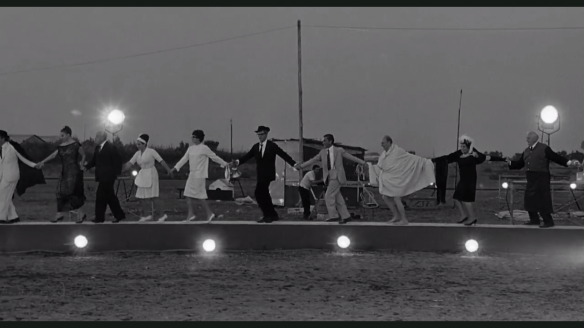
That’s in part why he has his legions of characters join hands in an almost communal dance of absurdity. Simultaneously, a journalist can be heard throwing his questions out, “Are you for or against eroticism?” and in the same breath, “Do you believe in God?” Because this is Fellini’s answer — the solution he has drawn up for himself. There is a sense of grandiose absurdity that is full of dreamscapes — where the distinction between reality and fantasy hardly means anything. Because in the eye of the beholder they are hardly different.

On purely a level of spectacle, it’s indubitably a fascinating set-up. Fellini is known for his quintessential style. To be Felliniesque is to be wrapped up in the surreal and the fantastic. But the philosophical conclusions that go hand in hand with such a provocative approach to film are rather disheartening. If this is part of what Fellini is trying to grapple with as it pertains to love and ultimate truth then 8 1/2 does fall back on a rather dismal ending.

As Guido explains to the man of the cloth, he is looking for some flash of understanding, some obvious moment of truth, like Saul at Damascus. He, like all his peers, carries the foundations of a Catholic upbringing. The religious authorities tell them that there is no salvation outside the church. His strict Catholic school told him what was wrong. Likewise, Guido plans to have a spaceship in his next film — humanities “new Noah’s Ark.” And it’s true that space exploration has been the final frontier, a beacon of potential hopes and truths. You see that in later works like 2001 and Solaris.  However, Noah’s Ark was also a vessel to escape destruction as much as it was a ship of exploration.

In drawing other cinematic comparisons, Fellini’s film revolves around a pointless MacGuffin (the phrase Asa Nisi Masa) rather like Welles famed Rosebud. Truthfully, this is a comedy in the same way perhaps Citizen Kane is a comedy. In a similar way, Guido seems isolated, but his mind, in particular, is twisted up with fantasies.

The most divisive scene in the film is yet another fantasy conjured up by Guido that is either extraordinary humorous or sadly indicative of his state of being depending on how you view it. He dreams himself in the stead of all the women he has crossed paths with thus far, all ready and waiting on his whim — his personal harem of sorts — totally and completely objectified for his pleasure. Again, it’s played for truly comic effect but what are the implications?

8.5 3.png

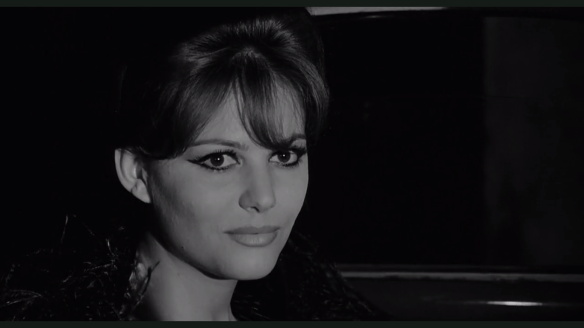
As the eternal beauty Claudia (Claudia Cardinale) notes, “He doesn’t know how to love.” She speaks of Guido’s protagonist but as the meta-ness suggests, this protagonist is Guido himself and going down even a layer further maybe even Fellini too. It’s precisely these problems that tie back into Guido’s disillusionment. “There’s no part in the film. And there’s no film. There’s nothing anywhere,” he says to Claudia.

Chaos and nothingness. True perfection is nothingness. His final conclusion? Life is a celebration. Let’s live it together. In essence, it’s true but the carnival showmanship and parlor tricks cannot obscure the bottom line here. As Francis Schaeffer once noted someone like Fellini “has no way to distinguish between right and wrong, or even between what is objectively true as opposed to illusion or fantasy.” That’s a terrifying world to come to terms with. During filming, Fellini supposedly kept a note on his camera to remind himself that this was a comedy film. But much like Citizen Kane, perhaps there’s a need to label it a tragicomedy. You cannot deal with such issues without elation being matched with some amount of melancholy.

5/5 Stars

Platoon (1986)

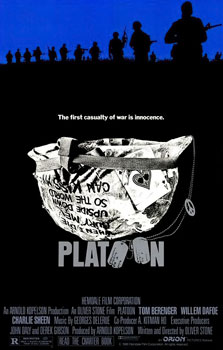
platoon_posters_86It’s a rather interesting parallel that Charlie Sheen is playing much the same role his father did in Apocalypse Now. At least in the sense that they become our entry point into the mire of war, specifically in Vietnam. But where Apocalypse seemed to belong more so to Brando or even Duvall, Platoon is really Willem Dafoe’s film. At least he’s the one who makes it what it is. His final moment is emblematic of the entire narrative.
But it is also striking that the film opens with an excerpt from Ecclesiastes as follows, “Rejoice young man in your youth…” But the latter half of that same verse has major implications that will come into play later.

For now, these soldiers muddle their way through their tours of duty the best they can. Smoke, beer, and Smokey Robinson is the perfect way to combat the insanity and humidity right outside your tent.

Oliver Stone conjures up themes of politics and government conspiracies. The first word is uttered several times throughout Platoon but in the general sense. When you get a group of people together vying for positions and attention there’s bound to be politics. As for government conspiracy, Stone doesn’t quite scrape that barrel, although to be sure as a Vietnam veteran himself perhaps he has a lot to be disgruntled about.

Instead, he has a cast of characters who get to reflect all the angst and disillusionment for him and it’s a fairly impressive bunch. Aside from Sheen and Dafoe, John Bergener, Keith David, John McGinley, Forrest Whitaker, and even Johnny Depp make appearance wading their way through Vietnam.

It’s been far too long since I’ve seen Apocalypse Now to draw too many comparisons. However, although Platoon is a perturbing film it’s not the same type of expansive labyrinth that I recall from Coppola’s epic.  Charlie Sheen’s voiceovers attempt to add an introspective tinge to the entire narrative, but that is not where the strength of the film lies.

Platoon also has its share of pyrotechnics, in fact, it succumbs to them too often but that’s not the reason the film is affecting either. It’s the aftermath of those explosions. The carnage that is left in the wake of the barrages of RPGs. The bodies maimed and the images that haunt these young men.

And as audience members, it’s hard not to feel something. Repulsed. Angry. Frustrated. Confused. Perhaps that is the film working — giving even a zenith of the taste of what it was to be in the jungles of Vietnam back in 1967. This is one of those experiences I cannot take too often because it’s almost too much.

My initial hope was that Stone would not inject this film with his own brand or message and I will say that when I watch Platoon I am not left with the feeling that I am listening to Oliver Stone but instead I am watching something terribly volatile unfold. That’s certainly a testament to this film. In the end, Platoon is bolstered by its sheer intensity.

But back to Ecclesiastes, the earlier verse ends “and let your heart be pleasant during the days of young manhood. And follow the impulses of your heart and the desires of your eyes. Yet know that God will bring you to judgment for all these things.” And it’s this final bit that is important in suggesting that young men are laid low due to their joy. But it’s hard to make that type of assertion. If anything, a film such as Platoon is perplexing because the answers are unclear and the reasons the world works the ways it does are not known to us.

Young men will continue to walk through life naively and he will struggle through life questioning the presence of God as much as this seemingly apathetic indifference towards the suffering in the world. Whether Stone was grappling with those same questions is up for contention but the beauty of film is that it very rarely works on a singular level. It can mean many things to many people. So it is with Platoon.

4/5 Stars

Fallen Idol (1948)

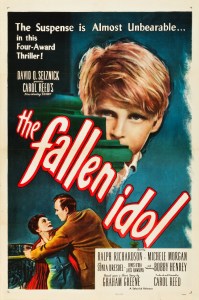
fallen-idol-poster-1948Fallen Idol is a fascinating film for how it develops inner turmoil. It’s earnestly interested in the point of view of a child and as such, it functions on multiple levels –that of both kids and adults. Philippe’s (Bobby Henrey) home is the embassy as his father is a French ambassador who is always away on the job. So Phil’s a little boy who is perpetually in the care of servants. Namely the authoritarian Mrs. Baines (Sonia Dresdel) and her good-natured husband (Ralph Richardson).
It seems like he has a fairly cushy life, able to have his run of the embassy, play all the time, and eat three square meals a day. He diverts himself with numerous trifles like any good little boy would, including an affinity for his pet snake McGregor. Meanwhile, Mrs. Baines is constantly pestering and prodding him to behave. Simultaneously Mr. Baines continually affirms his boyish nature. It’s no secret which one Philippe likes better.

This triangular relationship is vital to the film but it’s only the beginning. Because Mr. Baines, rather understandably, is unhappy in his marriage. It’s not working out for him and he has met another woman (Michele Morgan) who he dearly loves and who loves him. Of course, the one moment he goes off to meet her in confidence, the mischievous, prying eyes of Phillip find them, but he does not fully comprehend what he is seeing — what they are talking about in hushed voices — as he nibbles away at tea cakes and pastries.

The nuances of the events at hand are earnest between two deeply concerned adults who fear never being able to be together. But again, as a young boy, Philippe doesn’t quite understand the subtext of all that is going on. How could he? And Carol Reed does a wonderful job of conveying this through some simple camerawork throughout the story. It always seems like Philippe’s point of view is either from the distant staircase looking down at the figures below or he is looking up at the adults who stand above him. There’s always a pronounced distance, a gap that must be forged. And all of this suggests just how far removed he is from the events swirling around him.

At this juncture, Mr. Baines asks him to keep their secret and they go on an escapade to the zoo together. Philippe is happy with the reptile house and other animals, while Mr. Baines is soaking up his final moments with Julie before she goes away. She can’t bear to not be with him. Still, Phil is uninterested in the whole business.

But later, when some words slip out, Mrs. Baines puts two and two together. Now she is asking Phillip to keep their own little secret. He’s been asked to hold onto two conflicting secrets now and he doesn’t quite know how to respond. His mind’s convictions about lying and truth-telling are tied up in knots and they remain that way for the entire film.

The final act is even tenser as Baines must cope with the tragic aftermath of his wife’s death. She was confronting him about his love but that’s hardly the most interesting part. At this point, Phil thinks he knows what he saw and he doesn’t want to tell on Baines. In his eyes, Baines killed someone, but he likes Baines. There’s this troubling moral dichotomy that’s created in his little head. When the police inspector comes in digging around for the truth, the boy’s no help and Baines’ story is highly suspect at best.

Everything young Philippe does in an attempt to help only serves a hindrance for the man he idolizes. His allegiances were manipulated and by the end, his cries to be listened to are all but disregarded. When all is done he scampers down to his returning mother joyously. Completely ignorant of the bullet that Baines has dodged. It’s the perfect ending, summing up a film about a child embroiled in something far above what he can even fathom.

He doesn’t quite understand that Julie is not Mr. Baines niece. He doesn’t know what Mr. Baines meant when he was bickering with his wife about his freedom. Or even that the lady that he clings so closely to in the police station is a woman of the street. That’s what makes the performance that Reed teases out of his actor that much more impressive because it gets that obliviousness and confusion across perfectly.

In truth, Reed’s film brings to mind two other classics of the 1940s from British masters.   The first is Rebecca with Mrs. Baines asserting her domestic dominance rather like the unnerving Mrs. Danvers played by Judith Anderson. Furthermore, the heartbreaking nature of infidelity in this film also calls to mind David Lean’s heart-wrenching work with Brief Encounter. However, again, what sets Fallen Idol apart is the perspective of a child. It’s an innocent way of trying to make sense of the world. A world that is so often confused, ambiguous, and complex.  The beauty of being young is that same naivete. So much has gone on and Phil has seen and done so much. Yet when his mother is home, he cannot help but be happy to see her. All else fades away. That innocence remains to the end.

4.5/5 Stars

Review: The 400 Blows (1959)

400 blows 1.png

Being a great believer in context,  it was a wonderful thing watching 400 Blows once more because I felt like I knew this man behind the camera so much better and I knew this character Antoine (Jean-Pierre Leaud) even better than he knew himself. After all, he was just coming into his own in this initial film.  I was also aware of some cameos including Francois Truffaut himself, Jean-Pierre Brialy and of course Jeanne Moreau, all important forces in the French New Wave movement.

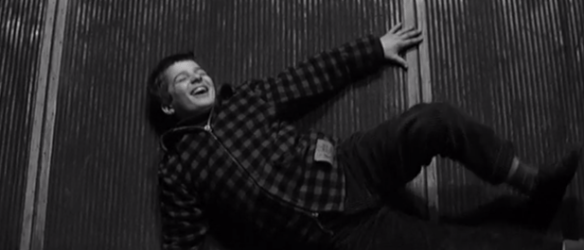
However, one the most powerful things is the degree of foresight we gain about Antoine Doinel. All the things that make up his life at this juncture in time have repercussions later on that Truffaut continued to examine as he matured. We can see the gears turning as the boy develops as an adolescent. He skips out on class to go to the cinema and the carnival. He purloins a bottle of milk out of thirst, steals little trinkets from the ladies room and finally a typewriter from his father’s work. He receives the ire of his teacher and goes home to the cramped conditions and turbulence of his home life. His mother and step-father are constantly bickering. His mother is having an affair. It’s not a very happy life or a firm foundation for a boy to grow up in. And it shows.

In many of these moments, the autobiographical aspects come to the fore. Before Antoine’s story was simply a depiction of realism but as time goes on it becomes more obvious that Truffaut is being very transparent in showing bits and pieces of his own experiences. What’s striking is that this is hardly a bitter film. Somber and melancholy, yes, but it hardly ever seems to cast blame. It shows the brief moments of reverie along with the pain and that’s why I am a great admirer of Truffaut. He’s a deeply heartfelt and personal filmmaker, no more evident than in The 400 Blows.

400 blows 4.png

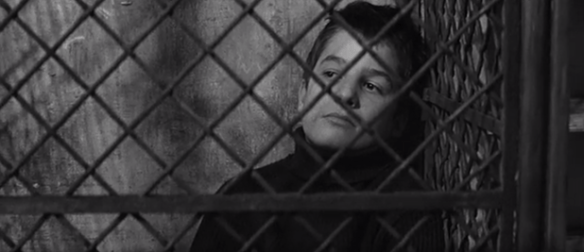
Antoine Doinel is a vagrant and pretty dismal kid, getting in all sorts of trouble and yet Truffaut makes us sympathize with him and to an extent we see the director’s point of view too. He’s the one trying to fall asleep while his parents bicker about what to do with him. He runs away from home and relies on the charity of a friend. He’s being locked up in a jail cell on his way to juvenile detention. He talks to a psychologist candidly about his parents never trusting him. All those moments have the power to move.

And the film is so easy to watch, so simple and wonderful and honest and unassuming, it’s almost hard to remember how influential this film was for not only jump-starting the French New Wave but for rejuvenating cinema in general. Hollywood didn’t make movies like this. That’s all I had ever seen for the longest time. But the likes of Truffaut, Godard and even Renoir, De Sica and Rossellini revealed to me that there are numerous ways to make an impassioned cinematic experience.

400 blows 3.png

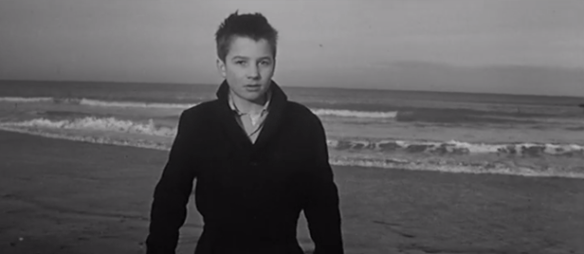
As always, my mind returns to the climatic freeze frame of The 400 Blows. It remains with me and part of its iconic status is undoubtedly due to how it sums up this boy so perfectly. There’s a sadness in the eyes that without saying anything denotes all that we have already seen. It’s the perfect summation of his story thus far and with that look, it’s difficult to forget his hardships–his flaws too. Perhaps it allows us to extend grace to him because we can see firsthand that he’s in dire need of some. He has not been offered much his entire life with true love and affection being traded for punishment and biting remarks. True, his story does not end here but it’s a telling chapter of his life. Arguably the most formative years for the rest of his existence.

Within the storyline, Truffaut includes passing references for his love of the cinema and even suggests his promise with his writing composition though his teacher accuses him of plagiarism. But from these troubled roots came a man who loved movies to an extent that few others could claim. He was passionate both as a critic, champion, and creator.

Thus, it makes perfect sense that this film was dedicated to the memory of Andre Bazin, the noted founder of Cahiers du Cinema. Truffaut undoubtedly owed a tremendous debt to the magazine and its editor but he also elevated it with his own amount of passion. That same passion comes out in The 400 Blows and really all the subsequent films he made before his death. His movies are wonderful because each one shows that he genuinely cares about the material on its own individual merit. That is the kind of director that I want to watch.

5/5 Stars

E.T. The Extra-Terrestrial (1982)

e-t-the-extra-terrestrial

I remember the first time seeing  E.T. and enjoying it immensely, though it never floored me. I felt the same thing this time around for no particularly justifiable reason. Good but, in my estimation, not great, whatever that means because those terms are equally murky. Still, the fact that there had been little change in some ways made me feel uneasy. What was I not seeing?

But then thinking about it more I latched on to this idea that made me appreciate E.T. far more than I had before. Like an epiphany, it came to me what this film really is. It’s a childlike fantasy full of personal notes from a director who just happens to be Steven Spielberg. That’s not much of a discovery, but the implications are great.

The story of young Elliott (Henry Thomas) and his chance encounter and befriending of E.T. is rather like a boy and his dog story. Except both characters are going through almost parallel situations and Spielberg takes it to the literal extreme. They actually feel each other in a sense. They are perfectly empathetic towards one another.  With E.T. the motives are most obvious. His ultimate goal is to “phone home” so that he might be reunited with those that he calls family. For Elliott, it’s also about home. His home life is a bit fragmented with a father who is vaguely mentioned to be in Mexico (although that’s probably not the case) and siblings who quarrel like siblings usually do.

However, it also struck me how this family really does care about each other. Little Gerty –a beyond memorable Drew Barrymore–is the quintessential 5-year-old sister. First frightened of, then intrigued by and finally faithfully devoted to E.T. And the older brother Michael teases his siblings as has always been the case since the beginning of time but he too invests himself in this adventure. Certainly, it’s out of charity towards this visitor from outer space but it’s undoubtedly also an extension of the affection he has for his little brother.

It’s also peculiar that almost all the secondary characters are very ill-defined and the antagonistic forces attempting to impede E.T. and Elliott are even vaguer. At first, this felt wrong in some regards– a potential sign of poor storytelling. But once more I was brought back to the unmistakable idea that this film really is a boyhood dreamscape. This is Elliott’s story and if it’s Elliott’s story, it’s even more so Spielberg’s own meditation on adolescence and his own childhood. The narrative is even said to have been inspired by his own imaginary friend as a child and his own dealings with a split household. And there’s also a hint of the Wizard of Oz here. There’s no place like home.

Thus, what becomes undeniably important is this dynamic relationship between this boy and his newfound friend who just happens to be from outer space. It’s quite simple. It’s childlike really. And that is and forever will be the beauty and allure that comes from this film. Families can watch it. Kids can marvel at it. Parents can soak it up. Because just as it is about a family–dysfunctional as they may be in their suburban life–it is also for families.

There’s the sheer mayhem of the shrimpy kid grabbing a kiss from the pretty girl in class as hordes of frogs hop by. The iconic magic of Elliott and his friends soaring through the sky on their bicycles, John Williams’ score dancing majestically in the background again and again. Even the fact that this extra-terrestrial goes from death to life is strikingly analogous to the archetypal biblical narrative that permeates our culture. It’s all spectacularly remarkable but rather than be skeptical we acknowledge it with almost wide-eyed wonderment, accepting it, accepting these people that we meet. And watching E.T. ascend back into the atmosphere with true awe.

I find it fascinating that only a few years earlier Spielberg was inspired to put Francois Truffaut in Close Encounters. In E.T. I see his closest approximation of the French director’s own thematic elements. To put it in terms of homage. E.T. is Spielberg’s version of 400 Blows, granted featuring space aliens, Star Wars, cultural references and so on, but they’re not all that different. They really are about the same core issues. It takes until after 400 Blows for Antoine Doinel to find love and intimate relationship with his wife. For Elliot, it comes with family, his brother and sister, and mother, and of course, with E.T. This is what has a lasting impact on Elliott and I could guess, with Steven Spielberg as well. But the audience gets to be a part of it too, an equally important  piece in this trinity.

4.5/5 Stars