People Will Talk (1951)

peoplewill1People Will Talk is in this weird gray area between genres. It has humor but it’s not screwy enough to be a screwball. It has drama, but it’s not intense enough to be a full-fledged melodrama. And underlining all this are issues that reflect such areas as the medical industry, the Korean War, and most definitely the witch hunts that were going on in the nation — bleeding into the Hollywood industry.

Written and directed by Joseph L. Mankiewicz, this is a minor classic about a doctor named Noah Praetorius (Cary Grant), who is under investigation from one of his by-the-book colleagues Dr. Elwell (Hume Cronyn), who dislikes the good doctor’s unorthodox and thoroughly effective approach to his trade. Praetorius by now is a preeminent physician who started his own clinic and also teaches classes at a local med school.

One of these individuals happens to be Mrs. Deborah Higgins (Jeanne Crain). She is not a student but sits in the lecture because her former partner was a medic. A date with a cadaver proves to be too much for her and she faints. Seems normal enough right? Wrong. After examining her, the Dr. tells her she’s pregnant. The truth comes out that she’s not really married and the father is dead. Her own father would be greatly distressed to learn about her condition, since he cannot provide for her.

That’s where Dr. Praetorious comes into the picture, and he takes great concern in Ms. Higgins condition. He attempts to allay her anxiety by saying she’s not really pregnant, and she runs away from his clinic out of embarrassment, since she is falling in love with him. He goes with his stoic friend Mr. Shunderson to the farm owned by Deborah’s uncle.

Deborah turns out to have a strange mix of aloofness and lovesickness, but when she realizes the Doctor’s true motive for being there (before he even does) she is wholly relieved. They share a passionate kiss and leave the farm behind to get married. Of course, the Doctor still hasn’t told her about the pregnancy.

Meanwhile, the whole storyline culminates with a concert conducted by Praetorious himself, but it just so happens that the hearing to analyze his conduct is happening simultaneously. Some mysterious truths about Mr. Shunderson are given in his own words, and stale Mr. Elwell’s case is dumped. Everything wraps up nicely as you expect with a happy marriage and Grant free to direct the symphony in one last glorious crescendo.

So you see if you really look at this film, there are these two main story arcs. One is a response to McCarthy’s witch hunts, the other an equally subversive love story about a doctor marrying a woman who had a pregnancy out of wedlock. When you put it that way this film seems chock full of controversy, and yet it is all veiled in a palatable comedy-romance. Walter Slezak is a welcomed addition to the cast as the nutty colleague and Hume Cronyn has taken on better roles, but nonetheless, he is always an enjoyable character actor. Obviously, this is a lesser Grant performance, but his pairing with Jeanne Crain is still a fun one.

4/5 Stars

Donnie Brasco (1997)

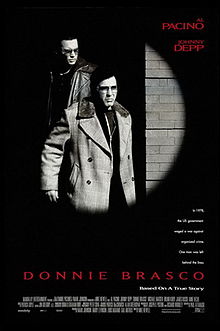
220px-Donnie_brasco_ver2In the tradition of such films as Serpico, Goodfellas, and even The Departed, Donnie Brasco is another worthy addition to the gangster canon. You have a necessary mainstay in Al Pacino, playing the veteran and streetwise hit man Lefty. He’s been around and is claimed to have 26 “whacks” to his name. One fateful day he took Donnie under his wing and the two became real pals. Better than that they were family and Lefty vouched for Donnie, bringing him into his life and his business. It’s just that his business revolves being a member of one of the mob families.

The story is twofold, however, because Donnie Brasco’s real name is Joe Pisone, and he is an undercover agent for the FBI. However, in order to do his job he has to be gone for months on end. He checks in and has a tape recorder on his person, but for all intent and purposes, he is a member of the mob. They think he’s one of them which Pistone’s superiors are delighted about, but he also begins to relate to them and see himself pulled into their reality.

Long months away from his wife and kids do not help their marriage or his family life. Whenever he drops in their life, he’s cold and detached. His wife expects something more. She wants her husband back, but all he has for her is a fiery temper courtesy of the crowd he hangs out with now.

He follows their crowd from New York, down to Florida trying to get a cut of the land there, but after getting ousted by the cops, they must head dejectedly back to New York. Several times Joe almost gets his cover blown, but even more perturbing he stops checking in with his superiors. His wife is bearing the toll of his absence and tries to content herself with thoughts of him being dead. It’s easier to take.

Meanwhile, young hopeful Sonny (Michael Madsen), with the help of his cronies, knocks off his rival and things are looking up for the whole lot of them. Donnie knows however that there will come a point where he will be pulled out and that will be the end of it. He tries to give his new found friend and confidante Lefty a way out. He offers money to his pal, in a last-ditch effort to get the vet to leave this life behind. Instead, they follow through with the hit that they’re supposed to.

The irony of this story is that Joe Pisone gets a medal and a $500 check for his services to his country. He spent however many months and years in this high tension, high-stress environment and that’s what he gets. You can see him scoffing at it. His marriage is essentially shot to hell. He lost one of the best friends he had and that’s the end of it.

It’s great having Al Pacino in this film because he along with Robert De Niro will always embody the gangster to me. Except instead of playing the steely Michael Corleone, he’s the more world wearied type. Bruno Kirby sounded so much like Joe Pesci that it was almost uncanny to me. And it was a pleasure to see Johnny Depp in such a role since he is so often remembered for his quirkier roles. Here he truly seems to show his dramatic acting chops, and the camaraderie between him and Pacino is palpable in their scenes.

4/5 Stars

Shall We Dance? (1996)

shallwedance1Shall We Dance is a film with important ties to American culture such as the King and I and The Drifters, but it has far more important roots in its native Japan. Thus, its remake starring Richard Gere and Jennifer Lopez undoubtedly loses some of the cultural significance of the original film.

Because Japan is a nation of etiquette, good manners, and the like. They act as a whole society, not as individuals. They care about honor, modesty, and how others will perceive them. They work hard for long hours. Men bring home the bacon and wives faithfully serve their husbands and families. Ballroom dancing in a culture like that is about as compatible as oil and water. Men and women are not to show affection — sensing it instead — and holding hands or saying “I love you” is out of the question. Thus, a mode of expression where men and women are meant to be so close and intimate has a stigma attached to it.

When a seemingly successful businessman, Mr Sugiyama (Koji Yakusho) spies a girl in the window of a dance studio, he has no intention of learning the art form. All he wants is to get close to this mysterious beauty. Of course, he has a wife, a daughter, and a good job, but he feels trapped in his life. He has nothing to give him joy, nothing to make him feel alive, just the monotonous rhythms of office life.

shallwedance2In fact, his first jaunts in the dance studio are rather comical, because his ineptness is magnified by his two classmates, one rather rotund and the other short and squat. It’s as if he’s learning to dance with Laurel and Hardy by his side. In fact, a great many characters have tremendous personality on the whole. Ms. Tamura is Shohei’s sagely teacher, who constantly builds him up with encouragement. Mr. Aoki is one of the work colleagues, who also moonlights an extravagant aficionado of the rumba. They are only a few in a vast company of supporting players.

But of course, this is a sort of faux-love story. Think Ginger Rogers and Fred Astaire and you get the idea. Except in the Japanese society, the only place you dare talk about dance is in the men’s room with no one around. Stripping away everything else this film is about finding self-expression, especially in a society that has a complex relationship with such an idea. Mr. Sugiyama eventually revels in his chance to dance, practicing steps on the platform waiting for the subway, improving his posture in the rain, or even conspicuously tapping his feet on the ride home.

Mai the beautiful object of his desire is aloof, with glassy eyes, and often feels like the antithesis of Japanese women in many ways. She is strong, straightforward, and physically imposing in a graceful way. As an audience we know essentially the road this film will traverse. Mr. Sugiyama must go through a transformation just as Mai must because they are not the same two people we first met looking out from their prospective windows.

shallwedance3What became most interesting to me was this idea of the affair. Mr. Sugiyama’s wife feels like she has been cheated on and her husband agrees with her openly. However, as an American audience, we look at this plotline and see no sex or anything like that. In essence, it depends on how you define an “affair.” For instance, if we look through the lens of an Astaire & Rogers film, their musical comedies were romances, but they could never show characters sleeping together due to the production codes. So the evolution of a relationship had to be illustrated through dance – the courtship, the conflict, and ultimately the passion. Perhaps Shall We Dance is a little different, but if we look at dance in this symbolic way, this was a film about an affair.

More importantly, however, it is a film about reconciliation, self-expression, and really breaking out of the status quo. Those are themes that ring true, although they might be easier to swallow in an American society.

4/5 Stars

Make Way for Tomorrow (1937)

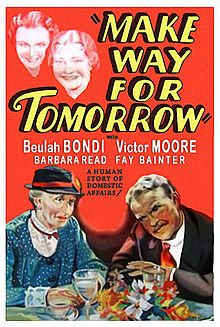
Make-way-for-tomorrow-1937It seems like Leo McCarey and this film for that matter often get lost in the shuffle. In his day he was a highly successful and well thought of director of such classics as The Awful Truth and Going My Way. However, his moving drama Make Way For Tomorrow is now often overshadowed by a similar film that used it as inspiration, Ozu’s Tokyo Story (1953).

I will not pass judgment on which film I like more. In fact, to even begin to make a decision I would have to go back to both. However, this film opens by restating the 5th commandment. Honor thy father and thy mother. After all, this film is certainly about the gap between generations, parents with children, grandparents with grandchildren, but at its core is this main concern. Honor thy father and thy mother.

The film opens in the home of Barkley (Victor Moore) and Lucy Cooper (Beulah Bondi). 4 of their 5 grown children are gathered together on the request of their parents who have something to tell them. Because their father has not been able to work, the bank is taking their house and so they will be displaced. Thus, the story is set up as the kids worry about what to do, because no one feels capable of taking both parents. Finally, it is decided that eldest son George (Thomas Mitchell) will take Mother, and one of the sisters will take father.

It is difficult for everyone. The old folks are split up for one of the first times in their 50 years of marriage. Meanwhile, grandma disrupts bridge lessons, makes life more of a nuisance on George’s daughter, and forces the maid to take on more hours. It does not make anyone angry at first, but it begins rubbing and chafing. Creating bitterness and annoyance which is arguably worse. Things reach the breaking point when George’s peeved wife finds out that her daughter is rendezvousing with men, and she is not happy at all when grandma confesses to knowing about it. She loses her temper and grandma apologizes. Seeing a letter from a retirement home she quietly decides it would be better for all if she simply moves there.

Her husband does not fare much better, and the harsh New York weather is taking a toll on his health. Furthermore, his daughter is obviously getting tired of him as her patience continues to wear thin. Mr. Cooper does make a friend in a kindly old shop owner (Maurice Moscovitch), but he soon is turned off as well. Finally, his daughter decides to send their father out of California. She says it’s for his health, but the real reason is she wants him off their hands so her other sister can deal with him.

With this new turn of events, Barkley and Lucy have one last meeting set up so they can spend time together before he is sent off to California. This is the most touching part of the entire film because underlying this oasis is the doubt that they might not see each other again. In the wake of that proposition, they have sort of a second honeymoon. They ditch the kids and have a magical evening just the two of them, reliving their youth and remembering the olden days. The miracle of this sequence is that everyone seems to finally understand them, appreciate them, and really honor them. They are offered a ride in an automobile and are met by the hotel manager who offers them drinks and listens to their wonderful stories of times past. Even the conductor plays a slow waltz just for the two of them. It’s a beautiful extended moment that is made especially moving in contrast to the earlier scenes. These are two people who, despite their advanced years, are still very much in love. It speaks to the importance that marriage holds in the life of some people. In certain circumstances, it is not a shallow event, but a lifelong friendship that carries so much weight.

When the time comes, the two lovebirds say goodbye at the train station and we don’t know what happens to them. We can guess certainly, but McCarey leaves a sweeter taste in our mouths before finishing with a realistic ending. It’s beautiful, moving, and tearful, but not in an overdramatic sort of way. In the mundane, sorrowful way that seems to reflect the rhythms of real life. Beulah Bondi was featured in some many great films, but I’m convinced that this was her greatest performance as an individual. Victor Moore was a worthy companion for her as well. However, my favorite character was probably the shopkeeper Max, because he was such a personable man in a sea of grumbling and annoyance.

5/5 Stars

Champion (1949)

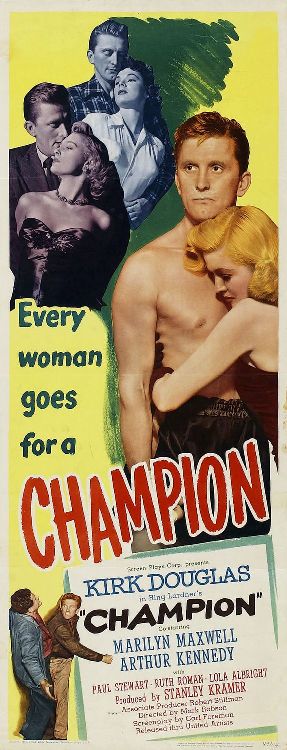
Champion1949filmA premier boxing film and Kirk Douglas‘s big break, Champion is in the company of other Noir such as The Killers, Body and Soul, and The Set-Up. This story is about one man’s rise to the top of the business and in his business, the blood and corruption actually show.

Douglas is Midge Kelly, a fiery nobody who is trying to make ends meet with his crippled brother Connie (Arthur Kennedy). When work at a hot dog joint falls through, Midge willingly takes some quick money sparring in the boxing ring. He’s got guts, but no skill, so he thinks that’s the end of his chances. Back to working at a Diner it is, and Midge has his eyes on the proprietor’s daughter (Ruth Roman), but then he’s forced into a shotgun wedding that he’s not too fond about.

Fed up with this kind of life, he searches out a manager so he can begin the long hard odyssey to make a name for himself as a boxer. His faithful brother Connie sticks by his side as does his manager Tom Kelly. City after city, Midge keeps knocking them out rising up the ranks until he is called on to throw a match. It’s all set, but in a brief instant, the reluctant slugger splits with the program. It’s a turning point that gets him in trouble with the big boys and yet makes him a media darling with the press. The opportunistic platinum blonde Grace Diamond (Marilyn Maxwell) realizes the tides are shifting and begins pursuing Midge.

It’s at this crossroads that Midge’s relationships begin to splinter since Diamond convinces him to take on the bigger fight manager Mr. Harris who can help catapult him to the top. The one thing Midge always had going for him was his loyalty to brother and manager, but in the pursuit of “happiness,” he lost both.

Connie returns to the home of his mother and pleads with Emma to come back with him. Their romance quietly builds as Midge’s star continues to rise. His infidelity also ascends with it. His next object after Diamond is the beautiful and more cultured Palmer Harris (Lola Albright), who also happens to be the young wife of Jerome Harris. However, he soon ditches the genuinely lovestruck girl when Harris gives him a wad a money to lay off of her. That’s the kind of man he’s become, but at least he’s Champion.

In one final effort, he tries to patch things up with Connie and Emma following the death of his mother. A rematch with Johnny Dunne is coming up and Midge hints at retirement, while also bringing Tommy back for one last hurrah. In rather predictable fashion, the fight plays out as we expect and yet as with any good noir their needs to be a little wrinkle and there is.

This film is by no means Citizen Kane, but in a sense, it is Kirk Douglas’s version of it.  Because he got the opportunity to play a character following the mold of the American Dream. He rose from the depths of poverty to become the champion of the world! And yet along the way, he became a cold-blooded, money-grubbing, scumbag who lost connection with all the people who actually cared about him. It’s the inverted American Dream — a cautionary tale on the most archetypal level. He plays Midge with the same tenacity of some of his earlier roles where he balances cold-hearted corruption with a nevertheless infectious charm.

Something else it has is a Cain and Abel type complex  — much like Force of Evil. There are the two brothers at odds, except instead of murder, there’s more of a self-destruct going on. In this respect, Connie is far from the most important character, but he is an interesting character thanks to the earnestness of Arthur Kennedy.

Also, I find it particularly interesting in terms of the women in Midge’s life. Thanks to posters I assumed Marilyn Maxwell was the main love interest, but in the film, he’s actually married to Ruth Roman’s character almost the entire film, and it seems to be Lola Albright’s character who is the only one who actually loves him. It makes for an interesting dynamic because these women are drifting in and out of his life. And he doesn’t end up with any of them. That’s the life of a Champion sometimes.

4/5 Stars

Review: The Apartment (1960)

The_apartment_trailer_1What has always stood out to me about Billy Wilder’s films and the writing behind them is that you can almost always observe cynicism paired with wit. They are continually sharp, often funny, but they also are underlined by more serious topics altogether. This quality is what allowed him to make films as diverse as Double Indemnity and Some Like it Hot. There’s a subversion of the norm that sometimes is dark, sometimes is funny. His second pairing with Jack Lemmon in The Apartment seems to fall somewhere in between.

The legend is that this story formed in Wilder’s mind after watching a Brief Encounter, about a tryst between an English man and woman. What interested him was a very small detail indeed. What type of person would allow his place to be the location of such a rendezvous? And in such a question came the inception of C.C. Baxter a man who was unwittingly funny, but also pitiful as played by Lemmon.

He’s a man trapped in the bureaucracy, attempting to climb the corporate ladder of a  company. He’s fighting in this game of survival of the fittest and trying to get ahead the only way he knows how. Lending his flat out to higher-ranking executives who are looking for a place to take their dates and have a good time. Baxter is somewhat of a hapless stooge though. He’s far from shrewd and his high ranking pals like him for it. He follows their requests. Does what they want. He’s a perfect cog in their plan. He’s one of them. Even Baxter’s neighbor Dr. Dreyfuss and his landlady get the impression that he’s a real high flyer since there’s always music emanating from his suite and bottles piling up outside his door. But he lives the charade and spends many a frosty evening waiting for his customers to clear out. It’s certainly a sorry existence, but he doesn’t mind at first since it pays off handsomely as he moves up the ranks.

One of the more personable employees in this mass of humanity is elevator gal Fran Kubelik (Shirley MacClaine), who is always friendly with Mr. Baxter since he is a true gentleman. However, she is also caught in an affair with top exec Mr. Sheldrake (Fred MacMurray) and she is actually in love. It’s a messy situation made even more complicated when Sheldrake asks Baxter for the use of his flat. He enthusiastically agrees, but he has no idea who else will be there. That’s one of those painful moments of dramatic irony where our opportunistic nonetheless lovable protagonist gets hurt. Lemmon is good at playing the drama movingly and filling his scenes with organic humor (much like the late Robin Williams).

At this point, C.C. Baxter becomes the general scapegoat for his colleagues and even his neighbors. Everyone gives him a hard time for things he has not done or does not really deserve. Sheldrake leaves his wife and looks to solidify things with Fran, and this moment is paramount because Baxter finally mans up. He may have lost his job, but he got to finish the best game of gin rummy of his life.

I must admit the themes of The Apartment are not always my favorite. I am much more partial to Some Like it Hot or even The Odd Couple, but Lemmon makes the film for me. Whether he’s straining spaghetti through a tennis racket or trying on his new suave business bowler for size, it’s hard not to like him. Ray Walston, Fred MacMurray, and about every other character is a cad. Shirley Maclaine is pretty good, but then again she’s never been the most captivating for me actress-wise.

When it’s all said in done, this is not Wilder at his absolute best, but teaming up with IAL Diamond elicited another classic vehicle with Jack Lemmon. Now shut up and deal!

4/5 Stars

Nebraska (2013)

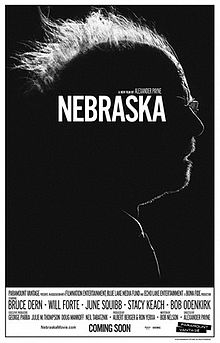
Nebraska_PosterDirector Alexander Payne tackles his native Nebraska in this character study that is part road trip movie, part father-son drama. Honestly, I never knew much about Bruce Dern, but at well over 70, I think it is safe to say he gave one of his great performances as Woody Grant. In this story, he is convinced that he has won a million dollars. It’s not a scam to buy magazine subscriptions like everyone seems to tell him. Including his weary, but good-natured son David (Will Forte). Woody’s ornery wife Kate is fed up with his behavior. He’s feeble, absent-minded, and not as sharp as he used to be. In fact, David and his older Ross (Bob Odenkirk) are thinking of putting their dad in an old person home sometime soon.

However, Woody is bent on getting that money, even if he has to walk all the way to Lincoln Nebraska, from Billings Montana where he lives. It’s utterly ludicrous and everyone knows it except Woody. But instead of fighting it, David sees it as a chance to spend some quality time with his dad away from his job in an electronics store. So the two of them set off to Nebraska to spend time with Woody’s family in his old stomping grounds.

Now Woody’s not much of a talker similar to his brothers (including Rance Howard), however, David and the audience soon come to realize that despite a rough exterior and alcohol problems, he really is a kind man. He’s a giver. That’s evident whether it was his family or his former partner, the opportunistic Ed Pegram (Stacy Keach). Because when all of these folks catch wind of the money, Woody becomes somewhat of a local celebrity and no one will believe that it’s not the case. They think it’s simply a dodge to avoid sharing the wealth.

Really most of the townspeople are petty, opportunistic, folks looking to gain from somebody else’s good fortune. However, it also revealed the shallowness of some, who were quick to ridicule when the money turned out not to be real. This film made me appreciate my own family in the Midwest and some of the more good-natured characters did strike a chord with me. There’s something so attractive about a community that remains so close-knit with each other over the years. I can never have the experiences of my grandparents. Even if I manage to be married for 50 or 60 years, I can never have that wonderful small town feel of returning to my roots and seeing all my classmates from bygone years. Although sometimes I suppose it can be a blessing and a curse because in small towns people will talk and that’s not always conducive to quality relationships.

That’s why when David lets his dad ride through town in front of all his old friends, it is such a poignant moment because he gifts his father one final moment of freedom to relish in front of his friends. All he got was a stupid hat that reads “Prize Winner,” but his son sold his car to allow his father to live out his dream one last time.

Because if you strip it down and take out all the white noise, this is a father and son film. It’s beautifully stark at moments with its modern black & white visuals. Yet it still has intimate scenes between father and son, that sometimes are incredibly sad, but also have a shard of hope attached to them. It took reading several other articles to latch onto the fact that this is seemingly Payne’s nod to the great Japanese director Ozu. Or at least he shares a lot of the same issues in this film and in some respects very similar pacing. It’s not some high-speed action flick, but it cares about deeper issues and reality. This is not California, but Nebraska and still relationships are universal. They look a shade or two different wherever you go, but never lose that personal meaning. It breaks through time and place, to speak to each of us on a personal level. Honor your father and mothers, because those relationships have great value even when they are a struggle.

4/5 Stars

Frances Ha (2012)

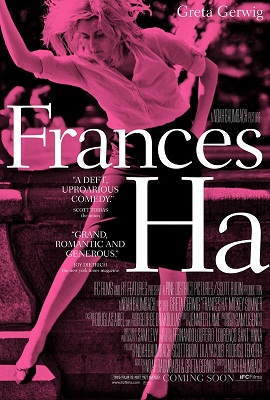
Frances_Ha_poster“You look older but a lot less grown up…” 

People as diverse as Buddy the Elf, Holly Golightly, and Annie Hall call New York their stomping ground and along with these iconic figures comes Frances Halladay. Her bubble does extend to France and California, but New York is really her home base. In Noah Baumbach’s film, we follow this enigma as her address constantly changes, and she strives to follow her dream of becoming a professional dancer. We are allowed time to examine and analyze her in all sorts of situations because plot usually gives way to various asides showcasing the free spirit who is Frances.

She worries about money, can’t pay rent, wants to play fight with her best friend, and is a self-proclaimed “undateable.” She acts like a five-year-old one moment and yet has an almost unknowing beauty about her.  In other words, she’s a real winner. We cannot help but fall in love with her since she wins us over with all her oddities from beginning to end. Her friend Sophie cannot stay mad at her forever either. It’s just not possible. They have to make up.

Frances settles down one final time, after trying her hand rather successfully at choreography and moving back to Washington Heights. There we get one last little nugget. We finally can chuckle knowingly about the title of this film. It’s so Frances and it’s the perfect cherry on top of the sundae.

In the tradition of New York films, Baumbach’s effort has a visual style that was meant to hearken back to the austere black & white of Woody Allen’s Manhattan (1979). In some sense, it acts as another character altogether. Whether he is pandering to us or not, there is no doubt that I am a sucker for the cinematography and it made things just a little bit more magical.

Thankfully Greta Gerwig helped craft this script and in her character, she found the perfect paradox. An individual so extremely quirky, but still somehow believable in the same instance. Her foibles and pratfalls only help to solidify her character in our mind. The fact is that each of us probably knows some variation of Frances. Those individuals who dance to a different drum and give every single day that they live on this earth a certain degree of pizzazz. I speak for all the cautious, rationally minded human beings out there. We need the Frances Has to make us laugh and to shake up our normality at least a little bit.

4/5 Stars

Review: To Kill a Mockingbird (1962)

Atticus_and_Tom_Robinson_in_courtHere is one of the rare occasions when novel and film are so closely connected in my mind that I cannot help love Harper Lee’s initial work and its adaptation to the screen. They’re both so timeless in their own ways. Don’t get me wrong. They are very firmly entrenched in a bygone era, but this story exudes certain themes that are universal.

It’s rather like visiting an old friend. It seemed like so long. I can hardly remember the last time I sat down with To Kill a Mockingbird the book, or the movie for that matter. And yet it rushes back so easily. The characters, the settings, the story. I can almost visualize the words on the page as the scenes take place on screen. It’s a wonderful experience and I wish I could connect with something like this more often. But To Kill a Mockingbird is special to me because I read it at a young age and really ate it up. Thanks to Peck’s performance the story was just moving the second time around. It never ceases to be.

It struck me that I thoroughly enjoy Gregory Peck’s iconic performance as Atticus Finch, because of Mary Badham. Finch is a stalwart father figure and that comes out in the ways he guides and leads his young daughter Scout through life. She has a very cut and dry view of the world, not getting down the nuances or complexities around her. What Atticus does is model what it is to live life with other people, pure and simple. He takes the complexities of life and simplifies them in terms his daughter can try to make sense of.

To a lesser extent, that means telling his kids to leave the Radleys be and complementing the always ornery Mrs. Dubose. He is not prone to bravado by acting his age instead of playing football and not gloating about his skill with a gun. He’s too humble a man for that. He also does not fight back. He has more self-respect for himself and other people.

He attempts to instill this and other skills like tact in his kids, especially naive Scout. He gives her the eponymous metaphor that it is a sin to kill a mockingbird because they are a bird (supposedly) that brings only beauty and goodness into the world. And as he says, and I’m paraphrasing, you never understand someone else until you climb into their skin and walk around a bit. He delves into what empathy is and it’s what allows him to feel sorry for the Ewells, instead of desiring vengeance.

Atticus Finch is one of the special characters that I would actually use as a model. He makes me question my own actions as I take on a role much like Scout. He’s constantly reminding, constantly being patient, and modeling what it means to do what is right. All this is done without condescension, without lecturing. It’s done out of love.

His greatest act is, of course, defending accused African-American man Tom Robinson (Brock Peters), because after all, without this central point there is no film or book before it. But rather than focus on the depiction of these African-American characters and whether they are objectionable or not, I would rather acknowledge that this was a simpler time with a lot of evil still left in the world (as there is now), so this film speaks to me, because on a basic level, it is a story of good in the midst of all this blind discrimination and hatred.

That simple truth still speaks to me even with a story that is over 50 years old. The only adult cast member who is still with us now is Robert Duvall, and he is well into his 80s. Gregory Peck with his bespectacled visage and his soothing yet commanding voice is gone. Brock Peters is no longer with us, nor are the many other lesser known figures. But their story and these characters they embodied remain as a testament to Harper Lee’s original work.

It seems important to ask ourselves why would a man like Atticus do what he did? Why would he take that risk when no one else would? He answers Scout in this straightforward manner, “If I didn’t I couldn’t hold up my head in town, I couldn’t represent this county in the legislature, I couldn’t even tell you or Jem not to do something again.” He’s a man who holds himself to a different set of standards.

5/5 Stars

The Virgin Suicides (1999)

VirginSuicidesPosterIn her debut, Sofia Coppola fashions the 1970s with a washed out wistfulness that feels like a distant memory — lingering for a time — leaving a few far away remembrances to be eulogized and reminisced about.

Her film is really about two groups. There are the Lisbon girls who live with their militantly authoritarian parents and then the neighborhood boys who look on with awe. These girls are the unattainable prize that all of these young men are entranced by. They are not besmirched or dirtied by the ways of the world, stuck in the ivory tower of their parent’s home. It’s almost as if they come out of a dream, so pure and in the same way so provocative.

However, things get shaken up when the youngest daughter attempt to commit suicide and then in a free moment she jumps out of the window and meets death by the metal fence posts below. Red flags should be going up everywhere, but stubborn Mrs. Lisbon only becomes more stringent in her moralistic ways. She should be trusting her daughters, allowing them certain freedoms, but she only takes away more. And reluctant Mr. Lisbon does nothing to stop her. He just lets it be.

Only allowed to socialize at one dance under strict guidelines, the girls relish this opportunity and so do the boys. They finally get their chance with a different class of girl. But after the smitten Lux breaks curfew, all the sisters lose all contact with the outside world. The iron gates go down, and she never gets another moment with high school heartthrob Trip. On top of that, their mother makes her burn all her records in another strict turn.

Lux defies her passively in any way possible as she and her sisters try and maintain contact with the boys on the outside. But there is a point for any person where this type of confinement, this type of prison, gets to be too much. The girls reach the end of their rope and take the only way out they can see.

Oddly enough, most of the boys have little personality, but the focus is the Lisbons and specifically their daughters. The Virgin Suicides was partly intriguing because it never seemed to take on some dramatic tone and it never felt all that personal. I felt so far away. As Carol King mournfully sang, “Doesn’t anybody stay in one place anymore. It would be so fine to see your face at my door. Doesn’t help to know you’re so far away.” That’s exactly what this film does. It doesn’t allow us to get close and that aloofness lent itself to the intrigue we have in these girls. We’re pulled into their story along with all these young boys.

3.5/5 Stars