Crossfire (1947)

crossfire 1.png

Like any self-respecting film noir, it opens with men whaling on each other amid stylized darkness. Edward Dmytryk’s Crossfire is an issue-driven picture and it’s an important one given the cultural moment in which it came into being. There’s no doubting that.

But though the imagery is spot on and we have numerous noir regulars, it doesn’t feel like a noir film in the semi-conventional sense. Maybe it’s because the issue it was looking to root out takes precedence over any of its more formalistic qualities and that’s perfectly fine.

From a practical standpoint, Dymytrk opted to shoot the film with low key lighting as it’s a cheaper set-up and also a lot quicker which allowed the picture to be churned out in a mere 20 days. However, it’s still quite befuddling how a film this short can still somehow be incomprehensible at times.

Like any good procedural it whips out a long list of characters introduced in every sequence who either have significant amounts of screentime or show up for a few moments and still manage to play a crucial part in this obscured piece of drama.

Realistically, Crossfire can be touted as the film of the three Roberts: Young, Ryan, and Mitchum. Robert Young will always be heralded as a television father much like Hugh Beaumont and so while I can never take him quite seriously in such a role as a police investigator, he certainly doesn’t do a poor job as Captain Finlay.

Paradoxically, Robert Ryan is one of those actors who is probably grossly underrated and yet as far as personal taste goes I’ve never liked him much (Though my esteem steadily rises). Maybe that simply pertains to the kind of characters he often played such as the belligerent Montgomery in this film. They are not meant to be affable and he does a wonderful job of eliciting a scornful reaction.

Likewise, Robert Mitchum has arguably the least important role of the three, but he still has that laconic magnetism that wins us over, portraying one of the other soldiers caught up in this whole big mess. Sgt. Peter Keeley is a bit of a tough guy but also ready to watch the back of his brothers in arms. He’s our counterpoint to Robert Ryan.

The minor players list out like so. The victim of it all was a man named Samuels (Sam Levene) who crossed paths with the demobilized soldiers in a bar and seemed nice enough. He even struck up a conversation with a homesick G.I. named Mitch (George Cooper) who Keeley guesses might be a prime suspect for murder.

Jacqueline White is the wanted Corporal’s concerned spouse while Gloria Grahame plays a characteristic noir dame who might prove to be an invaluable witness on his behalf, if only she’ll cooperate.

This is yet another link in the chain of post-war crime pictures where soldiers were returning home only to meet a new kind of disillusionment (ie. The Blue Dahlia or Act of Violence). A certain bar scene played over from multiple perspectives proves to be a pivotal moment, but it’s full of fuzzy recollections and screwy bits of information. No one seems quite sure what happened and the film banks on this ambiguity.

However, it’s about time to cease skirting around the obvious and say outright what the film is an indictment of. It’s anti-Semitism. “Jew-boy” is the trigger word. Though the film requires some reading between the lines, thanks to the production codes, there’s no context needed to understand what that means. It’s instantly apparent bigotry is rearing its ugly head.

As such, Crossfire shares a similar conviction with the year’s other famed issue-driven picture The Gentleman’s Agreement (1947) and it brings to mind the wartime short film headlined by Frank Sinatra, The House I Live In (1945).

But, of course, when you begin to analyze one group of people there always seem to be others still being marginalized whether Japanese-American, African-American, Mexican-American. You name it. And that’s part of what makes such a portrait fascinating. To see to what extent the lines of inclusion will be drawn up.

Though it’s evident that he’s preaching, there are still some steadfast truths coming from Robert Young as he tries to convince a soldier (William Phipps), still wet behind the ears, what he must do for the sake of his conscience. There’s a need to stand up to the bigots because hate is always the same. They hated the Irish and the Italians before just like they will continue to hate some other people group in years to come.

Even if the history gets pushed to the fringes and it doesn’t get taught in school, that doesn’t make it any less of the truth or any less of our history. It’s possible to contend that we are made stronger, not weaker when our troubled history and past indiscretions are fully acknowledged. Only then can we learn, heal the wounds, and pursue a better future together.

So Murder, My Sweet (1944) is still a superior film noir from Edward Dmytryk and probably a great deal more fun, but there’s no denying the message that’s at work behind Crossfire.

3.5/5 Stars
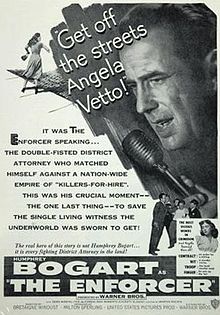
The Enforcer (1951)

220px-The_Enforcer_1951.JPGNot that this should deter you completely but The Enforcer isn’t a particularly unique crime film by any stretch of the imagination. Still, we have Humphrey Bogart headlining the police procedural not unlike a Call Northside 777 (1948), The Naked City (1948), or Panic in the Streets (1950).
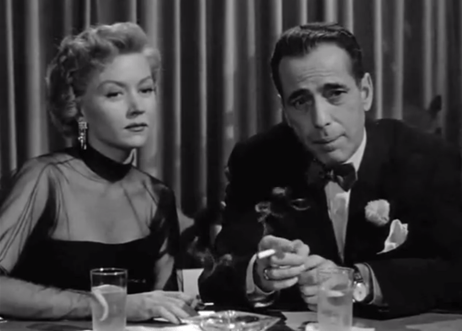
He’s the acting district attorney entrenched in the war against syndicated crime in the city. And the case he has topples like a house of cards when his one key witness is terminated. All the efforts behind four long years of tireless legwork go out the window.

They knew that it was an expansive operation with a multitude of contracts, a laundry list of hit men, and an undertaker on the payroll. They subsequently unearthed abandoned cars, drained marshes for the dead bodies, and questioned countless others who were purported to be involved. And yet it all seemed all for naught. No one knew enough or else they weren’t talking.

But Martin Ferguson (Bogart) is not about to let his case against the wanted crime boss Albert Mendoza (Everett Sloane) crumble that easily. There’s got to be another way to nab him. The script from Martin Rackin spends the majority of the time filling in all the details. In fact, he probably spends too much time before finally tacking on Bogart`s last-minute hunch almost as if it were an afterthought.

Ultimately, The Enforcer could almost be called a Raoul Walsh picture as the veteran director and friend of Humphrey Bogart took over the project when the incumbent Bretaigne Windust was taken seriously ill early in production.

No disrespect to Mr. Windust at all but the film got a leg up thanks to Raoul Walsh who directed many of the film’s more volatile sequences, capturing the action with bullets flying and fists flailing — brought to us with his usual dynamism. That counteracts some of the faulty storytelling that bogs the plot down.

The narrative structure is strikingly similar to aspects of The Killers (1946) but it’s hardly executed in the same gripping fashion. In fact, the layering of the flashbacks is hardly ideal even if it feels canonically very typical of what we often term noir. By the film’s end, whether or not the story gets told feels beside the point but nevertheless, Walsh manages to provide us with a decently tense climax that satiates some of our clamorings for a quality ending.

The film’s better assets are a few of the supporting cast members that help to add color to the procedural. We are treated to the typical menagerie of seedy characters including Ted de Corsia, Jack Lambert, and Zero Mostel. But the kingpin of them all is Everett Sloane. I can’t decide if it’s simply an uncharacteristic role for the actor or simply a poor bit of casting for the role of the boss of Murder Inc. But no matter, it is what it is.

There are also no femme fatales and very few female characters to speak of at all. For one moment, a woman is important: one Angela Vetto. Otherwise, it’s pretty bleak going. Even Bogart is not particularly interesting per se but he is still Bogart, making his scenes worth watching at the very least because he’s more than believable in any incarnation as a tough guy.

3/5 Stars

Review: In a Lonely Place (1950)

in a lonely place 1.png

Director Nicholas Ray customarily takes his material and subverts our expectations or better yet deconstructs the conventions that we often take for granted. But this is also matched with his penchant for showing a very raw and honest percolation of emotion. It causes every one of his movies to leave a perceptible toll on the audience because it’s difficult to have any other response. In a Lonely Place is another textbook example.

Here is a film with a murder plot which would normally be of primary concern. Instead, it ends up falling by the wayside to become nearly unimportant. It sounds almost callous to make such a claim since a life is at stake but then there is a bit of a detached quality permeating the picture.

A brooding Humphrey Bogart is at his most explosive as screenwriter Dixon Steele, a man with some talent, but a very odd way of exercising it. He’s an exasperating case for many in the industry, including his agent. Art Smith provides a wonderfully vivid performance as the agent nursing his ulcers while still faithfully standing by his client despite the turbulent nature of his temper. (Coincidentally Smith was featured in the earlier Dorothy B. Hughes adaptation Ride the Pink Horse).

It’s true “Dix” can be a tough man to figure out. Bogart may have played more appreciated, more iconic characters but there’s something especially raw about him here.

On top of Bogart’s performance, this is Nicholas Ray’s own examination of the Hollywood industry’s mechanisms, spitting out has-beens and flops as much as fame and fortune. There’s the continuous inner conflict between making a smash — the kind of trashy stuff that sells — and then trying to create something of worth on the spectrum of art.

If we had to draw up thematically similar films, All About Eve is a more flamboyant choice and Sunset Blvd. boasts the cynical edge but In a Lonely Place probably deserves to keep the same company with these noted classics from 1950 as a film of truly morose sentiments. It’s not simply cutting through the artifice of Hollywood. It’s trying to provide a deeper study of the people who are cogs of the industry.

After a precocious hat check girl (Martha Stewart) is found murdered it sets off an investigation by the police force. As Steele had requested the girl come over to his home to give him the plot summary of the low brow novel he is meant to adapt, just hours before her demise, he is placed on the top of the lists of suspects.

Conveniently, his neighbor across the courtyard, a bit part actress (Gloria Grahame at her most aloof and restrained), who he hardly knows, is brought in and vouches she saw him and it’s not a lie. He really was at home and he did not commit the crime.

If we wanted to, we could leave the story right there but that’s not all the film is working away at. It unravels in other ways too. In another world, this almost voyeuristic setting could have been made for Rear Window (1954) but this is not that film either.

Frank Lovejoy is the average cop with a thoughtful wife (Ms. Jeff Donnell) — a genuinely nice guy who knows “Dix” from back in their war days. He takes orders but he also has an inherent confidence in Steele as a human being. At any rate, he wouldn’t be prone to killing girls and so Brub helps to humanize this man in the eyes of the audience.

And yet there are still some troubling caveats on Dixon Steele. He owns a history of violent outbreaks but it goes beyond this. There’s a raging darkness that is part of his makeup as a character. He is tortured by hatred and by his own accompanying desolation. We can chalk it up to a number of things. His own personality. His lack of consistency. The often cruel industry that became his livelihood. It could be any number of these things or all of them.

In fact, for a film noir, the outcomes prove to be unique. It has murder but we never see it. There’s an actress who played countless femme fatales playing a slightly different iteration here. Even Bogart, though carrying a simmering temper that goes off on several occasions, is generally not a hardboiled heavy. Just a tormented screenwriter with demons to exorcize.

Beating up a college kid doesn’t go with the glorified and gritty brutality that might crop up in a Maltese Falcon (1941) or The Big Sleep (1946). It’s just callous barbarity in the normal world. Throwing phones or beating up friends in public is not normal behavior. There’s no other conventional excuse for it.

But this is Dixon Steele for you. He’s just a troubled man. Not an archetypal noir antihero. As much as we fear for the people in his stead, there’s also a mild pity reserved for him. He shows himself capable of love. He simply proves to be very ill-equipped for the endeavor.

The layers go deeper still and more personal as Gloria Grahame’s marriage with director Nicholas Ray was splintering and was finally absolved quietly during filming.

Beyond that, you get the sense, Bogart who financed the picture is playing someone, not unlike himself. Perhaps it’s the closest he ever got. Like the film, he found love in a woman, Lauren Bacall, many years his junior who nevertheless made him very happy. Sure Bogey was a success but it took him a long time to get to the top of the summit. He was a hard-drinker with a notoriously white-hot temper to match. Still, he was a romantic and an idealist in such a way we sympathize with. He’s ardently beloved today as he was in his heyday.

The contents of the story take on an entirely new spectrum of meaning with this personal context. In a Lonely Place wasn’t just an examination of Hollywood and the lives of people who could be real. In a Lonely Place feels far more transparent. It is Hollywood and these are the very people who find themselves caught up in its disillusioning grip.

Loneliness is there’s to have and to hold. They don’t need the prototypical genre conventions of graft and crime — the brand we conveniently label as film noir. There’s really little need for the more darkly cinematic overtones. They have themselves. That’s dismal enough already.

4.5/5 Stars

“I was born when she kissed me. I died when she left me. I lived a few weeks while she loved me.”

The Woman on the Beach (1947)

woman on the beach.png

The Woman on the Beach is ripe with subject matter that feels akin to Jean Renoir as much as any Hollywood picture possibly could be. Since the beach, in his specific case, initially evokes not the California coasts but the shores that might have so easily cropped up in the paintings of his renowned father Auguste Renoir. Marrying that preconception with the domain of beguiling femme fatales makes it all the more disconcerting.

But this is also a story of what it is to be an artist and you can see Renoir using the materials at his disposal to grapple with such themes which were no doubt ruminating in his own mind.

Like any director of irrefutable substance, Renoir was probably aspiring to do far more with the medium than his American backers would have preferred and that could explain why his movie was cut down from an unspecified length into the version we now have.

It’s true that the film is yet another collision of worlds with a tortured American tough guy like Robert Ryan paired with a French master of composition and commentary like Renoir. But far from being a mere incomprehensible jumble, the results are still revelatory if not quite flawless.

The opening underwater dreamscape proves to be an entrancing interlude as it plays out in Robert Ryan’s subconscious, brought to us by a self-imposed exile like Renoir no doubt with obstacles of his own to do battle with.

If we want to try and be standard in our appraisal of the picture by providing the cadence of the plot, it’s about a Coast Guard officer (Robert Ryan) stationed on the West Coast who is taken with a woman (Joan Bennett) he comes across when she is picking up firewood on the beach.

There’s an almost uncanny lucidity to how she pinpoints his deepest fears in their initial encounter and they come to the conclusion that they’re pretty much alike. How Peggy Butler can be so sure is slightly beyond the point. Certainly, it doesn’t make sense in rational terms.

Here again, we are met with the bewitching gaze of Joan Bennett that first came to my attention in a portrait found within a dream of a film called Woman in the Window (1944). She’s undoubtedly one of the underrated noir sirens out there because she was one of the preeminent talents in casting a spell of enchantment to entangle her male companions. Ryan falters much like Edward G. Robinson did previously, twice over.

Charles Bickford gives a performance of equal import as the blind artist Tod Butler, a man who is as attached to his work — a passion that he can no longer realize — as much as he is to his wife. They want to get rid of him in one moment and they think he’s faking his frailty in another but all these preoccupations fall by the wayside.

Thus, The Woman on the Beach cannot be branded as a pure film-noir but instead a vein of those crime pictures grafted with Renoir’s own sensibilities. Even if the studio knew in part what they were getting, it still makes sense that they were not completely satisfied.

It looks to be one of those sordid love triangles that were always a mainstay of film noir but, again even in its short running time with footage lopped off, it works beyond that and despite Hollywood’s best efforts (whether intentionally or not), Renoir’s going to have a voice.

To a degree, it’s possible to see some sort of progression from Le Bete Humaine (1938) in its stylized atmospherics highlighted by billowing smoke, psychological duress, and oh yes, an alluring gal playing opposite Jean Gabin in Simone Simon.

Aside from the luminescent Bennett, a few other ideas leave a lasting impression whether it’s the turmoil of an artist caught in the throes of obsession or the dreams that overtake a man plagued by post-traumatic stress. This picture has more to offer than you might expect.

It brings to mind John Huston’s Red Badge of Courage (1951) another cannibalized picture that in its present form is about two-thirds of a minor masterpiece. There’s still an exceptional spirit and resonance to what was leftover. It can only lead us to imagine what might have been on both accounts.

This would prove to be Renoir’s last film in the States before he washed his hands of the whole industry and returned to his native land to continue the creation of high-regarded works like he had never left. True, this is a picture that is often neglected but that’s simply because there are other works of great repute. That does not speak entirely to the detriment of The Woman on the Beach.

3.5/5 Stars

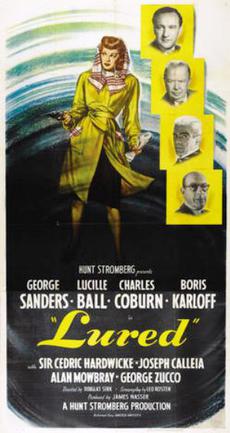
Lured (1947)

LuredPoster.jpg

Herein is a slightly off-kilter serial killer, mystery-thriller and early American film in the career of German emigre Douglas Sirk. Of course, the action is actually set in England. It’s a film that builds a paranoid framework like The Lodger (1944), I Wake Up Screaming (1941) or other like-minded films. However, it goes through the normal paces only to lurch forward in the most curious directions.

The parties involved include a Scotland Yard guided by that industrious Brit for a day Charles Coburn. Other people of interest include a street-smart nightclub dancer (Lucille Ball) who saw one of her co-workers go missing after a rendezvous with a mystery man. In fact, a rash of disappearances of young attractive women has overtaken the city.

Thus, upon finding Ms. Carpenter to be a plucky and intelligent young woman the inspector calls upon her services to force their elusive perpetrator out in the open acting as the tantalizing bait. She begins to respond to advertisements in the paper — his calling card — to lure victims into his clutches.

The only problem is figuring out who the man might be because numerous candidates roam the streets and many people circa 1947 placed postings in the paper. It’s common practice. Among people she gets caught up with are a delusional fashion designer who became unstable after years of criticism. The one and only Charles van Druten is played by none other than Boris Karloff in one of the film’s many digressions.

Likewise, Ms. Carpenter answers a call for a position as a maid, though the prospective employer’s intentions prove to be far more insidious involving some dealings in South America and too-good-to-be-true promises of advancement. Once more Scotland Yard puts an end to the criminal activities but is no closer to their murderer.

One of the more prominent people of interest is Robert Fleming (George Sanders) a man of vast influence and a stage producer who finds classical music tepid and most of the upper echelons of the society’s elite even worse. He goes about it all with the playful disdain that can only be attributed to George Sanders at his best.

In fact, his manner is off-putting to Sandra as well but their prickly beginnings cannot completely derail romantic feelings. In those respects, both Ball and Sanders prove to be adequate romantic leads propelled by their wry comedic proclivities. That’s far more rewarding than any romance. The only problem is that he might not be who he claims to be and at any rate, a great deal of circumstantial evidence is piled up against him. A final push for justice must be made.

Lured isn’t an instant classic as the tension while there is never altogether sweltering. But simultaneously the screen is crammed with quality performers and just enough idiosyncratic moments and bits of humor to keep the film from being absolutely conventional. George Zucco is by far the most amusing of the many supporting characters as the crossword puzzle-loving officer H.R. Bartlett who acts as Sandra’s guardian angel while simultaneously coming upon many of his solutions through simple eavesdropping.

This is also a telling film that should make us uncomfortable and it’s not so much that things feel overwhelmingly misogynistic and objectifying of women, it’s the even more sobering fact that things have not changed as much as we would like to believe.

What is the root of most serial killing? Surely we can see familial issues or mental instabilities but oftentimes it’s tied in with a distorted sense of love wrapped up in perverse fantasies hidden from view.

Our killer is obsessed with the poetry of Baudelaire and uses it to realize the fantasies that he never seems able to act out on. The man’s interest is in destroying beauty instead of making love to paraphrase Coburn’s character. When he finally is revealed I’m not sure it’s a surprise but then need we be surprised? Many “normal” men are capable of great evil. They’re simply good at covering it up.

3.5/5 Stars

Sleep My Love (1948)

sleep my love

It’s an alarming cold open. Allison Courtland (Claudette Colbert) wakes up on a train to Boston with a gun in her purse and no recollection of how she got there. It drives her into a fit of hysterics that riles up the whole train, though a fellow passenger (Queenie Smith) attempts to steady her nerves. We can’t blame her much since she’s been through quite the ordeal. Still, Courtland spends the entire picture trying to figure out what’s happening as does the audience.

Her concerned husband is played by Don Ameche that suave and charismatic heartthrob. It’s easy to see how he could be absolutely charming in comedy fare (ie. Midnight). Here he’s not so enjoyable. Perhaps in attempting drama, he comes off as too flat. There’s not enough definition there to be compelling. He’s just another handsome face.

Meanwhile, Allison’s evenings are haunted by a specter of a man (George Colouris) who keeps her under psychological duress with broader implications that tie him to a sultry and sulking siren and an entire plot to discredit Allison’s sanity through hypnosis and mind games. If it sounds ludicrous it is but Hollywood was mesmerized by the powers of such forces in the post-war years.

Because you see, she conveniently is the holder of a large inheritance and it seems like a lot of people want a piece of the pie and they’ve gone to great lengths to get it. Hazel Brooks continues in the same mode as Body and Soul (1947) providing the film’s femme fatale, Daphne, sizzling with avarice.

Most people are probably not accustomed to Douglas Sirk and film noir together but this movie proves it to be so, unfolding as an eery paranoia-filled drama that is very much brethren with Hitchcock thrillers like Suspicion (1941) or even Notorious (1946) along with George Cukor’s Gaslight (1944). And some of the broad aspects of psychological conspiracy are akin to I am Julia Ross (1945). However, Sleep My Love does enough to carve out its own unique path even if it’s not as prominent as these earlier titles.

Because Claudette Colbert far from going it alone finds a formidable ally in Bruce Elcott (Robert Cummings), a friend of one of Courtland’s old acquaintances the bubbly Barby (Rita Johnson). Elcott becomes quite the sleuth and a character of tremendous integrity who seems a far better fit for our leading lady than her actual husband. He’s also falling for her.

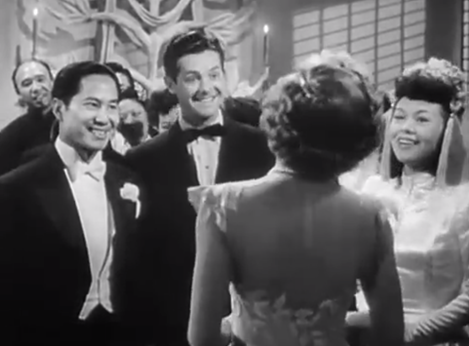
A high water mark of the film is an extended wedding sequence that is surprisingly fascinating. First off, it’s rather remarkable because it shows a wedding between a Chinese-American couple (Keye Luke and Marya Marco) and it plays it straight and true without any stereotypical sentiment. It feels like a real wedding and an authentic portrayal of this union without the necessity of needless bigotry to sully the moment.

The evening festivities prove equally joyous for our stars who form a quality bond and what feels like it could have been an unfortunate aside becomes one of the film’s most diverting sequences choosing to forego dime a dozen drama for a bit of depth.

In subsequent scenes, Keye Luke, Bruce’s “brother” from his extended time in China becomes his right-hand man as he tries to get to the bottom of Mrs. Courtland’s curious situation that turns perilous very, very quickly. It blows up in the end with a domino effect of dramatic trip wires that set off all sorts of outcomes that came hurtling to their conclusions as quickly as they began. It’s over the top certainly but no less a gripping finale if the film is given leeway in the areas of realism.

If this film is not what we would come to think of in Douglas Sirk there’s no doubt that it feels less dated than most, anthropologically speaking, coming from an intellectual man who seems to carry an open-minded and forward-thinking approach.

Likewise, the intense interest in the human psyche might have matured in the years since, but there’s little doubt that it still holds a prominent place in our modern world with its ceaseless intricacies. One could say psychological complexity is one of the reasons movies still get made today. That and a craving for romance.

3.5/5 Stars

Crime Wave (1954)

crime wave 1.png

The opening gambit is wonderful. It’s marvelous. You can’t blame me if I get a little…Well, anyways if you thought that squeaky-clean Doris Day could never turn up in a film noir you were gravely mistaken.

In this particular case, a jovial gas station attendant has her blaring loud on the radio right before he gets whaled on. Crime Wave makes its intentions fairly clear right from the beginning. Here is yet another arbitrary noir title that tells you next to nothing. That’s what this first scene is for. It tells everything to us in visual language.

A trio of San Quentin convicts are pulling bank jobs dotted all the way up and down the coast of California and this is just one of them. But a cop has been killed and they ran off with the cash register’s contents.

I had to do a serious double take because my eyes must have passed over Charles Bronson’s name in the credits. Seeing him young and tough as ever is like seeing an old friend — even if he’s playing a thug.

He’s an ogling and ill-mannered brute as can only have a life in such a darkly cynical world. Meanwhile, Ted De Corsia is the ringleader who has been sitting on his scheme for years now. But they need someone to call on — a new home base for their operations after one of their men gets a bullet in the gut.

Just like that, reformed jailbird Steve Lacey (Gene Nelson), currently working as an airport mechanic and married to a nice respectable girl (Phyllis Kirk) hears his old life calling. It’s the old Out of the Past (1947) conundrum. You never truly escape the specter. So he gets netted once more by his old mates and slowly dragged back into the crime world he hoped to never look back on.

But even in his attempt to maintain his path on the straight and narrow and remain on the right side of the law, one momentary lapse in judgment is all that it takes. He tells his wife to keep a pact with him. A man came to their house and that was all. He doesn’t want to be implicated any further so he leaves out the shady doctor who took the cash on the dead convict’s person. It seems such an easy bit of information to divulge but then again, the world is twisted in knots of confusion. He’s paranoid and distrusting of everyone. Perhaps he has every right to be.

Two dueling philosophies seem to present themselves from the side of the law. Police Detective Sims (Sterling Hayden) holds fast to that old adage that “Once a crook, always a crook” while Lacey’s kindly veteran parole officer seems to think that “sick men get well again.” And as the film seesaws back and forth we are forced to consider both trains of thought. The cop with no heart for ex-cons or their wives, while the parole officer entertains more sympathy. But it’s hardly enough.

However, that plays precisely in its favor as a gritty picture rooted in realism while still overlaid with a cinematic crime story inspired by a Saturday Evening Post write up. The film presents a world where the cops are as cunning as the villains and in a sense, they have to be.

It has the imprint and the contours of an L.A. that existed at one time — though now eroded and reconstructed through the years — but this is a stylized vision of it all from Andre de Toth. The streets and names might be all too real from Glendale to San Diego but the events and accents are not — overrun with stray cats and dogs — not to mention the colorful mugs of pet doctor Jay Novello (some might remember his nervous-types on I Love Lucy) and the forever crazed-faced Timothy Carey.

It becomes a sort of neorealism with the Hollywood touch even in its ending which while not a complete sellout definitely caps the film with optimism. And in that moment, maybe Crime Wave gives us a hope for the real world. Maybe cops and robbers don’t look all that different. Maybe they both are prone to corruption and vice. But maybe justice can still be enacted.

If this film was all about morals it wouldn’t be worth much to many movie audiences. Thankfully it’s a gripping picture that places us right into the scenario like all the great caper films and it gives us a hero to empathize with. The visuals are presented as a stellar piece of added everyday reality. Search this one out if you’re a fan of small-time gems.

3.5/5 Stars

Shack Out on 101 (1955)

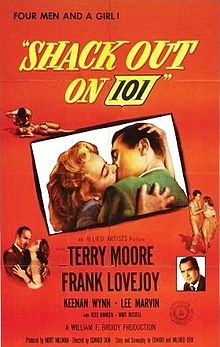
Shack_Out_on_101_film_posterLike a Cry Danger (1951) or a Private Hell 36 (1954), this low budget film noir flick is such a joy to watch because it wears what it is right on its sleeve, clear out in the open. What we get is an utterly absurd paranoia thriller that also happens to be a heaping plate of B-noir fun.
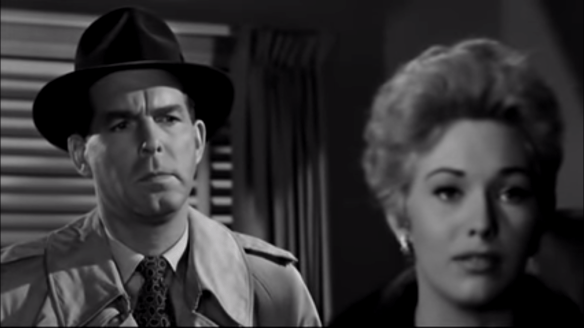
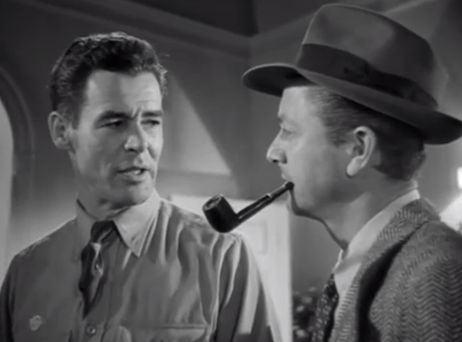
It’s a dirty, grimy picture about a dirty, grimy place. The cook behind the counter’s named Slob (Lee Marvin) and he has a dirty mind and disheveled look to match. He’s constantly at odds with the owner of the roadside shack (Keenan Wynn) and they make countless verbal barbs at each other time and again. You get the feeling that they relish jawing and putting the other man down.

Meanwhile, though the joint might not be one of the most frequented attractions there is some traffic from PCH and it brings in a few regular visitors.

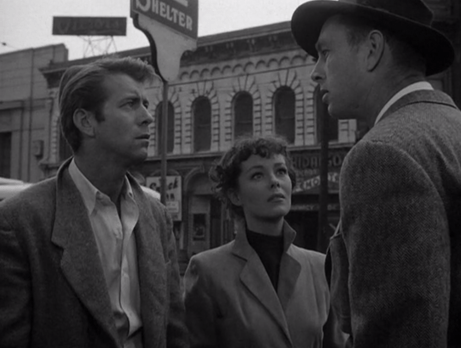
The day-to-day “Hash Slinger” and longtime waitress Kotty (Terry Moore) is in the middle of a rapturous romance with a local professor Sam Bastion (Frank Lovejoy), and she’s beyond ecstatic to be going with someone who is a real man — intelligent and gentlemanly. Though recently he’s been especially occupied with work.

The traveling salesman Eddie (Whitt Bissell) with a nervous streak nevertheless remains a tried and true friend. He and George (Wynn) both made it through D-Day together and since then he always makes a habit of coming by the old place when he has a free moment. Kotty and the Professor take kindly to him too. He’s just that kind of amiable fellow.

Shack Out on 101 shines most obviously amid its small talk because there’s an invention to the dialogue that’s delightfully slovenly and colloquial. It’s full of the types of dialects, jabs, and put-downs that fill our everyday conversations in a way that feels thoroughly authentic and brings each character alive as they sit at the counter.

There might be two men standing in the front of the diner on a slow day lifting weights and talking about how muscles are for amateurs. Pecs are what real men call them.  Then they proceed to show off and compare their physical attributes. No reservations whatsoever.

Later on, they try out the latest fashions in spearfishing attire as they dream about the mythical “Pancho” who they’ll soon spear in the tropical waters off the coast of Mexico. Little do they know how close that is to the truth. Except there’s no need to go to Mexico. The catch is right at home.

When the film actually gets preoccupied with its plotting, it starts to go cockeyed and crazy. Admittedly, fallout from the Cold War must have been on everyone’s minds because, like Aldrich’s Kiss Me Deadly (1955), this picture too tries to play the nuclear angle. It’s hardly effective though I suppose it needed a broader, more concrete story to add a certain amount of intrigue and this one is complete with spies and government secrets.

Still, in the end, it comes out pretty thin. What we truly relish as the audience are not the attempts at drama but the way the film manages to make its apparent lulls invariably interesting and even how it manages to have asides at all given its infinitesimal running time. Sure, it won’t win any awards and the joint is a real dive but that’s all part of its cruddy charm. For a B-picture, this cast is quite the array of talent.

3.5/5 Stars

Pushover (1954)

pushover 2.png

A film such as Pushover is easy to admire for the simple fact that it does not waste a moment in telling its story. As the credits roll a bank job is already in full progress laying the basic groundwork for what will unravel in the subsequent minutes.

The introduction of our stars follows soon thereafter in a meet-cute happening outside of a local theater, the pretense being engine trouble. It’s enough of an excuse for them to make a connection — two people who started the evening on their own but felt enough of a spark to wind up together.

Of course, when we pull back it’s easy to realize a pretense is all that it was. Paul Sheridan (Fred MacMurray) is a cop tasked by his police chief (E.G. Marshall) to help recover the $200,000 that was nabbed in the bank job. The alluring young Lona McLane (Kim Novak) ties into it all because she was the one-time moll of wanted thug Harry Wheeler.

Thus, the police soon have her apartment under surveillance and her phone tapped for any hint of contact with the gangster. But what they weren’t counting on is for Sheridan to fall for her and put his own stake in getting back the missing money. Meanwhile, his partner Rick trusts him completely and the old vet Paddy is just trying to limp by to retain his pension.

What develops is this strange dichotomy between what is the ethical long arm of the law and what is pure voyeurism encroaching on a person’s right to privacy. Though it doesn’t explore the topic as Rear Window (1954) did that same year, there are still some interesting issues to be culled through.

Further still, despite being a policeman, Sheridan’s personal philosophy seems to be that money makes the world go around. Although he’s quite a bit older, there’s still much to enjoy about Fred MacMurray. Even if his occupation has changed, there is a sense that he’s playing another thinly veiled version of Walter Neff, that pragmatic everyman not fully prepared for playing with fire. Since that role was one of the ones that lit up his career, if this is a mere copy, it’s still a fairly enjoyable one placing him opposite Novak’s femme fatale.

There are passionate kisses that strike like lighting, some gorgeous shadows that easily help to put this into the dark recesses of the noir canon, also reflected by the number of cigarettes smoked and the loose morals that run through the narrative.

Even in her scintillating debut, Kim Novak’s voice is as husky and sultry as ever. Whether wearing her mink coats or driving her sleek wheels. Smoking her cigarettes and coolly spilling her drinks on anyone who gets fresh with her.

But she is not one of the independent strong-willed dames out of the war years. She is not Phyllis Dietrichson. She comes from a different generation and so, far from being a manipulator, it feels far more like she is willingly complicit in Sheridan’s plan as he takes the reins. In fact, it’s difficult to call her a femme fatale at all in the typical sense. It’s really the men around her who are crooked and more than anything she garners sympathy.

Phil Carey plays the stalwart cop who stands by his colleagues but he’s also no schmuck when it comes to laying down the law. The ever-active nurse next door (Dorothy Malone) who shares an adjoining wall with Lona becomes the object of his desire and it conveniently sets up parallel love stories. We now have two cops and two gals. Two romances and a line of entanglements as Sheridan tries to sidestep his colleagues and get the payoff for his own and for his beautiful new accomplice. Pushover develops into a delightfully messy piece of drama full of police corruption and avarice. But it’s a small-time story too. That’s part of its charm.

3.5/5 Stars


Caged (1950)

caged 1.png

Caged proves to be a stark, even uncompromising picture for the 1950s. Director John Cromwell had a long career in Hollywood, helmed some quality film noir, and became a subsequent casualty of the Blacklist, but this just might be his finest effort.

Furthermore, despite being an actress of some acclaim, I must admit that even I forget about Eleanor Parker aside from her well-remembered appearance in The Sound of Music (1965). But if Caged is any indication, she is most certainly worthy of more credit. She freely channels a bit of the flustered timidity of Joan Fontaine early on only to transform into a completely different person entirely.

It’s a film that dances on the complete opposite spectrum of George Cukor’s The Women (1939) another film that is dominated by the lives of female characters. In that case, the narrative is preoccupied with the intricacies of their frivolous catty ways and malicious gossip. Caged has not even a pretense for laughter.

Likewise, the scenes of incarceration bring to mind images of  The Snake Pit (1946) and Shock Corridor (1964) but even those films were about mental illness and the lack of quality care, not so much the abominable corruption that begins to coalesce within prison walls.

Marie Allen (Eleanor Parker) is one of the first-time offenders who comes in with the new batch of prisoners. At only 19 years of age, she seems like no more than a girl and yet she’s already been married, had her husband fatally killed during a bank robbery, is pregnant with a child, and has an accessory rap pinned on her. That’s how Marie got where she is even if she doesn’t seem meant for such a hardened life.

Agnes Moorehead delivers one of her most sympathetic performances as a champion of rehabilitation who unfortunately is fighting a losing battle against the system as we soon see.

Some might remember the imposing Hope Emerson from Cry of the City (1947) but she leaves an even more indelible mark on this picture as the ever-necessary sadistic prison guard — an individual who sees little worth in her inmates — believing them to be animals to be treated as such. She is indicative of the institution as the cog that lays down the law and narrowly believes that there is no worth left in these women. They’re trash.

When everyone thinks that it becomes a bit of a self-fulfilling prophecy. And in time as she comes up for parole and then has it spit back in her face, the changes begin to show in Marie’s face. It’s hardened. Her voice is tougher. She’s more defiant.

Andy Dufresne in Shawshank Redemption (1994) was another character with unfortunate circumstances but he maintained his humanity in a dank place. You either get busy living or get busy dying. Yet being an impressionable girl Marie takes to heart the words of her veteran prison mates, “You get tough or you get killed.”

Maybe Caged outcome is easy to read and it ultimately succumbs to melodrama but there’s still something unnerving about the film on the whole with its overarching unsentimentality.

When I saw the name of famed composer Max Steiner as part of the production that was a tip-off but Caged rather audaciously functions in many sequences without any scoring and that lends to the overall sense of realism that pulses through this prison noir.

The utter irony is that the notes of “Rock of Ages” can be heard wafting through the corridors as Marie prepares for her final parole hearing and she makes it this time. But by now there seems little chance for redemption. She is intent on calling her own shots and not about to rely on anyone else. She’s gone beyond clinging and seeking shelter from the world around her. She doesn’t seem to need anyone. She’s become part of that world. The before and after are startling. They make for a harsh indictment of a flawed prison system.

4/5 Stars