My Night at Maud’s (1969)

nightatmaud's1I love the forum that is created in international cinema where all things can be debated and discussed without fear of what the audience will say. Hollywood caters to the audience and that more often than not means that thrills are given greater weight than substance. Eric Rohmer worked at Cahiers du Cinema alongside French New Wave visionaries like Jean-Luc Godard and Francois Truffaut, but he joined the game a little later than his colleagues with a different style. Rohmer took his pseudonym from director Erich von Stroheim and British novelist Sax Rohmer. He was a highly educated man and that comes out in his films.

My Night at Maud’s comes from the perspective of a man, who we have a sneaking suspicion might be a lot like Rohmer.  Jean-Louis (Jean-Louis Trintignant) is a reserved, highly religious, intelligent man. He attends mass on Sunday, bumps into an old school chum on the street, and willfully enters a discussion on all sorts of philosophical topics.

Whereas Godard interest himself in the lowly gangsters, the streetwalkers, or the lovers on the run, Rohmer’s character are in a completely different stratosphere. They are a higher slice of society, and it shows in what they spend there time philosophizing about. In fact, there’s a lot of discussion stemming from Pascal’s wager on whether or not it is beneficial to believe in God. Although he can be a bit of a clown, Vidal is also a philosophy professor and ready and willing to delve into such topics. He holds hypotheses on the meaning of life, and he’s considered where hope comes from. These are intelligent beings and deep thinkers, and by transference, they lead us to think. They drop by on Vidal’s friend Maud (Francoise Fabian), who is a divorcee, irreligious, and most certainly a free thinker. She’s also beautiful, and she likens there little late night convo to the salons of old as they gather around her bed to raise their conjectures.

nightatmaud's4I feel like I have known people like Jean-Louis, and I cannot help but like them. He’s a fairly resilient Christian, but not a perfect example mind you, and yet he feels far from a hypocrite. With his new dialogue partners, he speaks of his past love affairs and how they can exist with his religious convictions. Maud rather matter-of-factly labels him a “shame-faced Christian” and a “shame-faced Don Juan,” because he’s not fully committed or acknowledging of either. And yet she generally likes him a lot. He likes her company too and so they can continue talking in a genial manner. She pokes fun and ribs but never attacks. And she openly brings up numerous different ideas about Christianity. There are things that feel very human, but not very Christian to her. Maud asks if Christians are judged by their deeds? She assumes there is a bookkeeping aspect of Christianity where good deeds are weighted versus sin. Several times the rather obscure term of Jansenism is thrown around a bit in reference to the theology of Dutchman Cornelius Jansen. It surely is difficult to keep up we these folks at times, but it’s well worth it.

Maud has her own preconceived notions about religion, while Jean-Louis has some delusions about romance. He thinks he’ll meet a pretty blonde Catholic gal and fall in love. It sounds utterly preposterous and yet then he meets Francoise (Marie-Christine Barrault) after his night at Maud’s. She’s the perfect embodiment of everything he’s ever dreamed of in a romantic partner. They seem like a good pair, although she is still in school, they are intellectual equals with similar personal convictions.

nightatmaud's5Sure enough, 5 years down the line they are married with a young son. Jean-Louis has not seen Maud for many years now, but quite by chance they bump into each other on the beach. Both pick up where they left off as if no time has passed because it’s so easy for them to converse. Francoise is noticeably uncomfortable around Maud, but nothing more is said about it. Jean-Louis moves on and plays contentedly with his family on the beach. Maud heads back up the hill as cordial as ever. This is an ending that is made powerful in its subtleties above all else because Jean-Louis and the audience realize something about Francoise. Yet there is no need to voice those conclusions because all that matters to him is that he is happy.  It toes a soft line between romance and drama, instead resorting to a beautiful exchange of ideas. Noticeably, in Rohmer’s film, there is no score so the dialogue is elevated to the level of music. It fills the void using deep, introspective and personal forms of verbal expression.

4/5 Stars

Jour de Fete (1949)

220px-Jour_de_fete-posterJacques Tati’s film seems like the perfect mode of expression in the post-war world. It’s boosted by lively, accordion-laden carnival music, with wry commentary from the old lady, and a bicycling postman, the mustachioed Francois (Tati himself). Use of sound becomes so integral to the comedy and the comedy is so important to the story because there isn’t much of a story. It’s populated by every type of livestock imaginable and you’re not quick to forget it because they’re constantly being heard and causing havoc, whether it’s a billy goat or a brood of chickens.  It’s a little different feel, but Tati makes me think of Britain’s own quaint Postman Pat. He’s a little more humble than the U.S. Postal Service and his customers are a simpler sort of folk. Although he becomes obsessed with the American-style of mail delivery complete with helicopters and motorbikes. This leads to a frantic race to deliver the mail with the speed of Americans. But the French countryside was not meant to function like urban America. This is Tati’s critique of not simply American culture, but more so it’s reliance on technology. But he takes off any of the edge by delivering it through his charming, bumbling brand of humor.

Amid this meager plot, Francois finds time to help put up a flagpole and enjoy the local carnival that enters the small town. Not to mention being accosted by a very industrious fly. Fittingly, Tati seems to pull off the Buster Keaton sliding stop, giving the illusion of being out of control, when in reality he was a wonderful physical comedian. Much lengthier than his predecessor, but still memorable in his own right. His bike riding antics feel reminiscent of Keaton in Sherlock Jr.

Jour de Fete is not quite as enchanting as Tati’s later works, but part of that might be due to the absence of the Mr. Hulot persona. It’s his saga that we want to be a part of, and he’s the man we want to get to know. Right now the director is still exploring the world that would become more pronounced in his later films. However, Francois does not have quite the aura that Hulot could build. Truth be told, I was slightly thrown off by the colorization. I probably would have appreciated the straight black and white of M. Hulot’s Holiday or the vibrant color of Mon Oncle. But that is not to say that Jour de Fete is not at least a mildly fun romp.

3.5/5 Stars

Two Days, One Night (2014)

Deux_jours,_une_nuit_posterIf people watch Two Days, One Night, they’ll probably recognize one face and you’ll hear something similar to the following: “That’s the girl from Inception and the Dark Knight Rises right?” The more observant viewer might say something like: “Isn’t that Marion Cotillard?” And they would be right on either of these accounts and yet the Dardenne Brothers (who the average viewer, unfortunately, might not know), take Ms. Cotillard and place her in a completely different type of role altogether. They take an A-List Hollywood star and drop her in the every day, lower class world that the brothers themselves came out of. In fact, the story and most of their stories are set in Seraing, a French-speaking area of Belgium that is known for industry.

They have an immense fascination in simple people just trying to make ends meet. Most of their stories have mundane narratives like The Kid with a Bike (2011), and Two Days, One Night is little different in that respect. It’s so basic in conception and yet in this banal and rough-edged world, the Dardennes find immense beauty.

Our chief subject is Sandra, a young woman who is married has two kids and has just battled her way back from depression. Undoubtedly it was a tough road, but she is obviously resilient and ready to get back to work. After all her family needs the money because her husband only works at a restaurant. But her whole reality is changed in a matter of minutes when she learns she will be laid off. Her company can either keep her on or give all their other employees bonuses. The majority took the bonus over Sandra. Her work friend Juliette buys her another ballot for the following Monday, so Sandra has a few days to try and plead her case. But she’s done fighting. She’s tired and defeated before she begins. It’s her husband Manu who urges her forward and reluctantly Sandra follows through.

This is the core of the film as Sandra goes from home to home, ringing doorbells, and talking with the people hidden away in their homes. They are no longer her faceless colleagues, but soon they become living, breathing people. Just like Sandra, they have a personal stake in this decision. Maybe it’s to pay for a daughter’s schooling, remodeling a home, or trying to stay afloat as a single parent. There are those who are simply fearful of being laid off and those who hope that Sandra will succeed while admitting they’ll vote for the bonus. They all seem like generally legitimate responses, and Sandra knows that just as we do, but she tries anyway, at least to talk with them–get them to see her side. Because this decision has major repercussions, and it’s not just occurring in a vacuum.

Things are teetering dangerously on the edge of equilibrium for everyone involved because everyone seems to be between a rock and a hard place. And there’s no difference between Marion Cotillard and all these other unknown actors. They’re all bracing themselves for sinking in the same boat.

In a way I found myself comparing this film to the courtroom drama 12 Angry Men because in a similar manner Sandra must go about trying to convince her colleagues to change their minds, and talk them out of their convictions. It’s a difficult task, and this film speaks to the logic and rationale that dictate human decisions. There are individuals all across the board from those who only are looking out for themselves. Is it too hypocritical to call them selfish? It’s hard to know. There are those who want to good, but just cannot, and finally those who stand by Sandra, because they feel it is the right thing to do. The most painful of these interactions occur with those colleagues, who are so conflicted inside. You can see the situation at hand tearing them apart.

Other directors would be terrified of such a film, looking to fill slow moments with some kind of heightened state of action. The Dardennes are content with having their actors rock out to Them’s “Gloria” after a long day. And true, there are many moments of tension and even conflict, but most of this film is about people talking, mirroring the rhythms of real life. The camera is constantly by Sandra’s side, peering at her face, and staying on her hip. Her face has to carry some scenes at times, and it does so wonderfully. Really, this is a film that displays her resilience, grit, and determination to push forward. It had the potential to be either feel-good drama or a tragic story, but it finds a beautiful middle ground. Sandra comes out an undisputed winner, just not in the way that she expected.

4.5/5 Stars

The Double Life of Veronique (1991)

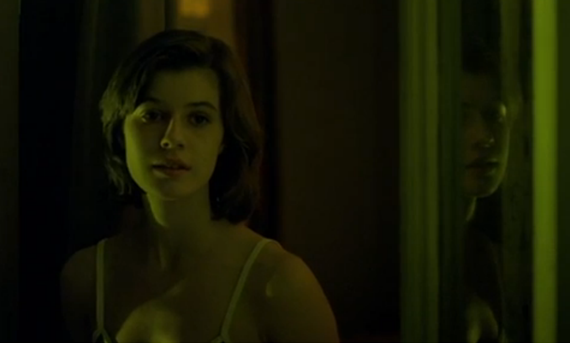
thedoublelife4Krzysztof Kieslowski’s The Double Life of Veronique fills an ethereal world full of dancing light, soft hues, and faint reflections. It’s beautifully muted visuals complement a wonderfully mysterious story. Its title suggests the potential of a story about one woman living two varying lifestyles, one respectable, the other not. Instead, the film revolves around two women living parallel lives. Neither is shameful or noticeably corrupt. They are both sweet individuals with aspirations that drive their lives. They desire love and commendation like many of us.

The first is named Weronika, a Polish beauty, who is an up and coming operatic performer. While her star is on the rise, she meets a new boyfriend and goes a trip to visit her aunt. But everything goes back to the music. In fact, music often takes center stage totally enrapturing us in song. There are sublimely haunting melodies that pierce right through our core. The angelic voices are gracefully wafting through the chambers of cathedrals and music halls. And just like that the breathe is gone out of one of the angels for good. We get a hint at it from Weronika’s aunt, suggesting that all their family members died unexpectedly, but there’s no more explanation.
thedoublelife5
The majority of the narrative follows French music teacher Veronique, who is the spitting image of her Polish counterpart. Except they have no relationship whatsoever, only some odd intuition that there is someone else out there who they do not fully know. As we observe the daily rhythms of this young woman’s life, it feels almost otherworldly with an unearthly golden glow that illuminates the streets she walks. It’s a film where marionettes are made graceful and bouncy balls are little orbs of wonder. Along the way, Veronique finds a love of her own that she doesn’t even know. But she’s enchanted by him and the magic that surrounds him, much as we are bewitched by her. Her lover is constructing two identical marionettes in order to tell a new story about two women with a connection that cannot be described. In other words, the mythos around his narratives, tread closely to Veronique’s own life. A girl in one of her photos makes it clear. Everything comes to a fitting full circle, and yet we get little in the realm of a fully gratifying ending.

thedoublelife2More often than not Kieslowski’s film has a mesmerizing effect on me and a  great deal of that power of entrancement is due to Irene Jacob. She is like a cinematic goddess with a face made to be scrutinized. A charming classical beauty, she exudes a range of emotions, while still managing to hold onto a semblance of mystique. Jacob is a wonderful muse for the director’s purposes and she would prove so again in Three Colors: Red. But that’s another conversation entirely.

I consciously ask myself, “Is this a film even to be understood?” Because the plot points and the pieces don’t always seem to fit together especially well when you actually consider them. And somehow I remain content in that reality. Whereas someone like Michelangelo Antonioni throws away a few pieces of the puzzle for good measure, for Kieslowski these final pieces never existed. They are not paramount to what he is trying to accomplish. The Double Life of Veronique maintains such a transcendental almost spiritual quality because we can only watch and listen. Ours is not to reason why ours is to simply look on in awe at what we are witnessing. The beauty, the enigma, and the feelings. Because Kieslowski is more interested in the essence of the film than the particulars.

4.5/5 Stars

Au Hasard Balthazar (1966)

auhasard1Robert Bresson’s Balthazar is the best piece of art I have viewed in some time and it is art in the sense that it may have various interpretations, it causes us to think, and it elicits an emotional response. In truth, it is a story that I do not fully understand and I can never hope to know, but there is nevertheless an austere beauty to this parable. Furthermore, there is a kind of magic in this air of ambiguity. I want to watch it, again and again, to see if I can understand, to see what revelations come my way. It was one of those experiences that left me wondering what I had just watched, however, I know enough by now not to fight it, but enjoy that feeling of not comprehending in full.

Essentially this is a tale about a donkey cherished by a young girl and over the years they lose contact, reunite, and go away again, as is the rhythm of life day to day. The plot points started becoming less important in comparison to the images and emotions that begin to well up inside of us. At the same time that the donkey is often being mistreated or carrying the burdens of his various masters, his girl Marie (Anne Wiazemsky) is growing up trying to figure out what love is. She is close to a boy named Jacques only to have him drift in and out of her life several times. She cannot decide how she feels exactly about him. There’s the boy Gerard who is good at raising hell and Marie spends some time with him. But it remains to be seen what the real agenda of her parents or Gerard and his friends are. What of these matters of honor and murder? Do all the particulars even matter that much?

Balthazar’s own path includes whippings, long hard toil as a beast of burden, a stint in the circus with all the other captive animals, and happy times driving Marie’s cart. But is that wrong to personify him? Is he even capable of emotion? I’m not sure if he is, but the audience certainly is. We can be joyful when we see that cute young donkey being enveloped in hay with young children playing. We can become somber as Balthazar is slowly being worked to death as the years drag ever onward and his master considers putting him down in lieu of getting a new harness. Somehow a donkey can be a victim of his circumstances, bravely taking the abuse of others, and living without a shred of retaliation. In some strangely entrancing way, it works.

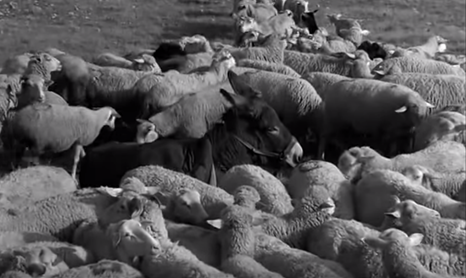
auhasard2Then, Balthazar takes a stray bullet and weakened he comes upon a green pasture where he kneels down peacefully to die. Around him comes a flock of sheep led by a shepherd. It’s a deeply heart-wrenching and visually arresting moment evoking Biblical imagery from Psalm 23. The full life having been lived and now it’s over in tranquility. It’s really a summation of the spiritual journey that each one of us traverses in our lifetime and yet Bresson brings us this allegory through simple, clean strokes. Images and sounds balanced exquisitely together in a completely naturalistic mode of expression.  Wiazemsky on her part is a natural beauty who positively captivates with every move she makes (reminding me of Anna Karina) Furthermore, Bresson somehow causes us to build a deep connection with a donkey which is hard to believe.

It’s the trademark of Bresson to have a stripped-down, straightforward approach to film-making, so much so that his style almost feels like no style at all. It’s so clean and unobtrusive. He shows us the world simply, succinctly, and without pomp. Even with the casting of non-actors, and in this case a donkey, as his main players. But he’s undoubtedly the master of inducing a response based on even the most basic of subjects. There are times it’s almost easy to forget you’re watching a film entirely because you get so wrapped up in what he is showing us.

4.5/5 Stars

The Young Girls of Rochefort (1967)

rochefort1If the Umbrellas of Cherbourg is a piercing operatic drama, The Young Girls of Rochefort is pure, unadulterated escapism at its finest. 

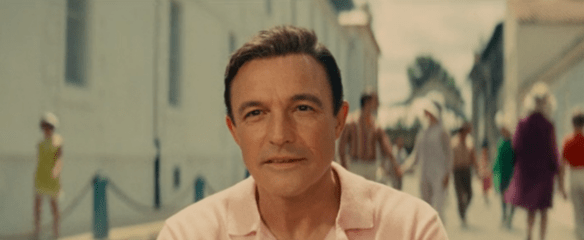
Directed by Jacques Demy and starring an ensemble cast including Catherine Deneuve, Francois Dorleac, Gene Kelly, Michel Piccoli, George Chakiris, Grover Paul, and Danielle Darrieux, this is a whimsical French musical that has no equal. 

rochefort9

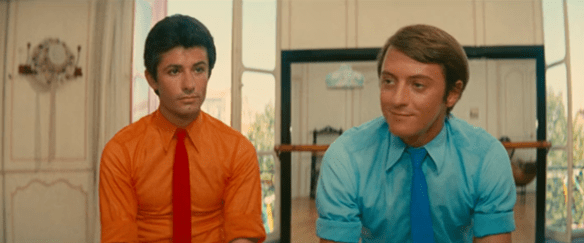
The film opens with a group of performers coming into the town of Rochefort to get ready for a big outdoor show. They become acquainted with the local hangout that includes a kindly matron (Darrieux) and many locals including an idealistic artist and sailor who is searching for his ideal lover. Nearby her two adult twin daughters hold piano and ballet lessons as they too get their little prodigies ready for the big show. Delphine (Deneuve) is fed up with her suitor and desires a new love, while Solange (Dorleac) on her part hopes to advance her career as a pianist. She goes to the proprietor of a local music store to see if he can introduce her to a prestigious American Friend.

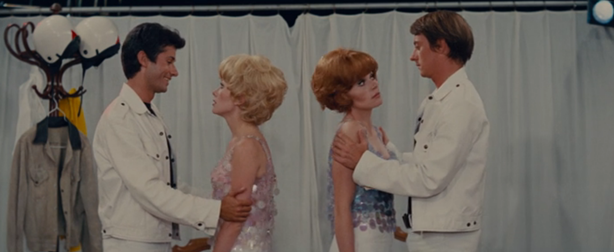
A great deal of dramatic irony sets in and the plot is constantly moved forward through song. Yvonne at the café is still depressed over a split with a lover 10 years prior, because he had an unfortunate name. Solange has a chance encounter while stopping to pick up her kid brother Booboo, and Delphine becomes curious about an artist who painted a portrait that looks strikingly like her. All of these events reach their apex on the Sunday of the big performance, and in need of some performer, the carnies enlist the help of the twins. They are a huge success and things wind down.

rochefort4

The next morning the performers get ready to leave for Paris and the girls decide to follow suit. However, Solange has another encounter that changes her plans and then Yvonne is united with her love. That leaves only Delphine to go with the boys to Paris, but not to worry, she would be united with her painter soon enough.

The light and very French-sounding tunes are hard not to like, but that is only the very beginning. Demy pays homage to Hollywood musicals of old going so far as casting Gene Kelly (Singin’ in the Rain) and George Chakiris (West Side Story) in his film. He undoubtedly owes a debt to Vincente Minnelli and Stanley Donen with some striking moments reminiscent of An American in Paris (1951). It makes sense. Demy uses the pastels and costumes of a Hollywood musical extravaganza while also including dashes of French style.

rochefort2

Rochefort takes place in a real location, but it truly is a fantasy world that the characters inhabit, full of perpetual dancing and dialogue that is delivered through song. The real-life sisters do a wonderful job in this film and there is something reassuring about seeing Gene Kelly. Rather like an old friend who gives comfort in a whimsical, but altogether new experience. The story arc of dashed, renewed, and ultimately newfound love allows Demy to once more explore the issues of fate and chance that always seem to enchant him.  His partnership with Michel Legrand is once again bountiful including the enduringly memorable “Chanson Des Jumelles,” an infectiously bouncy, trumpet-laden number performed by the sisters.

There’s nothing much else for me to say except The Young Girls of Rochefort is one of those underappreciated gems that is thoroughly enjoyable and chock full of all sorts of fun. It delivers a serving of something with a familiar flavor while giving it a little extra panache. It’s about as playful and fluffy as you can get which in this case is not a bad thing at all. 

4.5/5 Stars

L’Atalante (1934)

LatalanteHere is perhaps one of the greatest wedding processions we could ever hope to see. Buster Keaton is more outrageously funny in Seven Chances, but this one is solemn, and somehow still funny in its own way. And that’s what is most striking about L’Atalante (which also serves as the name of the boat of choice). This film seems so serious and strait-laced, you might say, and yet it brims with comedy. It’s the type of everyday comedy that makes us laugh even now. Funny looking characters, odd voices, a plethora of cats all over the place. There’s no way for that to get lost in translation, and it remains quirky and engaging 80 years later.

It also happens to be a beautiful film exemplified by a newly-wedded bride walking the prow of a boat with the fog billowing around her. Or perhaps it’s two lovers embracing passionately and a smile bursting on the face of the woman. It’s so visceral, so engaging in its displays of love, energy, and emotion. In this way, it brings to mind other love stories of the age like Sunrise, It Happened One Night, and certainly the early works of Jean Renoir. Except the thing here is that director Jean Vigo never made another film after L’Atalante. He entered bad health even during filming and died soon afterward in his early 30s, but he left behind a masterpiece.

In short, the story revolves around four main characters living life together on a boat named L’Atalante. Jean is the captain and groom who has picked a beautiful wife named Juliette who is going to share his existence on the sea. His first mate is the weathered and scruffy Pere Jules. He might have a rough exterior, but he and his cabin boy are full of bumbling and buffoonery that endears them to all.

For the two lovebirds, Paris is the enchanting destination for a fantastic makeshift honeymoon, but it also proves to test their relationship from the get-go, since Jean is extremely jealous and a street peddler openly flirts with Juliette. It’s a tragic turn in their love story which leads to Juliette looking for a way home and Jean sinking into a state of depression aboard his boat. That’s what makes their ultimate reunion all the sweeter.

Thus, L’Atalante blends a timeless topic like love with little moments of magic that bubble up from within these scenes. Whether it is Juliette walking the streets window shopping, or Pere Jules giving a lens into his past with all the souvenirs he has accrued over the years. Without a doubt, he was my favorite character. I have never quite seen anything like him.

4.5/5 Stars

Review: Breathless (1960)

breathless2Breathless is such a fresh, smooth piece of cinema that feels as cool now as it was back then. The transcontinental French vibe paired with the revolutionary production is strangely still appealing. It does so many things with such style that is always unique but never quite off-putting. Not to mention the score which is playful in an elegant sort of way. The film has an array of quick cuts, it’s discontinuous, abrupt, and it literally jumps between images. Actions, like shooting a cop or sitting in a room with a girl, become more interesting than we could ever give them credit for.

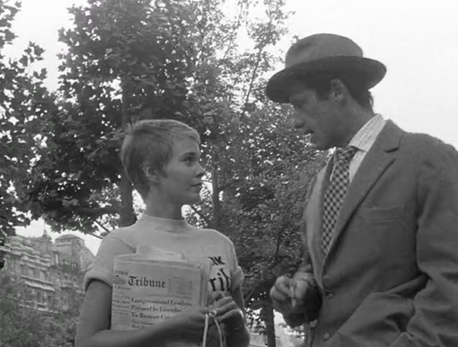
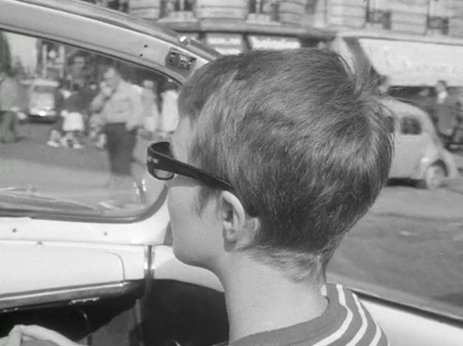
Godard is known for saying that all you need for a film is a girl and a gun and that’s basically all Breathless is. Michel (Jean-Pierre Belmondo) is a low down, no good hood who also happens to be quite funny at times. He shoots a cop for no good reason and after that, the police are after him on the streets of Paris.breathless5He’s also broke and all his buddies are either unavailable or in some trouble of their own. He swipes money from one girl and rendezvous with his latest fling, the aspiring American journalist Patricia (Jean Seberg). They do very little except drive around the city or lounge around her room. In one memorable shot, jump cuts piece together scenes of the back of Patricia’s head as she sits in the passenger seat observing the world around her pass by.

Michel, on his part, seems only to want sex and yet he says he’s never loved a girl before. He’s continually drawn to Patricia, and he never can quite pull himself away.

She, meanwhile, has another man with an eye on her, and she hopes to propel her fledgling journalism career. Her one assignment happens to be interviewing the highly philosophical and somewhat pompous Mr. Parvulesco (Jean-Pierre Melville).breathless10The billboards around town even foreshadow the impending doom of Michel. Patricia later learns from the police that her lover is wanted for murder, and she must decide what to do about it. In a memorable scene, Patricia is shown pacing around the room in a wide circle. In the end, she does turn in the hood to prove to herself that she doesn’t truly love him.

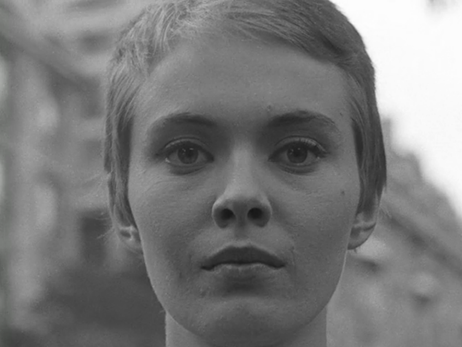
Michel looks utterly pitiful, like a wounded deer after he gets winged by the police and collapses in the middle of a quiet avenue. Patricia stares straight at the camera giving the queerest of looks as Michel breathes his last. If you wanted narrative clarity you’re definitely looking in the wrong place.

breathless9In some ways, Jean Seberg’s iconic look reminds me a young Audrey Hepburn another gamine glamour girl. The photography of Seberg is iconic from the reflection in her sunglasses to her donning Michel’s hat. Breathless proves film is not just entertainment, but it can also be lastingly stylish. There’s nothing wrong with that, and it still seems to work after over 50 years. Honestly, when I was starting out, Breathless helped open up all of European cinema to me and for that, I am indebted to Godard and The French New Wave.

4.5/5 Stars

Purple Noon (1960)

purplenoon4Right off the bat, there are two things that stick out about Purple Noon. First, you cannot help to notice the colors because the blues and reds pop like some vibrant 1960s painting. Then there’s Alain Delon who at the age of 23 made his rise to stardom, thanks to this film and Rocco and his Brothers (1960). As Tom Ripley, he finds a role that is fascinating in more ways than one.

During the first interludes of Rene Clement’s thriller, based on the Patricia Highsmith novel, I didn’t really know what I was watching or what to think. Tom was sent to Italy to bring the wealthy Phillipe Greenleaf back to San Francisco at the wishes of the man’s father who is paying Ripley. Their story begins as an entertaining jaunt through the city. They lounge at cafes, take carriage rides, and generally have fun living it up at night.

Tom is nothing like Greenleaf. He’s far poorer coming from a humbler background, but he is also much more resourceful and clever. When he takes a trip with the wealthy young man aboard his yacht, he finally hatches a plan to get what he wants. He abruptly stabs Greenleaf during a game of cards and the whole trajectory of the film changes in an instant. It began playfully absurd and quickly switches gears as a thriller involving murder, stolen identity, and deception.

purplenoon5

He plays up the tiff between Greenleaf and his girlfriend Marge, telling her that he is still angry and so he went off somewhere else without her. Thus, begins Ripley’s transformation into Greenleaf, forging a passport and signatures until he can pass off as the man himself. He starts dressing differently, spending more money, and continually acting as if he actually is Greenleaf. But things get difficult when he nearly runs into folks he knows, and Marge is desperate to know where her love is. These all prove problematic and yet Ripley skirts most of these entanglements with relative ease. It’s when a friend of Greenleaf’s named Freddie Miles figures out his charade that things begin to escalate because Tom’s only option seems to be murder. He commits the act coolly and plans his next move with calculated ease.

The police are after a murder, but it looks as if Tom has tied up all the loose ends and we find him relaxing reclined on the beach. He doesn’t know that the game is up, because of what the police found at sea.

The visuals of this film definitely do justice to the young Delon who is strikingly handsome with piercing eyes, but his turn is interesting in its own right because he was always so adept at playing the coolest of characters. He’s no different here and Purple Noon proved to be the initial boost to his storied career.

4/5 Stars

Bay of Angels (1963)

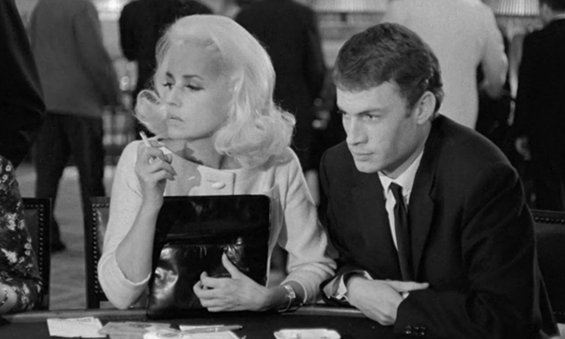
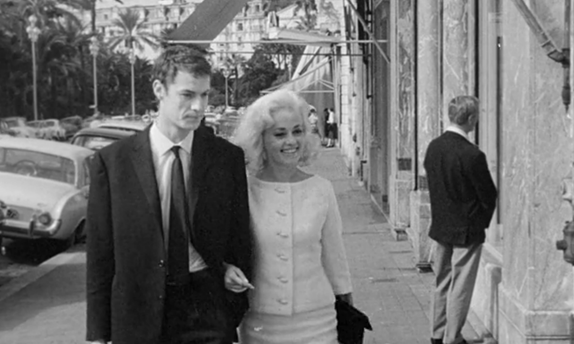
bayof3Bay of Angels is quite different than anything else I have seen by Jacques Demy. Similar to Lola (1961) it is shot in starkly beautiful black and white and it has a kind of love story, but it lacks the music or general whimsy that often characterized Demy’s later works.

This film finds its subject matter in gambling, and it follows one woman’s obsession and another man’s growing interest in roulette. At first, Jean is a rather bored young bank employee, who is coaxed by a colleague to take up gambling.

bayof2

Initially, he is skeptical, looking down at the pastime as a frivolous waste of time and money, after all, he is a sensible young man. However, he parts with the sensibilities that his father would have for him and instead take a few weeks of vacation to spend some time in the casinos of Nice and Monte Carlo.

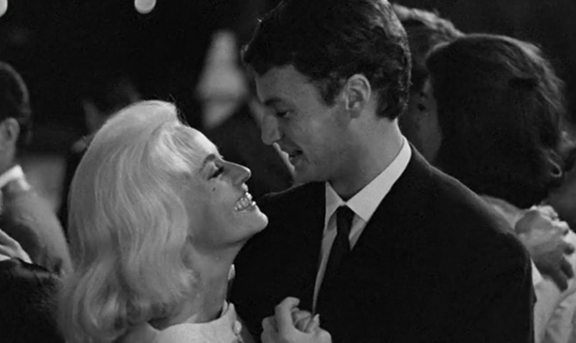
Soon he gets bitten by the gambling bug and he’s hooked. He finds an equally enthused companion in Jackie (Jeanne Moreau), who has had a far longer history with roulette. Jean falls for her very quickly and Jackie holds onto him like her good luck charm. Their many days spent in the casinos are constantly fluctuating roller coasters of luck. Once gambler’s fallacy has taken hold it’s hard to kick the habit, and Jackie constantly blows her money. If not at the wheels, it gets spent on fine dining and clothes. She has no restraint when it comes to spending and Jean indulges her willfully. It gets so bad that Jean begins to get as reckless as his companion, and he cannot bear to leave her, although she really does have a problem.

bayof4The formally reserved persona of Jean becomes violent and passionate for Jackie’s affection, but she’s not quite as ready to give it out. The ending felt a bit forced, but yet again Demy delivers a story that is riddled with feelings of love and passion.

It is an interesting observation that his male characters pale in comparison with his female leads ranging from Anouk Aimee, Jeanne Moreau, and Catherine Deneuve. These ladies who are always the object of affection, steal the screen with their mesmerizing performances. In fact, Claude Mann has a rather slumping posture, a glum face, and not particularly good looks. Thus, in contrast, Jeanne Moreau looks like an especially alluring beauty, who seems at home in gaudy gambling houses billowing with smoke or seaside promenades.

Bay of Angels is supposedly the place that brings the pair luck, but the reality is that this film is all about chance. Not fate so much as Demy usually explores, but a topic that is still somewhat similar. It is also a film that makes me never want to play roulette. I do not want the mundane lifestyle of Jean, but I would like to find my excitement somewhere else. I suppose that’s what made Moreau’s character so fascinating because her obsession was so great and yet she simply accepted it and thought little of it. But it drove her life.

We’re partners in a game. Let’s leave it at that.” ~ Jackie

4/5 Stars