The Leopard (1963)

Directed by Luchino Visconti and starring a stellar cast including Burt Lancaster, Alain Delon, and Claudia Cardinale, this Italian film revolves around a Prince and Patriarch during a period of social change in Italy in the 1860s. 

His Excellency the Prince of Salina (Lancaster) is a highly respected noble, who lives with his family on a large estate in Sicily. In his own life, the Prince is annoyed with his marriage and perturbed about the company his nephew Tancredi (Delon) is keeping. However, a revolution led by a man named Garibaldi means great change for the nation and finally following the lead of his nephew, who joins the rebel redshirts, the Prince sides with the new way and supports the plebiscites that are set up. His nephew falls for the beautiful daughter (Cardinale) of an aristocrat, and despite the fact that his own daughter has an eye on Tancredi, Don Fabrizo fully supports the marriage knowing it is good for the family. Because of his title and the respect he has garnered, the Prince is offered a position as a senator in the new government. But he courteously turns it down feeling he is too old and too attached to the old ways. Tancredi and Angelica are to be engaged and they are presented together at an extravagant ball. Over the course of the evening, Don Fabrizo has time to talk, dance with the young beauty Angelica, and reflect on his own life. As the lavish evening begins to dwindle the Leopard walks off to clear his head. 

In some respects, I saw this as an Italian equivalent to Gone with the Wind, and I could see some precursors to The Godfather here because the Italians portrayed are very religious and chivalrous people who can also be ruthless. However, I think it is fair to say that The Leopard is its own film entirely, and it should be taken as such. Tancredi and Angelica are no Rhett and Scarlett and the Prince is not the Godfather. They are their own unique characters. In my personal opinion, I would recommend the Italian version because that is the way the director meant it to be seen and Lancaster’s normal voice seems out of place in the film. Some may say that this detracts from his performance, but I think his presence and acting ability show through even if he is dubbed.

4.5/5 Stars
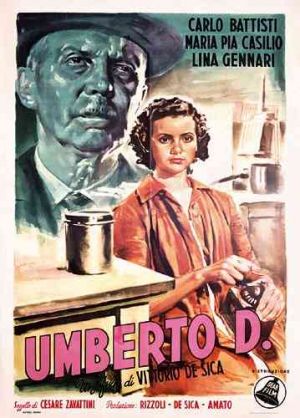
Umberto D (1952)

ed3e0-umbertod

This Italian neo-realist film directed by Vittorio De Sica, with many untrained actors, is about an elderly man scraping by off his pension. His landlady wants to evict him and his only real friends are a maid and his dog Flike. Much of the movie follows him as he tries to pawn belongings for money. He is a very proud man with a respectable past, but now times are tough. We watch as he goes to the hospital, has his home taken out from under him, and then he tries to give away his beloved dog. This film at times can be very bleak but Mr. Umberto is resilient to the end.

4/5 Stars

The Bicycle Thief (1948)

This Italian post-war neo-realist film, directed by Vittorio De Sica, is about a man who has his bicycle stolen and then must find it in order to continue working. Antonio Ricci is a man desperate for a job and he is fortunate enough to get an opportunity. However, he needs a bike and he sold his trying to provide for his family. He gets enough money to buy it back and he starts his days work pasting posters up in Rome. While his back is turned his bicycle is stolen and the culprit gets away. Because it is his livelihood Antonio desperately searches first with his friends and then with his son Bruno. After much looking he believes he has found the thief but with no proof the boy gets off. As the day ends Antonio chooses the one option left with no avail. This film is wonderfully simple and beautifully realistic. You feel deeply for this man who is by no means perfect, in fact he has many faults. But he is simply human. In a sense we are left with a cliffhanger ending that leaves us anxious for him.

5/5 Stars

The Good, The Bad, and The Ugly (1966)

Starring Clint Eastwood, Lee Van Cleef, and Eli Wallach as the title characters, this is a memorable Spaghetti western. Angel Eyes (Cleef) is on the prowl for a man who stole some gold. Meanwhile Tuco (Wallach) is on the run until three bounty hunters confront him. However, Blondie (Eastwood) is the one who turns him in and then helps Tuco escape after he picks up the reward. Finally, the two accomplices split up on bad terms. The next time Tuco turns the tables capturing Blondie and marching him through the desert. While on their journey they learn where the gold is hidden. First they have run ins with Angel Eyes an the Union army and then they got caught up in a Civil War skirmish. The two of them endure it all and go to the cemetery where the gold is. There they have the final showdown with Angel Eyes in epic fashion. This film is great because it is exciting, it features an iconic Ennio Morricone score, and it has great cinematography which is a trademark of Sergio Leone. An Italian western may seem strange but Leone somehow makes it work.

5/5 Stars

For A Few Dollars More (1965)

7c912-forafewdollarsmoreStarring Clint Eastwood and Lee Van Cleef with director Sergio Leone, this Spaghetti western is the second film in the “Dollar Trilogy.” The film opens with two bounty hunters, and in two separate instances we quickly realize their skill in bagging their man. However, when a notorious outlaw, “El Indio,” and his gang begin to cause trouble, both men are intent on getting the reward. Reluctantly they agree to join forces and Manco (Eastwood) joins Indio in his robbing of a bank so the two mercenaries can bring him down. The bandits get away with the money and then later they overhear the intentions of Manco and the Colonel, and so they rough them up. In secret Indio has them released, then sends his gang after them so he can get away with the money.

However, the colonel took the loot and so the next morning he and Manco systematically mow down the bandits. Indo comes for the money and shares a tense moment with the colonel only to have Manco appear too. Using the chime of a pocket watch, they face off. In the end one man leaves, his revenge complete and the other takes the reward. Although this is not the best Eastwood western, it certainly had some action-packed moments that were very entertaining.

4/5 Stars

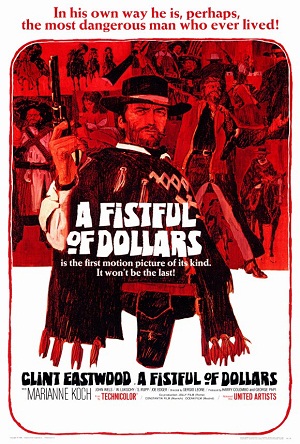
A Fistful of Dollars (1964)

c0810-a_fistful_of_dollars_posterStarring Clint Eastwood with director Sergio Leone, this western adaption of Yojimbo has a poncho-wearing gunslinger (Eastwood) playing two rival gangs off of each other. Upon entering the town, the man with no name is soon disturbed by the Baxters and he makes light work of four men.

Then, he decides to join the rival Rojos gang while spending the rest of his time at the local saloon. After a massacre takes place over some gold, the man uses two of the bodies to lure both sides out to a cemetery  In the ensuing chaos, the Rojos capture one man and then the man with no name sends a hostage over the the Baxters. He was able to get money from both sides before the exchange took place. That night the Rojos celebrate and the gunslinger sneaks off to rescue a woman who is captive. He does a virtuous deed but is found out and the Rojos beat him to a pulp. Using his ingenuity yet again, the man escapes to fight another day. Thinking he received help from the Baxters, the Rojos brutally wipe them out.

With his friend the innkeeper in trouble, the man returns for the final showdown. He outwits his foe and beats the sharpshooter, Ramon, at his own game. As would become the norm  the man would ride off as the victor in one of Leone’s famous panoramic shots.

4.5/5 Stars