Sabotage (1936)

Sabotage1936.jpgSabotage: Willful destruction of buildings or machinery with the object of alarming a group of persons or inspiring public uneasiness.

It’s not exactly a titillating introduction but since this is precisely where this 1930s Hitchcock thriller commences so will I.

Again, Hitch is collaborating with Charles Bennet and of course Alma Reville (his wife) core members of his team by this point. I do find it funny that it came from a novel called The Secret Agent, the name of one of Hitchcock’s earlier entries, only to be changed to Sabotage. But it only goes to show how throwaway some of these titles were because they are hardly reflective of the genuine satisfaction in partaking in what is trying to be accomplished.

The inciting incident of the entire film involves the power grid going out all across the city. Some people assume it’s a freak event but those embroiled in national security and connected with Scotland Yard know there are far more ominous intentions. There are men looking to undermine the nation through systematic acts of sabotage and ultimately terrorism.

From our perspective, these were obvious harbingers of impending world war. In that climate, they were probably quite close to home. This film occupies itself with a single individual as he’s tailed by a government agent with his adopted family (Sylvia Sidney and Desmond Tester) acting as his convenient alibis because he’s been nothing but good to them.

One telling statement comes from the little boy when he’s talking aloud excitedly about gangsters and the like.  Because gangsters look quite ordinary, just like you and me and it’s an offhand comment but he doesn’t know how right he is. This is another textbook Hitchcock scenario because this is by no means a mystery. We know from the opening shot who the perpetrator is. But Hitchcock uses that modicum amount of knowledge to grab hold of his audience.

Similarly, he uses the tried and true example he mentioned in his dialogue with Truffaut. Having two individuals talking before a bomb blows up isn’t inherently suspenseful but if you show your cards early you’ve instantly ratcheted up the tension. He does that here immaculately aboard a double-decker bus.

Although even then it would be hard to favor Sabotage over some of his other works even those that are part of his thriller Sextet. It’s really a fairly minor addition and though Sylvia Sidney is as candid as ever she’s hardly meant for a Hitchcock film. Oskar Homolka and John Loder aren’t bad per se but they’re hardly as compelling as a Peter Lorre or Robert Donat.

Though the terrorists might look slightly different and their motives are more political than any other, there’s this uneasy sense that there is very little that is new under the sun. It’s telling that Bennet’s screenplay was loosely adapted from a Joseph Conrad story which was itself focused on sabotage in the late 19th century perpetuating this idea that certain stories are truly timeless.

Reading Walt Disney’s name in the opening credits might be a pleasant surprise for some and as might be expected, since this story does take place partially in a cinema, they show a cartoon short, seeming to be a harbinger for Sullivan’s Travels (1941) except in this story the main character gets shot with an arrow — very much a Hitchcockesque spin on animated cartoons if there ever was one. There can be humor but it’s always underlined by a sizable dose of dread.

3.5/5 Stars


Rear Window (1954): Visual Cinema and “Lisa”

rear window 1.png

There are such a vast number of levels to appreciate Rear Window on and one of those is its impeccable use of sound as well as a score courtesy of Franz Waxman. In fact, it is quite easy to consider it as a film with a wholly diegetic soundtrack but it’s really a complicated weaving of sound orchestration playing against the images onscreen. For instance, against the credits, as the blinds come up, we’re met with the playfully cool jazzy beats of “Prelude and Radio” which proves to be in perfect juxtaposition with the deathly hot heatwave hitting Greenwich Village in the film’s opening moments.

We’re also inundated with all types of songs popular and otherwise which can be picked out of the story organically if you’re paying attention. Two of the most obvious additions are “That’s Amore” and then “Mona Lisa” which can be heard being sung by a group of party guests.

Whether or not it’s a slight nod to our heroine Lisa is up for debate but it’s also notable that she, in essence, receives her own theme song which is concurrently composed by the songwriter who lives in the courtyard that we come to know over the course of the film. It slowly involves from its nascent stages into a full-fledged tune that gains its wings once the romance between Lisa and our protagonist L.B. Jefferies has come into its own.

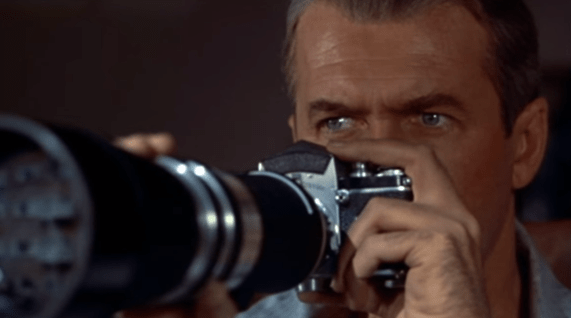
Obviously, beyond the elements of soundtrack Rear Window develops so immersive a world and Hitchcock expertly inserts us directly into the environment to the extent that we have no choice but to become involved in the whole ordeal. We are accomplices, if you will, in this viewing party of Jimmy Stewart’s.

It truly is an exhibition in the moving image because the film works so brilliantly with them. Certainly, it begins with the staging and the complex setup Hitchcock had to work with at Paramount Studios but there’s simultaneously the use of color cinematography, the lighting of the stages which sets the scene given the time of day, and common street noise that lends an almost imperceptible authenticity that we take for granted.

Furthermore, working with his long trusted photographer Robert Burks you see Hitchcock moving so fluidly and with so much purpose through the playground provided him. The camera captures objects with clear intention and a crispness that far from simply giving us the illusion of being in the space, in many ways, makes us feel like we are actually right there with Stewart looking out into the courtyard.

You also get the true essence of what visual filmmaking is because his powers of suggestion and even persuasion of the audience are impressed upon us by what he deems important. Hitchcock lays out nearly all of Stewart’s backstory not with clunky expositional dialogue but by giving us a wordless parade of his apartment while our protagonist sleeps. And the whole picture is a constant rhythmic cadence of being fed images followed by Stewart’s reaction shots. It’s Film at its primacy. Where two images put together are blessed with so much more meaning and suggestion than they could ever have alone.

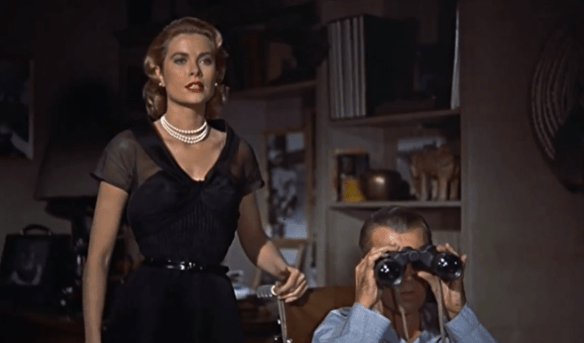
But far from simply marveling at what Hitch has accomplished it’s far more miraculous that we become so enveloped in this story. It’s an admirable mystery plot chock full of tension that’s built up over time and successive shifts in perception, time of day, and personnel moving in and out of the complex. Our one commonality is Stewart stuck in that wheelchair with only his broken leg, his camera, and the neighbors to keep him entertained. They do far more than that.
rear window 4.png

Rear Window’s A-Plot is a perplexing mystery thriller that we watch unfold with a systematic unraveling that’s unnerving in part because Hitchcock has orchestrated it all in a limited space. Furthermore,  he has handicapped his protagonist and the outsiders coming in are constantly causing us to second guess or reevaluate our assumptions be they the insurance agency nurse Stella, Jefferies’  policeman pal, or his best girl Lisa. Each character is at one point in opposition to Jefferies while also providing a sounding board for his cockamamie theories which start to bear the grain of truth. We get to be a part of it all.

The utter irony is that once more not only is Hitchcock’s villain atypical — in nearly all areas a seemingly unspectacular man — he’s also quite overtly styled after David O. Selznick. If you know anything about the producer he shares some resemblance with Raymond Burr and there’s no denying that Hitchcock was never fond of the other’s meddling. As much as I love the Rebeccas (1940) and his earlier American works if Rear Window was a representation of the hands-off approach to his filmmaking than I would have to side with him.

At least by this point in his career, there’s no denying that he projected a singular vision that could hardly be quelled by any individual. This is “Alfred Hitchcock’s Rear Window,” after all, as the opening credits proclaim.

However, the beauty of this picture is that it truly does stand up to multiple viewings and every repeated viewing offers up new depths or at least minor revelations that add an even greater relish to the experience.

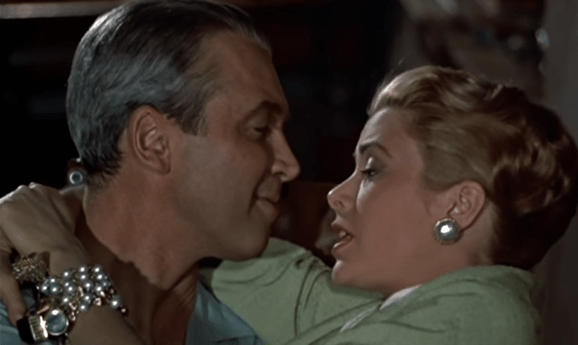
In particular, are the underlining themes of romance. Because this is a film about love in all its many facets with each character or couple reflecting a certain permutation of what romantic love looks like.

The love stories are playing out in each compartment of the apartment complex. Miss Torso, the queen bee with the pick of the drones. She’s very much eye candy but in the final frames, we realize there’s more to her as her love comes back home from the army. There’s Miss Lonelyhearts who is desperately seeking love and yet has enough respect not to stoop below her dignity. It’s a song that lifts her out of her despair. The Newlyweds are still in the honeymoon phase and we never see them.
rear window 2.png

Meanwhile, you have Stella providing her homespun philosophy that people shouldn’t overanalyze their situation. Jefferies is pushing back against any serious romance because in his estimation Lisa is far too perfect for him. Meanwhile, Lisa is left believing she can live in any world that Jeff is in. The list goes on and on.

But for the threads to be resolved that must become fully intertwined with the murder at its core because such an event calls for a response from our characters — at least our main ones. When Lisa sacrifices so much to show her love and devotion to him, he realizes how much he misjudged her character and perhaps more profoundly how dearly he loves her and never wants to lose her. He has made the transition from armchair philosopher and misanthrope to a man smitten with someone else. As long as he ditches the window watching he should be fine.

That leads us to another area of discussion. There’s a bit of a moral commentary present though Hitchcock doesn’t seem all that interested in those conclusions per se as much as he likes manipulating them for the sake of his drama. And yet like Vertigo four years later there is this unnerving sense that he is tapping into some of humanity’s darkest desires to watch and spy on others for pleasure without any consequence or any vulnerability on the part of the peeper.

That draws me to another aspect of the film that I’ve never really considered. Rear Window implicitly asks what it is to be a neighbor or at least what it is to live with neighbors. There’s very little in the realm of actual judgments except for the small condemnation that comes from the woman who lives just above the murderer after her yippy dog has been killed. What does she say?

You don’t know the meaning of the word ‘neighbors’! Neighbors like each other, speak to each other, care if somebody lives or dies! BUT NONE OF YOU DO.

What she provides is a heartfelt and searing indictment which is nevertheless lost in all the commotion whether it’s the big party going on across the way or the realization by our heroes that their theories about murder have been confirmed. It did make me consider even briefly if the so-called Great Commandment is to “Love Thy Neighbor,” what does that look like?

Far from peering in at other people and staying anonymous, it seems like it involves reaching out to others. In some ways, being vulnerable and candid — transparent even — so others feel comfortable entering into our lives. Like Stella says sometimes people need to go on the outside and look in for a change. If nothing else that breeds empathy.

Of course, if that was the case, there would probably have been no murder and that’s what we want right? Well, anyways, Rear Window still stands as my favorite Hitchcock picture and one of the most clinical and compelling thrillers of all time.  But you probably already knew that. If you did not I implore you to break both your legs if need be and go lock yourself in a room and force yourself to watch it right this minute.

5/5 Stars

A Matter of Life and Death (1946)


Matter_Life_Death_Hunter_Niven

Matter of Life and Death is planted in its era. It carries the vague notions of a war film, it’s certainly a romance, and it revels in the throes of fantasy. But on the whole Michael Powell and Emeric Pressburger’s film functions outside the typical confines that are put on film as a medium. The scope it dares to take on is far more expansive.

The plot is made in the first few minutes when a pilot looks to eject amid the fog engulfing his failing bomber. It’s in that single moment where he picks up the signal of a radio dispatcher down below and their lives are never the same. Believable or not they fall instantly in love — in that moment of heightened emotion — they find a connection. She, never to see his face and he, never to make it out alive.

The Conductor (Marius Goring) from the other side is already looking to pick him up. Except something goes terribly wrong, or terribly right for the pilot, depending on your perspective. In other words, he doesn’t die. He escapes death. It causes a bit of a stir and Conductor 71 must try and rectify the situation.

But of course, Peter David Carter (David Niven) quite by chance is reunited with the woman from the other side of the wire, the American named June (Kim Hunter) and they are allowed a happy life together. Except with his reservation with the afterlife still up for contention, Peter finds himself being visited by the Conductor who coaxes him to accept his death. Instead, Peter calls for an appeal and his case is set to be brought before the highest authorities to decide once and for all if he must accept his death as ordained or have it postponed so that he might continue to cement his love for June.

It evolves into a wonderfully fantastical courtroom drama, wrapped up in romance, with a bit of time travel, purgatory, special effects, and color all mixed together in a tirelessly imaginative arc.  It’s true that the ambitions of the conceptual narrative are really unlike any other cinematic creature as it cycles so lithely through time and space. Freezing images, moving characters about this way and that, and cutting back and forth between worlds most easily differentiated by their color schemes.

Still, in some way, I was gripped more with the furious emotion of The Red Shoes (1948) and yet with its phenomenal conception and immaculate staging, A Matter of Life and Death manages to be an extraordinary picture by most accounts. If its waves of romance did not seize me instantly, its sheer inventiveness was nevertheless breathtaking.  And if the concept enthralls me even more than the narrative does then so be it. It shares a world akin to Seventh Heaven (1927) or Wings of Desire (1988) and that alone is worthy of praise — carving out a place in the pantheon of transcendent films — featured on the conveyor belt that makes its way through the years.

Fantasy films were made to be like this, arguably functioning in a realm that only films could facilitate and Powell and Pressburger examined near unfathomable realms. Not only with scripting but the selection of shots, and developing fascinating spectacles out of the Other World from the stairway to heaven to the infinite courtroom where Peter’s case is debated. Jack Cardiff’s photography takes on the monumental task of balancing two worlds with equal import — the world we know and the complete other realm that has yet to be revealed to us who are still among the living. It leaves us feeling enamored with both. Not simply because of beauty but sheer size and scale.

The storyline comes down to the final moments where Peter and June are asked to make the kind of choices we have been expecting. Right about now we can hear the words ringing in our ears, there’s no greater love than to lay down one’s life for the ones you love. Their actions say as much. But as we might just come to find, give and it will be given back to you more abundantly than you could ever imagine. Sacrifice all that you have and you will find yourself gaining so much more.

It brings to mind a dialogue that emerged from the courtroom when the prosecutor (Raymond Massey) notes that “nothing is more important than the law. The whole universe was built on it.” But his learned opposition (Roger Livesey) ascertains that “this is a court of justice not of law.” The implications being that the law is good and must still be fulfilled but justice is the key here, where right is done by all men and love reigns supreme.

There are a plethora of interesting topics that arise from The Archers’ film but one of the foremost is the sentiment of not only the post-war but of an entire millennium. It’s a belief that could arise from many marginalized points of views suggesting that there is a great deal of prejudice and ill-will that could be exacted against the English (and certainly Americans too), anyone who has been a major world power.

The jurors put up against the defendant all have grievances they could hold against the English people, but then again, we are not our fathers’ fathers and we cannot necessarily turn back the clock on their past sins. But what this film does suggest more powerfully still, relevant in a post-war era or any age really, is the idea that people can reach out across the sea and really across the world to be united by something. We’ll give it a name to it and call it love in its many forms — more specifically as the Greeks might call them, storge, philia, eros, and greatest of all agape.

4.5/5 Stars

Note: My entry in the Time Travel Blogathon


Angel and the Badman (1947)

Angel_badman.jpg

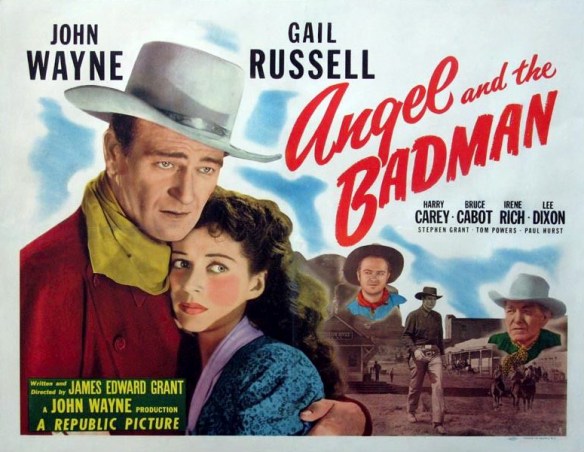
With John Wayne partnered with his longtime collaborator James Edward Grant (Hondo, McClintock!) it’s easy to see Angel and the Badman as an early vehicle for his conservative ideals but far from being heavy-handed, it goes down as a solid B-picture with a surprisingly unique perspective on the West.

In this instance, the western is used to construct a fairly simple parable that plays out over the frontier using figures that we know well from every cowboy picture we’ve ever seen.  The outlaws and the homesteaders, the sheriffs and the doctors, they’re all present.

But underlying their every interaction is a certain purpose. It’s not simply to entertain — though the film is adequate in that department and has it’s share of gunfights and showdowns. It foregoes most of the normal set pieces to carry out its main objective as a moral tale. Still, these established figures help draw up the themes by the very way they see the world.

Quirt Evans (John Wayne) has and always will be an outlaw as preordained by society until the fateful day when he finds sanctuary in the home of a Quaker family after incurring a wound. They take care of him and nurse him back to health but above all, they give him the benefit of the doubt — that he is not too far gone and he still has more than a fair chance to redeem his life if he so chooses.

The local apothecary functions as the main counterpoint to our angelic first family. He is very rational-minded, devoted to scientific thought and his cynicism leads him to begrudgingly patch up the outlaw all the while grumbling under his breath. It’s telling though that he holds this overtly religious family in high regard. But nevertheless, the parameters have been set. We must sit back and find out where John Wayne falls within the frames of this corral.

It’s true that he’s saddled with a past full of womanizing, guns, greed, and every other sin known to man. In fact, the local sheriff is bent on hanging a rope around his neck but the old veteran (Harry Carey) is a sly fellow ready to bide his time and let Quirk slip up somehow.

The main point of contention is a payload of gold that a band of glowering thugs is intent on getting a handle on. Quirt is all that stands between them and the prize but even in his injured state he still packs a gun — the bullets inside and his stellar marksmanship being the key deciding factors.

Playing against this very storyline is a parallel thread that bears equal importance if not more. Penelope Worth (Gail Russell) is the daughter of this Quaker family and she is tasked with taking care of this formidable outlaw. In any other scenario, they would be oil and water. Their lives and personalities should never mix and yet in this romance, they ultimately do. True, his lawless lifestyle chafes against the worldview of these religious Quakers who promote an existence of good will and pacifism. Still, people can change.

John Wayne notably disliked High Noon (1952) and his most famous denouncement of the picture can be seen in Rio Bravo (1959), viewed by many as a cinematic answer to its predecessor. However, in this earlier film, you see in Wayne’s character a man who also falls for a Quaker much like Will Kane (Cooper) does in High Noon. But here he comes from the wrong side of the law. Still, she redeems his very nature and far from throwing off the perceived shackles of her beliefs or simply tolerating them to stick to what he knows best (namely gunplay and showdowns) he does the fairly brazen thing and wholeheartedly embraces her way of life. Because he loves her.

It begs the question, which outcome is more believable: The sheriff who went against his wife’s pleas so he could uphold his personal convictions or the outlaw who gave up his old way of life even in the face of death because he was transformed by the love and lifestyle of his woman? Rather than drawing up which one is better exactly, it might suffice to say that Angel and the Badman, while lesser known, is still a diverting western with its own moral dilemma because westerns are and always have been horse operas.

3.5/5 Stars

Man’s Castle (1933)

220px-Mans-castle-1933.jpg“Blessed are the poor in spirit for their’s is the kingdom of heaven”

With Frank Borzage taking on both WWI and WWII in his career it only makes sense that he would take on the event that in many ways bridged them — The Great Depression.

It’s fairly early on in the story where the local resident Ira (Walter Connolly), a minister by day and a night watchman by night cites the Sermon on the Mount and later references 1 Corinthians 1:27. The moral being: Blessed are the poor in spirit and God chooses the lowly things of this world and the despised things to nullify the things that are strong.

If nothing else a character such as Ira is one of the lovable figures in this fairly dank and dreary tale but his words breathe an inherent worth into the masses of everyday individuals slogging their way through the Depression.  In many ways, this film is a eulogy to those very people, the downtrodden, the poor, the heavy-laden folks.

But sometimes those same folks seem to come in all shapes and size making it nearly impossible to get a line on them. We first meet Bill (Spencer Tracy) a veteran fast-talking Artful Dodger-type who works the streets of New York in his top hat and tails. In this very first sequence, he’s in the middle of a seemingly frivolous activity offering breadcrumbs to the pigeons.

He catches the young gal (Loretta Young) next to him giving him the eye and calls her out. Although she might not look it, she’s destitute, going without food on two days now so he begrudgingly agrees to treat her to some fine dining. Of course, when the time to pay the check comes so comes the big reveal. Bill is just about as broke as Trina and they get thrown out (at least with full bellies).

For the rest of the film they hold up together in a shantytown in the local Hooverville where the existence is sparse but Trina exists as a happy homemaker whose indefatigable spirit never seems to dampen. Bill spends his days drifting finding bits and pieces of work here and there and in the evenings he comes home to his gal. Any other circumstances and their lives would seem fairly normal.

He playing the breadwinner. She playing his devoted spouse. Except he gets the bread by serving a summons to a local stage performer and stilt walking in his free moments, among other things. But he scrapes together enough to get Trina a new stove for their hovel. The fact that they remain unmarried is invariably inconsequential and Trina’s not looking to tie down her man — she’s far too understanding and open-minded for such thoughts.

And although partially unbelievable its integral in how Tracy’s protagonist reveals his true character. Yes, he is a man with restless feet constantly playing the curmudgeon — disdaining the “ball and chain.” However, there’s an old adage that would be apt in describing him. His bark is worse than his bite.

There’s no conceivable way that two individuals such as this should remain together and even in the film there are moments when their symbiotic relationship seems to be splitting at the seams.

Tracy is brusque and surprisingly stink-eyed but as is his custom he comes around and has the audience on his side for the very fact that Loretta Young is so devoted to him. On her part, the sprightly and ever-effervescent Young at the ripe young age of 20 might be skinny but she holds her own and is crucial to making this love story something of substance.

Borzage once more dissects a romance that’s, in this case, one of the most unlikely pairings but Bill ceaselessly subverts our expectations. He’s not such a bad cad after all and Trina makes him be better than he has any right to be.

In this specific instance, the two lovers get their happy ending clutching each other closely in a pile of hay aboard a freight train. The destination nor the future seems to matter because the underlining factor is they have each other. You’ll be hard-pressed to find many affluent people in this picture and this is an important distinction to make. This is not a screwball comedy. On the contrary, center stage is given to members of society who are usually marginalized and it comes off exceedingly well thanks to Tracy and Young.

3.5/5 Stars

Note: It’s most likely that the cut you will see is the 1938 reissued version following the installation of the Hays Codes. I’m not actually sure if an original print is still available or if it’s considered lost.

7th Heaven (1927)

Seventh_Heaven_19277th Heaven is one of those films that revels in classical storytelling where the drama is rich and deep; the score hits all the crescendos and fills them in with the sweetest of notes that are both beautiful and moving. The love scenes are rapturous in a way that makes us hold romance in a higher esteem than we did previously and the horrors of war abhorrently brutalize the world like never before. These are the kind of themes as old as storytelling itself.

Director Frank Borzage would play with these same themes time and time again. I say this with every film of his but it’s so inevitably true. There’s no denying it in any frame within his work. It’s just there and yet in Seventh Heaven, he delivers bar-none his greatest, most extraordinary outcome of his entire career, which must only be seen to be believed.

There has never been such an angelic, more serene and innocent face than Janet Gaynor’s or at least you’d be hard-pressed to find one. I became acquainted with her in F.W. Murnau’s masterful parable of love, Sunrise (1927), but here she is equally demure, reflecting all the many qualities of the most ingenuous of beings.

In this particular scenario, her life is horrible, lived out in utter poverty in France and what’s worse, she is abused and whipped by her tyrannical sister. For a silent film, it feels fairly graphic, and there’s little restraint in showing the sister’s uninhibited rage.

But Diane does find herself a savior or rather he finds her. His name is Chico a sewer worker who is promoted to being a street cleaner. Despite his lowly beginnings, his aspirations are high, constantly geared towards the stars, and he really is a strapping even remarkable fellow, if not simply for the fact that he believes in himself.

Though his most telling trait is his anger toward the Bon Dieu — The Good Lord — or in our common terms, God. As he sees it, he gave the Almighty a chance and look what it got him. Absolutely zilch. That’s why he’s an atheist. God owes him 10 francs.

However, in an individual moment of integrity, he speaks up on Diane’s behalf, taking some of her burden upon himself and claiming to be her husband. The act of charity is not lost on her. She’s grateful but now he’s in a bind. If the detectives call on him and find him unmarried, it’s the hoosegow for him. But being the generally sympathetic spirit that she is, Diane follows him back to his home and agrees to stand-in as his wife for a time. He, in turn, is grateful.

Soon he shares a little bit of his rooftop heaven with her along with some faux-marital bliss where they begin to truly enjoy each other’s company. In this mutually beneficial relationship, they find more than mere altruism. It’s in these interludes where true romance begins to bud between them.

It’s in this heaven above the chaos of the world where they begin to fall in love — it’s a reverie that picks them up and carries them away on clouds of peace, comfort, and contentment. Never before have we seen Diane so at ease and never before have we seen Chico so overjoyed.

But once more war tears apart the hearts of those in love. It’s most overtly reflected in the two scores that battle for supremacy. The passionate love theme playing over their embraces full of kisses and then the shrill call-to-arms playing down on the streets as men march off to battle. It’s the melodious juxtaposed with the harsh. That which is mellifluous clashing with these markers of chaos. Chico is finally called into battle but he is not going to leave his love without making a promise even if it’s in words alone.

Marriage once more is cast in this spiritual light ordained by God and some people would agree that it most certainly is but Borzage seems to take it nearly a step further in that it becomes its own religion — once more this rapturous experience to be undertaken as a form of worship. It’s accentuated by the fact that every day without fail at precisely 11 o’clock they both talk to each other, communing together, rather like a prayer, managing to keep them together wherever they might be from the trenches to the munition factory. Their universal union remains forever intact.

The war sequences are utter chaos for the sheer mass of humanity that is mobilized with dust whirling around, cars zooming down the road, and guns pointed in all directions. It’s a fairly impressive showing of cinematic tumult.

But the film’s ending is a sheer miracle of bright-eyed brilliance — a moment of resurrection that’s so powerful — only felt in a few other films so evocatively. Dreyer’s Ordet (1955) being one of the few examples that comes to mind although presently more titles elude me.

Seventh Heaven ends on yet another spiritual note much as it began. In these final moments, the epiphany is not only a miraculous apotheosis of sorts but the stirring realization that in this narrative the Bon Dieu was always working dynamically in Chico’s life — just not in the ways that he was expecting.

Every time he questioned God’s Will he was met with some sort of answer. One could bring into question if this is, in fact, a “Christian” film but it brings in a multitude of religious themes and readily positions itself as another impassioned depiction of love of the highest order as revealed by Frank Borzage.

4.5/5 Stars

A Farewell to Arms (1932)

394px-Poster_-_A_Farewell_to_Arms_(1932)_01Again, I must confess that I have not read yet another revered American Classic. I have not read A Farewell to Arms…But from the admittedly minor things I know about Hemingway’s prose and general tone, this film adaptation is certainly not a perfectly faithful translation of its source material. Not by any stretch of the imagination.
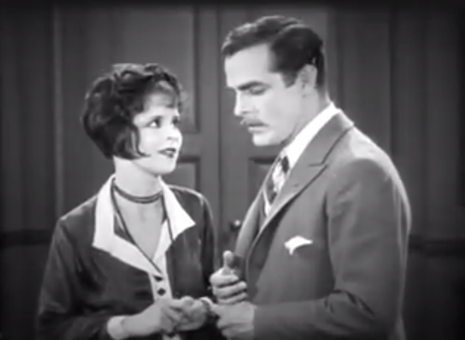
However, I do know at least a little something about Frank Borzage a filmmaker that time has been less kind to, though he contributed some quality pictures during the silent era and during the ensuing generation of talkies — even a couple of reputed classics. And yet watching A Farewell to Arms you can see his philosophies working themselves into the story line — the very themes that he would repeat again and again in many of his movies.

It soon becomes apparent that Borzage’s film is not about a war at all though WWI is a major plot point. He would examine an analogous idea with The Mortal Storm. Its his predilection not to focus so much on the carnage or alienation of war and more so on the effects that such a cataclysmic event has on the lives of those thrust into the middle of it. So his narrative borrows from Hemingway but hinges on this idea of lovers battling against the wiles of the world through the sheer euphoria of their romantic fling and yet it proves to be more than transient.

There’s without question a verisimilitude and a candor to the portrayals of Gary Cooper and Helen Hayes as said lovers — an ambulance driver and a nurse. Two seemingly unextraordinary individuals who nevertheless become extraordinary in each other’s arms. They will go to such great lengths to remain together despite the obstacles hindering them on every side. Perhaps it’s heightened by the times but still, there is this general belief in what they do on the part of the audience — that they can actually fall in love and will do whatever it takes to stay together.

Even if it’s not wholly plausible, they lend that needed credence to the parts. Their emotions feel genuine even as their romance gets crippled by the very circumstances they find themselves in. Where years are sped up into days and marriage must be forged in the most humble of moments. There’s no time or space for a normal life with a normal love affair even if that’s what both parties desire. It cannot be so.

Gary Cooper exudes a gentle tenderness in the majority of his scenes and he manages to be as vulnerable as we’ve ever seen him in the part because this romance tears him apart. Helen Hayes is an actress that I, unfortunately, know very little about but she strikes me as a beauty like Claudette Colbert and yet I find an easier time liking her and by some form of transference, the same goes for the character that she plays. It’s also crucial to note the splendorous black & white cinematography of Charles Lang which paints the contours of this love affair with expressionistic shades while never quite allowing us to forget the war at hand.

Though we can compare Borzage’s film with the original novel it seems equally compelling to juxtapose this cinematic adaptation of A Farewell to Arms with Joseph von Sternberg’s romance, Morocco, of only two years prior also starring Gary Cooper and Adolphe Menjou with von Sternberg’s muse Marlene Dietrich. Hayes doesn’t have the same gravitas or allure of Dietrich but that actually serves her better in this film with what Borzage is trying to accomplish.

Because this story is a tragedy as much as it is a romance of faithful devotion. Whereas von Sternberg seems most interested in the locality and the depictions of his stars — allowing them to have looser morals, you could make the argument that Borzage film holds a greater stake in its thematics and what such a romance can represent in such a turbulent world. The Great War is only an unfortunate backdrop to play the action against and it’s unfortunate because love is a rapturous thing. But it’s the many evils of the world that tear it asunder. The kind of troubles that force two people to bid each other a tearful adieu even if it’s the last thing they want in the world.

3.5/5 Stars

It (1927)

It 1.png

“IT is that quality possessed by some which draws all others with its magnetic force. With ‘It’ you win all men if you are a woman and all women if you are a man. ‘It’ can be a quality of the mind as well as a physical attraction.” ~ Elinor Glyn 

I was always under the impression that the It Girl was a concept that came out of this movie but little did I realize it was literally built into the very construct of the storyline. But that deserves a bit of elaboration.

There are really three figures of note in It (1927). We meet the bumbling playboy Monty first as he ushers in his buddy’s first day of managing a department store with some good luck flowers. He bums around for a moment before happening upon an article by columnist Elinor Glyn and immediately he is taken with this idea of “IT.” He tells his friend that they need to find girls with that very same quality.

It’s a rather staid and antiquated concept when you actually consider its implications. Men ogling women trying to pinpoint this elusive quality or trait that seems far more based on physical features and outward appearance than anything else. And all the pretty maids all lined up in a row welcome the attention from the two well-to-do bachelors. Though it’s important to note “It” can apply to men as well.

Still, perhaps regrettably the term has remained prevalent to label women and still maybe it’s morphed for the better into the calling card of anyone who has ever burst onto the center stage and become the next big thing. However, you could argue that said person becomes a bit of a commodity or a fad for the media.

Still, Clara Bow in her own right was indubitably an icon and it went beyond a gimmick or a plot device. In many peoples’ eyes, especially in hindsight, she represents the free-spirit and joy of The Roaring Twenties as one of the foremost sex symbols of that generation.

You get that sense of the eponymous “It” that goes beyond her so-called sex appeal. It’s that genuine winning charm when she peeks in on her friend’s baby and begins cracking him up with a barrage of funny faces. “It” is when she’s snipping away at her dress to get ready for a night of fine dining at the Ritz because that one dress is all she has to work with. It’s frowning when she’s trying to order off an elegant international dinner menu. Yes, it’s even playfully sliding up onto the bosses desk or posing on a yacht to try and win her man back.

But we also cheer for her because she cares about those who are down and out and maintains a certain level of moral restraint. In other words, she has boundaries and standards set up. She’s not about to let a man just have his way on the first date. She’s a take-charge kind of gal but also a proponent of traditional values. Women in the home and taking care of children. Though she shares some of the striking features of Louise Brooks, the makeup of their characters are very different — not to mention their hairstyles.

This silent romantic comedy like so many others in the storied tradition is made of moments of miscommunication. But Betty (Bow) is not about to let miscommunication get in her way. A pair of colliding boats leaves a soaking wet Clara Bow just waiting to be rescued right after she saves her fellow castaway. Not even the long-held blonde versus brunette conundrum can get in the way. In the end, there’s nothing quite so romantic as clinging to an anchor soaking wet with the love of your life.

Though not the same type of comedy, It (1927) is a rom-com that has some similar set pieces to Harold Lloyd’s pictures. Namely the fact that its protagonist is a sales clerk like Safety Last! and there’s an excursion to Coney Island rather like Speedy. By today’s standards, IT might seem like a mere trifle but there’s no denying the unquestionable impact of Clara Bow and the influence she still holds on our cultural lexicon even today.

3.5/5 Stars

Review: Gilda (1946)

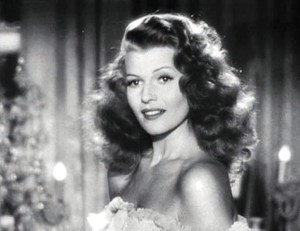
Gilda_trailer_hayworth1If you’re worried about Johnny Farrell, don’t be. I hate him~Gilda
And he hates you. That’s very apparent. But hate can be a very exciting emotion. Very exciting. Haven’t you noticed that?…There’s a heat in it that one can feel. Didn’t you feel it tonight? ~Ballin

Gilda became synonymous with Rita Hayworth and for good reason. She was the embodiment of so many of the things found desirable by many men from a certain age. Frisky. Sultry. Beguiling. Teasing men, leading them on, and leaving them. Hating them as much as she loves them. That’s where the passion derives from — very volatile beginnings.

It’s true that Hayworth’s playfully ravishing seductress was forever immortalized in Shawshank Redemption and really in the mind’s eye of anyone who ever has seen her singing “Put the Blame on Mame” even once. She’s also, consequently, the epitome of the deadly lineage of femme fatales at times both tragic and destructive, alluring and lively. It’s difficult not to get drawn in like a moth to the flame.

But underlying such a performance is something a little more disheartening as this is only a cinematic depiction. It is not reality and yet it brings to mind a paraphrased quote that I will attribute to Hayworth, perhaps recalling her turbulent union with Orson Welles or maybe all the men who found their way into her life. “They go to bed with Gilda and wake up with me.”

The implications, of course, are far-reaching suggesting just how much this fawned over female ideal was a pure fabrication. It’s not real. Rita Hayworth could never measure up to that fantasy nor should she have to. Because while Gilda’s tantalizing as a cinematic siren, in real life she could never exist. Her passions impinge on her entire existence where she sees hatred, lust, and love all in synonymous terms. She hates Johnny and she loves him. She doesn’t want him and she does for those very reasons.

While not to downplay the negative impact the role may have had for Hayworth’s personal life, there’s no doubt of its cultural clout even today and it helps make this film-noir directed by Charles Vidor a high water mark of the dark genre for the very reasons mentioned before. Jo Eisinger’s script is also a strikingly perverse number as it begins to draw up the relationships between Gilda and her men.

Because it doesn’t end with her. Gilda needs others to play with and she’s given the perfect counterparts in Johnny Farrell (Glenn Ford) a man who willfully counters anything she offers up in the areas of sexual tension, embittered ridicule, or psychological warfare. It’s like they enjoy to torture each other — they enjoy to be able to make each other reel and fume. It’s all part of the twisted game they play of love and hate. He seethes with a vindictive coiled anger just waiting to be unleashed and he lets it go time after time. Sometimes upon provocation and other times out of sheer malice.

It all finds roots in a past we can only presume about and it’s true that all three of our leads are shrouded in some mystery when we’re introduced to them. First, Johnny Farrell a smart aleck gambler who gets himself a job as the right-hand crony for Ballin Mundson (George Macready) a man who is far more than a simple casino magnate. His business dealings run a little broader and more clandestine than he initially lets on.

Farrell’s a quick learner and ambitious so he moves up the ranks and soon he’s got the most prized position by Ballin’s side as his closest confidante and most importantly of all he’s there to watch over the other man’s wife — his favorite treasure to flaunt — the one and only Gilda.

It’s in that unspoken past that Gilda and Johnny learned to disdain each other and it stokes the flames of their relationship. It’s brutality mixed with sensuality which is at one time disconcerting but at the same time hard to pull away from. Again, moths to the flame.  It’s so wickedly twisted with rage and passion and all those human emotions that make us despise one another one moment only to make us no be able to live without each other in the next.

At a certain point, there’s no longer any sense in trying to draw up sides whether it’s feeling sorry for Gilda or empathetic toward Farrell and the thoroughly uncomfortable position he has been placed in as keeper of the bosses wife. Both of them have the makeup of true noir protagonists.

Otherwise, Rudolph Mate’s gorgeous imagery is absolutely fantastic and is certainly worthy of simply being marveled at on multiple occasions for its delicious compositions and use of shadow. Hayworth is rendered even more beguiling and Macready becomes an even more perplexing figure masked in darkness. Meanwhile, the Carnival celebrations are cast as stunning spectacle and over the top extravagance that’s also rudely disrupted by murder.

One could take it as a metaphor suggesting that the post-war era had commenced with a flourish but that cannot completely get rid of the sour taste left over from the war. A veil of darkness still remains.  Along similar lines, there’s a bit of Casablanca’s tension running through this film, and its atmosphere, while not quite on par with its predecessor, still rings with a lot of character.

The roulette wheels are in fine form and the establishment is full of its own rogue gallery of humorous and foreboding figures alike. The always lovable Uncle Pio provides a dose of good humor but there are also treacherous Germans, numerous rich boy toys, and a surprisingly civil government agent who all make a habit of frequenting the most popular casino in Buenos Aires.

It might be true what Johnny says about gambling and women not mixing but then again with the lens of film-noir they prove to be a high octane combination, representing vice and sensuality, two of its most readily available commodities.

4.5/5 Stars

Jane Eyre (1943)

Jane-Eyre-1943-1Are you always drawn to the loveless and unfriended? ~ Edward Rochester

When it’s deserved. ~ Jane Eyre

I can still recall visiting the Bronte Parsonage, marveling at the fact that these sisters were able to have such a lasting impact on the world of literature — a world so often dominated by men at that time — and I simultaneously rued the fact that I had yet to crack open any of their works. Now several years down the road, I still have not opened up Wuthering Heights or Jane Eyre by Emily and Charlotte Bronte and so I can only come into this 20th-century adaptation with certain expectations.

I realize that no film can wholly represent every page of a novel — especially of great length — because in a practical sense it’s simply not theatrically possible. But my hope is that at the very least this version of Jane Eyre maintains the essence of the source material and if nothing else I can revel in the fact that it is a thoroughly engrossing film from director Robert Stevenson.

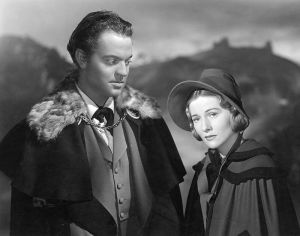
It feels like some sort of intriguing marriage between Orson Welles’ Mercury Theatre and the recent craze of gothic fiction adaptations — the most noted of course being Hitchcock’s Rebecca only a few years prior — that by some strange happenstance had input from Aldous Huxley. Here we have the ever timid beauty Joan Fontaine starring once more, this time opposite Welles. But the story starts at a much earlier point in the life of Jane Eyre.

Her life is a desolate and horrible affair as we soon find out, due in part to a caustic culture that uses their religion to ostracize others instead of bringing them into the fold of society.

In fact, most of those who hold a Christian belief system are puritanical and more problematic still, hard-hearted. Ironically, there’s no room for grace in the Christian faith that they practice. Foremost among this crowd is Mr. Brocklehurst (Henry Daniel) who runs the Lowood Institution for Girls.

It’s in this very issue revealed early on where the film finds much of its substance. Because thematically all throughout the narrative the audience is forced to grapple with various characters who are subjugated to the fringes of society and for various reasons are labeled as outcasts.

This is how Jane is seen first by her unfeeling aunt (Agnes Moorehead), then by the narrow-minded reverend. They seem absolutely incapable of compassion sitting atop their high horses of proclaimed humility and charity. In reality, they have very little of either to offer. A few do show her kindness including Dr. Rivers (John Sutton) and the cook Bessie (Sarah Allgood) but such behavior is the exception and not the norm.

Still, Jane the very person who has been relegated to a wretched and lesser state is for that very reason ready and willing to reach out to those around her who are treated likewise. The very fact that she has been marginalized allows her to see it in others and be compelled to move toward them when others move away.  She cares deeply for the outsider.

The most galvanizing experience involves her closest friend as a young girl (played by a child who still is very unmistakably Elizabeth Taylor). Then as she grows up and chooses to move away from the oppression of her surrogate home, it is the role of a governess in a gothic manor that once more allows her the opportunity to extend her graces to others. First in the form of the precocious ballerina extraordinaire (Margaret O’Brien) and then the brusque but obviously tortured man of the house (Orson Welles).

She sees in him something that runs deeper than the surface. He’s far from a bad man. In fact, she grows to love and cherish him because she sees the good that dwells in his conflicted soul. Burdened as he is with guilt and a past that still haunts him to the present moment. The film exhibits a bit of a love triangle as Rochester invites many guests to his estate among them the well-to-do Blanche Ingram (Hillary Brooke).

But the film pulling from its source material goes a step further still.  It digs into the dark recesses, involving itself with the less than pleasant realities, namely an unseen person who hangs over the storyline like a specter. In those very designs, whether they are simply employing the rhythms of Bronte’s book or not, there’s another evident parallel there with the 1940 adaptation of du Maurier’s Rebecca.

Gothic tones matched with an impending sense of foreboding with the demure Fontaine similarly relating the action through voiceover even reading verbatim off the page as if from a diary. And once again it works. While there is no Mrs. Danvers, Welles has the same Shakespearian gravitas of an Olivier that accentuates the very modesty of many of Fontaine’s performances. Their exchanges reflect the sensibilities of the time but furthermore help draw up the very differences of their characters. However, as much as that juxtaposition would seem to draw them apart it even more passionately brings them together.

Some might find this rendition of Jane Eyre too stark, too much of a studio production, even too abrupt, but with Welles and Fontaine opposite each other, it’s a frequently enjoyable gothic romance. As much as gothic romances can possibly be enjoyable.

4/5 Stars