
 Before the exoticism of Casablanca, Algiers, or even Road to Morroco, there was Josef Von Sternberg’s just plain Morocco but it’s hardly a run-of-the-mill romance. Far from it.
Although it involves soldiers, it’s also hardly a war film but instead set against a backdrop that presents an exotic love affair as only Sternberg could. With a sultry Marlene Dietrich matched with a particularly cheeky Gary Cooper, it instantly looks to be an interesting dynamic because they couldn’t be more different.
She, a radiant German beauty with an evocative pair of eyes to go with a somewhat sullen demeanor. He, America’s ruggedly handsome ideal of what a man should be. And it in Sternberg’s film neither of them is what we’re used to.
He’s a renegade soldier in the French Foreign Legion. She’s a cabaret singer (that hasn’t changed) but she also manages to be French, not German. Somehow it’s easy enough to disregard because it’s not necessary to get caught up on the particulars.
All that matters is that they both find themselves in Morocco. He is traipsing through town with his division and spends some free time taking in her floor show along with the rest of the rowdy masses. Neither one of them has found someone good enough for them — they’re equal of sorts. He’s a gentleman cad if you will and she’s hardly an upstanding woman, making a living in a dance hall but there’s more to her. It’s hinted that she once had love, perhaps.
It takes so long for them to actually speak to each other but they’re flirting from the first moment they lay eyes on each other. They say so much through simple expressions all throughout the cabaret show. Things proceed like so. She slips him a flower, then an apple, and finally a key. At this point, he gets the drift and we do too.
Later that evening he winds up at her flat and they spend their most substantial time together. It’s full of odd exchanges, meandering conversations that run the risk of sounding aloof. In fact, their entire relationship is replete with oddities.
Another man (Adolph Menjou) is smitten with Amy but he’s never driven to jealousy. He’s good-natured and generous in all circumstances. People like him must only drift through the high societies.
She holds onto some wistful longing for the tall dashing Legionnaire who drifted through her life. But she’s slow to act. Meanwhile, he hardly seems to take it as a blow to his love life when she resigns to stay behind. After all, he’s quite the ladies’ man. He probably doesn’t need another woman. He’s always got several draped over each arm.
Morocco is a film interesting for the spaces that it creates and not necessarily for the story it develops. Visually, by the hands of the director and then simultaneously by Cooper and Dietrich as they work through their scenes both together and apart. Though it might in some ways lack emotional heft, its stars are still two invariably compelling romantic stars of the cinema.
Somehow it still manages to be quite lithe and risque when put up next to its contemporaries. It exudes a certain mischievousness of the Pre-Code Era. It’s not so much licentiousness and debauchery but it wishes to suggest as much. It can be implied without actually going through all the trouble of showing it.
Dietrich sums it up perfectly in her little diddy about Eve (What am I bid for my apple/ the truth that made Adam so wise? On the historic night/ when he took a bite/ they discovered a new paradise). In essence, the world got a lot more exciting when sex and deceit were brought into the equation. Maybe she misses the implications the Fall of Man but that’s precisely the point. Still more Pre-Code sauciness case and point.
In the final moments, where Dietrich abandons her heels and goes slinking across the sand chasing after her man, it feels less like a romantic crescendo or even a tragic turn and more like a ploy by the director to make his leading lady the focal point of his story one last time. She is granted the final bit of limelight. Because in many ways Gary Cooper could not win when it came to upstaging Marlene Dietrich orchestrated by her devoted partner/director Sternberg. Thus, Morocco turns out to be a rather curious love story different than some of the more typical Hollywood fare.
4/5 Stars
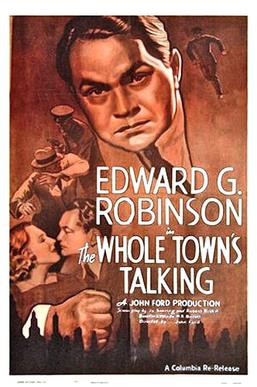 Comic mayhem was always supercharged in the films of the 1930s because the buzz is palpable, the actors are always endowed with certain oddities, and the corkscrew plotlines run rampant with absurdities of their own. Penned by a pair of titans in Jo Swerling and Robert Riskin, The Whole Town’s Talking opens with an inciting incident that’s a true comedic conundrum.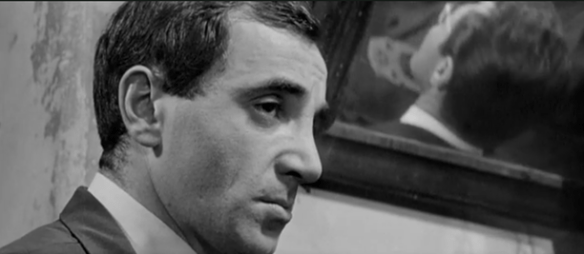
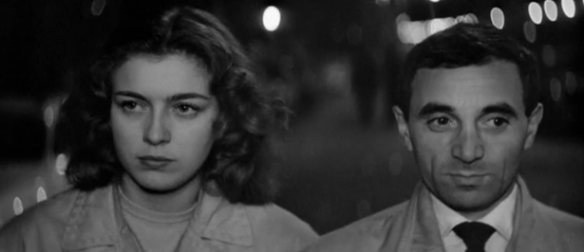
 In his opening introduction, Kumail (
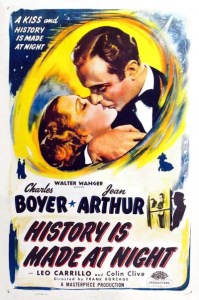 History is Made at Night molds love into the grandest of pursuits and it wouldn’t be altogether wrong in that assertion because for humanity it is one of the most euphoric, confounding, beautiful entities known to mankind. I have no qualms with saying that whatsoever.
 Our introduction to The Mortal Storm feels rather flat. Bright and bland in more ways than one as we become accustomed to our main storyline. Professor Viktor Roth (Frank Morgan) is held in high regard all throughout the community as a prominent lecturer at the local university and beloved by his colleagues and family. The year is 1933 and the Bavarian Alps are still a merry and gay place to live. That’s our understanding early on as the Professor celebrates his 60th birthday with much fanfare and receives a commemorative memento from his class.
 The strands of our lives are woven together and neither time nor the world can break them.
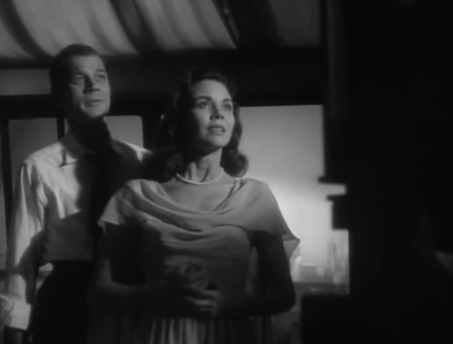 But it’s a chance encounter with a young girl named Jennie (Jennifer Jones) that gives Eben the type of inspiration that every artist dreams of because it’s precisely this spontaneous spark of joyous energy he needs to add something vibrant to his own life. In her constantly evolving role, Jennifer Jones exudes an effervescence, a certain radiance in body and spirit that lights up the screen in embodying this apparition of a girl.
 I find that despite his pedigree Joseph Cotten still comes off as an underrated actor and with each film I see him, I enjoy him immensely. Maybe for those very qualities. He’s not altogether handsome but he has a pleasant face. His voice isn’t the most formidable or debonair but it does have character. The supporting players lend some Irish flair to the cast and it’s striking that everyone from Ethel Barrymore to Lilian Gish glows with a certain hope. There is no obvious antagonistic force in this film. Eben Adams found his inspiration — the muse of a lifetime — and that passion is enough to lay the foundations of a film.
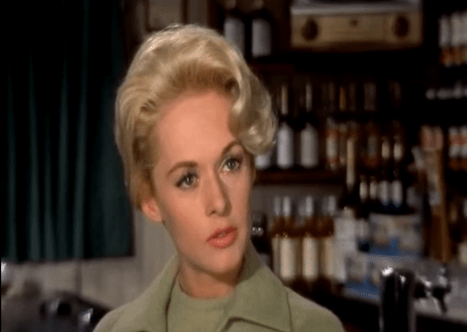 The Birds is about all sort of birds. The ones we are acquainted with initially are actually a pair of humans. Lovebirds you might call them. Except they don’t know it quite yet, but the moment Melanie Daniels (Tippi Hedren) and Mitch Brenner (Rod Taylor) meet in a pet shop, the sparks are already flying — the birds too.
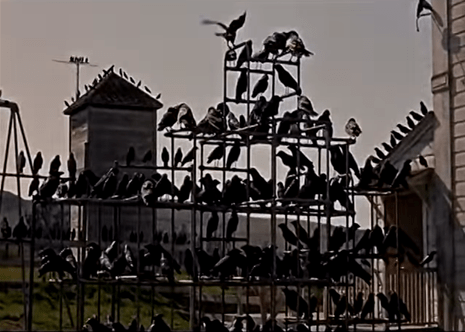 Most assuredly, the film benefits from long stretches of wordless action. The most striking example involves a murder of crows gathering on a jungle gym near the schoolhouse. Never before was the name of their posse more applicable. And while the narrative lacks a true score, the unnerving screeches from the birds is sound enough to send chills down the spine of any audience.
 The Greek gods created a woman – Pandora. She was beautiful and charming and versed in the art of flattery. But the gods also gave her a box containing all the evils of the world. The heedless woman opened the box, and all evil was loosed upon us.
 4 Star Films