Review: Modern Times (1936)

6b168-chaplin_-_modern_timesModern Times: A story of industry, individual enterprise, humanity crusading in the pursuit of happiness

With those words, Charlie Chaplin’s Modern Times opens with the final installment of The Little Tramp. Clocking in at a little under 90 minutes, Chaplin is still able to do so much, because he does not waste a single segment of film. This is one of the most wonderful pieces of social commentary that Chaplin was able to dream up to reflect the life and times of his audience — to reflect these modern times.

As was his style with The Great Dictator as well, he pokes fun and critiques his targets all under the guise of comedy. He sets the stage at the industrial factory that the Tramp works in. In a precursor to the famed I Love Lucy conveyor belt episode, it is the Tramp who must fight against the constant stream of nuts and bolts. Breaks and lunch become a thing of the past, and the little man suffers a nervous breakdown that leads to mayhem involving a wild ride through the cogs of the machinery as well as some oily madness.

Right off the bat, Chaplin poked fun at this mechanized system that is overseen by a Big Brother-type figure who spends his idle moments at his desk working on puzzles and reading Tarzan serials.

After the Tramp is forced to leave his job following the series of mishaps, he is confronted by numerous issues that Chaplin gleefully exploits. These include communism, the police force, prison, and even drugs (smuggled nose-powder).

Through the Tramp character, Chaplin comments that with the state of the nation during the Depression it was better to be in jail than out in the world. At least you got a bed and food. It was better than unemployment or starving to death with the police constantly on your backs ready to quell any riots.

These sorts of issues are explored through the character of the Gamin (Paulette Goddard). She becomes the Tramp’s love interest for the rest of the film, but the circumstances of their meeting are important. She was attempting to steal a loaf a bread from a bakery truck. It was not out of malice but desperation to feed her family.

The antics are often funny throughout these sequences, but the reality is, she and her sisters lose their father, and they are already motherless. The future is bleak and there is no help to be found with the Depression at its peak.

Here is where possibly my favorite part of the film begins. The two vagrants imagine themselves living in a middle-class household with fruit they can pick from outside their window and a cow that comes up to their door to be milked. They have a fully furnished home with furniture, ottomans, drapes and a fully stocked kitchen. This is their American Dream and that is where their hope lies. One could say that this was the consumerism culture of the post-war 1950s in a nutshell.

Next, the Tramp becomes a night watchman in a department store and for the evening he and the Gamin have the place all to themselves: To roller skate, eat, and use the beds and furs as they please. It is a moment of relaxing diversion from their normally grungy, monotonous lives.

Finally, they find a home as well. It is a real fixer-upper, but it’s home and that’s all that matters. They have each other, and they seem happy enough making do. The Tramp goes back to his 9 to 5 at the factory only to get kicked out once more. The pair of them land work at a local restaurant only to have juvenile officers come after the fugitive Gamin after an uproarious floor show from the Tramp.

Thus, they are once more on the road again. But that never stopped them before, and with his inexhaustible spirit the little man cheers on his love, “Buck up, never say die. We’ll get along!”

They walk off down the highway with new resolve but more importantly they have each other. If they ever do find that elusive lifestyle I am not sure it would be all that it is cracked up to be. The life of a Depression Era vagabond was no picnic, but I think the gift of the Tramp is he is able to make the best of all circumstances. He may look to a better lifestyle in the future with hope, but he does not need it to bring him happiness. Because the reality is, it never could completely satiate. I tip my hat to you for once little man, because for someone so humble you teach us a great deal about ourselves.

Chaplin did it again bringing us a near silent picture in the age of talkies. Although I admit it might seem awkward at times, this film uses sound and the score wonderfully to accentuate the images onscreen. Chaplin did not need the needless babble of dialogue unless it was for comic effect. After all, he and Paulette Goddard had enough chemistry beforehand, they didn’t need words.

5/5 Stars

It Happened One Night (1934) – Updated

Hopefully no one holds this against me, but I have never been a big fan of Claudette Colbert. However, I will say that I am a Capra aficionado and Clark Gable is certainly a classic Hollywood star who is dynamic in this film. Thus, despite my hangups with Colbert, I can still thoroughly enjoy this romantic comedy, the so-called original screwball. It helps to have such comedic fellows as Roscoe Karns, Alan Hale Sr. (father of The Skipper) and Walter Connolly.

Peter Warne is the down on his luck newspaper man and Ellen Andrews is a socialite who feels trapped between her suffocating father and an upcoming marriage. Does this formula sound familiar? It undoubtedly is, but this was the original, all those following were impostors.

The unlikely pair begin a cross country trek towards the destination of New York. It includes uncomfortable bus rides, awkward overnight stays, a bit of hitchhiking, and eating carrots to survive.

Only in the movies could such a scenario play out and yet that is the fun because anything can happen one night or another. In this case all the caterwauling and antics lead to a happy ending. To think many people thought this film would not be very good! That was obviously proved wrong by numerous accolades. Just think this film came out 80 years ago and we are still watching it today! That is amazing. That is the power of the movies.

Peter Warne: A normal human being couldn’t live under the same roof with her without going nutty! She’s my idea of nothing!
Alexander Andrews: I asked you a simple question! Do you love her?
Peter Warne: Yes! But don’t hold that against me, I’m a little screwy myself!

5/5 Stars

Guys and Dolls (1955)

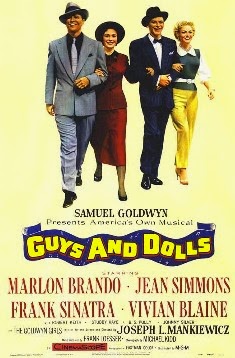
8d99c-guys_and_dolls_movieposterHeadlining this film are Marlon Brando and Frank Sinatra as Sky Masterson and Nathan Detroit respectively. Both men are high stakes gamblers and things have heated up in town because the police are trying to crack down on a floating crap game. That’s not the only thing that turns hot though. Masterson is bet by Detroit that he cannot get a sidewalk missionary (Jean Simmons) to fly with him for an evening in Cuba. Detroit has his own problems brought on by his reluctance to marry the girl he has been going with for 14 years. All along the way money constantly switches hands and “markers” are doled out as IOUs.

Both Masterson and Detroit ultimately show their noble sides and as you would expect the guys get the dolls.

This musical certainly had its moments and it looked lavishly beautiful in color like many of the contemporary musicals. I will say that there were some great personalities here including Vivian Blaine. However, Brando seemed painfully out of his element here and I’m pretty sure Sinatra had better roles. I wonder what this film would have looked with a different cast? We can only speculate now.

Also, the dialogue almost completely lacking in contradictions was quite noticeable, but I’m not sure if that was a bad thing or not. Overall I think this one would be better for the stage than on film. But don’t get me wrong a lot of the numbers like Sit Down You’re Rocking the Boat were catchy. I will say I was surprised that Brando ended up singing Luck Be a Lady and not Sinatra. I had previously only heard the Sinatra version.

3.5/5 Stars

It Happened One Night (1934)

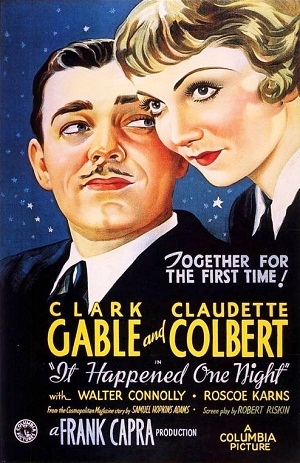
Gable_ithapponepm_posterStarring Clark Gable and Claudette Colbert with director Frank Capra, this light romance pits a sunk newspaper man with a dissatisfied socialite. Colbert feels stuck in her life with a domineering father who does not approve of her marriage, and so she runs off to get away. While on a bus she meets the recently fired Peter (Gable) and there is immediate friction between them. However, realizing she is inexperienced, Peter watches out for her and they travel together. Finding out who she is, he is even more driven to get a story and stay with her. Along the way Colbert begins to fall in love but he does not immediately react. When he finally realizes his true feelings, the situation becomes complicated when Colbert returns to her father and fiancee. In the midst of the wedding she hears of Peter’s true love and runs off to him. By that evening they are married and the “walls of Jericho” come tumbling down. Gable and Colbert both do well in this film and Capra gives us another light classic.

5/5 Stars

Review: Singin’ in the Rain (1952)

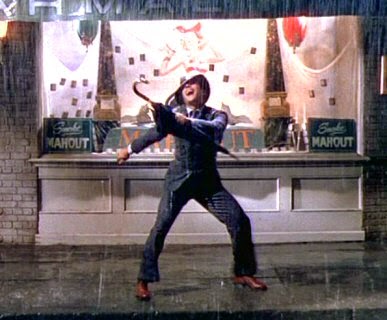
f7d3a-singin_rain I always seem to get goosebumps during Gene Kelly’s “Singin’ in the Rain” number, because each time I see and hear it, there is still a new magic to it every time. You see when I was young, before I knew all the classics, first and foremost, I knew this gem of a film. It is such a wonderful buildup to that moment with such personal favorites as “Make em’ Laugh” and “Moses Supposes.” Then you have the always popular “Good Morning” with not only Kelly but Donald O’Connor and Debbie Reynolds performing. Great stuff! There’s tireless choreography that goes into many of those sequences but it comes off so effortlessly and it brings us into the moment. There those wonderful, brief instances when you lose yourself in the music, the magic, and so on.

As the story goes, the three friends save the failing “Dueling Cavalier” by losing the simple “talkie” gimmick and making it a musical by dubbing the squeaky-voiced Lena Lamont (Jean Hagen). Cathy (Reynolds) no longer is a bit player, and she gains the acknowledgment that she deserves. Then Don Lockwood (Kelly) gets the girl who burst out of a cake. Cosmo Brown (O’Connor) is along for the ride staying with Don through thick and through thin, even calling him a cab when necessary. He’s a true friend in a million.

Although Kelly had a career with other high points (arguably never as high as this one), I am always slightly saddened that O’Connor and Reynolds never reached another apex like this in their subsequent careers. But they were both so great here, we must simply cherish this film for what it is.

Even to this day, the film holds up, and that is a tribute to the writing of Betty Comden and Adolph Green highlighting the infant Hollywood and the advent of talkies. In the same breath, it’s both a satire of the movie star culture and still a love letter to that same cottage industry. The only film with a similar dissection of Hollywood’s Golden Age is another 50s classic in Sunset Boulevard. The big difference is that Wilder’s film is chock full of drama and darkness. Singin’ in the Rain will always and forever be a light, fun musical with a lot of laughs.  It is constantly quotable whether it is “dignity, always dignity” or “I CAN’T stand it!”

Jean Hagen is always the butt of everyone’s jokes, but she is indeed very funny with the most annoying voice in the history of cinema (She can’t act, she can’t sing, she can’t dance. Triple threat). You also have other fine performers like Millard Mitchell as studio head R.F., and then appearances by Cyd Charisse and Rita Moreno who made a name for themselves as dancers in the ensuing years. And is it just me or does Donald O’Connor remind others of Danny Kaye? He not only cracks the jokes, but he is a wonderful all-around performer. Although O’Connor was undoubtedly a better dancer.

All in all, this is a timeless classic and it will undoubtedly keep that title for as long as people watch movies. Now I hope it starts pouring buckets of rain so I can go outside and stomp around in the puddles. I will let you know if I come down with pneumonia. But until that happens I’ll enjoy every minute of it. I entreat you to do the same.

5/5 Stars

A Woman Under the Influence (1974)

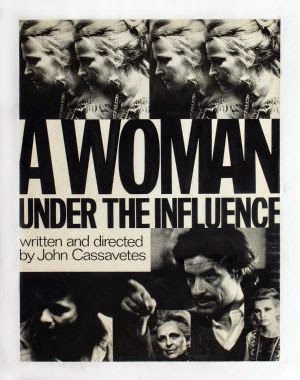
a6338-awomanunderinfluenceWow, this film from John Cassavetes was truly gut-wrenching and powerful. Gena Rowlands and Peter Falk are wonderful as Mabel and Nick. At their core they both seem like essentially good people. They love their kids, their family, and friends. Except Mabel’s problems tear them apart and in turn hurt the ones they love. The drama is not created my major plot twists, but the mundane and the typical. Dinner conversations, picking the kids up from school, gatherings with friends. This is when the film takes place and this is where we see their family unwinding at the seams. It is a personal story and the cinematography and the script for that matter are not polished. They are allowing us to see into this situation and thus the heartache and the pain washes over us and we become engaged with it.

Supposedly Richard Dreyfuss threw up after watching this film. Some may not be able to claim that same reaction, but there is no doubt that your heart goes out to not only Mabel but her children who are caught in the middle of it all. Even Nick, who can be a callous and even violent person is given a heart because he was portrayed by the great Peter Falk. This is definitely powerful stuff that is worth seeing.

This film may actually be more difficult to watch than some gorier films for the simple fact that it will hit the audience close to home. Literally. This is my first film from the director John Cassavetes and hopefully there will be more in my near future. Take a chance with this one because there is a chance that it is different than many of the polished Hollywood films you have seen in the past.

4.5/5 Stars

Review: The Best Years of Our Lives (1946)

15548-best2byears
Who in their right mind would make a film like this today? I mean it’s nearly three hours of incessant talking and character development. There are no explosions or special effects. There are not even any war scenes! And yet it is pure gold from William Wyler. He forces us to get to know these characters — all the details about them — and it is a pleasure.

In a year that boasted the likes of It’s a Wonderful Life, it is not simply a testament to the post-war sentiment, but also the power of this film, that led it to garner so much praise including a Best Picture Oscar.

Like Capra’s film, WWII plays a role here without actually focusing on the fighting. The effects of such a cataclysmic event were enough on their own.  The Best Years of Our Lives chooses to focus on the point of view of three returning servicemen. However, it would be selling the film short to suggest that is all the film is about. It revolves around deeper issues such as family, camaraderie, patriotism, and of course romance. Over the course of the film each man must navigate his own path, and much of those pathways have to do with their romantic relationships.

Al (Fredric March) has been married 20 years and yet he returns to a home with a wife and kids who seem more foreign than the battlefronts he fought on. His loving wife Milly (Myrna Loy) patiently allows him to become acclimated and stands beside him as he stands up for his convictions at his bank.

Then there is Homer (Harold Russell), the double amputee, who is bracing for the worst as he returns to his family and the girl next door named Wilma. His way of dealing with the situation is to avoid those he loves because by not letting them get close he thinks that will allow them to move forward with their lives. However, Homer completely misjudges just how much his girl loves him. Wilma is the real deal, and she is prepared to remain faithful to Homer no matter the circumstances.

The final relationship is perhaps the most complicated of the lot. Fred Derry (Dana Andrews) is the complete antithesis of Al. He has little work experience, and he was a young man who only knew his wife for a handful of days before he went off to war. Now it is all coming back to bite him because Marie (Virginia Mayo) is not ready to patiently wait around while the former soda jerk tries to find a job. She wants money, nights on the town, and good times. Sparks fly and Fred finds himself drawn more and more to Al’s daughter Peggy (Teresa Wright) since his marriage is a loveless one. This relationship is perhaps the most agonizing to watch as Fred is torn apart, but he ultimately gets the girl who will accept him for who he is.

“The best years of our lives” may have been during the war for some, but that really does not matter, because with the right attitude humanity is able to move forward to make the best of the future. That is one of the merits of this film, it exudes hopefulness and despite their different lots, each character is able to find a little slice of joy.

No one personality outshines any of the others, but on the contrary, all the players add up to the perfect combination. I will shamelessly acknowledge that Teresa Wright is one of my favorite actresses and over the last few years I have come to really appreciate Dana Andrews. They really do deserve more credit and I hope this film continues to get the praise it deserves. It is a delectable slice of cinema and Americana.

5/5 Stars

The Shop Around the Corner (1940)

cc994-the_shop_around_the_corner_-_1940-_posterStarring James Stewart and Margaret Sullavan with direction by Ernst Lubitsch, the film follows the events in a little shop in Budapest Hungary. Alfred Kralik (Stewart) is the most respected employee in the shop and when Ms. Novak (Sullivan) comes in he advises her no jobs are open. However, she does land one and thus begins their rocky relationship. They are constantly at each others throats arguing. Both of them want to end the conflict on a good note as they go their separate ways to marry people that they were corresponding with by letter. When Stewart is to finally meet his unknown lover, he is shocked to look in and see Ms. Novak. Through a series of events she finally figures out he was the writer of all her letters and the two former enemies fall in love. This unorthodox romance has good characters and comedic moments that make it enjoyable to watch.

4.5/5 Stars

Some Like it Hot (1959)

54e4b-some_like_it_hot_poster

Often considered one of the greatest comedies of all time, this film is certainly hilarious and special. This was one of Marilyn Monroe’s best performances, and her costars were absolutely brilliant. As far as humor goes it cannot get much zanier and crazier than this.

*May Contain Spoilers

In this Billy Wilder directed comedy, Tony Curtis, Jack Lemmon, and of course, Marilyn Monroe teamed up in making a great movie. In the era of Chicago gangsters, two male musicians witness a shooting that they wish they had not. In order to escape, they join a traveling band. The only catch is that it’s an all-women group, and so they get dressed up to win the job.

The rest of the film follows their crazy cross-dressing antics with the band as they spend their time at a beach resort in Florida. It includes two tremendous love stories on completely different ends of the spectrum! One involving a wealthy young yacht owner and Sugar. The other involving Daphne and well…The movie was filmed in black and white to camouflage all the makeup but as you will find out no movie’s perfect! However, the script from Billy Wilder as well as Lemmon’s performance are the real attraction to keep an eye out for.

Watching this film certainly gave me tremendous respect for the writing. The double talk between Josephine and Daphne is great. There is tremendous comedic irony, and some of the sequences are downright hilarious. First and foremost, I think Jack Lemmon is a wonderfully funny man, but he plays so well off of Tony Curtis, Marilyn Monroe, and Joe E. Brown. The basic concept of male musicians masquerading as women was a good idea, but I think these actors with Wilder’s directing really made it work well.

The juxtaposition of the two love stories is important too because you could call Some Like it Hot a romance or even a crime-drama initially, but above all, it is unabashedly a comedy. All you need to see is Jack Lemmon with maracas or hear the last line of the film and that remains completely evident.

It was fun to finally see the  Hotel Del Coronado, as I thought to myself that this is where some of the film was shot. Tony Curtis even spoke those four eponymous words on the same beach over 50 years ago now. It may be over 50 years later, but in my mind this film is timeless. I could not help but think of Jack Lemmon’s line as I reclined on the beach, “I’m a boy. I’m a boy. I wish I were dead. I’m a boy. Boy, oh boy, am I a boy.” Hopefully, I never run into the same problems they did.

“Syncopators. Does that mean you play that very fast music…jazz?”
“Yeah. Real hot.”
“I guess some like it hot. I personally prefer classical music.”
~Tony Curtis to Marilyn Monroe

5/5 Stars

The Sound of Music (1965)

88ab0-sound_of_musicI would like to dedicate this post to my sister since this is her favorite movie !
Starring Julie Andrews and Christopher Plummer, this musical follows a light-hearted nun who becomes the governess for the seven children of a widowed Austrian naval captain. When she first meets the children they are hostile towards her but they quickly become fond of Maria. However, when the captain gets wind of their adventures he is angry. Initially Maria is sent away but then the captain has a change of heart. After an evening full of fun, Maria is sent off this time by a jealous baroness. She returns later on the urging of a nun and Von Trapp then realizes his true love for Maria. However, everything is not well as the Von Trapps get ready for the Salzburg Music Festival since the Nazis are on the rise. With a little kindly help they are able to make their getaway in the end. I have to say that this is not one of my favorite films but the soundtrack is one of the most memorable of all time and Andrew’s voice is truly beautiful.

                                                               4.5/5 Stars