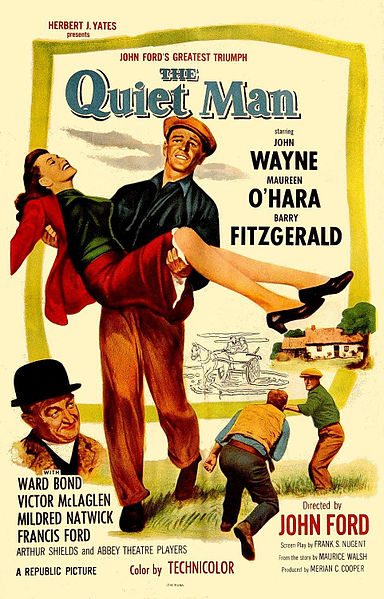
The Quiet Man (1952)

Starring John Wayne and Maureen O’Hara with director John Ford, the film follows an ex-American boxer as he returns to his roots in Ireland. Soon he is befriended by the proper yet kindly folk in the quaint town. Also, a beautiful red-haired girl catches his eye one day. Fireworks start between the American and the proud brother, so he will not condone the courtship or marriage of his sister. Finally, Wayne does gain his wife but she is unhappy without her dowry and she believes her husband is a coward since he will not fight for it. Little does she know the past he tried to escape, but once he gets it off his chest, he does fight. Through the exciting event both men grow fond of each other and the town gets a kick out of the entertainment. O’Hara and the rest of the cast including Barry Fitzgerlad are wonderful as the Irish folk, all playing off the Quiet Man.

5/5 Stars

Leave Her to Heaven (1946) – Film-Noir

Starring Gene Tierney and Cornell Wilde, this film noir is certainly unique. The movie is completely in color, it takes place in quiet locales, and it features a nice family with a new son-in-law. However, Tierney delivers a chilling performance as the jealous and deranged wife who falls for the author Richard Harland (Wilde) and she will not let him go. At first Ellen seems nice enough but all too soon we see the extent she will go to be the only one in Richard’s life. Soon her treatment of others perturbs him and she in turn gets jealous of the attention he gives to her sister. In her final act Ellen commits suicide and tries to pin it on her sister. Even from the grave it seems like she will never give up Richard. However, as we learn from the flashback, this is the first time she did not end up winning. This film is less about action and more about the characters. I must admit Tierney seemed like the greatest villain of all time sitting there callously in the boat and ironically Jeanne Craig became more beautiful the colder Tierney got. Tierney was in a lot of great movies but I think this has to be her best performance because in most of her other movies the audience adores her and here we openly despise her. We cannot wait for her to be left to Heaven so justice can be dealt.

4/5 Stars

Hiroshima Mon Amour (1959)

72bd9-hiroshima_mon_amour_1959This film is not only a seemingly early form of the French New Wave, it also has many qualities of a documentary, and it is certainly an international film. The film opens with a one night stand between a French actress and a Japanese architect who rendezvous one night in Hiroshima. In the short time they spend together, she reflects on her memories of the city that was not too long ago devastated by the atomic bomb. He often rejects her recollections but nevertheless, he cannot bear for her to leave and he continues to pursue her. Eventually in the course of their time together she relates her days back in the town of Nevers in France. During the occupation, she had a beau who was German and was eventually killed. The events and aftermath haunted her even many years later. They spend some of their time together walking the streets of Hiroshima and with their time running out they vow to remember each other by Hiroshima and Nevers respectively because their real names are never mentioned. This film begins very much like a documentary on Hiroshima but very quickly it turns into a character study focusing on ideas of love, memory, and personal identity. This film is more about art and expression and it uses quick flashbacks to replicate the past with voice-overs bringing the audience back to the present. That being said it should be treated as such because it truly is a masterpiece from Alain Resnais.

4.5/5 Stars

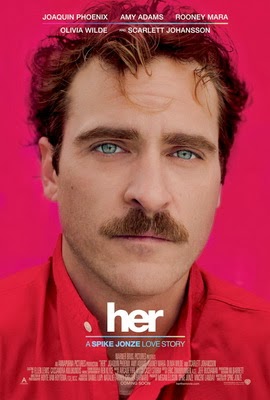
Her (2013)

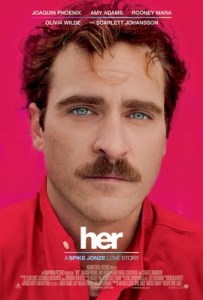
e69ce-her2013posterHer is a film that examines hyper-technological culture through a lens that has been around for centuries: romance.  In a not so distant future Los Angeles, Theodore Twombly is a craftsman of greeting cards. The only difference is he dictates personal messages, which are then transcribed by computers to be given to loved ones. He himself is going through a rough patch in life after a breakup with his wife and it has left him taciturn and distant.
Then one day he purchases the new OS or Operating System. Samantha, as she is called, is a very high level of artificial intelligence (Siri on steroids), who is able to openly communicate, do tasks, and even show emotion to some extent. Even though she does not actually have a tangible body (unless you count Theodore’s phone), he still finds a way to become enchanted by her. Not only can she check his emails, but Samantha also has access to vast amounts of data that allow her to evolve with Theodore, and she soon becomes his closest confidant and companion. Her desire to constantly discover the world invigorates Theodore, who is constantly used to the same technological, yet monotonous existence. Ironically, he develops his deepest relationship with Samantha, because she reflects how lonely technology has made him. 
Real human interaction seems foreign and awkward, whether it is with his estranged wife, work friends, or a blind date. For that matter sexual relations have also been perverted and, in a sense, trivialized by technology. Theodore’s complicated relationship with Samantha brings these and many other realities to light. 
Samantha can never truly be Reality. She can never have physical contact. This causes Theodore to put greater focus on the other aspects about her. Yes, she is not a normal human, but her knowledge on everything and her curiosity opens up numerous beautiful avenues for them to explore together. It could be love letters, the music she is composing, or even the sensation of ambling down a street. 
Ultimately, there is a downside to technology because despite being in an advanced future it cannot fully emulate the human experience and as Theodore painfully discovers there are terrible complications in relation to Samantha. 
This can be a difficult film, a strange film, and at times even a crass film, but for the most part Spike Jonze gives us a very thought-provoking piece that is pertinent to this social media and technologically saturated culture that is also our everyday reality. The world shown to us is washed out in its pastel shades, and yet it does not seem too far removed from us. 
It certainly brings up some interesting dilemmas about Her, whoever she may be. How do you reconcile technology whether computers, phones, video games, etc. with the human interactions that still make up (or should make up) most of our existence? For Theodore, Samantha leaves him with wonderment for life and an inquisitiveness which allows him to unplug a little and truly live in the present. 
Joaquin Phoenix gives a wonderfully nuanced performance, but everyone really wants to see, or rather, hear Scarlett Johansson as Samantha. Others who take on smaller but crucial roles are Amy Adams, Rooney Mara, Chris Pratt, and Olivia Wilde. Her is invariably melancholic but undoubtedly powerful stuff all the same.
 
4.5/5 Stars

Two for the Road (1967)

Starring Audrey Hepburn and Albert Finney,this romantic comedy gives a more realistic view of love and marriage. Mark and Joanna have been married about 10 years now and despite their wealth they seem unhappy. The non-linear story relates how they both met each other while vacationing in France. They were young, energetic  and in love. The film also covers their travels across France with Mark’s former girlfriend, her analytic husband, and their spoiled daughter. Then, we learn Mark finally got work as an architect. However  now with a small daughter, the marriage is dragging and they both have their own affairs. Despite the loss of their original passion, the couple realizes they are in love so Mark quits his job so they can start anew in Rome. This film gives off a sunny 60s vibe with a playful score by Henry Mancini, bright colors, French scenery  and of course love. I always enjoy Audrey Hepburn but I also felt Finney did an excellent job playing opposite of her. Most importantly  director Stanley Donen may have made a Hollywood style romance, but he made it more recognizably human than most. It does not simply examine the passion alone because there are many aspects of this big, messy experience called love.

4/5 Stars

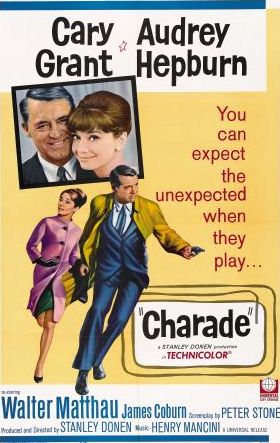
Charade (1963)

Starring the romantic pair of Cary Grant and Audrey Hepburn, with Walter Matthau, James Coburn, and George Kennedy, this film is considered the best “Hitchcock film” which the director did not make. While on vacation, Grant and Hepburn first meet briefly and then she returns to her home Paris. Hepburn goes there only to find out her husband, who she wanted to divorce, has been murdered. When meeting with a CIA man (Matthau), she learns that her husband and three buddies stole some money during a war but the three chums never got their shares. Upon meeting Grant again, he agrees to help Regina (Hepburn) and also says he is looking for the money. Through a series of events the three other men are all killed and everything seems to point to Grant. Hepburn runs for her life with Grant close behind and winds up meeting the CIA man. However, everything is not as it seems and after a shoot out Hepburn finally realizes the truth. Along with the thrills this movie has a nice score and a touch of playful comedy (including Grant’s many aliases including Peter Joshua, Alexander Dyle, Adam Canfield, etc.). Cary Grant was hesitant of playing opposite Hepburn since he was quite a bit older, but that is used nicely in the film as a source of even more comedy. Furthermore, Mancini’s score gives the film a 1960s spy vibe or I guess I should say agent… Hope you enjoy Stanley Donen‘s Charade.

4/5 Stars

Breakfast at Tiffany’s (1961)

Starring Audrey Hepburn and George Peppard, the movie follows the lavish lifestyle of the ditsy Holly Golightly. Moving into her apartment building, the down-on-his-luck writer Paul immediately grows fond of Holly’s quirky personality. Considering each other simply friends, Paul comes to one of Holly’s wild parties and they journey through New York together. However, although Paul is falling for Holly, his circumstances seem to prevent it and besides she is oblivious to his affection. Slowly they fall farther apart with Holly’s upcoming marriage to a wealthy man. In the end they do reconcile, embracing in the rain (of course). Holly has finally found a man who truly loves her and does not use her. The love story is an interesting one and Hepburn gives a lively performance. Henry Mancini’s “Moon River” is a wonderful addition to this film. I would say however that this is not my favorite film with Hepburn because it is certainly hard to top Roman Holiday.

Needless to say, this is a film that I have a difficult time  making my mind up about. I will wholeheartedly admit that I enjoy Audrey Hepburn movies ranging from Roman Holiday and Sabrina to Charade and Wait Until Dark. Of all of her performances, Holly Golightly is arguably her most iconic. Perhaps this is because she played against her usual gracefully timid image or maybe it was  the memorable wardrobe put together by Givenchy. Breakfast at Tiffany’s also has some wonderful supporting actors such as Patricia Neal, Martin Balsalm, Buddy Epsen, and an unfortunately badly cast Mickey Rooney. I think I would conclude that if Tiffany’s was just composed of its beautiful opening sequence accompanied by Moon River and the final romantic moments, I would thoroughly enjoy it. However, some of the moments in the middle I suppose are not as memorable or downright strange, making this a far from perfect film. It is, however, still an enjoyable romantic comedy that showcases Audrey Hepburn and includes the best of Henry Mancini and Johnny Mercer.

4/5 Stars

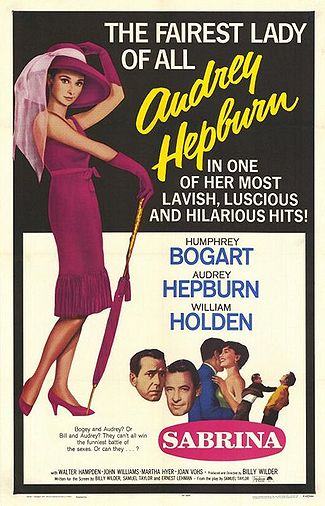
Sabrina (1954)

Starring Audrey Hepburn, Humphrey Bogart, and William Holden, with director Billy Wilder, the film begins with Sabrina (Hepburn) as a young girl. She lives with her father who is a chauffeur for a rich family. Sabrina loves the younger playboy son (Holden) however he gives her no serious attention. Depressed, Sabrina wants to kill herself and her father decides to send her off to culinary school in France. Some time passes and the grown up Sabrina is a perfect lady. Soon she catches the eye of Holden back home and all her dreams come true when they spend time together at a party. However, his older practical brother (Bogart) does not like it one bit since Holden has a fiancee. Wanting to get Sabrina away from his brother, Linus wines and dines her so the strategic wedding will stay on schedule. He then gives her a one way ticket and sends her off. Only afterward does he realize his own feelings for Sabrina and thus he decides to follow her. This film overall is a charming romance that is worth seeing.

4/5 Stars

Roman Holiday (1953)

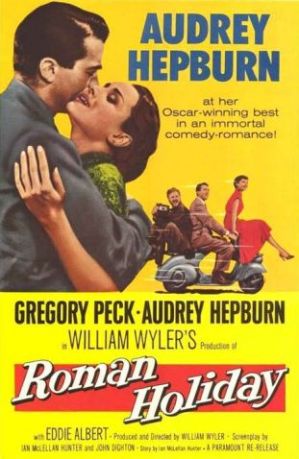
3fd3e-roman_holidayStarring Gregory Peck and Audrey Hepburn with direction by William Wyler, this movie has one of the greatest romances ever depicted on screen. Hepburn is a young princess named Ann on a trip to a foreign country. However, she is constantly bored from the rigidness of her life. On a whim she escapes in the night and finds herself sleepily wandering the streets of Rome. An American journalist (Peck) happens upon the disorientated princess and eventually decides to take her in since she seems lost. Soon enough he figures out just who she is and decides to take her through Rome with a friend (Eddie Albert) so they can get a scoop. Together they take her through the city to explore and secretly take candid photos.

However, Peck soon finds himself falling in love and he cannot bring himself to submit the article. With the thanks of the princess, they are left with the simple satisfaction that they were able to spend the day together. Peck and Hepburn are both wonderful in this one and the story is heartwarming and funny.

I tried to figure out why it is always so enjoyable coming back to this film. Was it the romantic chemistry of Peck and Hepburn, the timeless setting of Rome? Or perhaps is it the direction by William Wyler, the screenplay by blacklisted Dalton Trumbo, or the support work of Eddie Albert as Irving? Undoubtedly all of these wonderful occurrences play some part in making this film a classic.

Most of all it struck me that much like Jacques Tati’s Mr. Hulot’s Holiday, this is not just a film. It is quite like a vacation for the audience and we get to enjoy it along with all the main players. We get the privilege of taking part in all the adventure and the laughs. By the end we don’t want it to end but like any holiday we must say goodbye and wait until our next vacation comes around. Thus, it seems that Roman Holiday never gets old because the audience is constantly looking forward to the time away in 1950s Rome with our romantic stars.

5/5 Stars

The Spectacular Now (2013)

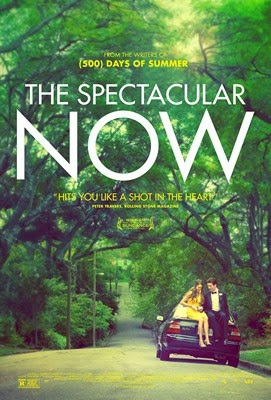
1ae0b-the_spectacular_now_filmFeaturing two rising stars in Miles Teller (Rabbit Hole) and Shailene Woodley (The Descendants), this film nicely melds a rough exterior with a heartfelt core to great effect.
Sutter (Teller) is a guy who parties hard, drinks incessantly, and has a long-term relationship with a beautiful girl named Cassidy (Brie Larson). He is the self-proclaimed life of the party and people like him, but no one takes him too seriously. At home, he lives with his mom, has no idea where his dad is, and hardly ever talks with his older sister. School, much less Geometry, is of little importance to him.
Matters take a turn for the worse when he and his girlfriend have a fight. He drives home plastered one night, only to wake up the next morning on a front lawn with a girl standing over him. And that is how he meets the quiet, studious, Aimee Finicky (Woodley). They strike up a friendship instantly as he helps her with a paper route, and she soon begins helping him with math. Although he convinces himself that he is doing it just because she is nice, he genuinely begins to like her. He invites her to a party and there their relationship deepens. It comes out that she is planning to stand up to her mom so she can go to university in Philadelphia. She wants Sutter to ask his mom about his estranged father. Together the two of them go to visit his dad, and Sutter is devastated to find out the truth about his father, which he never wanted to believe. On the drive home, half intoxicated by alcohol, half by his anguish, Sutter rejects Aimee’s love and tells her to leave, with dire consequences.

High school winds down and so does Sutter’s job. The night Aimee leaves for Philadelphia, however, he gets inebriated in a bar not wanting to hurt her anymore. He returns home in a stupor and confronts his mom, but he breaks down believing that he is exactly like his father. Despite all the annoyance that had been there before, she comforts him and proves Sutter otherwise.
Finally, Sutter is able to realize that his limitation is himself because even though he might veil his fears with jokes and alcohol, he has always been afraid. He takes another trip in his car, this time to Philadelphia to see Aimee again. The film ends on the steps of the university as their gazes meet and Aimee is just about to react. Who knows how it ends, but much like “Say Anything…” we can believe what we want. Needless to say, though he wasted so many of the previous “Nows,” Sutter seems destined to make the best of his tomorrow. 
This film is engrossing because although we have seen the story before no doubt, it is made fresh by the leads. A lot of people know someone like Sutter Keely. He is a person who is rough around the edges because of family, divorce, and alcohol. He often makes the stupidest of decisions. But there is still something about him that is likable and it creates empathy. Aimee on her part could be a real individual as well. She can be shy, but she is sweet and beautiful in her own unique way. However, because they are messy and have faults, it makes these two all the more believable. Neither of them can be labeled as a one-dimensional cliché because they have a genuine human quality. As Aimee would say they are not just defined by one thing, there’s more to them than that.

Some of the best moments in the film have to be when the two leads are talking with each other. It seems so real, even commonplace, the way they go through conversations. It is wonderful to watch. First, it begins awkwardly, builds into a friendship, and finally, evolves into a full-fledged relationship. These chats that they share not only cause them to grow closer, but it causes the audience to grow closer to them. I will admit I was in shock during the climax of the film, and I also dreaded the times Sutter drove home obviously drunk. That shows an actual attachment to the characters, something that is not always present in this type of film or any film for that matter. 
For a split instant I was disappointed that the film ended where it did, but then I quickly realized that’s how it had to be and it is better for it. Already I cannot wait for more from Miles Teller and Shailene Woodley especially. She is one of the most promising actresses of today along with Jennifer Lawrence. 
 
4.5/5 Stars