Roman Holiday (1953)

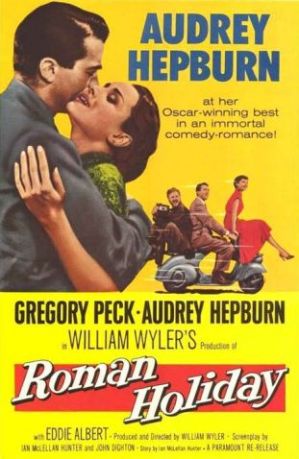
3fd3e-roman_holidayStarring Gregory Peck and Audrey Hepburn with direction by William Wyler, this movie has one of the greatest romances ever depicted on screen. Hepburn is a young princess named Ann on a trip to a foreign country. However, she is constantly bored from the rigidness of her life. On a whim she escapes in the night and finds herself sleepily wandering the streets of Rome. An American journalist (Peck) happens upon the disorientated princess and eventually decides to take her in since she seems lost. Soon enough he figures out just who she is and decides to take her through Rome with a friend (Eddie Albert) so they can get a scoop. Together they take her through the city to explore and secretly take candid photos.

However, Peck soon finds himself falling in love and he cannot bring himself to submit the article. With the thanks of the princess, they are left with the simple satisfaction that they were able to spend the day together. Peck and Hepburn are both wonderful in this one and the story is heartwarming and funny.

I tried to figure out why it is always so enjoyable coming back to this film. Was it the romantic chemistry of Peck and Hepburn, the timeless setting of Rome? Or perhaps is it the direction by William Wyler, the screenplay by blacklisted Dalton Trumbo, or the support work of Eddie Albert as Irving? Undoubtedly all of these wonderful occurrences play some part in making this film a classic.

Most of all it struck me that much like Jacques Tati’s Mr. Hulot’s Holiday, this is not just a film. It is quite like a vacation for the audience and we get to enjoy it along with all the main players. We get the privilege of taking part in all the adventure and the laughs. By the end we don’t want it to end but like any holiday we must say goodbye and wait until our next vacation comes around. Thus, it seems that Roman Holiday never gets old because the audience is constantly looking forward to the time away in 1950s Rome with our romantic stars.

5/5 Stars

The Spectacular Now (2013)

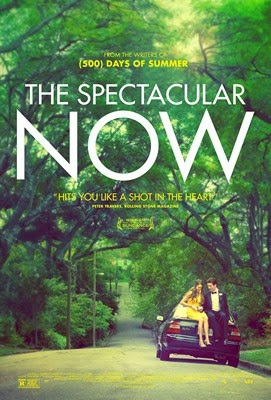
1ae0b-the_spectacular_now_filmFeaturing two rising stars in Miles Teller (Rabbit Hole) and Shailene Woodley (The Descendants), this film nicely melds a rough exterior with a heartfelt core to great effect.
Sutter (Teller) is a guy who parties hard, drinks incessantly, and has a long-term relationship with a beautiful girl named Cassidy (Brie Larson). He is the self-proclaimed life of the party and people like him, but no one takes him too seriously. At home, he lives with his mom, has no idea where his dad is, and hardly ever talks with his older sister. School, much less Geometry, is of little importance to him.
Matters take a turn for the worse when he and his girlfriend have a fight. He drives home plastered one night, only to wake up the next morning on a front lawn with a girl standing over him. And that is how he meets the quiet, studious, Aimee Finicky (Woodley). They strike up a friendship instantly as he helps her with a paper route, and she soon begins helping him with math. Although he convinces himself that he is doing it just because she is nice, he genuinely begins to like her. He invites her to a party and there their relationship deepens. It comes out that she is planning to stand up to her mom so she can go to university in Philadelphia. She wants Sutter to ask his mom about his estranged father. Together the two of them go to visit his dad, and Sutter is devastated to find out the truth about his father, which he never wanted to believe. On the drive home, half intoxicated by alcohol, half by his anguish, Sutter rejects Aimee’s love and tells her to leave, with dire consequences.

High school winds down and so does Sutter’s job. The night Aimee leaves for Philadelphia, however, he gets inebriated in a bar not wanting to hurt her anymore. He returns home in a stupor and confronts his mom, but he breaks down believing that he is exactly like his father. Despite all the annoyance that had been there before, she comforts him and proves Sutter otherwise.
Finally, Sutter is able to realize that his limitation is himself because even though he might veil his fears with jokes and alcohol, he has always been afraid. He takes another trip in his car, this time to Philadelphia to see Aimee again. The film ends on the steps of the university as their gazes meet and Aimee is just about to react. Who knows how it ends, but much like “Say Anything…” we can believe what we want. Needless to say, though he wasted so many of the previous “Nows,” Sutter seems destined to make the best of his tomorrow. 
This film is engrossing because although we have seen the story before no doubt, it is made fresh by the leads. A lot of people know someone like Sutter Keely. He is a person who is rough around the edges because of family, divorce, and alcohol. He often makes the stupidest of decisions. But there is still something about him that is likable and it creates empathy. Aimee on her part could be a real individual as well. She can be shy, but she is sweet and beautiful in her own unique way. However, because they are messy and have faults, it makes these two all the more believable. Neither of them can be labeled as a one-dimensional cliché because they have a genuine human quality. As Aimee would say they are not just defined by one thing, there’s more to them than that.

Some of the best moments in the film have to be when the two leads are talking with each other. It seems so real, even commonplace, the way they go through conversations. It is wonderful to watch. First, it begins awkwardly, builds into a friendship, and finally, evolves into a full-fledged relationship. These chats that they share not only cause them to grow closer, but it causes the audience to grow closer to them. I will admit I was in shock during the climax of the film, and I also dreaded the times Sutter drove home obviously drunk. That shows an actual attachment to the characters, something that is not always present in this type of film or any film for that matter. 
For a split instant I was disappointed that the film ended where it did, but then I quickly realized that’s how it had to be and it is better for it. Already I cannot wait for more from Miles Teller and Shailene Woodley especially. She is one of the most promising actresses of today along with Jennifer Lawrence. 
 
4.5/5 Stars

Miracle on 34th Street (1947)

Starring Edmund Gwen, Maureen O’Hara, John Payne, and Natalie Wood, the film tells the heartwarming story of an old man who acts as Santa Claus for the Macy department store in New York. However, Kris who is a very warm person (Gwen), truly does believe he is Santa and he is constantly being kind to others. Despite his popularity, a sour psychologist claims Kris is crazy and the case goes to court to decide once and for all if he is Santa. Although the case seems bleak, Kris is enlightened by the fact that his test case family (O’Hara and Wood) finally believe in him. Through a series of extraordinary events his lawyer friend (Payne) is able to win the case right before Christmas. Pretty soon Kris seems to prove that he really is who he said he was. This is one of the great cheering Christmas classics of cinema.

5/5 Stars

Merry Christmas everyone!


It’s a Wonderful Life (1946)

This is not only a Christmas classic but a classic in any sense of the word. It is the best of Stewart and Capra adding up to one of the most heartwarming stories of all time.  This may exhibit Stewart is his everyman role once again, but it breaks away from Mr. Smith in many ways making it another uniquely great film. A film like this that makes you know and feel for characters so profoundly is certainly worth watching.

Starring Jimmy Stewart and Donna Reed with a fantastic supporting cast,  the film tells the life story of George Bailey. We watch with the angel Clarence as he sees George’s life unfold. George saves his brother Harry as a boy and as a result, loses hearing in his ear. He works in the Bedford Falls drugstore and keeps the proprietor Mr. Gower from making a deadly mistake. Later on, he plans to travel the world and go to college so he can escape his hometown and do bigger and better things. But once more he sacrifices. One fateful day, he doesn’t know it yet, but he meets the love of his life Mary, and the same day his kindly father has a stroke. Soon after,  Harry goes off to college and George is left holding down the fort at their father’s old building and loan. He builds up all those around him with selfless kindness, while simultaneously standing up to the grumpy millionaire Mr. Potter. Eventually, he marries Mary and has children. First, during the Depression George gives up his honeymoon to keep the building and loan open. Then, during WWII while his brother and others become heroes, George stays in Bedford Falls because of his poor hearing. In this post-war period, the story picks up in the present.

Although, by unfortunate circumstances George Bailey finds himself contemplating suicide after the absent-minded Uncle Billy misplaces $8,000. That’s when Clarence comes into his life to show George just how important he really is. George sees a world where Harry is dead, Mr. Gower is a disgrace, Martini does not own the bar, his mother has no sons, Uncle Billy is insane, Violet is disgraced, Bert and Ernie do not know him, Mary is an old maid, and Mr. Potter has monopolized Bedford Falls.

Once he gets his life back George finds immediate joy and gains so much because of his friends and family. He runs through the streets of Bedford Falls yelling out “Merry Christmas,” because he is simply grateful to live again. Miraculously, the whole town rallies around him, and George reaps the reward for all he has sowed over the years. Clarence is finally awarded his wings and George Bailey is the richest man in town. There is nothing much to do after this film but simply be happy and sing “Auld Lang Syne.” It is a Wonderful film in many ways, with a wonderful cast, and a wonderful message. It has some of the greatest character development of any film ever because you do not simply become attached to one man but an entire community. That’s what makes the scene where Uncle Billy loses the money one of the most difficult for me to watch. Each and every time I’m so attached to these people. Even if I already know the resolution, I cannot bear for anything bad to happen to them. In fact, it is interesting to focus on just one of the supporting characters and see how they are affected by the life of George Bailey. It makes me ask myself if I were to die tomorrow would anyone care? We know in the case of George they certainly would.

I am further reminded of the phrase that is written on the wall of the building and loan, “You can only take with you, that which you give away.” This is what George Bailey did, and I believe it is something that each and every one of us should be mindful of. He is a great character not only because James Stewart played him genuinely and with such magnetism and heart, but because he was such a sacrificial figure. True, this is a sentimental film given the title and the director, but it is paramount to realize the progression this film follows. George must sink into the depths of his despair and disillusionment before he can truly realize that It’s a Wonderful Life. I would challenge you the next time you watch this film, to not simply acknowledge it as perennial Christmas fare, but look a bit deeper because there is so much more here. As always, Attaboy Clarence! You did it again.

5/5 Stars

The Bishop’s Wife (1947)

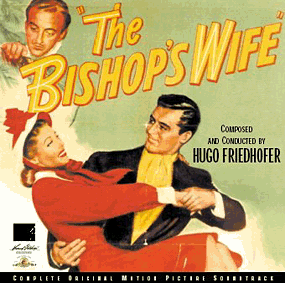
Starring Cary Grant, Loretta Young, and David Niven, I would certainly consider this film a Christmas classic. It opens and we are introduced to the kindly and handsome angel Dudley (Grant). When a Bishop prays for guidance in the difficult task of building a Cathedral, Dudley is sent to him. The once genial man has become frustrated and troubled, making life more difficult for his loving wife. When Dudley arrives, Henry finds out in disbelief that he is an angel. However, to everyone else Dudley is simply a charming man who has come to assist Henry. Everyone gravitates towards his kindness, except Henry. Dudley befriends an old professor, is kindly to the servants, helps their little daughter, and above all makes the Bishop’s wife happy by spending time with her. Over time he becomes attracted to her but she doe snot feel the same way. A jealous Henry stands up to the angel and realizes he must strengthen his marriage. Before he leaves Dudley explains he will not be remembered and he will not reutrn. Then on Christmas Eve the Bishop delivers a sermon as a new man. Dudley look on contentedly, knowing that he wrote the sermon. Most importantly he fixed the Bishop’s attitude and marriage so he could continue doing good with or without a cathedral. Grant’s charming portrayal reminds me somewhat of Clarence Oddbody and it makes sense because Henry Koster directed James Stewart in Harvey as well.

4/5 Stars

Holiday Affair (1949)

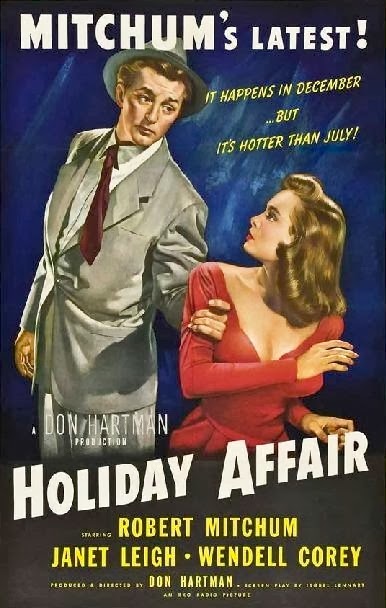
a869b-holidayaffair1949Starring Janet Leigh and Robert Mitchum, this Christmas romantic comedy revolves around a young widow, her son, and the two men in her life. The film opens with Leigh shopping at Crowley’s in New York and buying a toy train from a clerk. She takes it home and her excited boy sneaks a peak at it. However, as the sales person suspected she is a comparative shopper who returns the train. He is about to report her but does not, which costs him his job. Over time, he becomes better acquainted with Connie Ennis, her boy, and her kindly but unexciting boyfriend. Timmy then wakes up on Christmas morning to find the train under the train for him. However, as Mrs. knowns it was not from her and she goes to see Steve. She tells him of her upcoming marriage and they have a falling out. Later, Steve is taken in by the police suspected of thievery, and must be bailed out. He is then invited to Christmas dinner which is also attended by Connie’s parents. Steve announces that he loves Connie and she tells him to leave. Timmy returns his train the next day so Steve can have the money. Soon her boyfriend realizes it is over and then Connie has a confrontation with Steve. However, in the end she realizes her true love for him and she and Timmy follow him to California. This is a relatively unknown Christmas film with a lot of Christmas spirit.

3.5/5 Stars

The African Queen (1951)

1c3a0-the-african-queen-1With the ultimate pairing of Humphrey Bogart and Katharine Hepburn, this film throws together two starkly different people in extraordinary circumstances. Hepburn is a prim and proper missionary in Africa whose brother dies after a confrontation with German soldiers. Bogart is the rough-edged pilot of an old steamboat christened The African Queen. Together they take on the dangerous task of going down the river in order to sink a German ship. At first they are both at odds with each other and struggle to cope with their situation. However, with no one else to turn to, over time, they become close. Their bond is so great that they are willing to die rather than to be separated. This is truly a heartwarming story of love and loyalty with two legends who literally light up the screen.

5/5 Stars

In a Lonely Place (1950) – Film-Noir

Starring Humphrey Bogart and Gloria Grahame with direction by Nicholas Ray, the film is about a struggling screenwriter with a hot temper. Dixon Steele (Bogart) has not written a good script in a while but then one evening he has an enthusiastic young woman explain a novel he is supposed to adapt since he has not read it. Everything goes seemingly normal however the next morning she is dead and Steele is the main suspect. The police investigate, including Steele’s detective friend, but a neighbor gives an alibi which seems to save Steele. Soon Grahame begins to fall in love with him and vice versa. However, she soon realizes his violent side and second guesses Steele’s innocence since he has such a violent history. Although they are to be married it is broken off when he finds out she was going to leave. Only then does Grahame find out he was indeed innocent but the damage is already done and their relationship cannot be saved. This is a pretty good film noir with powerful characters.

4.5/5 Stars

Bonnie and Clyde (1967)

b1a0c-bonnie_and_clydeStarring Warren Beatty and Faye Dunaway, with director Arthur Penn, the film chronicles the crime life of a group of notorious gangsters during the 1930s. Clyde Barrow (Beatty), a small time thief meets the beautiful young girl Bonnie Parker (Dunaway) and together they begin robbing banks. Soon they enlist the help of a dim-witted mechanic C.W., and then Clyde’s brother joins the fray bringing along his wife. They have a string of successes and they become infamous nationwide. Soon they begin to bicker among themselves and the police start to buckle down. In a shootout Buck is shot dead and Bonnie, Clyde, and C.W. just barely escape. However, their actions eventually do catch up with them and thus ends the story of these two figures depicted as anti-heroes. This film is significant because it was influenced by the French New Wave but it in turn ushered in a new era of American film . It has a unique combination of comedy, romance, violence, and of course banjo music.

5/5 Stars

Midnight in Paris (2011)

8d293-midnight_in_paris_posterDirected and written by Woody Allen and starring Owen Wilson, this film is a nostalgic piece of romantic fantasy. 

Gil is a successful screenwriter, who is attempting to finish his first novel, and he is in Paris with his wife (Rachel McAdams). She dismisses his work on a nostalgia shop because she feels it is not as worthwhile as his screenwriting career. Gil is infatuated with everything about Paris, while his wife is content with fine dining and shopping with her parents and wine tasting with stuffy friends. 

Then one evening Gil wanders the streets of Paris, and at Midnight a 1920s style car pulls up and he is invited in. Over the course of the evening, he meets the likes of F. Scott Fitzgerald, Zelda Fitzgerald, and even Ernest Hemingway, who agrees to read his manuscript. The following night he brings his wife but she leaves and he is picked up once again at midnight. This time he talks with Hemingway, meets Gertrude Stein, Pablo Picasso, and the beautiful Adriana (Mario Cotillard). Gil continues to return at night much to his wife’s annoyance and his father-in-law’s disapproval. He meets legendary surrealists such as Salvador Dali, Man Ray, and Luis Bunuel, who he inspires with his conversation. 

He finds Adriana’s diary in the present and meets a fellow aficionado (Lea Seydoux) of the olden days. Gil returns to the 1920s and Adriana convinces him to go back to the 1890s where they meet Toulouse-Lautrec, Gauguin, and Degas. This is where Adriana is happy and despite their love, Gil realizes that even though nostalgia is good it is best to live in the present. Gil gets some final feedback on his manuscript and then breaks up with Inez, realizing it was not meant to be. However, Gil finally does find someone who shares his love of Paris in the rain. 

Allen made this film really enjoyable for me because he brought to life many people such as Hemingway, Dali, Bunuel, and others. This type of history fascinates me much like Gil, and it was fun to see these figures represented in the flesh by the likes of Tom Hiddleston, Kathy Bates, and Adrien Brody. That being said, this film carries a good lesson about living your life in the present. I would have initially said that Owen Wilson seemed wrong for this film, but I think he did a wonderful portraying Gil as a man mesmerized by the golden days of Paris.

4/5 Stars