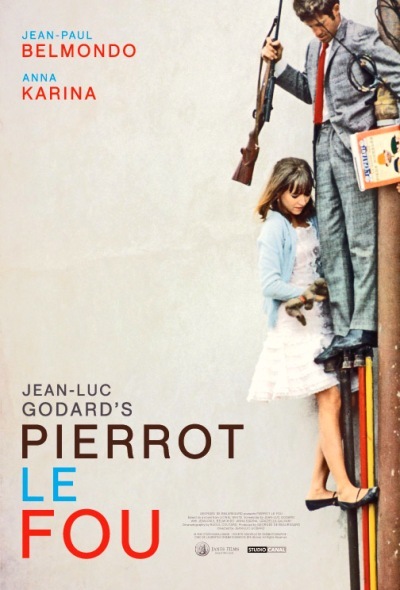
Directed by Jean-Luc Godard and starring Jean Paul Belmondo and Anna Karina, this film is chock full of poetic musings, literary allusions, pop culture images, and so on. Belmondo is a Frenchman who is unhappy with his life and marriage. When a young woman he is already acquainted with comes to watch his child, they eventually elope together. Ferdinand goes with Marianne to her apartment only to find a corpse and they must flee the scene from two gangsters. Now on the run, the two lovebirds are intent on living life and making their own Hollywood inspired movie that they can both star in. Their aspirations lead them to live a wild life on the move, but finally they settle down for a awhile in the French Riviera. Ferdinand is content with a quiet life of philosophizing but Marianne is discontent with this life right out of a Robert Louis Stevenson novel. They finally move on and stop at a night club where they face one of their pursuers. After some mishaps Ferdinand and his girl get separated. Finally they are reunited only to have Marianne turn on “Pierrot” for her real boyfriend. The final moments are filled with gunfire, a suitcase full of money, blue paint, and dynamite. You could say that everything blew up in Ferdinand’s face, and you would be quite correct.
4/5 Stars
Category Archives: Romance
Breathless (1960)
The debut of Jean-Luc Godard and starring Jean-Paul Belmondo with Jean Seberg, this film was influential in helping to jump start the French New Wave. The story begins with a small-time thief named Michel stealing a car and then killing a policeman Quickly, he becomes a fugitive in need of money. This brings him in contact with an American journalism student he had met before. They spend time together with Michel professing his love and Patricia still feeling unsure whether or not she truly loves him back. In a final act of reassurance Patricia betrays Michel and he is chased down by the authorities. He is a far cry from the American movie stars and crime films he idolizes. With its jazzy score, bilingual dialogue, jump cuts, and Parisian scenery, this film is chic and cool. It paid homage to Hollywood but it also paved the way for a new era of films starting in the 60s. The film is perhaps not as impressive to today’s audiences but it certainly has a look that you have to appreciate. Godard was ahead of his time because he went against all conventions that had been set up for cinema and he thereby revolutionized the film world.
4.5/5 Stars
The Quiet Man (1952)
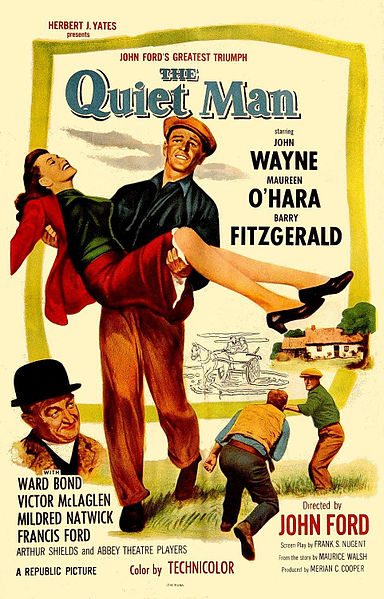
Starring John Wayne and Maureen O’Hara with director John Ford, the film follows an ex-American boxer as he returns to his roots in Ireland. Soon he is befriended by the proper yet kindly folk in the quaint town. Also, a beautiful red-haired girl catches his eye one day. Fireworks start between the American and the proud brother, so he will not condone the courtship or marriage of his sister. Finally, Wayne does gain his wife but she is unhappy without her dowry and she believes her husband is a coward since he will not fight for it. Little does she know the past he tried to escape, but once he gets it off his chest, he does fight. Through the exciting event both men grow fond of each other and the town gets a kick out of the entertainment. O’Hara and the rest of the cast including Barry Fitzgerlad are wonderful as the Irish folk, all playing off the Quiet Man.
5/5 Stars
Leave Her to Heaven (1946) – Film-Noir
Starring Gene Tierney and Cornell Wilde, this film noir is certainly unique. The movie is completely in color, it takes place in quiet locales, and it features a nice family with a new son-in-law. However, Tierney delivers a chilling performance as the jealous and deranged wife who falls for the author Richard Harland (Wilde) and she will not let him go. At first Ellen seems nice enough but all too soon we see the extent she will go to be the only one in Richard’s life. Soon her treatment of others perturbs him and she in turn gets jealous of the attention he gives to her sister. In her final act Ellen commits suicide and tries to pin it on her sister. Even from the grave it seems like she will never give up Richard. However, as we learn from the flashback, this is the first time she did not end up winning. This film is less about action and more about the characters. I must admit Tierney seemed like the greatest villain of all time sitting there callously in the boat and ironically Jeanne Craig became more beautiful the colder Tierney got. Tierney was in a lot of great movies but I think this has to be her best performance because in most of her other movies the audience adores her and here we openly despise her. We cannot wait for her to be left to Heaven so justice can be dealt.
4/5 Stars
Hiroshima Mon Amour (1959)
This film is not only a seemingly early form of the French New Wave, it also has many qualities of a documentary, and it is certainly an international film. The film opens with a one night stand between a French actress and a Japanese architect who rendezvous one night in Hiroshima. In the short time they spend together, she reflects on her memories of the city that was not too long ago devastated by the atomic bomb. He often rejects her recollections but nevertheless, he cannot bear for her to leave and he continues to pursue her. Eventually in the course of their time together she relates her days back in the town of Nevers in France. During the occupation, she had a beau who was German and was eventually killed. The events and aftermath haunted her even many years later. They spend some of their time together walking the streets of Hiroshima and with their time running out they vow to remember each other by Hiroshima and Nevers respectively because their real names are never mentioned. This film begins very much like a documentary on Hiroshima but very quickly it turns into a character study focusing on ideas of love, memory, and personal identity. This film is more about art and expression and it uses quick flashbacks to replicate the past with voice-overs bringing the audience back to the present. That being said it should be treated as such because it truly is a masterpiece from Alain Resnais.
4.5/5 Stars
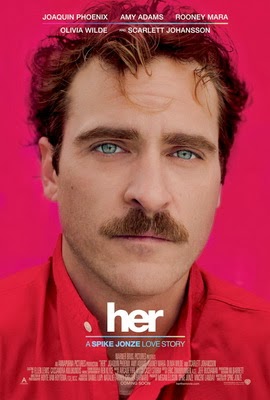
Her (2013)
Her is a film that examines hyper-technological culture through a lens that has been around for centuries: romance. In a not so distant future Los Angeles, Theodore Twombly is a craftsman of greeting cards. The only difference is he dictates personal messages, which are then transcribed by computers to be given to loved ones. He himself is going through a rough patch in life after a breakup with his wife and it has left him taciturn and distant.Two for the Road (1967)
Starring Audrey Hepburn and Albert Finney,this romantic comedy gives a more realistic view of love and marriage. Mark and Joanna have been married about 10 years now and despite their wealth they seem unhappy. The non-linear story relates how they both met each other while vacationing in France. They were young, energetic and in love. The film also covers their travels across France with Mark’s former girlfriend, her analytic husband, and their spoiled daughter. Then, we learn Mark finally got work as an architect. However now with a small daughter, the marriage is dragging and they both have their own affairs. Despite the loss of their original passion, the couple realizes they are in love so Mark quits his job so they can start anew in Rome. This film gives off a sunny 60s vibe with a playful score by Henry Mancini, bright colors, French scenery and of course love. I always enjoy Audrey Hepburn but I also felt Finney did an excellent job playing opposite of her. Most importantly director Stanley Donen may have made a Hollywood style romance, but he made it more recognizably human than most. It does not simply examine the passion alone because there are many aspects of this big, messy experience called love.
4/5 Stars
Charade (1963)
Starring the romantic pair of Cary Grant and Audrey Hepburn, with Walter Matthau, James Coburn, and George Kennedy, this film is considered the best “Hitchcock film” which the director did not make. While on vacation, Grant and Hepburn first meet briefly and then she returns to her home Paris. Hepburn goes there only to find out her husband, who she wanted to divorce, has been murdered. When meeting with a CIA man (Matthau), she learns that her husband and three buddies stole some money during a war but the three chums never got their shares. Upon meeting Grant again, he agrees to help Regina (Hepburn) and also says he is looking for the money. Through a series of events the three other men are all killed and everything seems to point to Grant. Hepburn runs for her life with Grant close behind and winds up meeting the CIA man. However, everything is not as it seems and after a shoot out Hepburn finally realizes the truth. Along with the thrills this movie has a nice score and a touch of playful comedy (including Grant’s many aliases including Peter Joshua, Alexander Dyle, Adam Canfield, etc.). Cary Grant was hesitant of playing opposite Hepburn since he was quite a bit older, but that is used nicely in the film as a source of even more comedy. Furthermore, Mancini’s score gives the film a 1960s spy vibe or I guess I should say agent… Hope you enjoy Stanley Donen‘s Charade.
4/5 Stars
Breakfast at Tiffany’s (1961)
Starring Audrey Hepburn and George Peppard, the movie follows the lavish lifestyle of the ditsy Holly Golightly. Moving into her apartment building, the down-on-his-luck writer Paul immediately grows fond of Holly’s quirky personality. Considering each other simply friends, Paul comes to one of Holly’s wild parties and they journey through New York together. However, although Paul is falling for Holly, his circumstances seem to prevent it and besides she is oblivious to his affection. Slowly they fall farther apart with Holly’s upcoming marriage to a wealthy man. In the end they do reconcile, embracing in the rain (of course). Holly has finally found a man who truly loves her and does not use her. The love story is an interesting one and Hepburn gives a lively performance. Henry Mancini’s “Moon River” is a wonderful addition to this film. I would say however that this is not my favorite film with Hepburn because it is certainly hard to top Roman Holiday.
Needless to say, this is a film that I have a difficult time making my mind up about. I will wholeheartedly admit that I enjoy Audrey Hepburn movies ranging from Roman Holiday and Sabrina to Charade and Wait Until Dark. Of all of her performances, Holly Golightly is arguably her most iconic. Perhaps this is because she played against her usual gracefully timid image or maybe it was the memorable wardrobe put together by Givenchy. Breakfast at Tiffany’s also has some wonderful supporting actors such as Patricia Neal, Martin Balsalm, Buddy Epsen, and an unfortunately badly cast Mickey Rooney. I think I would conclude that if Tiffany’s was just composed of its beautiful opening sequence accompanied by Moon River and the final romantic moments, I would thoroughly enjoy it. However, some of the moments in the middle I suppose are not as memorable or downright strange, making this a far from perfect film. It is, however, still an enjoyable romantic comedy that showcases Audrey Hepburn and includes the best of Henry Mancini and Johnny Mercer.
4/5 Stars
Sabrina (1954)
Starring Audrey Hepburn, Humphrey Bogart, and William Holden, with director Billy Wilder, the film begins with Sabrina (Hepburn) as a young girl. She lives with her father who is a chauffeur for a rich family. Sabrina loves the younger playboy son (Holden) however he gives her no serious attention. Depressed, Sabrina wants to kill herself and her father decides to send her off to culinary school in France. Some time passes and the grown up Sabrina is a perfect lady. Soon she catches the eye of Holden back home and all her dreams come true when they spend time together at a party. However, his older practical brother (Bogart) does not like it one bit since Holden has a fiancee. Wanting to get Sabrina away from his brother, Linus wines and dines her so the strategic wedding will stay on schedule. He then gives her a one way ticket and sends her off. Only afterward does he realize his own feelings for Sabrina and thus he decides to follow her. This film overall is a charming romance that is worth seeing.
4/5 Stars